
Manufacturing Executive Search for Industrial and Robotics Leadership
Published · Last updated
Retained executive search across industrial automation, advanced materials, specialty chemicals, and semiconductor manufacturing.
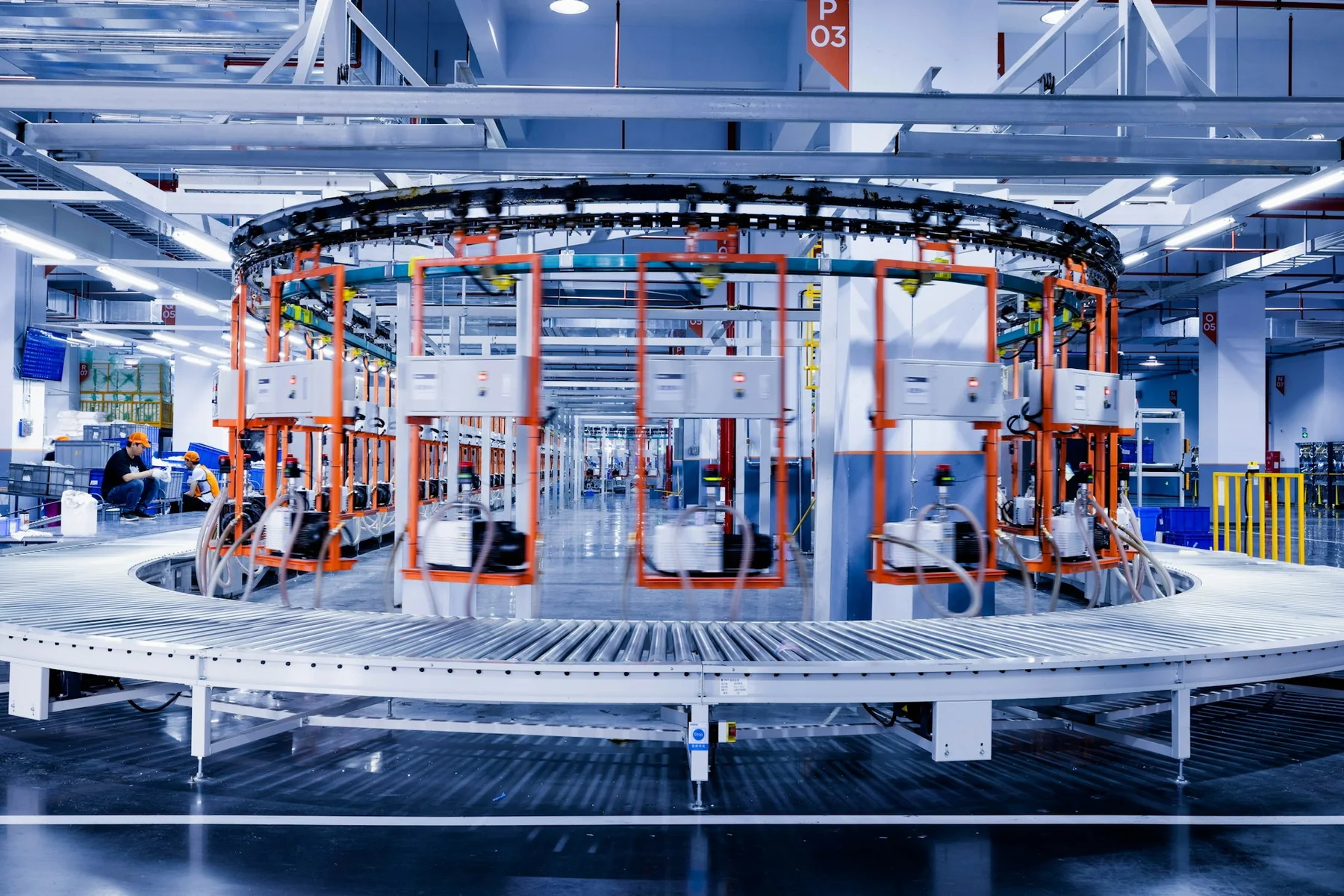
What makes executive search in industrial manufacturing and robotics different?
The mandate is almost always transformation under constraint: modernising operations — automation, robotics, connected production — that were built decades ago, without breaking throughput, safety or margin while you do it. It rewards deep operational domain and unglamorous patience far more than disruption rhetoric, and that profile is consistently underpriced by the wider talent market.
Greenfield visionaries often founder here because the real work is brownfield: sequencing change across plants, unions, suppliers and a workforce that has heard transformation promised before. Safety is not a value statement but a hard operating culture, and a leader who treats it as friction loses the floor in weeks.
We look for evidence of change actually delivered through legacy systems and people — not slideware — and for the credibility to stand on a production line as readily as in a boardroom. The best candidates are frequently invisible to volume recruiters because they are heads-down running something that works.
Direct headhunting across Industrial, Manufacturing, and Robotics, with mapped market intelligence and shortlists validated against client-specific buyer criteria. How we measure performance.
Where leadership demand is concentrated right now
The structural forces, talent bottlenecks, and commercial dynamics shaping this market right now.
The global energy transition will require lithium production to rise by almost 300 percent by 2040, yet the U.S. mining workforce averages over 45 years old, and half the industry's engineers are fast approaching retirement age. This demographic collapse, termed the Grey Tsunami, is forcing a sharp structural divergence across heavy industry. Traditional manufacturing volume is slowing, but capital deployment in high-tech industrial infrastructure is highly aggressive. Boards are no longer hunting for basic operational efficiency; they need strategic architects of the phygital convergence where physical machinery meets Agentic AI. Demand is fiercely concentrated in semiconductors, industrial robotics, autonomous mining, and specialty chemicals. In the semiconductor space, the U.S. CHIPS Act is funding massive facility build-outs, but commissioning these advanced plants requires scarce clean-room specialists and ramp-up directors. Simultaneously, humanoid robotics have moved from trade shows to real-world battery assembly lines, shifting the leadership profile from mechanical engineering to software architecture and physical AI integration. The war for this hybrid talent has radically recalibrated executive compensation. Chief Supply Chain Officers at billion-dollar firms now command total direct compensation packages exceeding $1.5 million, with variable pay and long-term incentives making up over 60 percent of the structure. Non-technical executives demonstrating AI literacy are securing salary premiums of 15 to 20 percent over their traditional peers. Geographic requirements are highly localized. Multinational manufacturers are nearshoring to regions that offer a dense mix of research institutions and established supply chains. Detroit maintains near-zero vacancy for advanced EV manufacturing space, while Munich and Turin dominate European demand for engineering-led General Managers. In Asia, Tokyo and Singapore command massive premiums for AI and software engineers willing to integrate digital systems into factory environments. We evaluate leadership portfolios with a strict best-owner principle, matching deep technical credibility with the commercial acumen required to survive these shifting global supply chains.
Our Industrial, Manufacturing & Robotics Sectors
Each sector maps the specialisms, role paths, and authority clusters beneath this pillar.
-
i. Sector
Manufacturing Recruitment
4 specialisms within Manufacturing.
Explore sector → -
ii. Sector
Industrial Automation Recruitment
3 specialisms within Industrial Automation.
Explore sector → -
iii. Sector
Robotics & Autonomous Systems Recruitment
4 specialisms within Robotics & Autonomous Systems.
Explore sector → -
iv. Sector
Supply Chain & Logistics Recruitment
3 specialisms within Supply Chain & Logistics.
Explore sector → -
v. Sector
Materials & Chemicals Recruitment
2 specialisms within Materials & Chemicals.
Explore sector → -
vi. Sector
Mining & Metals Recruitment
1 specialisms within Mining & Metals.
Explore sector →
Priority Industrial, Manufacturing & Robotics Specialisms
These first-wave authority specialisms deserve a more prominent place than a standard card grid.
-
i.
Flagship specialism
Advanced Manufacturing Recruitment
Market intelligence, role coverage, salary context, and hiring guidance for Advanced Manufacturing.
Explore specialism → - ii.Flagship specialism
Controls & PLC Recruitment
Market intelligence, role coverage, salary context, and hiring guidance for Controls & PLC.
Explore specialism → - iii.Flagship specialism
Robotics Software Recruitment
Market intelligence, role coverage, salary context, and hiring guidance for Robotics Software.
Explore specialism → - iv.Flagship specialism
Warehouse Automation Recruitment
Market intelligence, role coverage, salary context, and hiring guidance for Warehouse Automation.
Explore specialism → - v.Flagship specialism
Supply Chain Planning Recruitment
Market intelligence, role coverage, salary context, and hiring guidance for Supply Chain Planning.
Explore specialism →
Why clients use KiTalent for Industrial, Manufacturing & Robotics mandates
KiTalent combines retained-search discipline with market mapping, multilingual outreach, and hands-on stakeholder calibration. We work across specialist leadership mandates where domain context matters as much as the shortlist.
- i.
Mapped before outreach
We define the industrial, manufacturing & robotics candidate universe before first contact, so outreach is deliberate rather than reactive.
- ii.
Commercially calibrated
Mandates are shaped around decision makers, compensation logic, and the real talent constraints of the market.
- iii.
Built for passive talent
The strongest candidates in this market are usually already delivering results elsewhere. The process is designed for discreet conversion.
Industrial, Manufacturing & Robotics Leadership Hubs
Four city markets where this pillar has strong commercial density, candidate concentration, or board-level hiring activity.
Tell us which supply chain gap is keeping your board awake
Start a confidential search across industrial automation, specialty chemicals, or semiconductor manufacturing.
Whether a leader has genuinely delivered change through legacy plants and people, or merely narrated it, is a distinction we ground in the capability-identity distinction in executive hiring.
How we measure the work
7 to 10 working days
To a validated shortlist on mapped senior-management mandates
96%
One-year retention: hires still in role after twelve months
NPS 72
Twelve-month rolling client satisfaction survey
8+ years
Average length of an active client relationship
Definitions and measurement basis are set out in our methodology.
Questions clients usually ask before launching this search
What is driving executive hiring in the industrial sector?
Three distinct forces are colliding: the shift to Agentic AI, reshoring mandates, and an aging workforce. With nearly 50 percent of mining engineers retiring within ten years, organizations are racing to find leaders who can deploy autonomous systems to bridge the talent gap. The 2026 Kearney Reshoring Index reveals a 28 percent increase in CEOs planning to reshore operations, driving demand for ramp-up specialists capable of commissioning new facilities. In Europe, Frankfurt industrial districts prioritize executives who manage complex regionalized supply chains. Leaders managing these converging pressures are heavily incentivized, routinely securing base salary hikes of 25 percent when transitioning to digitized operations. As a retained search firm, we track VP Global Operations recruitment patterns across both traditional heavy industry and emerging semiconductor hubs in Texas. Analyzing these industrial hiring trends 2026 ensures we identify executives who turn capital investment into measurable output.
What roles are hardest to fill in modern manufacturing?
Integration Directors and Physical AI architects top the list of vacancies. Boards are struggling to source candidates who possess both mechanical engineering backgrounds and advanced software fluency. As humanoid robotics like the Figure 02 transition into active battery assembly at facilities like BMW's, companies require executives who can manage the handover between human workers and autonomous units. Collaborative robots will infiltrate 30 percent of green-field manufacturing cells by 2026, creating acute shortages for these integration specialists. This scarcity has forced a market recalibration; an integration specialist with proven digital twin management experience commands an AI premium of up to 30 percent over standard operational directors. Successfully executing Plant Director recruitment requires pulling talent from tech corridors rather than traditional factory floors. Conducting effective robotics executive search means competing directly with Silicon Valley for software architecture experts willing to relocate to Detroit manufacturing centers or South Korean gigafactories.
How much does a Chief Supply Chain Officer earn?
Total direct compensation for a Chief Supply Chain Officer at a billion-dollar U.S. firm now medians at $1.5 million. Base salary is increasingly irrelevant compared to the broader package structure. Performance-linked rewards, specifically variable pay and long-term incentives, comprise roughly 60 percent of that figure. Below the C-suite, a VP Strategic Sourcing commands an average base of $260,000, while a Global Supply Chain Director can reach $210,000. The premium is heavily weighted toward executives who deploy dynamic intermodal toolkits to protect margins against geopolitical shocks, proving that modern supply chain leadership is a primary strategic differentiator. Tracking supply chain hiring trends 2026 reveals that executing Chief Supply Chain Officer recruitment often involves targeting Indianapolis logistics hubs and cross-border specialists near Mexico . Our logistics executive search methodology directly correlates compensation benchmarks against a candidate's ability to unify edge, IoT, and ERP systems across a $38 billion digital twin market.
Where are the top hubs for advanced manufacturing talent?
Talent is highly clustered around regional research and infrastructure ecosystems. Detroit remains the epicenter for electric vehicle expertise with manufacturing vacancy rates below 2 percent. The $39 billion CHIPS Act has transformed Texas, Ohio, and Arizona into massive domestic semiconductor hubs requiring specialized facility leadership. Internationally, the German Mittelstand thrives around Munich automotive centers, while Northern Italy 's districts like Turin see surging demand for engineering-led General Managers. Meanwhile, Tokyo and Singapore have become fiercely competitive battlegrounds for semiconductor and software engineering executives. Relocating top talent from these tech-heavy hubs requires substantial total value of employment packages, often including housing allowances that add 15 percent to base compensation. Successful semiconductor executive search campaigns increasingly target these specialized corridors to extract passive Fab Directors. Executing international General Manager recruitment requires deep immersion in these local talent pools, particularly as India establishes global capability centers projecting 4.5 million roles by 2030.
How is the EU Machinery Regulation affecting robotics recruitment?
Mandatory cybersecurity risk assessments are now the primary driver for compliance hiring. Because non-compliant machines will be prohibited from the European market by 2027, industrial equipment builders are urgently recruiting Compliance and Cybersecurity Leaders. This regulatory shift, alongside the ISO 12100 revision, mandates that physical safety is assessed through a control system lens. Simultaneously, the Carbon Border Adjustment Mechanism (CBAM) requires EU importers to purchase certificates covering embedded emissions by 2026, driving a massive surge in Supply Chain Governance hiring. Executives capable of documenting and justifying these cybersecurity frameworks are capturing immediate salary premiums, often pushing their base pay 20 percent higher than traditional compliance officers. Effective Compliance Leader recruitment demands technical fluency in these evolving frameworks. Our manufacturing executive search practice targets these highly specialized professionals across European industrial centers, ensuring we place executives who turn mandatory regulatory compliance into a commercial advantage.
Why use retained search for industrial automation executives?
The required candidate profile rarely exists in an active job market. We identify hybrid leaders operating deep within tech corridors rather than traditional factory floors. When 75 percent of manufacturing CEOs report talent scarcity as a top threat, passive talent mapping becomes the only reliable acquisition strategy. The demographic crisis means nearly 50 percent of existing engineers are nearing retirement, making VP Operations recruitment highly competitive. Average base pay increases are forecasted at 4 to 5 percent annually, but candidates with digital twin expertise command an AI premium adding 15 to 20 percent to their total package. Navigating these industrial hiring trends 2026 requires a retained search model built on rigorous technical assessment. We evaluate portfolios based on a candidate's ability to drive margin growth and integrate Physical AI across complex global supply chains. Because these leaders command base salaries upwards of $450,000, our automation executive search process deeply vets their capability to deliver measurable ROI before introducing them to your board.