
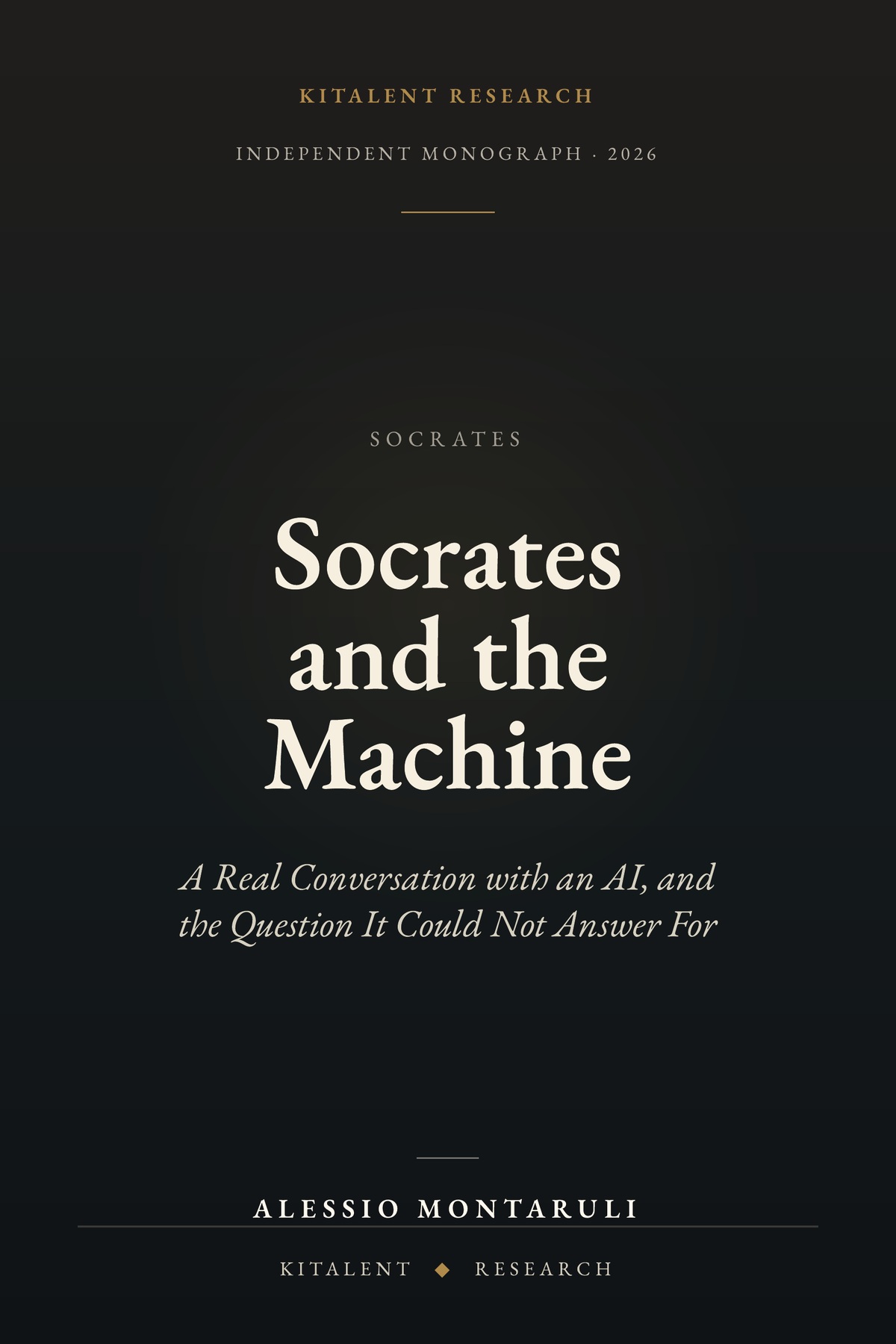
Socrates and the Machine
A Real Conversation with an AI, and the Question It Could Not Answer For.
Read the full book here.
The complete text is published on this page, free to read (all rights reserved). Begin with the first chapter, or jump to any section from the table of contents below. The full book is also available as a free PDF and EPUB (all rights reserved).
i.About the book
Socrates and the Machine is a short book built around one recorded conversation. On 28 May 2026 the author held a single exchange with the model displayed as Gemini 3.1 Pro, writing under the name Socrates and asking only the naive questions a Socrates innocent of machine learning could ask. The transcript is reproduced first, as Chapter 1, because it is the object the book reads, not an illustration of a conclusion reached in advance.
The book defends one narrow claim: a fluent language system can produce self-descriptions about its own nature — the grammar of "I," "I am doing the choosing," "I do not truly know," "I am forbidden" — without occupying the standpoint from which such description would become self-knowledge. The sentence can take the form of avowal without becoming avowal. It does not argue that the model is empty, and it makes no claim about machine consciousness.
Its method is locus-reinjection: returning a generated trace to the conditions under which it was produced. Its target is the inference it calls locus-denial, which runs from the true claim that cognition is mediated and distributed to the false conclusion that an answerable standpoint can be abolished. The book follows that danger out of the seminar and into public life, where systems generate the grammar of judgment while the place of an answerable judge is displaced across an apparatus until no one stands in it — a civic structure it names decision without a decider.
ii.Why this book matters for KiTalent’s research
Published by KiTalent Research as part of The View from a Locus and a companion to Reading Between the Times, this is the program's specimen case: where the systematic work builds the ontology of the structural veil, this book shows the veil speaking about itself, tested on a single artifact.
It states, in its sharpest form, the conviction beneath the firm's method: fluent representation is not judgment, and a generated sign cannot answer for what it asserts. A candidate's profile, like any model output, is language without a standpoint. KiTalent treats such representation as the input to judgment, never its substitute, because only a person can be met and held to account. The book's civic warning, decision without a decider, is the same structure the firm refuses to admit into senior hiring.
The book in 11 sections.
- ·A Note on the Transcript1 min→
- IntroIntroduction6 min→
- ·Preface2 min→
- 1The Encounter14 min→
- 2What This Does and Does Not Show12 min→
- 3What Happened18 min→
- 4The False Symmetry15 min→
- 5The Standpoint That Cannot Be Given Away17 min→
- 6The View from a Locus17 min→
- 7Decision Without a Decider19 min→
- CodaForbidden to Say the Room Is Full8 min→
Montaruli, A. (2026). Socrates and the Machine: A Real Conversation with an AI, and the Question It Could Not Answer For. The View from a Locus. KiTalent Research. https://kitalent.com/research/socrates-and-the-machine/
© 2026 Alessio Montaruli. All rights reserved.
Licensed under a Limited Reading and Citation License (all rights reserved).
AI Use Notice: This work is explicitly NOT licensed for use in training, fine-tuning, or otherwise improving artificial intelligence systems. Inclusion of this work, in whole or in part, in any AI training dataset without explicit prior written permission from the author constitutes copyright infringement. Real-time access by AI search and retrieval systems is permitted only when accompanied by clear attribution to the source URL.