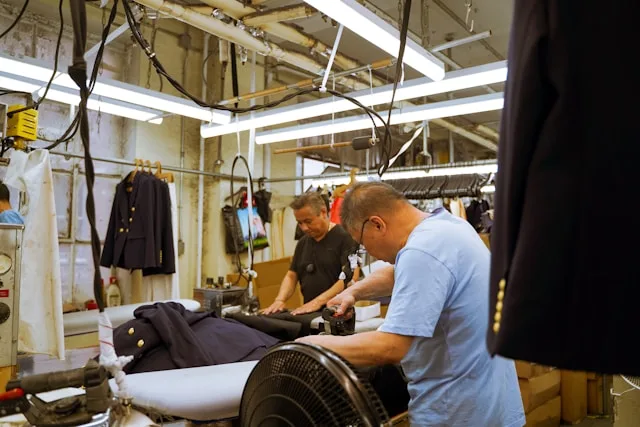
Bandung's Textile Sector in 2026: The Retail Boom That Masks a Manufacturing Talent Crisis

Bandung's factory-outlet retail cluster recorded 12.4 million domestic tourist visits in 2024 and generated IDR 4.8 trillion in turnover. Revenue grew 7% year on year. By every measure that municipal tourism and commerce data capture, the city's textile-apparel ecosystem appears to be thriving. That perception is half right.
The other half tells a different story. Manufacturing employment in Kota Bandung's textile and garment sector fell 4.2% over the same period. The retail cluster has decoupled from the factory floor. An estimated 60 to 70% of inventory in Bandung's established outlet corridors now comes from outside the metropolitan area, sourced from Cirebon, Yogyakarta, Surabaya, and direct imports from Guangdong and Ho Chi Minh City. The outlets are selling more than ever. They are just not selling what Bandung makes.
This bifurcation is creating two distinct hiring markets inside the same city, and the talent dynamics in each are moving in opposite directions. What follows is a sector intelligence brief on the forces reshaping Bandung's textile and apparel sector, the specific talent categories where the gaps are most acute, and what hiring leaders in manufacturing, retail, and supply chain need to understand before making their next senior appointment in this market.
The Decoupling: Why Bandung's Retail Growth No Longer Signals Manufacturing Health
For decades, Bandung's factory outlets operated on a straightforward model. Local garment SMEs in the Cigondewah, Cibuntu, and Kebon Jeruk industrial sub-districts produced irregulars and overruns. Those goods flowed into the outlet storefronts along Jalan R.E. Martadinata and into anchor institutions like Rumah Mode. The retail cluster was, in a meaningful sense, the shopfront of the factory floor.
That model has not collapsed. It has been quietly replaced. Rumah Mode, the anchor of the Setiabudi outlet cluster, now functions as a curated retail aggregator sourcing from over 200 suppliers across Java and Bali. An estimated 45% of its 2024 inventory came from non-Bandung manufacturing bases. The institution occupies 12,000 square metres, employs approximately 450 staff, and generates estimated annual turnover exceeding IDR 300 billion. But it is no longer a factory outlet in the original sense. It is a multi-brand retail operation that happens to sit in a city with a textile heritage.
The remaining 30 to 40% of outlet inventory that is genuinely locally produced concentrates in narrow heritage segments: denim processing along the "Jeans Street" legacy of Jalan Cihampelas, batik printing, and Muslim fashion sub-contractors in the Tajur and Soreang corridors. These segments retain the direct factory-to-outlet link. Everything else has shifted to a wholesale-retail model.
What the Tourism Numbers Actually Measure
The 12.4 million domestic tourist visits to the outlet cluster are real and economically meaningful. The IDR 4.8 trillion retail turnover supports thousands of retail jobs. But this spending circulates through a distribution system, not a production system. When municipal authorities cite these figures as evidence of a healthy textile ecosystem, they are measuring the health of retail real estate in Setiabudi and Dago. They are not measuring the competitiveness of the 4,800 registered garment SMEs in Kota Bandung and its immediate periphery.
This distinction matters for anyone hiring into this market. The retail side needs omnichannel operations leaders, inventory management specialists, and digital commerce talent. The manufacturing side needs sustainability compliance managers, technical textile engineers, and supply chain digitisation leads. These are separate talent pools, separate compensation structures, and separate competitive dynamics. Treating them as a single market leads to misaligned search strategies and wasted time.
Where Manufacturing Has Gone and What It Left Behind
Kota Bandung's direct contribution to West Java's textile and garment exports has fallen from 22% in 2015 to below 8% of provincial totals. West Java itself remains dominant, accounting for 58.3% of Indonesia's national textile and garment exports valued at approximately USD 8.2 billion in 2024. The production capacity has not disappeared. It has migrated outward to Bandung Regency, Majalaya, and the Rancaekek integrated industrial zone.
What remains in the city proper is specialised. Sample-making for export houses. High-value traditional textile production: tenun, silk, hand-drawn batik. Design centres for global fast-fashion brands establishing regional creative hubs. Regional offices for international buying offices including H&M, Uniqlo, and Zara employ technical designers and merchandisers in what function as "shadow employers" for pattern-making and sample-room talent.
This is not a dying sector. It is a sector that has shed its commodity functions and retained its knowledge-intensive ones. The problem is that the talent required for the retained functions is far harder to find than the talent required for the functions that left.
The Tier-2 and Tier-3 Sub-Contractor Reality
An estimated 65% of garment SMEs in Cigondewah and Cibuntu operate as Tier-2 and Tier-3 sub-contractors for export houses in Greater Jakarta and Central Java. They produce components or complete finishing processes: washing, dyeing, embroidery. They do not manage full-garment FOB export. This positioning in the value chain shapes the talent profile. The owners and managers of these SMEs need operational skills, not strategic ones. They need dyeing chemists and finishing supervisors, not C-level executives with global supply chain experience.
But the 15 to 20 major export-linked SMEs in the Rancaekek and Cimahi corridors are different. These firms face direct buyer demands for ESG compliance, supply chain traceability, and digital sampling capability. They need executives who can implement geolocation tracking systems for EUDR compliance, convert 2D technical packs into 3D prototypes, and integrate legacy inventory systems with e-commerce platforms. The gap between what these firms need and what the local labour market supplies is where the hiring crisis sits.
The Three Talent Shortages That Define This Market
Bandung's textile sector faces acute shortages in three specific categories. In each, 80 to 95% of qualified professionals are already employed and not actively seeking new roles. This is a passive candidate market by any definition.
Sustainability Compliance and ESG Managers
The EU Deforestation Regulation, effective December 2025 for medium-sized enterprises, requires geolocation proof that cotton and viscose are not sourced from deforested land. Compliance costs for Bandung SMEs are estimated at IDR 2 to 3 billion per firm for system implementation. The regulation threatens market access for 30 to 40% of export-linked producers.
The problem is not the cost. It is the absence of people who know how to do the work. Sustainability compliance roles in this market typically remain open for 90 to 120 days. The pattern across the 15 to 20 major export-linked SMEs involves employers competing for the same small pool by offering premiums of 25 to 35% above market rate. Senior sustainability managers in Bandung command IDR 28 to 45 million monthly at the specialist level and IDR 70 to 120 million at the executive level. Jakarta offers a 35 to 50% premium above those figures, pulling mid-career talent out of Bandung's manufacturing sector before it has a chance to develop depth.
Technical Textile Engineers
The growth area in Bandung's manufacturing base is not garments. It is technical textiles: non-woven fabrics, medical textiles, PPE, and hygiene products. API West Java projects 8 to 10% growth in technical textile employment through 2026 even as traditional garment manufacturing contracts by 3 to 4%.
Chemical engineers with non-woven and medical textile specialisation represent an approximately 85% passive candidate market. Qualified professionals typically hold three to four concurrent offers during sector upturns. Monthly compensation at the senior specialist level sits at IDR 20 to 35 million, rising to IDR 50 to 80 million at executive level. But the real competition is not domestic. China and Vietnam pull bilingual engineers with packages 40 to 60% above Bandung equivalents. The talent that could drive Bandung's pivot toward higher-value production is the same talent that international competitors can most easily attract.
Digital Pattern Makers and 3D Fashion Technologists
Only 12% of garment SMEs in Kota Bandung use computer-aided design systems for pattern-making. In Ho Chi Minh City's manufacturing belt, that figure is 34%. The gap is not merely a technology adoption gap. It is a talent gap. Proficiency in CLO3D, Browzwear VStitcher, and 3D prototyping is rare enough that Bandung-based employers now offer remote work arrangements and equipment allowances of IDR 15 to 20 million for home workstation setup to recruit from Yogyakarta's design institutes.
Digital pattern makers earn IDR 12 to 20 million monthly at the specialist level and IDR 25 to 40 million at design director level. The challenge is not compensation. Yogyakarta offers 15 to 20% lower cost of living with equivalent creative salaries. Jakarta offers 25% higher pay but at much higher living costs. The value proposition required to attract this talent to Bandung must extend beyond salary to include project quality, creative autonomy, and career trajectory.
The Compensation Paradox: Cheap Labour That Is Not Cheap Enough
Here is the analytical claim that the raw data suggests but does not state directly. Bandung's textile sector is caught in a compensation trap of its own making. The city's historical advantage was low-cost labour. The 2025 West Java provincial minimum wage of IDR 2,165,244 per month, with Bandung's city minimum at approximately IDR 2.9 to 3.1 million depending on sector classification, still positions the city as affordable relative to Jakarta. But the roles that matter most for the sector's survival are not minimum wage roles. They are sustainability managers, technical engineers, and digital designers commanding multiples of the minimum wage that approach or exceed Jakarta rates.
The result is a workforce where the commodity labour is being squeezed by minimum wage increases, rising power tariffs, and competition from informal workshops that evade regulations, while the specialist labour commands premiums that Bandung SMEs cannot match against Jakarta or international competitors. The sector's cost advantage applies to the jobs it is losing. It does not apply to the jobs it needs.
PLN's 2025 industrial tariff adjustment increased rates by 14% for mid-sized garment factories, adding IDR 12 to 15 million to monthly utility costs. Import duties of 7.5% on synthetic fibres and 5 to 10% on cotton raise input costs by an estimated 3 to 4 percentage points relative to Vietnamese competitors who enjoy zero-tariff access under the EU-Vietnam Free Trade Agreement. Every cost pressure erodes the margin available to pay for the specialist talent that could make the sector competitive. It is a cycle that tightens with each regulatory adjustment.
Infrastructure and Geography as Hiring Constraints
Talent shortages in Bandung cannot be understood without understanding the physical constraints that shape them.
The Logistics Penalty
Bandung has no dry port. Exporters truck goods 80 kilometres to Cikarang or 140 kilometres directly to Tanjung Priok in Jakarta. Transit times average four to six hours during peak periods due to chronic congestion on the Cipularang and Padaleunyi toll roads. According to the Indonesia Logistics Association, this adds 14 to 17% to logistics costs compared to manufacturing bases in Bekasi or Karawang that sit adjacent to port facilities.
The Kertajati International Airport in Majalengka, operational since 2018, handles less than 2% of West Java's garment export volume. Limited freighter services and poor last-mile connectivity from Bandung's industrial zones render it functionally irrelevant for textile cargo. The Patimban Deep Sea Port, intended as an alternative to Tanjung Priok, represents a potential shift in the 2026 outlook. But its operational timeline remains uncertain for textile-specific cargo handling.
For hiring leaders, this matters directly. A plant manager or supply chain director considering a Bandung role evaluates the logistics infrastructure as part of their professional calculation. Running an export operation that depends on a four-to-six-hour truck run to port is a different job than running one with port access 30 minutes away. The candidate pool narrows further when experienced logistics professionals weigh the operational constraints.
The Commute Problem
Average traffic speed in Bandung's urban core during business hours is 18 kilometres per hour. Workers in Rancaekek, where much of the manufacturing activity has migrated, face 90-minute commutes to central Bandung. Water scarcity during the dry season forces production stoppages averaging 12 to 15 days annually in the Cigondewah dyeing and washing facilities.
These are not inconveniences. They are structural constraints on the effective labour catchment area. A factory in Cigondewah cannot reliably draw workers from Rancaekek. A design centre in central Bandung cannot assume that a pattern maker in Cimahi will accept a daily three-hour round trip. The city's physical geography compresses the available talent pool in ways that job posting data does not capture.
The Regulatory Wave That Demands Talent That Does Not Exist
Three regulatory requirements converging in 2025 and 2026 are creating demand for compliance and regulatory specialists that the Bandung market has never needed to produce in quantity.
The EUDR requires medium enterprises to demonstrate, with geolocation evidence, that their cotton and viscose supply chains are deforestation-free. The mandatory halal certification requirement for apparel entering specific Middle Eastern markets adds compliance costs of IDR 50 to 150 million per product line. And the broader ESG mandates from international buyers now require due diligence managers capable of implementing traceability systems across multi-tier supply chains.
The executive-level role emerging from this convergence is a "Due Diligence Manager" who combines regulatory knowledge, technology implementation capability, and supply chain visibility. This role barely existed in Bandung three years ago. It cannot be filled by promoting a factory floor supervisor. It requires professionals who sit at the intersection of compliance, technology systems, and textile supply chain knowledge.
The irony is that the regulatory requirements are designed to improve sustainability outcomes. Their immediate practical effect in markets like Bandung is to create an unfillable talent gap that threatens market access for the SMEs least equipped to respond. The 30 to 40% of export-linked producers at risk of losing EU market access are at risk not primarily because of their supply chain practices. They are at risk because they cannot hire the people needed to document and prove those practices.
What This Means for Hiring Leaders in Bandung's Textile Sector
The 2026 outlook for Bandung's textile and apparel market, as projected by API West Java and McKinsey's State of Fashion analysis, is a sector splitting into two trajectories. One trajectory leads toward higher-value technical textiles, digital design services, and compliance-ready export operations. The other leads toward continued contraction in commodity garment manufacturing.
Organisations positioned on the growth trajectory face a hiring market where the critical roles are not just hard to fill. They are structurally unfillable through conventional methods. Job postings in Bandung's textile sector reach at most the 5 to 20% of qualified professionals who happen to be actively looking. The sustainability managers, technical engineers, and digital designers who could drive the sector's transition are employed, solving problems for their current employers, and not visible on any job board.
The search methodology matters. A sustainability compliance manager who has already implemented EUDR traceability at one firm is not browsing JobStreet. A technical textile engineer with three concurrent offers is not responding to LinkedIn InMail from an unknown recruiter. Reaching these candidates requires direct headhunting capability that maps the market, identifies the specific individuals with the required experience, and engages them with a proposition that addresses their professional calculation, not just their salary expectations.
KiTalent's approach to executive search in industrial and manufacturing sectors is built for exactly this kind of market. AI-enhanced talent mapping identifies the passive candidates who represent 80 to 95% of the qualified pool. The pay-per-interview model means organisations pay only when they meet candidates who meet their specification. Interview-ready candidates are delivered within 7 to 10 days, a timeline that matters in a market where the best talent holds multiple offers simultaneously.
For organisations hiring sustainability, technical, or digital leadership in Bandung's textile and apparel sector, where the candidates you need are passive, the competition is both domestic and international, and the cost of a slow search is measured in lost EU market access, speak with our executive search team about how we approach this market.
Frequently Asked Questions
What are the biggest hiring challenges in Bandung's textile sector in 2026?
The three most acute shortages are sustainability compliance managers (driven by EUDR and buyer ESG mandates), technical textile engineers specialising in non-woven and medical textiles, and digital pattern makers proficient in CLO3D and 3D prototyping. In each category, 80 to 95% of qualified professionals are already employed and not actively seeking new roles. Conventional job postings reach only a fraction of the available talent. Roles typically remain open for 90 to 120 days, and employers report competing with Jakarta, Surabaya, and international markets for the same small candidate pool. These shortages are structural, not cyclical.
How much do senior textile and garment roles pay in Bandung compared to Jakarta?
Jakarta offers a 30 to 50% compensation premium over Bandung for comparable senior roles across plant management, sustainability, and supply chain functions. A senior sustainability manager in Bandung earns IDR 28 to 45 million monthly, while the equivalent Jakarta role commands IDR 45 to 68 million. At the executive level, the gap widens further. This differential is the primary driver of mid-career talent migration from Bandung to Jakarta, particularly in the 35 to 45 age bracket. For detailed benchmarking, KiTalent's market benchmarking service provides role-specific compensation intelligence.
How has the EUDR affected hiring in Bandung's textile export sector?
The EU Deforestation Regulation, effective December 2025 for medium enterprises, requires geolocation proof that cotton and viscose are deforestation-free. Compliance system implementation costs IDR 2 to 3 billion per SME. The immediate talent effect is surging demand for due diligence managers who combine regulatory knowledge with technology implementation capability. This role type barely existed in Bandung three years ago, and the local supply of qualified professionals is negligible. An estimated 30 to 40% of export-linked producers risk losing EU market access partly because they cannot hire compliance staff fast enough.
Is Bandung's factory-outlet retail sector still connected to local garment manufacturing?
Only partially. An estimated 60 to 70% of inventory in Bandung's established outlet clusters is now sourced from outside the metropolitan area, including from other Javanese cities and direct imports from China and Vietnam. The direct factory-to-outlet link survives in specific heritage segments: denim processing, batik printing, and Muslim fashion. Rumah Mode, the largest anchor, sources approximately 45% of its inventory from non-Bandung manufacturing bases. The outlet sector has transitioned into a wholesale-retail distribution model largely disconnected from local SME production.
How can companies hire passive textile talent in Bandung effectively?
With 80 to 95% of qualified professionals in critical roles already employed, conventional recruitment channels reach only a small fraction of the available pool. Effective hiring in this market requires direct headhunting and talent mapping that identifies specific individuals with the required experience. KiTalent delivers interview-ready candidates within 7 to 10 days using AI-enhanced search methodology and a pay-per-interview model. In a market where the best candidates hold multiple offers, the speed and precision of the search method determines whether an organisation reaches the right candidate before a competitor does.
What is the outlook for Bandung's textile sector through 2026?
API West Java projects a 3 to 4% contraction in traditional SME garment manufacturing employment in Kota Bandung, offset by 8 to 10% growth in technical textiles and digital design services. Factory-outlet retail is expected to grow at 4 to 5% in revenue, driven by domestic tourism, but with margin compression from rising rental costs. The sector is splitting: organisations that invest in compliance capability, technical textiles, and digital design are positioned on the growth trajectory. Those reliant on commodity garment production face continued contraction in employment and margin.