Bassano del Grappa's Tourism Is Growing. Its Talent Supply Has Hit a Wall That Money Alone Cannot Move
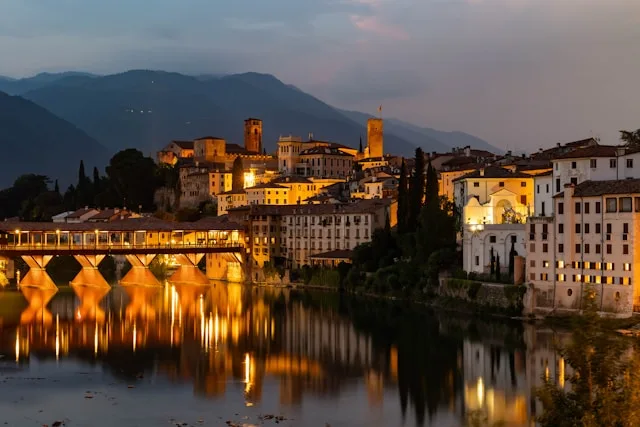
Bassano del Grappa recorded 142,000 tourist arrivals in 2024, reaching 98% of pre-pandemic volume. The Ponte degli Alpini drew over 1.2 million crossings. Cyclist transits on the Ciclovia del Brenta have grown 18% year-over-year since 2022. Experiential tourism now contributes an estimated 28% of the municipality's total tourism revenue, up from 19% in 2019. By every volume metric, the recovery is nearly complete.
The revenue story is less comfortable. Average stays have compressed from 2.3 nights in 2019 to 1.8 nights. RevPAR at four-star properties sits at €89. Sixty-one percent of visitors are day-trippers from Verona, Padua, and Vicenza who congest the historic centre without generating accommodation revenue. And the municipality's UNESCO buffer zone proximity and zoning regulations impose a hard cap of 1,850 authorised beds in the historic centre, with no expansion pathway. The sector is being asked to generate more value per visitor because it cannot meaningfully increase the number of visitors who stay overnight. That requires a different kind of workforce: specialists in experiential design, digital integration, enogastronomic curation, and technical outdoor leadership. These are exactly the roles Bassano cannot fill.
What follows is an analysis of the forces reshaping Bassano del Grappa's hospitality talent market, why conventional hiring methods fail in this specific environment, and what operators and investors competing for leadership talent in this constrained corner of the Veneto need to understand before their next search.
A Market Where Capital Is Investing in Experiences the Labour Pool Cannot Deliver
The shift toward experiential tourism in Bassano del Grappa is not a marketing exercise. It is a structural response to a fixed physical constraint. With accommodation supply legally capped and 61% of visitors arriving and departing within a single day, the only path to revenue growth runs through higher per-visitor spend. Grappa masterclasses, multi-day cycling itineraries, ceramic workshops, and curated enogastronomic menus represent the margin that hotel nights alone cannot provide.
The €4.2 million "Bassano 2030" investment in cycling infrastructure, including bike-sharing hubs and Brenta riverbank restoration scheduled for completion by mid-2026, signals where the municipality believes its future lies. The Veneto Cycle Route interconnection, linking Bassano's corridor to the broader regional network, is designed to convert day-trippers into multi-day visitors and to draw the German and Dutch cycling tourism markets deeper into the Vicenza foothills.
None of this works without the people who run it.
The Excelsior Information System data shows demand for tourism experience managers in the Veneto exceeding supply by an estimated 40% as of late 2024. Executive chefs with enogastronomic specialisation carry average vacancy durations of 127 days, nearly three times the 45-day average for standard line cook positions. Only 12 licensed multilingual cycling tour guides operate in the municipality against estimated peak-season demand for 25 to 30. The infrastructure investment is arriving on schedule. The talent to activate it is not.
The Paradox of Wage Moderation in an Acute Shortage
Here is the analytical tension at the centre of this market, and it is one that standard labour economics does not explain cleanly.
Vacancies Last Months. Wages Barely Move
Regional wage data from IRES Veneto shows hospitality compensation in the Veneto growing at just 2.1% annually through 2023 and 2024. In isolation, that figure suggests a balanced market. But vacancy durations for specialised roles exceed 300 days in some cases, and the hospitality-specific unemployment rate in Bassano stands at 4.2%, below the provincial average. These are not the conditions that produce 2.1% wage growth. They are the conditions that produce bidding wars.
The explanation lies in the ownership structure. Sixty-eight percent of Bassano's accommodation remains family-owned. These operators face energy costs 23% above pre-2022 levels and revenue concentration so acute that 68% of annual income arrives between April and October. A family-run three-star hotel generating €64 RevPAR does not have the margin to offer a 25% salary premium to attract an experiential tourism manager from Verona. The alternative is to leave the role unfilled and absorb the lost revenue that the specialist would have generated.
This is the dynamic that makes Bassano's talent market genuinely unusual. The shortage is real. The price signal that should clear it is suppressed by the margin structure of the employers who need the talent most. The result is not a market that equilibrates. It is a market that stalls.
Who Can Pay, and Who Cannot
The picture is not uniform. Consolidated operators like Hotel Bonotto, the municipality's largest hospitality employer with 42 staff, and anchor institutions like Distilleria Nardini (€42 million turnover in 2023) have the balance sheets to compete on compensation. According to La Tribuna di Treviso, Nardini's restaurant operation recruited Chef Matteo Zanoni from a competitor establishment in Asolo in September 2024, reportedly offering a 25% salary premium above his previous compensation plus accommodation support. That is what it costs to move a specialist in this market.
Family-owned three-star properties cannot match that offer. The talent market is bifurcating: a small number of capitalised employers can recruit aggressively, while the majority of the accommodation base watches its most critical roles sit vacant for quarters at a time. The hidden cost of leaving these roles unfilled compounds quietly. Every month without an experiential tourism manager is a month of unrealised revenue from programming that exists on paper but not in practice.
Who Bassano Competes Against for Every Senior Hire
The competitive radius for hospitality leadership talent around Bassano del Grappa extends roughly 100 kilometres in every direction. Each competitor market offers something Bassano does not.
Verona, 45 kilometres southeast, pays 15 to 25% more for equivalent management roles, according to Unioncamere Veneto's interprovincial compensation comparison. It offers a larger luxury hotel portfolio, international airport connectivity, and the career verticality that comes with managing properties at greater scale. The net talent flow runs from Bassano toward Verona at the mid-management level.
Venice, 75 kilometres southeast, competes for multilingual, international-facing hospitality staff. Higher tips, global brand exposure, and the cachet of working in one of the world's most visited cities exert a gravitational pull that a town of 43,000 residents cannot easily counter.
Cortina d'Ampezzo, 90 kilometres north, competes specifically for outdoor tourism specialists. According to Confesercenti Belluno, Cortina offers 30 to 40% winter premiums to ski instructors who transition into summer cycling guide roles. That seasonal premium disrupts year-round staffing for Bassano operators trying to build stable teams.
Trento and Bolzano, 60 to 90 kilometres northwest, are emerging as the most serious competitors for cycling tourism specialists and bike hotel managers. South Tyrol's stronger public tourism funding supports higher wages, and the German-language market integration gives operators there a direct pipeline to the cycling tourist demographic Bassano is trying to reach.
Bassano's counter-positioning relies on quality of life: housing costs 40% below the Venice lagoon area, year-round employment stability versus Cortina's intense seasonality, and the autonomy of working in a family-run operation where decisions happen at the speed of a single conversation. This proposition is genuine, but it reaches only the candidates who already know about it. The 80% of qualified professionals who are not actively searching in this market will never encounter it through a job board posting.
The Roles That Define Whether This Market Grows or Stalls
Tourism Experience Managers
This is the role where the talent gap carries the most strategic consequence. A tourism experience manager in Bassano must integrate digital booking platforms with on-site experiential programming: multi-day cycling tour logistics, grappa blending workshops, ceramic studio scheduling, and the CRM infrastructure to convert day-trippers into returning overnight guests. The role sits at the intersection of hospitality operations, digital marketing, and outdoor activity management.
According to Il Giornale di Vicenza, Hotel Bonotto advertised a "Responsabile Esperienze e Cicloturismo" position from March 2024 through January 2025. Ten months. Three external candidates reportedly declined offers, citing insufficient career progression compared to opportunities in Verona or Trento. The role was ultimately filled through internal promotion of a junior staff member.
That outcome tells you everything about the market structure. The candidates with the right skill combination are employed. They are not looking. And the proposition required to move them from a larger market into a 43,000-person town must answer a question that salary alone does not resolve: what does my career look like in three years?
Executive Chefs with Enogastronomic Specialisation
The demand is not for chefs. It is for chefs who can develop tasting menus pairing local grappa varieties, Bassano white asparagus DOP, and Morlacco cheese with modern technique, while operating within the constraints of a historic centre kitchen. Unemployment for this profile sits below 2% across the Veneto. Average tenure exceeds 4.5 years, meaning the installed base turns over slowly. The majority of hires occur through direct headhunting or culinary network referrals rather than public postings.
Compensation for an executive chef at a flagship restaurant in Bassano ranges from €50,000 to €65,000, with material variation tied to Michelin recognition or Slow Food accreditation. That range is competitive within the municipality but trails what Verona's luxury hotel restaurants offer by 15 to 20%.
Multilingual Cycling Tour Guides
Twelve licensed guides serve a market that needs 25 to 30 during peak season. The required profile combines technical cycling competency (the Bassano-Monte Grappa climb is a serious route, not a leisure path), first-aid certification, historical knowledge of WWI memorial routes, and fluency in English and German. Dutch is an emerging requirement as the cycling tourism market from the Netherlands grows.
This is not a role that can be trained in a two-week course. The certification pipeline runs through the Regione del Veneto licensing system, and the combination of technical, linguistic, and historical skills creates a profile so narrow that the 12 practitioners currently operating in Bassano probably represent a meaningful fraction of qualified individuals in the entire region.
The Succession Risk Sitting Underneath the Shortage
Thirty-one percent of hospitality business owners in Bassano are over 60 years old, according to CNA Vicenza's generational transition survey. This is not a future problem. It is a current one. When the owner of a family hotel is also the general manager, the head of F&B, and the person who maintains the relationship with the local tourism consortium, their retirement does not create a single vacancy. It creates a leadership vacuum across every function simultaneously.
The industry response has been to offer permanent contracts with seasonal flexibility clauses, a practice that was uncommon in the 2010s but is now increasingly standard among family operators trying to retain mid-level managers who might otherwise migrate to Verona. According to Il Giornale di Vicenza, this contractual innovation reflects an acknowledgement that the old model of seasonal hiring and annual rehiring no longer works in a market where qualified candidates have multiple competing offers.
But a permanent contract does not solve succession. A family hotel needs either a next-generation owner who wants to operate it, an external buyer with operational capability, or a professional general manager recruited from outside the family. The first option is increasingly unlikely given demographic trends. The second is happening selectively: external investors now control 23% of four-star room inventory, up from 12% in 2019. The third requires exactly the kind of executive search capability that this market's reliance on personal networks and local recruitment channels cannot deliver at scale.
What the Capacity Cap Really Means for Talent Strategy
The original synthesis that emerges from combining these data points is this: Bassano del Grappa's legal accommodation cap is not just a supply constraint on beds. It is a talent strategy constraint that forces every hiring decision through a profitability filter that most comparable markets do not face.
In a market where you can build new rooms, a strong hire pays for itself through volume growth. A talented general manager fills more beds. A creative F&B director attracts more guests. The return on the hire compounds through the additional revenue the expanded operation generates. In Bassano, the beds are fixed. A talented hire can only increase revenue per visitor, not visitors per room night. The return on a senior hire is real but bounded, and that bounded return is what makes family operators reluctant to pay the premiums that the talent market demands.
This creates a specific trap. The operators who most need experiential tourism managers and enogastronomic chefs to increase their revenue per visitor are the same operators whose capped capacity limits the return those specialists can generate, which limits the compensation those operators can offer, which means the specialists go to Verona or Trento instead. The cycle is self-reinforcing.
Breaking it requires one of two things: either a fundamentally different revenue model that extracts more value from the existing bed count (experiential programming is this, which is why the investment is happening), or a search methodology that can reach and move candidates for whom the non-monetary proposition (autonomy, quality of life, creative freedom in menu and experience design) outweighs the compensation gap. Probably both.
The Excelsior data projecting 6 to 8% hospitality labour demand growth in 2026 against flat or declining supply (2 to 3% contraction from demographic ageing and urban emigration) confirms that this trap is tightening, not loosening. The talent pipeline problem in Bassano is not cyclical. It is embedded in the market's physical and regulatory structure.
How to Hire in a Market Where the Best Candidates Are Never Looking
The passive candidate dynamics in Bassano's specialised hospitality roles are stark. For experiential tourism managers, the ratio of active to passive candidates is estimated at 1:4. For enogastronomic executive chefs, unemployment sits below 2% and average tenure exceeds 4.5 years. As Il Sole 24 Ore reported, employers in this market acknowledge that "the best candidates are never looking at job boards; they are running someone else's operation in Verona or Trento."
A job posting on a generalist platform reaches the active 20%. In a market where the active 20% consists primarily of seasonal service staff and recent graduates, that approach fills housekeeping roles but misses every candidate who could run an experiential programme, develop an enogastronomic concept, or manage a cycling tourism operation.
The search methodology that works in this market has three characteristics.
First, it maps the specific talent pool. In a market this small, the number of qualified experiential tourism managers within commuting distance of Bassano is finite and knowable. Talent mapping that identifies every relevant professional in the Veneto, Trentino-Alto Adige, and Friuli Venezia Giulia regions before a search begins is not a luxury. It is the minimum viable approach.
Second, it builds the proposition before the approach. A passive candidate earning 15 to 25% more in Verona will not move for a salary match. They will consider moving for a combination of creative autonomy, equity participation in a family business, housing support, and a credible answer to the career progression question. The proposition must be built before the first conversation, not improvised during the interview. This is where understanding what drives senior candidates to change roles becomes operationally critical.
Third, it moves fast. In a market with 127-day average vacancy durations for specialist roles, the operators who present a compelling proposition within 10 days of identifying a candidate have a decisive advantage over those who take two months to assemble a shortlist. KiTalent's model delivers interview-ready candidates within 7 to 10 days, with pay-per-interview pricing that aligns the cost structure with the margin realities of mid-market hospitality operators.
For family-owned hotels and experiential tourism operators across the Veneto competing for the same small pool of enogastronomic chefs, cycling tourism managers, and multilingual guides, the difference between a ten-month vacancy and a ten-day shortlist is the difference between a season of unrealised revenue and a season of growth. KiTalent works with hospitality and luxury sector employers facing exactly this dynamic, applying AI-enhanced direct search to reach the passive candidates that job advertising cannot. To discuss how this approach applies to your specific search, start a conversation with our executive search team.
Frequently Asked Questions
What are the hardest hospitality roles to fill in Bassano del Grappa?
Tourism experience managers combining digital platform expertise with on-site experiential programming are the most difficult to recruit, with demand exceeding supply by an estimated 40% across the Veneto. Executive chefs with enogastronomic specialisation in local products (grappa, white asparagus DOP, Morlacco cheese) carry average vacancy durations of 127 days. Multilingual cycling tour guides with English and German fluency face a structural undersupply: only 12 licensed guides serve peak-season demand for 25 to 30. These roles require a direct headhunting approach because the qualified candidates are employed and not actively searching.
What does a hotel general manager earn in Bassano del Grappa?
An operational director (Direttore Operativo) at a four-star property in Bassano typically earns between €42,000 and €55,000 in base salary plus benefits, based on Federalberghi's 2024 national survey adjusted for the Vicenza province cost of living. A general director with multi-property or large independent hotel responsibility can earn between €65,000 and €85,000, with performance bonuses tied to RevPAR and guest satisfaction metrics. These figures trail Verona equivalents by 15 to 25%, which is the primary driver of mid-level management outflow.
Why is it so difficult to recruit hospitality talent in small Italian towns?
Small Italian tourism destinations face a triple constraint. Compensation is limited by the margin structure of family-owned operators (68% of accommodation in Bassano). Career progression is bounded by the scale of the local market. And the demographic pipeline is shrinking as younger workers emigrate to larger urban centres. In Bassano specifically, a legal cap of 1,850 beds in the historic centre further limits the return on senior hires, suppressing the compensation employers can justify. The result is a talent market where vacancies persist for months despite genuine demand.
How does cycling tourism affect hospitality hiring in the Veneto?
The Ciclovia del Brenta has driven 18% annual growth in cyclist transits through Bassano since 2022, and the Veneto Cycle Route interconnection is expected to accelerate this further from mid-2026. This growth creates demand for cycling tour guides, bike hotel managers, and experiential tourism coordinators with technical outdoor skills. Roles combining hospitality and cycling expertise command 15 to 20% premiums above standard hospitality wages. The supply of qualified candidates is severely limited by certification requirements and the narrow intersection of linguistic, technical, and historical knowledge required.
What is the best way to recruit passive hospitality candidates in Bassano del Grappa?
Job boards reach approximately 20% of the qualified candidate pool for specialised hospitality roles in this market. The remaining 80% are employed, typically in Verona, Trento, or Bolzano, and must be identified and approached directly. Effective recruitment in this environment requires pre-search talent mapping of the specific regional candidate pool, a pre-built proposition addressing non-monetary motivators (autonomy, creative freedom, quality of life, equity participation), and a rapid process that moves from identification to interview within days. KiTalent delivers interview-ready candidates within 7 to 10 days through AI-enhanced talent mapping and direct executive search.
What seasonal staffing challenges do Bassano del Grappa hotels face?
July and August account for 34% of annual hotel occupancy, while February averages just 18%. Housekeeping and front-of-house service roles exhibit 15 to 20% vacancy rates during peak summer months, filled partially through cross-border commuting from Slovenia and Croatia. The 68% revenue concentration between April and October creates cash flow constraints that limit operators' ability to offer year-round permanent contracts, though an increasing number of family hotels now offer permanent contracts with seasonal flexibility clauses to improve retention against competitors in Verona and Cortina d'Ampezzo.