Brașov's Automotive Sector Is Automating Fast and Losing Talent Faster: What the Numbers Reveal
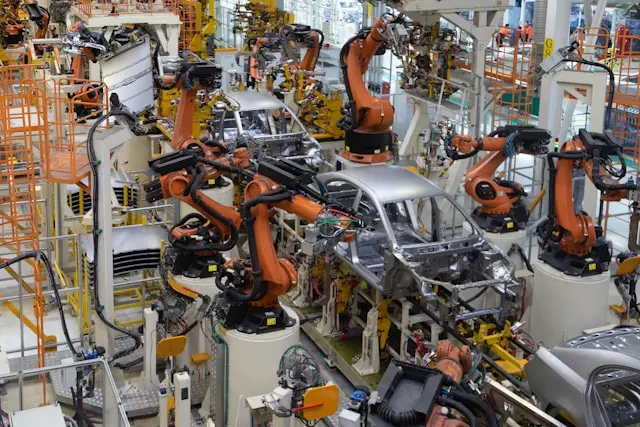
Brașov County's precision manufacturing sector installed more industrial robots between 2022 and 2024 than at any point in its history. Investment reached €180 million in robotics alone during that period. Yet the vacancy rate for skilled technicians climbed to 6.8% by the third quarter of 2024, nearly double the national manufacturing average. The machines arrived. The people to run them did not stay.
This is the central paradox facing every hiring leader operating in Brașov's industrial economy. A sector that employs over 42,000 workers, accounts for 34% of the county's industrial output, and anchors one of Romania's most concentrated automotive supply chains is haemorrhaging the very talent it needs to complete its transition to automated, electrification-ready production. The robots are not replacing people. They are replacing one kind of worker with another kind that does not exist locally in sufficient numbers, while the experienced technicians who could have been retrained are leaving for Germany at three times the salary.
What follows is a ground-level analysis of the forces reshaping Brașov's manufacturing talent market, where the gaps are most acute, and what organisations hiring in this region need to understand before they commit to a search strategy built for a market that no longer exists.
The Automation Paradox: Why €180 Million in Robotics Has Deepened the Shortage
The instinct is reasonable. If skilled technicians are scarce, automate the processes that depend on them. Brașov's largest manufacturers have followed this logic aggressively. Robot density in the county's automotive sector reached 127 units per 10,000 employees in 2024, up from 98 in 2022, according to the International Federation of Robotics World Robotics Report. Schaeffler Romania's €45 million expansion of its roller bearing facility, completed in the second quarter of 2024, added 400 specialised positions oriented toward high-precision electrification components.
The problem is that automation does not reduce the need for skilled humans. It changes the kind of skilled humans required. For every ten robots installed in Brașov manufacturing facilities, data from 2022 to 2024 shows only three operators were redeployed to higher-skill roles. Meanwhile, four to five experienced technicians per installation cycle emigrated to German-speaking markets during the same period. The net effect is negative. Capital moved faster than human capital could follow, and the gap between what the machines need and what the local workforce can deliver widened rather than narrowed.
This is the insight most hiring leaders in this market have not yet internalised. Automation investment in Brașov has not alleviated the skilled technician shortage. It has transformed it into something harder to solve: a shortage of professionals who can programme, maintain, and optimise automated systems, rather than a shortage of operators who can run manual ones. The old problem was volume. The new problem is capability. Capability shortages do not respond to the same interventions.
The Benchmark That Matters
Brașov's 127 robots per 10,000 employees still trails the Czech Republic's 170-unit benchmark. Closing that gap would require not only additional capital expenditure but a proportional increase in the automation engineering talent that makes each robot productive. With only 90 qualified automation and robotics graduates emerging annually from Brașov's technical universities against 180 open positions, the math does not work at any plausible growth rate. Every percentage point gained in robot density increases the demand for the very professionals the market cannot produce fast enough.
Where the Talent Gaps Are Most Acute
The shortages in Brașov's precision manufacturing sector are not evenly distributed. Three role categories concentrate the most acute pain, and each operates under different dynamics that require different search approaches.
Five-Axis CNC Programmers and Setters
There were 340 open positions for CNC programmers and setters across Brașov County as of late 2024. The average time to fill these roles reached 94 days, compared to 28 days for general machine operators. This is not a marginal difference. It represents a search cycle more than three times longer for a role category that directly constrains production throughput.
An estimated 75 to 80% of qualified five-axis CNC programmers in the region are passive candidates: employed, not looking, and unlikely to respond to a job posting. Active applicants in this segment frequently lack current certifications or carry employment gaps, according to the Hays Romania Candidate Behaviour Study from 2024. Standard job board recruitment for this specialism yields candidate pools with qualification match rates below 15%. The practical implication is stark. A hiring leader posting a CNC programmer role on a Romanian job board is paying for visibility among a population where fewer than one in six applicants can actually do the job.
Automation and Robotics Engineers
The 180 open positions for automation engineers in Brașov exist against a pipeline of 90 annual graduates. This two-to-one deficit assumes every graduate stays in the county. They do not. Only 35% of Transilvania University of Brașov engineering graduates remain locally after completing their studies. The effective pipeline is closer to 30 to 35 qualified individuals entering the market each year against demand for 180.
According to the Michael Page Romania Industrial and Manufacturing Hiring Report from 2024, 40% of searches for senior automation engineers with PLC, SCADA, and Siemens TIA Portal competencies in Brașov fail to produce qualified candidates within 90 days. The typical outcome is relocation of the role to Cluj-Napoca or Timișoara, or recruitment from Polish and Czech markets with relocation packages attached. Every relocated role is a role that Brașov's economy loses permanently.
Quality Directors and IATF-Certified Managers
At the senior end, 85 open positions for IATF 16949-certified quality managers existed in the county as of late 2024, with 62% of postings requiring seven or more years of automotive-specific experience. The passive candidate ratio for quality directors exceeds 85%. These roles are filled exclusively through direct search or internal promotion. Public job postings, where they exist, serve compliance purposes only. They do not generate viable candidates.
The compensation for a Quality Director in Brașov ranges from €75,000 to €100,000 gross. In Cluj-Napoca, the equivalent role commands 15 to 18% more. In Germany, it commands three times as much. The question is not whether qualified quality directors exist. It is whether the proposition available in Brașov can compete with the alternatives these professionals already have.
The Demographic Drain: Brașov's Real Competitor Is Not Cluj
Every analysis of Brașov's talent market begins with the competitive dynamic against Cluj-Napoca and Timișoara. Cluj offers 15 to 20% higher gross salaries for equivalent engineering roles, €55,000 to €70,000 compared to Brașov's €48,000 to €60,000. Timișoara draws experienced technicians with German language skills via targeted recruitment campaigns and 10 to 12% salary premiums for quality and project management roles.
But the numbers reveal a more consequential competitor. Between 2023 and 2024, approximately 1,200 to 1,500 skilled technicians, toolmakers, and CNC operators emigrated from Brașov County to German-speaking markets. According to the Federal Employment Agency of Germany's ZAV statistics, these professionals were attracted by net salaries of €45,000 to €60,000, roughly three times Brașov levels, with EU Blue Card fast-track processing removing the administrative friction.
Brașov County's working-age population declined 1.2% annually between 2020 and 2024. The emigration is concentrated among 25 to 35-year-old skilled technicians. This is not a general population decline. It is a precision strike against the exact age cohort that represents the mid-career talent any manufacturing employer needs for its next decade of operations.
The competitive dynamic with Cluj or Timișoara is a fight over the distribution of talent within Romania. The demographic drain to Germany is a net loss from the entire Romanian system. Brașov is not simply losing a competition for talent allocation. It is losing people who will never return to any Romanian employer.
This is where the hidden 80% of passive talent becomes relevant in a different way than most markets. In Brașov, the passive pool is not merely hard to reach through job boards. It is shrinking in absolute terms, year over year, through permanent emigration. A passive candidate identification strategy that was effective two years ago may reach 15% fewer viable candidates today simply because those candidates now live in Stuttgart.
The SME Talent Trap: When Ecosystem Density Becomes a Weakness
Brașov's 340 metalworking SMEs, concentrated in the Bartolomeu North/South Industrial Parks and Feldioara Industrial Zone, are frequently cited as a competitive strength. The density creates supplier depth, enables specialised subcontracting clusters like the 22 firms in the Metrom Brașov network, and supports cumulative turnover of €1.2 billion at Bartolomeu alone.
But the same density creates a destructive internal dynamic. Three hundred and forty SMEs are competing for the same pool of approximately 2,000 to 2,500 skilled machinists. Tier 1 suppliers routinely recruit from SMEs with 50 to 150 employees, offering 25 to 35% salary premiums for five-axis CNC programmer roles. The result is annual turnover rates of 18 to 22% in precision machining SMEs. Smaller firms operate at 85 to 90% capacity not because of order shortages but because of unfilled setter positions.
The pattern is cyclical and self-reinforcing. Brașov trains technicians through Transilvania University and dual vocational programmes like the Schaeffler-affiliated centres and the Kronstadt Technological High School. These programmes produce roughly 450 apprentices annually with an 85% retention rate at sponsoring employers. But the sponsoring employers are predominantly multinationals. SMEs that cannot offer equivalent compensation or career progression lose their trained staff to larger local competitors within two to three years. The SME trains. The multinational recruits. The SME trains again, at its own expense, for someone else's benefit.
Brașov's SME ecosystem does not function as a talent incubator for the region. It functions as a talent pipeline for a small number of large employers, subsidised by the training investment of firms that cannot retain the output. For any organisation considering Brașov as a manufacturing base, the implication is that relying on the local SME workforce as a recruitment pool is a short-term strategy with diminishing returns. Each hire from an SME accelerates the fragility of the supply chain those SMEs support.
Compensation Realities: What Roles Pay and Why It Matters
The compensation data for Brașov's manufacturing sector tells a story of structural misalignment between what the market pays and what it needs to pay to retain the talent it produces.
At the senior specialist and manager level, a Production Manager in Brașov earns €42,000 to €58,000 gross. A Plant Engineering Manager earns €48,000 to €65,000. A CNC Programming Manager earns €35,000 to €48,000. These figures sit 8 to 12% below Bucharest equivalents and 15 to 18% below Cluj-Napoca. The cost-of-living discount in Brașov runs 20 to 25% below both cities, which closes the gap on paper. In practice, the gap is what candidates see first. The cost-of-living adjustment comes second, if at all.
At the executive level, a VP of Operations or Plant Director in Brașov commands €95,000 to €135,000 gross plus 20 to 30% bonus. An R&D Director in automotive earns €90,000 to €120,000. A Technical Director at an SME earns €60,000 to €85,000. These figures are competitive within Romania's secondary manufacturing cities. They are not competitive with the German market that represents Brașov's primary talent drain.
The salary differential with Germany is not 15 or 20%. It is approximately 200%. A skilled CNC operator earning €18,000 to €22,000 net in Brașov can earn €45,000 to €60,000 net in Germany. No salary negotiation within the Romanian framework can bridge that gap. The only viable retention proposition for mid-career technicians involves total compensation elements that Romanian SMEs structurally cannot offer: housing support, long-term career pathway guarantees, and quality-of-life differentiators specific to Brașov's geography and lifestyle.
For executive-level searches, the compensation picture is less extreme but still requires careful positioning. A Quality Director search in Brașov at €75,000 to €100,000 must compete not only with Cluj's €90,000 to €118,000 range but with the perception among candidates that Cluj offers a stronger career trajectory into R&D leadership, particularly at employers like Bosch and Continental. The compensation conversation in Brașov cannot be separated from the career progression conversation. Candidates at this level are weighing five-year outcomes, not annual salary differentials.
The 2026 Inflection: Aerospace Growth Against Automotive Slowdown
Brașov's manufacturing sector enters 2026 with two forces pulling in opposite directions. Automotive growth is moderating, projected at 2.8 to 3.2% CAGR, down from 4.1% between 2022 and 2024. The deceleration reflects German OEM budget constraints filtering through to supplier orders. Given that 72% of Brașov's automotive output feeds German supply chains, and German battery electric vehicle sales fell 27% in 2024 according to the KBA (German Federal Motor Transport Authority), the transmission mechanism is direct and unavoidable.
Against this, aerospace subcontracting is projected to grow 12 to 15% as IAR Brașov expands H215M helicopter production for Airbus. The spillover demand targets five-axis CNC machining and composite materials engineering, role categories that overlap with but are not identical to automotive precision engineering. The Sânpetru Industrial Park, currently at 45% occupancy with 15% tax incentives for R&D investments, is positioned to absorb some of this growth.
The tension here is that aerospace growth demands a talent profile the automotive sector has been losing. Five-axis CNC capability is the bridge skill between the two sectors. A machinist who can programme a Mazak or Makino for automotive bearing components can, with additional certification, programme the same machines for turbine blade work at firms like Astra Blades in Feldioara. But if that machinist has already emigrated to Bavaria, neither sector benefits.
The Green Compliance Layer
Layered on top of this sectoral tension is the regulatory burden of EU CBAM and REACH compliance. Precision engineering SMEs face €50,000 to €200,000 in compliance costs for carbon monitoring and energy efficiency audits by 2026. Thirty-four percent of Brașov's metalworking SMEs report insufficient capital for dual investment in automation and green retrofitting. The REACH SCIP database requirements for reporting substances of very high concern in automotive components demand dedicated compliance officers. Brașov shows a 60% undersupply for this role category.
Industrial electricity prices in Brașov averaged €0.18 per kilowatt hour in 2024, net of subsidies. The Czech Republic pays €0.12. Poland pays €0.14. For energy-intensive precision grinding and heat treatment operations, this cost differential compounds directly into margin pressure. SMEs already struggling to match multinational wage offers now face simultaneous pressure on energy costs, compliance investment, and the capital expenditure required to replace machinery that is, in 60% of cases, over fifteen years old.
The organisations that survive this convergence will be those that solved their talent problems before the cost pressures arrived. The ones still searching for automation engineers and IATF-certified quality managers in the second half of 2026 will be doing so from a position of accumulated disadvantage.
What This Means for Hiring Leaders Operating in Brașov
The synthesis of Brașov's data points to a conclusion that is not obvious from any single statistic. Brașov's SME density, its historical strength as a manufacturing cluster, has become the mechanism through which the market's talent problems compound. The 340 SMEs do not collectively retain talent. They collectively train it and lose it: upward to multinationals within the county, laterally to Cluj and Timișoara, and permanently to Germany. The ecosystem is functioning as an export platform for skilled labour, not a retention system for it.
This has direct implications for any organisation running an executive or senior specialist search in this market. The approach that works in a market with a large, stable passive candidate pool, systematic identification, targeted outreach, competitive offer, does not account for a pool that is shrinking year over year through emigration. Talent mapping in Brașov must factor in not just who is available today, but how many of those individuals will still be in the market six months from now.
The sector will face a net deficit of 1,800 to 2,200 qualified technicians by the fourth quarter of 2026 if current training pipeline gaps persist, according to Romania's National Employment Agency. For senior leadership roles in industrial and manufacturing businesses, the deficit is smaller in absolute numbers but proportionally more damaging. A plant that cannot find 20 CNC operators can adjust shift patterns. A plant that cannot find a Quality Director or an R&D Director cannot certify its output or develop its next product generation.
Standard job board recruitment in this market yields qualification match rates below 15% for critical technical roles. The candidates who can fill the most consequential positions are passive, employed, and being actively courted by employers in Cluj, Timișoara, and Munich simultaneously. Reaching them requires direct search methodology built for a market where speed matters as much as reach. An offer that arrives 30 days late in Brașov does not get declined. It arrives after the candidate has already accepted a relocation package to southern Germany.
KiTalent delivers interview-ready executive candidates within 7 to 10 days through AI-enhanced talent identification and direct headhunting, reaching the 75 to 85% of Brașov's qualified technical leaders who will never appear on a job board. With a 96% one-year retention rate across 1,450 executive placements, and a pay-per-interview model that eliminates upfront retainer risk, the approach is designed for markets where the cost of a slow search is not merely inconvenience but lost production capacity and permanent talent drain.
For organisations competing for manufacturing leadership in Brașov's precision engineering sector, where every quarter of delay narrows the available candidate pool further, speak with our executive search team about how we approach this market.
Frequently Asked Questions
What is the average time to fill a CNC programmer role in Brașov?
As of late 2024, the average time to fill a five-axis CNC programmer or setter position in Brașov County was 94 days. This compares to 28 days for general machine operators. The extended timeline reflects severe supply constraints: 340 open positions existed county-wide with 75 to 80% of qualified candidates classified as passive. Standard job postings yield qualification match rates below 15% for these specialisms, making direct candidate identification essential for any search with a realistic timeline.
How does Brașov manufacturing compensation compare to Cluj-Napoca?
Brașov manufacturing salaries run 15 to 18% below Cluj-Napoca for equivalent roles. A senior engineer in Brașov earns €48,000 to €60,000 gross compared to €55,000 to €70,000 in Cluj. At the executive level, a VP of Operations in Brașov earns €95,000 to €135,000 gross. Brașov's cost of living is 20 to 25% lower, which partially offsets the gap, but candidates weighing offers typically compare headline figures and career progression prospects before factoring in living costs.
Why do automation engineers searches fail in Brașov?
Forty percent of searches for senior automation engineers in Brașov fail to yield qualified candidates within 90 days, according to Michael Page Romania's 2024 Industrial and Manufacturing Hiring Report. The primary cause is a two-to-one deficit between demand (180 open positions) and the annual graduate pipeline (approximately 90 from local universities, of whom only 35% remain in the county). Failed searches are typically relocated to Cluj-Napoca, Timișoara, or filled through international recruitment from Poland or the Czech Republic.
What role does emigration play in Brașov's talent shortage?
Emigration to German-speaking markets is the single largest drain on Brașov's manufacturing talent pool. Between 2023 and 2024, approximately 1,200 to 1,500 skilled technicians left Brașov County for Germany and Austria, attracted by net salaries roughly three times local levels and EU Blue Card processing. This outflow is concentrated among 25 to 35-year-old mid-career professionals, creating a gap that neither university programmes nor vocational training can close at current output rates.
How can KiTalent help with manufacturing executive search in Brașov?
KiTalent uses AI-enhanced direct headhunting to identify and engage passive candidates in markets like Brașov where 75 to 85% of qualified technical leaders are not actively looking. The pay-per-interview model means organisations only pay when they meet qualified candidates. With interview-ready shortlists delivered within 7 to 10 days and a 96% one-year retention rate, KiTalent's approach addresses the speed and precision requirements of a market where delayed searches result in permanent talent loss to international competitors.
What is the outlook for Brașov's manufacturing sector in 2026?
Brașov's automotive growth is moderating to 2.8 to 3.2% CAGR, down from 4.1% in the 2022 to 2024 period, driven by German OEM budget constraints. Aerospace subcontracting is a counterweight, projected to grow 12 to 15% through IAR Brașov's expanded Airbus work packages. The sector faces a net deficit of 1,800 to 2,200 qualified technicians by late 2026. Organisations that secure senior technical and operations leadership before the deficit peaks will hold a material advantage over those still searching in the second half of the year.