Karaganda Rail Freight Logistics: The Talent Market Splitting in Two Behind a Single Growth Number
Karaganda's rail freight sector grew by an estimated 3-4% through 2025. That figure tells you almost nothing useful. Behind it sit two entirely different markets moving in opposite directions. East-west container transit through the Middle Corridor expanded by roughly 35% annually through the region. North-south coal and metallurgical traffic to Russia fell by 12%. One market is building new container terminals. The other is watching heavy-haul coal lines lose volume. The professionals who run each of these operations share a city, a rail network, and almost nothing else.
For any senior leader responsible for hiring into this corridor, the implication is immediate. The talent required to manage a containerised intermodal terminal bears little resemblance to the talent that has run bulk coal marshalling yards for three decades. Yet both talent pools draw from the same regional labour market, a market where 4.9% unemployment coexists with six-month vacancy periods for specialised technical roles. General economic distress has not made hiring easier. It has made the mismatch harder to see.
What follows is a structured analysis of the forces reshaping Karaganda's rail freight sector, the employers driving that change, and what senior leaders need to understand before they make their next hiring or retention decision in this market.
Karaganda's Rail Network: A Hub Caught Between Two Eras
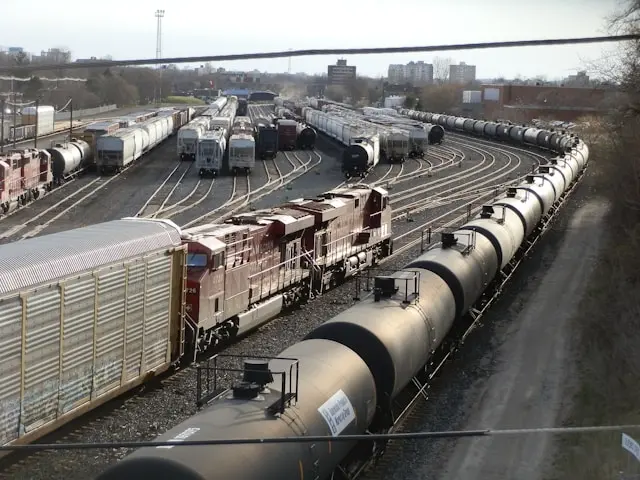
Karaganda sits at the intersection of the Turkestan-Siberia Magistral and the Trans-Kazakhstan railway line connecting Russia to Central Asia. This geography made it a critical node in both north-south and east-west corridors. The region handles approximately 25-30 million tonnes of freight annually. Coal accounts for roughly 40% of that volume. The Karaganda-Sorting station and Temirtau freight yards serve as the primary consolidation points for coal from the Karaganda Coal Basin, Kazakhstan's second-largest producing region after Ekibastuz.
The Single-Track Constraint That Shapes Everything
The infrastructure constraint that most directly affects operations and hiring alike is the 180-kilometre single-track bottleneck on the Shu-Aynabulak-Karaganda corridor. This stretch limits capacity to 18 train pairs daily against demand for 25 pairs during peak coal season from October through March. The result is costly queueing, detention charges, and operational pressure that cascades through every function in the yard. According to the World Bank Logistics Performance Index 2023, this constraint forces scheduling decisions that depend on precisely the kind of experienced operations managers the region cannot retain.
KTZ has committed 387 billion KZT (approximately $850 million) in infrastructure investment for 2024-2026, including electrification of the Karaganda-Aynabulak line and construction of a new container terminal at the Karaganda-Sorting station. The investment programme, approved by the Samruk-Kazyna board in late 2023, is now entering its final phase. But capital investment in track and terminals does not automatically produce the workforce capable of running what gets built. That gap between infrastructure spending and human capital readiness is the central tension in this market.
Coal Decline and the Qarmet Transition
The restructuring of ArcelorMittal Temirtau, now transitioning to state ownership under JSC Qarmet, has reshaped Karaganda's freight volumes materially. Coal transport volumes through Karaganda declined by 12% year-on-year in H1 2024, according to the Karaganda Regional Akimat's economic development report. The steelworks still consume 4.5 million tonnes of coal annually transported via rail through Karaganda yards. But future investment in captive coal mines at Batkak and Shubarkol remains uncertain.
According to Fitch Ratings' Kazakhstan metals and mining assessment from October 2024, this transition creates sustained volatility in rail demand. Spare capacity has appeared in warehousing and bulk handling infrastructure previously dedicated to metallurgical coal. That spare capacity looks like relief until you consider that the operators who managed it are already being drawn to faster-growing corridors elsewhere.
The structural risk extends beyond one employer. The EU's Carbon Border Adjustment Mechanism is projected to reduce Kazakhstan coal exports by 15% by 2027, according to the EBRD Kazakhstan Climate Risk Assessment 2024. For Karaganda, where coal logistics has been the foundational activity for decades, this is not a cyclical downturn. It is a directional shift.
The Middle Corridor: Growth That Demands a Different Workforce
While bulk coal volumes contract, east-west transit traffic is accelerating through exactly the same infrastructure. The Karaganda Logistics Centre, operated by KTZ Express, handled 28,000 TEU in 2024, up from 19,000 TEU in 2022. That 47% increase over two years reflects the broader expansion of the Trans-Caspian International Transport Route as Chinese containerised goods seek alternatives to Russian transit.
This growth demands a fundamentally different talent profile. Bulk coal handling requires experienced marshalling yard operators, heavy locomotive drivers, and safety-certified cargo handlers working in a Soviet-heritage operational framework. Containerised intermodal logistics requires coordinators fluent in Chinese and Russian, automation engineers capable of programming PLC-controlled crane systems, and managers who understand digital terminal operations.
The two workforces overlap almost nowhere. A senior freight yard operations manager with twenty years of coal marshalling experience cannot walk into a containerised terminal role without retraining. A trilingual logistics coordinator managing Khorgos-bound containers has no use for the coal loading certifications that define seniority in the traditional system.
This is where the headline growth number becomes misleading. A 3-4% overall increase in freight turnover, as projected by the Kazakhstan Association of Transport and Logistics, masks a market that is simultaneously losing experienced coal logistics professionals to retirement and failing to produce the intermodal specialists the Middle Corridor requires. The growth is real. The workforce for it is not yet present in sufficient numbers.
Where the Talent Gaps Are Most Acute
Kazakhstan's transport sector faces a national deficit of 3,200 qualified locomotive drivers and 1,800 railway engineers, according to the Ministry of Labor and Social Protection's 2024 sectoral assessment. In Karaganda specifically, KTZ Freight reported 340 vacancies for operational technical staff in Q3 2024. The average fill time for these roles was 4.2 months, compared to 1.8 months for administrative positions.
Locomotive Drivers: Effectively Zero Unemployment
The shortage of certified locomotive drivers has reached a level where KTZ has been unable to fill 25% of scheduled routes during peak periods on the Karaganda-Almaty line. According to a statement by the Kazakhstan Railway Workers Union to the Ministry of Labor in October 2024, overtime assignments routinely exceed 200 hours monthly per driver. The passive candidate market in this specialism is extreme: 85% of hires are direct headhunts from other regions or poached from industrial enterprises. Vacancy periods run six to nine months on average, with 40% of positions requiring recruitment from outside the region entirely.
The demographic dimension compounds the problem. Thirty-five percent of KTZ's Karaganda workforce is over 55 years old. The specialised Soviet-trained cohort of railway electrification and signalling engineers has an average age of 52. Younger replacements are immediately absorbed upon completing certifications, creating a market where qualified candidates receive three to five simultaneous offers.
Trilingual Logistics Coordinators: A Role That Barely Existed Five Years Ago
The Middle Corridor's expansion has generated demand for a professional profile that Karaganda's training institutions were never designed to produce. Managing east-west container transit requires coordinators fluent in Chinese, Russian, and ideally Kazakh or English, with operational knowledge of intermodal logistics, customs documentation, and digital freight management systems. This combination of linguistic and technical skills is vanishingly rare in a region whose educational infrastructure was built around mining and heavy industry.
Border cities like Khorgos and Dostyk offer 40-50% salary premiums for bilingual logistics coordinators working on Middle Corridor transit, according to a 2024 interview with KTZ Express's HR Director in Logistics of Kazakhstan Magazine. These markets draw operational talent away from internal hubs like Karaganda despite lower quality of life, driven by project-based bonuses that Karaganda's employers cannot match.
Terminal Automation Engineers: Poached Before They Settle
The third acute shortage involves engineers capable of operating and programming automated bulk handling systems. Qualified engineers with PLC programming skills are routinely recruited away by Chinese logistics firms at the Khorgos border crossing and by international operators in Almaty, typically at 40-60% salary premiums. The cost of losing a senior hire in this category is compounded by the months required to find a replacement in a market where the talent pool is measured in dozens rather than hundreds.
The pattern is clear across all three categories. Active candidate markets exist only at the entry level: freight forwarding agents, warehouse operatives, and administrative coordinators show active search rates of 35-40%. Every specialised role sits in a deeply passive market where conventional job advertising reaches a negligible fraction of viable candidates.
The Compensation Picture: Discounted and Distorted
Compensation in Karaganda's rail logistics sector runs at a 20-30% discount compared to equivalent roles in Almaty. That discount is the single largest factor in the region's retention failures, and it is widening fastest at the seniority level where the most critical roles sit.
At the senior specialist and manager level, freight yard operations managers and bulk terminal supervisors earn 1,200,000 to 2,000,000 KZT per month ($2,600 to $4,400). At the executive and VP level, regional logistics directors, KTZ branch managers, and supply chain VPs for mining clients earn 3,500,000 to 6,000,000 KZT per month ($7,700 to $13,200), according to the KATL Compensation Report 2024 and HR Consulting Accent Kazakhstan's executive compensation survey.
For specialised technical roles, the picture is equally constrained. Highly experienced locomotive drivers earn 800,000 to 1,100,000 KZT base monthly ($1,750 to $2,400), with overtime pushing totals to 1,400,000 KZT. Senior railway automation engineers command 2,200,000 to 3,200,000 KZT ($4,800 to $7,000).
These figures must be read against the competitive context. Almaty offers 25-35% premiums for equivalent logistics roles and hosts the headquarters of international freight forwarders including DB Schenker, DHL, and Maersk. Nur-Sultan concentrates KTZ's corporate headquarters and Ministry of Transport functions, offering stronger career trajectories into state administration. Border cities offer the project-based bonus structures described above.
Executive packages in Karaganda increasingly include hardship premiums of 15-25% above base salary for expatriate or relocated managers, plus housing allowances averaging 300,000 KZT monthly. These adjustments exist because the standard compensation package cannot compete with what equivalent roles pay in other markets. Even with the premiums, at least two major bulk commodity handling firms operating in Karaganda have relocated their logistics planning functions to Almaty or Nur-Sultan entirely, maintaining only operational staff in the region. The EBRD's Regional Economic Assessment documented this pattern explicitly, noting functional relocation of white-collar logistics functions driven by talent retention failures.
The compensation gap is not closing. It is widening at executive level, where Almaty's premium has grown from roughly 25% to 35% over three years as international forwarders in Almaty compete for the same Central Asian logistics leadership pool. For organisations benchmarking compensation in this sector, the challenge is not simply matching a number. It is matching the career proposition, quality of life, and professional trajectory that competing cities offer without the hardship premium.
Why Regional Unemployment Does Not Mean Available Talent
Karaganda Region reports unemployment of 4.9%, above the national average. The region has suffered industrial job losses in mining and steel. A surface reading would suggest favourable hiring conditions for employers willing to recruit locally. That reading is wrong.
The coexistence of elevated unemployment and acute specialised shortages reveals a market defined by occupational immobility and skills mismatch rather than absolute labour shortage. The workers displaced from mining and steel production do not hold the certifications, language skills, or digital competencies that rail logistics and intermodal operations now require. A retired coal miner cannot be retrained as a PLC automation engineer in any commercially useful timeframe. A monolingual Russian-speaking warehouse supervisor cannot manage Chinese container transit documentation.
This mismatch has a specific implication for search strategy. Conventional recruitment approaches that rely on local candidate pools, job board advertising, and inbound applications will surface volume from the wrong talent segment. They will generate applications from displaced industrial workers seeking any available position. They will not reach the locomotive engineers, automation specialists, and trilingual coordinators who are already employed, already receiving multiple competing offers, and not looking at job boards.
The only viable route to these candidates is direct identification and approach. In a market where 85% of locomotive engineer hires and 88% of bulk commodity logistics directors are sourced through direct headhunting rather than advertising, the distinction between firms that search actively and firms that wait for applications is the distinction between filling a critical role in weeks and leaving it open for six months.
The Investment Paradox: Capital Moves Faster Than Human Capital Can Follow
KTZ's $850 million infrastructure programme is building the physical capacity for Karaganda's next phase. Electrification of the Karaganda-Aynabulak line will relieve the single-track bottleneck. A new container terminal at Karaganda-Sorting will accommodate Middle Corridor growth. These are necessary investments.
But the investment in automation and new terminal capacity has not reduced the workforce requirement. It has replaced one kind of worker with another that does not yet exist in sufficient numbers. The new container terminal requires automation engineers, digital logistics coordinators, and intermodal operations managers. The electrified line requires drivers with electric traction certifications, a specialism where the Soviet-trained cohort is aging out with an average age of 52 and no pipeline behind them.
Capital moved faster than human capital could follow. This is the analytical reality that makes Karaganda's headline growth figure misleading for anyone planning a search in this market. The infrastructure is being built. The workforce to run it is not being produced at the required rate. The gap between the two is where executive search in Kazakhstan's industrial sector either succeeds through precision or fails through assumption.
The repatriation opportunity from Russia adds nuance to this picture. Since 2022, the flow of senior engineering talent from Kazakhstan to Russian cities like Omsk and Novosibirsk has reversed, driven by sanctions and mobilisation. This creates a window for Karaganda employers willing to offer competitive packages to returning professionals. But the window is narrow and requires active sourcing. Returning engineers are also being courted by Almaty and Nur-Sultan employers with larger budgets and more attractive living conditions.
What This Market Demands of Hiring Leaders
The conventional approach to hiring in Karaganda's rail logistics sector has been to post nationally through KTZ's internal channels and wait. For administrative and entry-level operational roles, this still works. For everything that matters, it does not.
Three principles distinguish organisations that fill critical roles from those that do not. First, compensation packages must account for Karaganda's specific competitive position. A base salary benchmarked against local rates will not attract a logistics director currently employed in Almaty. The hardship premium, housing allowance, and career development proposition must be explicit from the first conversation, not introduced as a negotiation concession.
Second, search methodology must match the candidate market. In a specialism where only 12% of qualified logistics directors are actively searching at any given time, the 88% who are not looking must be found through direct approaches. This requires detailed talent mapping across competing employers, border operations, and the Russian repatriation pool. Job advertising in this market is not ineffective by degree. It is ineffective by category. It reaches a different population entirely.
Third, speed matters disproportionately. A qualified automation engineer in Karaganda receives three to five offers simultaneously. An organisation whose interview and decision process runs longer than its competitors' will consistently finish second. The difference between a four-week search process and a twelve-week search process is not incremental. In this market, it is binary: you either reach the candidate before they accept elsewhere, or you do not.
For organisations competing for specialised rail logistics and bulk commodity leadership in Central Kazakhstan, where the candidates you need are already employed and already fielding competing approaches, speak with our executive search team about how KiTalent approaches this market. Our AI-enhanced direct headhunting methodology delivers interview-ready candidates within 7-10 days, reaching the passive specialists that job boards and internal channels cannot surface. With a 96% one-year retention rate across 1,450 placements globally, KiTalent brings the search precision that a market this constrained demands.
Frequently Asked Questions
What are the main rail freight logistics employers in Karaganda?
Kazakhstan Temir Zholy (KTZ) is the dominant employer, with an estimated 8,000-9,000 staff in the Karaganda Region across operations, maintenance, and management. KTZ Freight operates the Karaganda-Sorting and Temirtau-Sorting terminals. JSC Qarmet (formerly ArcelorMittal Temirtau) remains the region's largest bulk commodity client, consuming 4.5 million tonnes of coal annually via rail. Kazakhmys Corporation uses Karaganda infrastructure for copper concentrate transport. The Karaganda Logistics Centre, a KTZ Express subsidiary, handles growing intermodal container volumes for the Middle Corridor route.
Why is it difficult to hire locomotive drivers in Kazakhstan?
Kazakhstan faces a national deficit of 3,200 qualified locomotive drivers. In Karaganda, the shortage is severe enough that 25% of scheduled routes cannot be fully staffed during peak periods. The average vacancy duration runs six to nine months. Thirty-five percent of KTZ's Karaganda workforce is over 55, and the Soviet-trained specialist cohort is aging out without proportionate replacement. Unemployment among certified drivers is effectively zero, making this an almost entirely passive candidate market requiring direct headhunting rather than conventional recruitment.
How does Karaganda rail logistics compensation compare to Almaty?
Karaganda salaries run 20-30% below Almaty for equivalent rail logistics roles. A regional logistics director in Karaganda earns 3,500,000 to 6,000,000 KZT monthly, while comparable positions in Almaty command a 25-35% premium. Executive packages in Karaganda increasingly include hardship premiums of 15-25% and housing allowances of 300,000 KZT monthly to offset limited amenities and international schooling. Despite these supplements, multiple firms have relocated white-collar logistics planning functions to Almaty, citing the inability to retain senior professionals in Karaganda.
What is the Middle Corridor's impact on Karaganda's freight market?
The Trans-Caspian International Transport Route (Middle Corridor) is driving containerised transit growth through Karaganda. The Karaganda Logistics Centre handled 28,000 TEU in 2024, up from 19,000 TEU in 2022. This growth creates demand for trilingual logistics coordinators, terminal automation engineers, and intermodal operations managers. However, it simultaneously competes with traditional coal traffic for infrastructure capacity and workforce. The net effect is a market splitting between a declining bulk commodity sector and a growing container transit sector, each requiring different specialist profiles.
How can KiTalent help with executive hiring in Kazakhstan's rail logistics sector?
KiTalent's AI-enhanced executive search methodology is designed for precisely the kind of deeply passive candidate market that characterises Karaganda's rail logistics sector. Where only 12% of qualified logistics directors are actively searching, KiTalent's talent mapping identifies and approaches the other 88% directly. The pay-per-interview model means clients only pay when they meet qualified candidates, and interview-ready shortlists are delivered within 7-10 days. With experience across industrial and manufacturing sectors globally, KiTalent brings cross-border sourcing capability essential for a market that increasingly recruits from Almaty, border cities, and the Russian repatriation pool.
What structural risks affect Karaganda's rail freight sector in 2026?
Three risks dominate. First, the EU Carbon Border Adjustment Mechanism is projected to reduce Kazakhstan coal exports by 15% by 2027, directly impacting Karaganda's bulk handling volumes. Second, the transition of Temirtau steelworks to state ownership under Qarmet creates ongoing volatility in rail demand, with 2024 volumes down 12%. Third, demographic attrition is accelerating: the specialised Soviet-trained technical workforce is retiring faster than training institutions can produce replacements. These risks compound one another, making the talent challenge inseparable from the market's broader economic trajectory.