Khon Kaen's Logistics Infrastructure Is Growing Faster Than Its Talent Pool Can Follow
Khon Kaen Province processed 12,400 tonnes of air cargo in 2024, a 34% increase on the prior year. The airport achieved international status in December 2024. The double-track railway connecting Khon Kaen to Bangkok is due for completion in the first half of this year, cutting transit time from seven hours to three and a half. A ฿450 million DHL automated cold storage facility is on schedule to open by the end of 2026. By any infrastructure measure, Khon Kaen is no longer an aspiration. It is an emerging logistics centre for Thailand's Northeast.
Yet vacancy rates for cold chain technicians in the province sat at 28.4% in late 2024. For bilingual supply chain managers, the figure was 35.6%. One of the region's largest logistics operators spent ten months unable to fill a Regional Supply Chain Director role. A mid-sized regional 3PL relocated its finance and HR functions to Bangkok entirely, citing fourteen months of failed recruitment for a qualified accounting manager. The capital is arriving. The facilities are rising. The people to run them are not.
This is the defining contradiction of Khon Kaen's logistics market in 2026. What follows is an analysis of the forces reshaping this sector, the specific talent gaps that threaten to stall the infrastructure investment, and what organisations operating in or expanding into this market need to understand before they make their next senior hire.
The Infrastructure Thesis: What Has Actually Been Built
The public investment case for Khon Kaen as Thailand's northeastern logistics hub rests on three pillars: air, rail, and industrial estate development. Each has advanced materially. None has yet delivered the operational capacity the investment was designed to unlock.
Khon Kaen International Airport's new cargo terminal, opened in December 2024, includes dedicated cold rooms at both 0–4°C and -18°C. But the terminal spans only 2,400 square metres and can process just 50 tonnes daily. As of early 2025, it handled two to three international cargo flights per week, primarily to Guangzhou and Hanoi. The airport's total throughput represents 0.8% of Bangkok Suvarnabhumi's volume. International status is a necessary condition for hub development. It is not, by itself, sufficient.
Rail: Capacity Without Connectivity
The double-track railway between Bangkok and Nong Khai, passing through Khon Kaen, reached 95% completion by the third quarter of 2024. The State Railway of Thailand projects 12 daily freight services and 40,000 TEU annual capacity once operational. This is the single most consequential infrastructure change for the province's logistics sector. Halving the transit time to Bangkok reshapes the economics of every supply chain that currently relies on road haulage.
The constraint is at the station itself. Khon Kaen Station's freight yard covers 8,000 square metres with no dedicated intermodal container handling facility. There are no container cranes. No dedicated freight sidings beyond what currently supports four container trains daily. Without an inland container depot offering customs clearance, containers arriving by rail must be trucked eight kilometres to private depots. This negates the cost advantage the railway was designed to create. The Transport and Traffic Policy and Planning Office confirmed in its 2024 Northeast Logistics Corridor Study that ICD development at Khon Kaen is unlikely before 2027 at the earliest.
Warehouse Stock and Cold Storage: Full Before the Boom Peaks
Modern warehouse stock in Khon Kaen reached 285,000 square metres by the end of 2024, with 89% occupancy. Key facilities include SCG Logistics Park (42,000 sqm), the TFD Logistics Center (28,000 sqm serving tapioca starch and animal feed exports), and Kerry Express's expanded Northeast hub processing 45,000 parcels daily.
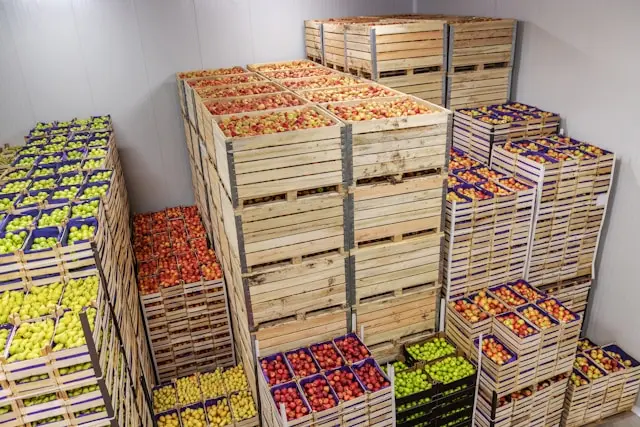
Cold storage tells a sharper story. The province's 12 temperature-controlled facilities hold approximately 45,000 pallet positions. That is 6% of Bangkok's capacity. Utilisation exceeds 94%. Agricultural exporters reported three-to-four-week waiting lists for frozen storage during harvest peaks in 2024. DHL Supply Chain Thailand's ฿450 million automated facility at Khon Kaen Smart Park, targeting pharmaceutical and premium fruit exports, will add 25,000 pallet positions when it opens in late 2026. This represents a 55% increase in regional cold capacity. Yet even with DHL's investment, total capacity will remain a fraction of what the projected China-Thailand agricultural trade corridor requires. Thailand's Board of Investment approved zero cold storage projects in Khon Kaen under tax incentive schemes in 2023 and 2024. In the same period, 14 were approved in the Eastern Economic Corridor.
The infrastructure is being built in anticipation of demand that depends on operational systems, customs integration, and trained personnel that lag the physical assets by three to five years. The buildings are ahead. Everything else is behind.
Why the Talent Shortage Is Not a Hiring Problem
The instinct of most hiring leaders confronting a vacancy rate of 28% or 35% is to adjust the recruitment effort. Raise compensation. Broaden the search geography. Engage more agencies. These are rational responses to a cyclical shortage. Khon Kaen's logistics talent gap is not cyclical. It is systemic, and it originates in a mismatch between what this market requires and what this market produces.
Khon Kaen University's Faculty of Engineering offers Thailand's only Northeast-based B.Eng. in Logistics Engineering. It graduates 80 students annually. The same faculty produces 15 to 20 graduates per year with the bilingual supply chain management profile that employers actually need: Thai-English proficiency at business level, agricultural export documentation expertise (GAP and Organic certification), and ERP fluency in SAP WM or Oracle WMS. Fifteen to twenty graduates. For a market that needs to grow its logistics workforce from 8,400 to 11,200 by the end of 2026.
The Thailand Refrigeration Association's regional membership data indicates that approximately 180 professionals in the entire Northeast possess the specific competency bundle cold chain employers require: industrial refrigeration system maintenance, HACCP certification for logistics, and temperature monitoring IoT integration. That is 180 people across a region of 22 million. The DHL facility alone will need a portion of them when it opens.
This is the original analytical claim that the data compels but the research does not state outright: Khon Kaen's infrastructure investment has not created a logistics hub. It has created a talent vacuum with a concrete shell around it. The physical assets are arriving on schedule. The human capital required to operate them at design capacity does not exist in sufficient quantity and cannot be produced fast enough by the region's educational institutions. Capital moved faster than workforce development could follow. Every hiring decision in this market now takes place inside that gap.
Compensation: Metropolitan Wages, Provincial Career Paths
The compensation data reveals a market that is already behaving irrationally. A Cold Chain Operations Manager in Khon Kaen earns ฿65,000 to ฿95,000 monthly at the senior specialist level. At Regional Director level, the range climbs to ฿150,000 to ฿220,000 plus performance bonuses of 20 to 30% and a company vehicle. A Chief Supply Chain Officer at a multinational agribusiness can reach ฿300,000 monthly. These are not provincial figures. When housing allowances and relocation packages are factored in, total compensation for senior logistics and supply chain leadership roles in Khon Kaen is approaching Bangkok equivalents.
The Premium That Does Not Stick
According to Bangkok Post reporting from August 2024, CJ Logistics Thailand recruited its Operations Manager for the Khon Kaen cold storage facility from competitor Thai Yokorei, paying a reported 35% premium over market rate. The base package reached ฿180,000 monthly against a market norm of ฿130,000 to ฿140,000, with a housing allowance on top. This followed a six-month search that failed to produce a viable candidate through conventional channels.
A Supply Chain Director in Khon Kaen earns ฿120,000 to ฿180,000 monthly. The same role in Bangkok or the Eastern Economic Corridor commands ฿200,000 to ฿350,000. The gap is 45 to 60% at the senior end. But Khon Kaen cannot close this gap by simply raising salaries, because the differential is not only financial. Bangkok offers exposure to international freight forwarding and digital supply chain technologies, multinational career trajectories, and the service ecosystem that supports executive development. Khon Kaen's logistics market is predominantly domestic agricultural logistics. Paying metropolitan wages does not create a metropolitan career path. The professionals who accept Khon Kaen premiums today acquire region-specific experience that makes them more valuable to competitors in Udon Thani or more attractive to Bangkok employers who need someone who understands Isan supply chains. The very experience that makes a hire valuable is the experience that eventually draws them away.
This dynamic is visible in the tenure data. Average tenure in senior logistics roles in Khon Kaen is 4.2 years, compared to 2.8 years in Bangkok. That sounds like stability. It is actually illiquidity. The pool is small, movement is rare, and when someone does move, the ripple is disproportionate. One departure creates a vacancy that the local talent pipeline cannot fill without importing a replacement from outside the region at a premium that inflates the benchmark for the next hire.
The Three Competitors Pulling Talent Away
Khon Kaen's talent challenge is not self-contained. It exists in a competitive field with three distinct gravitational pulls, each operating at a different level of the seniority spectrum.
Bangkok and the Eastern Economic Corridor
The EEC corridor running through Rayong, Chonburi, and Chachoengsao represents the primary draw for senior logistics talent. The compensation premium is one factor. The career factor is equally decisive. A supply chain professional in the EEC works with international freight forwarding operations, participates in digital transformation programmes, and builds credentials that transfer globally. In Khon Kaen, the work is operationally demanding but narrower in scope. According to reporting in Prachachat Turakij from November 2024, SCG Logistics offered its Regional Supply Chain Director role to three candidates, all of whom declined in favour of Bangkok-based opportunities offering 40 to 50% higher compensation. The role remained unfilled for ten months as of January 2025, with interim coverage provided by Bangkok-based executives commuting weekly.
For organisations trying to fill critical roles, this pattern is the core problem. The candidates with the right experience exist. They are reachable. But the proposition required to move them involves more than money. It requires answering the career trajectory question. Firms that cannot articulate a compelling two-to-three year development narrative for a Khon Kaen-based role will lose candidates to the same objection repeatedly.
Udon Thani and the Cross-Border Premium
The second competitor is less obvious. Udon Thani, 120 kilometres north, offers comparable cost of living but higher cross-border logistics exposure through the Nong Khai border with Laos. Thai-Chinese logistics firms including Sinotrans and COSCO Logistics are expanding into ASEAN via the Lao corridor, offering Khon Kaen talent 20 to 25% premiums for customs brokerage and cross-border transport coordination roles. This is a targeted extraction. The professionals being recruited are precisely the ones with intermodal operations expertise and bilingual capability. Every departure to Udon Thani removes exactly the skill profile that Khon Kaen's hub ambitions require most.
Internal Restructuring as Talent Loss
The third form of competition is not geographic. It is organisational. According to reporting in Thai PBS Business from October 2024, Thai MMC Logistics restructured its Khon Kaen operations after fourteen months of failed recruitment for a qualified accounting manager familiar with international logistics finance standards. The company relocated its finance and HR functions to Bangkok, resulting in 22 local administrative redundancies. This is not a firm leaving the market. It is a firm pulling its knowledge functions out while retaining manual operations locally. The pattern, if replicated, hollows out Khon Kaen's professional workforce while preserving its warehouse headcount. The city keeps the forklifts but loses the strategic roles.
The Passive Candidate Problem in a Small Market
An estimated 80 to 85% of qualified cold chain engineers and supply chain directors in Khon Kaen are passive candidates: employed, not actively searching, and invisible to job boards. This is consistent with the high tenure figures. In a market of this size, the qualified professionals are known quantities. They work for one of a small number of employers. They are not browsing listings.
This creates a structural problem for any organisation relying on inbound applications or job advertising as its primary talent acquisition method. The approach reaches, at most, 15 to 20% of the viable candidate population. The remaining 80% must be identified, assessed, and engaged through direct search methods that map the existing talent pool and approach individuals with a specific proposition.
The problem is compounded by the digital adoption gap. Only 23% of logistics SMEs in Khon Kaen have adopted warehouse management or transport management systems. The professional ecosystem is less digitally visible than in Bangkok. LinkedIn penetration among mid-career logistics professionals in Thailand's Northeast is materially lower than in the capital. Conventional database searches and platform-based sourcing miss a large portion of this market. Identifying the hidden majority of qualified candidates requires local market intelligence, sector-specific networks, and a search methodology built for passive engagement rather than application volume.
For organisations building senior teams in this region, the implication is straightforward. The search method matters as much as the compensation package. A well-funded search using the wrong approach will produce the same shortlist as a poorly funded one.
What the 2026 Market Requires from Hiring Leaders
The convergence of infrastructure completion and talent scarcity in 2026 creates a narrow window. The double-track railway will be operational by mid-year. DHL's automated cold storage facility will open by the fourth quarter. The Khon Kaen Smart Park Logistics and Multimodal Transport Zone is under active development. The State Railway of Thailand's business plan projects 40,000 TEU annual capacity through Khon Kaen. Employment in the sector is projected to grow 33% from 2024 to 2026, from 8,400 to 11,200 workers.
These are not projections. Most of these are construction timelines with completion dates. The facilities will exist. The question is whether they will operate at design capacity or sit partially staffed while employers cycle through failed searches.
Regulatory Pressures Compounding the Challenge
New Labor Protection Act amendments effective April 2025 increased severance pay for long-tenured employees and imposed stricter overtime regulations for logistics workers. For Khon Kaen's agricultural logistics sector, which depends on seasonal overtime during the October-to-January harvest peak, the Thai Chamber of Commerce estimated a 12 to 15% increase in labour costs. This tightens margins for regional 3PLs already under pressure from fuel costs and agricultural price volatility. Tapioca starch prices fell 18% year on year in 2024 due to oversupply. The operators who cannot absorb higher labour costs and cannot attract the talent to improve operational efficiency are the ones KResearch projects will exit or be acquired by national players by the end of 2026.
Climate risk adds another dimension. Flooding in September 2024 disrupted 45% of provincial road access for 72 hours. Only 35% of Khon Kaen's modern warehouse stock sits above ten-year floodplain levels. Warehouse operations directors and logistics planners with climate resilience and business continuity expertise are not a luxury hire in this market. They are a necessity that barely exists in the regional talent pool.
The Hiring Approach That Works in This Market
For organisations hiring into Khon Kaen's logistics sector in 2026, three principles hold.
First, treat every senior hire as a passive candidate engagement. The qualified professionals are employed. They are not looking. Direct headhunting and talent mapping across the small number of employers in this market is the only method that reaches them. Job postings in a market with 35.6% vacancy rates for bilingual supply chain managers are not reaching the people who can fill those roles.
Second, build the career narrative before you build the compensation package. The research is clear: candidates are declining Khon Kaen roles not because the money is insufficient but because the career trajectory is unclear. A well-structured executive search process includes articulating the role's strategic value, the organisation's growth plan, and the development path beyond the initial appointment. Candidates who can earn more in Bangkok will consider Khon Kaen if they can see a credible story about what this role leads to.
Third, move fast. In a market where a single departure cascades through the talent pool, a search that takes ten months is not just slow. It is structurally unable to succeed because the conditions change during the search itself. The candidate who was available in month two has accepted a counteroffer by month six. KiTalent's model delivers interview-ready candidates within seven to ten days, operating on a pay-per-interview basis with no upfront retainer. In a market this thin, speed is not a convenience. It is a precondition.
Why This Market Rewards a Different Kind of Search Partner
Khon Kaen's logistics talent market is small enough that every search is, in effect, a total-market map. There are 180 cold chain engineers in the Northeast. There are 15 to 20 bilingual supply chain graduates per year from the only relevant university programme. The talent pool is finite and known. What it requires is not more recruitment activity. It requires a search partner with the market intelligence capability to identify who is where, what moves them, and how to construct a proposition that works the first time.
KiTalent has completed over 1,450 executive placements globally, with a 96% one-year retention rate for placed candidates. The retention figure matters more than the placement count in a market like Khon Kaen, where the cost of a wrong hire or a hire who leaves within twelve months is measured not just in recruitment fees but in project delays, facility underutilisation, and competitive exposure to talent poaching.
For organisations competing for cold chain engineering, supply chain leadership, or intermodal operations talent in Thailand's Northeast, where the qualified candidates number in the hundreds and the passive rate exceeds 80%, speak with our executive search team about how we approach markets where conventional methods have already failed.
Frequently Asked Questions
Why is there a talent shortage in Khon Kaen's logistics sector?
The shortage stems from a mismatch between infrastructure investment speed and workforce development capacity. Khon Kaen University produces only 15 to 20 bilingual supply chain graduates annually against a market that needs to add 2,800 logistics workers by 2026. Cold chain technicians with the required HACCP and IoT competencies number approximately 180 across the entire Northeast region. Bangkok and the Eastern Economic Corridor draw senior professionals with 45 to 60% compensation premiums and broader career exposure, limiting the pool of experienced candidates willing to work in Khon Kaen.
What does a Supply Chain Director earn in Khon Kaen compared to Bangkok?
A Supply Chain Director in Khon Kaen earns ฿120,000 to ฿180,000 monthly. The equivalent role in Bangkok or the Eastern Economic Corridor commands ฿200,000 to ฿350,000. At Chief Supply Chain Officer level in Khon Kaen, multinational agribusinesses offer up to ฿300,000 monthly. Total compensation packages including housing allowances and relocation support are narrowing the gap, but the career development differential remains a stronger factor than base salary in candidate decisions.
How is the double-track railway affecting Khon Kaen's logistics market?
The Bangkok-Nong Khai double-track railway, expected to complete in the first half of 2026, will halve transit time to Bangkok and enable 40,000 TEU annual capacity through Khon Kaen. However, the absence of an inland container depot with customs clearance at Khon Kaen Station limits the efficiency gains. Containers must still be trucked to private depots. This creates immediate demand for intermodal operations managers with rail-yard and container optimisation expertise, a skill profile that barely exists in the regional workforce.
What cold chain investment is planned for Khon Kaen in 2026?
DHL Supply Chain Thailand is building a ฿450 million automated cold storage facility at Khon Kaen Smart Park, adding 25,000 pallet positions by the fourth quarter of 2026. This represents a 55% increase in regional cold capacity. Current cold storage utilisation exceeds 94% across the province's 45,000 existing pallet positions, and agricultural exporters face three-to-four-week waiting lists during harvest peaks. The new facility will require cold chain engineers and automation specialists that the local market cannot currently supply.
How can companies hire senior logistics talent in Khon Kaen when most candidates are passive?
An estimated 80 to 85% of qualified cold chain engineers and supply chain directors in Khon Kaen are employed and not actively searching. Job boards and inbound applications reach only a fraction of the viable candidate pool. Direct executive search methods that map the existing talent market and engage passive candidates with a specific role proposition are the only reliable approach. KiTalent delivers interview-ready executive candidates within seven to ten days through AI-powered talent mapping, with a pay-per-interview model that eliminates upfront retainer risk.
What regulatory changes affect logistics hiring in Khon Kaen?
Labor Protection Act amendments effective April 2025 increased severance obligations for long-tenured employees and tightened overtime regulations. For Khon Kaen's agricultural logistics sector, which relies on seasonal overtime during the October-to-January harvest, the Thai Chamber of Commerce estimated a 12 to 15% increase in labour costs. This margin pressure is expected to accelerate consolidation among regional 3PLs, with two to three mid-sized operators projected to exit or be acquired by national players by the end of 2026.