Olomouc Manufacturing in 2026: The Automation Bet That Outran Its Workforce
Olomouc's advanced manufacturing sector entered 2026 carrying a contradiction. Capital investment in robotic process automation rose 15% through the year, production lines extended for EV thermal management and lightweight exteriors, and FDI held steady at €120 million annually. Yet the workforce required to operate, programme, and maintain that new capacity is shrinking. The region's working-age population is declining at 1.2% per year. The vocational schools are graduating students, but only a third of them arrive with the applied skills that modern production floors demand. The money moved faster than the people could follow.
This is not a conventional talent shortage story. The Olomouc region's unemployment rate sat at 2.4% as of late 2024, and manufacturing vacancies averaged 94 days to fill for technical roles. Those numbers alone would signal a tight market. But the deeper problem is qualitative, not quantitative. The sector is bifurcating into two distinct tiers: firms that have completed or nearly completed their Industry 4.0 transitions, and firms that have not. The first group is capturing Tier-1 EV contracts from Škoda Auto and Hyundai. The second group faces margin compression, acquisition, or irrelevance. The talent each group needs is different. The talent pool serving both is the same.
What follows is an analysis of the forces splitting Olomouc's manufacturing sector, the specific roles and skills caught in that divide, and what senior hiring leaders need to understand before they compete for the engineers, programmers, and production leaders who will determine which firms survive the transition.
A Sector Built on Precision, Strained by Transformation
The Olomouc region's manufacturing base is not a single market. It is a layered ecosystem of approximately 28,000 workers generating CZK 45 billion in annual turnover. Precision metalworking accounts for 34% of sector output. Electromechanical components contribute 28%. Automotive plastics and exterior systems make up 22%. The physical infrastructure is anchored in two industrial zones: Hněvotín, at 79 hectares and 100% occupancy as of late 2024, and Křelov-Bílá Lhota at 45 hectares, hosting Hanon Systems and its associated logistics network.
The employer structure is bifurcated in a way that matters for hiring. At the top sit multinational Tier-1 anchors. Magna Exteriors operates from Hněvotín with approximately 1,200 employees, producing exterior trim and body components for BMW, Mercedes-Benz, and Škoda. The facility expanded in 2023 with a €25 million injection moulding line. Hanon Systems employs roughly 850 people at Křelov-Bílá Lhota, manufacturing HVAC modules and powertrain cooling systems. ABB's Olomouc facility contributes another 400 employees focused on electromechanical components and drives.
Below these anchors sits a dense network of approximately 140 Czech-owned SMEs, typically employing 20 to 80 workers, specialising in CNC machining, toolmaking, and electromechanical assembly. These firms serve as Tier-2 and Tier-3 suppliers to Škoda Auto in Mladá Boleslav, Hyundai Motor Manufacturing Czech in Nošovice, and ZF Group. They are the connective tissue of the region's automotive supply chain. They are also the firms least equipped for the transition now underway.
The distinction matters because multinational anchors and Czech SMEs are not competing in the same talent market in the same way. Magna and Hanon can absorb 8.2% annual wage inflation as a cost of market access. A 50-person tooling shop operating on 5% margins cannot. Both need CNC programmers and automation technicians. Only one category of employer can afford to pay what those candidates now cost.
The Automation Imperative and the Firms It Leaves Behind
CzechInvest projected a 15% increase in capital expenditure on robotic process automation across the Olomouc region through 2026. The drivers are straightforward: labour cost inflation, OEM pressure for EV-component certification, and the demographic arithmetic that makes hiring your way out of a declining working-age population impossible. By the end of 2026, an estimated 35% of firms in the region will have completed meaningful Industry 4.0 transitions.
That figure reveals the problem. Thirty-five percent is not a majority. It is a leading edge.
The Gap Between Leaders and Laggards
Only 28% of Olomouc's manufacturing SMEs had implemented robotic process automation as of 2024, compared to 45% in the Prague region. According to ČSOB's SME Credit Survey, capital constraints are the primary barrier. Most SMEs require a return on investment within three years to justify the purchase of collaborative robots and automated guided vehicles. That payback window is too short for the scale of investment required to reach Industry 4.0 readiness.
The consequence is a sector splitting along an automation line. Firms on one side of that line are winning EV contracts and attracting the talent to fulfil them. Firms on the other side are losing both. The ČSOB Industrial Sector Outlook for 2025 predicted that non-automated SMEs would face margin compression or acquisition. From a 2026 vantage point, that prediction is materialising. OEM production cuts in Q4 2024 reduced component orders by 12% regionally. For a firm already operating on thin margins without automated capacity, a 12% demand drop is not a temporary dip. It is an existential question.
What Automation Has Not Solved
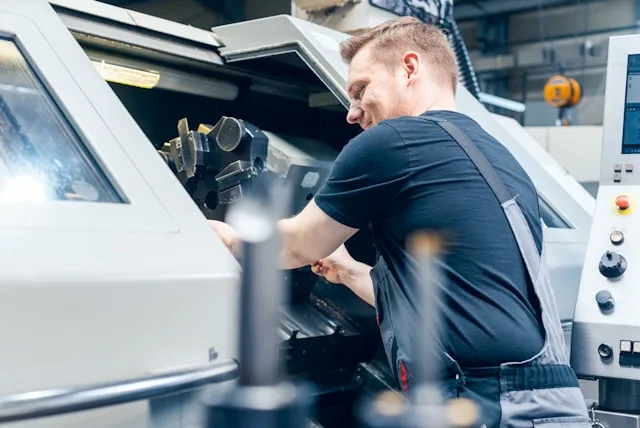
The investment in automation has not reduced the total workforce requirement. It has replaced one category of worker with another that does not yet exist in sufficient numbers. A conventional CNC lathe operator and a technician capable of programming a 5-axis simultaneous milling centre with Heidenhain or Siemens 840D controls are not the same person. A maintenance fitter and an automation technician fluent in PLC and SCADA systems are not interchangeable. The capital moved. The human capital has not caught up.
This is the original analytical tension in the Olomouc market: the very automation investment designed to offset a shrinking workforce has created demand for a different, scarcer type of worker. Every €1 million spent on robotic capacity generates new vacancies for the people who can make that capacity function. The firms that invested earliest are now competing hardest for the specialists they need to operate what they bought. The firms that invested later are competing for those same specialists from a weaker position. And the firms that have not invested at all are losing their existing workers to the firms that have.
Where the Talent Gaps Are Most Acute
The Olomouc Labour Office registered 4,200 manufacturing vacancies as of December 2024, a 22% year-on-year increase. Against this, only 1,800 registered job seekers held relevant qualifications. The ratio is stark: more than two vacancies for every qualified candidate. But the aggregate numbers conceal the severity at the specialist level.
CNC Programmers: 112 Days and Counting
The single most acute shortage is in CNC programmers with 5-axis machining experience. As of late 2024, 340 positions were open across the region with an average time-to-fill of 112 days. According to the Hays Passive Candidate Index, approximately 85% of qualified CNC programmers with five or more years of experience are currently employed and not actively seeking new roles. Recruitment in this specialism relies almost entirely on direct headhunting approaches rather than job advertising.
According to ManpowerGroup and Hays, employers in the Hněvotín industrial zone typically experience 90 to 120 day vacancy periods for senior CNC programmer roles. When candidates are secured, they are frequently attracted from competitors with salary premiums of 18% to 25% above standard pay scales. The resulting annual churn rate in this specialism reaches 22%. Firms are not building a workforce. They are circulating one.
Automation Technicians: A Shortage With No Upstream Fix
The second critical gap sits in automation technicians with PLC and SCADA competencies. Some 280 positions were open as of Q4 2024, and 78% of employers reported considerable difficulty sourcing candidates. The skills required span IoT sensor implementation, predictive maintenance algorithms, digital twin operation, servo drive configuration, and robotics integration for KUKA and ABB systems.
This shortage has no near-term upstream fix. The region's vocational schools graduate approximately 400 mechanical engineering students annually. That number appears sufficient to cover retirements. It is not. Employer surveys indicate that only 35% of these graduates possess usable skills in CNC programming or PLC troubleshooting without material retraining. The vocational pipeline is producing volume without the specific applied competencies that automated manufacturing requires. SPŠ Olomouc's own graduate tracking survey acknowledged a 30% gap between graduate skill levels and Industry 4.0 requirements. The "skilled workforce" that historically anchored Olomouc's manufacturing reputation is eroding in quality even as its quantity appears stable.
Welding Specialists and Production Managers
Below the headline shortages sit two additional pressure points. Welding specialists holding TIG/MIG certification to EN 287-1 standards account for 190 open positions, a shortage compounded by competition from infrastructure projects drawing the same certified workers. Production Manager roles requiring Czech or Slovak language skills, ISO 9001/IATF 16949 experience, and team leadership of 50 or more operators remain unfilled for four to six months, according to the Czech Association of Personnel Agencies.
According to Morgan McKinley, regional employers including firms such as SIGMA Group have begun recruiting Production Managers from Brno and Ostrava with relocation packages. Some have introduced remote or hybrid arrangements for planning functions. For a plant-floor leadership role, this is an unusual adaptation, and it signals how far the market has moved from conventional hiring norms.
The Geographic Squeeze: Brno, Ostrava, and the Cross-Border Drain
Olomouc does not compete for manufacturing talent in isolation. It sits between two larger industrial centres that exert gravitational pull in both directions.
Brno, 70 kilometres to the southwest, offers 15% to 20% salary premiums for automation engineers and R&D roles. Its unemployment rate of 1.9% is even tighter than Olomouc's, which makes its employers aggressive about poaching senior technicians from the Olomouc region. Brno also offers a deeper ecosystem of software and IT crossover skills, making it a more attractive destination for engineers whose career trajectory points toward digital manufacturing rather than conventional production.
Ostrava, 90 kilometres to the east, competes for welding and heavy machining talent at similar wage levels but with higher industrial density. The availability of frequent shift work and overtime opportunities draws blue-collar candidates who optimise for take-home pay rather than base salary.
The cross-border dynamic adds another layer. The Polish Opole Region sits just 45 kilometres north. The Slovak Žilina Region lies within commuting distance. Both markets offer manufacturing wage parity with lower living costs, making them attractive to mid-level production supervisors weighing their options. According to Eurostat's regional labour market data, cross-border mobility in the Czech-Polish-Slovak manufacturing corridor has increased measurably over the past three years.
For a hiring leader trying to fill a senior CNC programmer or automation technician role in Olomouc, this geographic context is not background information. It is the primary competitive constraint. The effective candidate pool is not defined by who lives in Olomouc. It is defined by who can be persuaded that Olomouc offers something Brno, Ostrava, Opole, and Žilina do not.
Compensation Realities: What It Costs to Hire and What It Costs to Lose
The compensation structure in Olomouc's manufacturing sector reflects both the regional cost base and the scarcity premiums that senior technical roles now command.
A Senior Production Manager or Plant Manager overseeing 80 to 200 full-time employees with P&L responsibility and ISO/IATF compliance earns a monthly base of CZK 80,000 to 110,000 (approximately €3,200 to €4,400). With annual bonuses of 20% to 30%, a company vehicle, and benefits, the total annual package ranges from CZK 1.2 to 1.6 million (€48,000 to €64,000).
At the VP Operations or Manufacturing Director level, covering multi-site responsibility across Olomouc and satellite plants with strategic automation investment authority and OEM relationship management, the monthly base rises to CZK 150,000 to 220,000 (€6,000 to €8,800). Bonuses of 30% to 50%, long-term incentive plans, and benefits bring the total annual package to CZK 2.4 to 4.0 million (€96,000 to €160,000). Executives covering Czech-Slovak operations typically negotiate cross-border responsibility premiums of 15% to 20%.
These figures are competitive within the Olomouc context but vulnerable to Brno's premium. A VP Operations candidate weighing an offer from an Olomouc-based manufacturer against a comparable role in Brno faces a straightforward calculation: Brno pays more, offers a richer professional ecosystem, and provides more options if the role does not work out. Olomouc's counter-proposition must rest on scope, autonomy, and the chance to lead a transformation rather than join one already in progress. That is a compelling argument for the right candidate. It is not an argument that compensation benchmarking alone can make.
Energy Costs, Regulatory Pressure, and the Margin Trap
The talent challenge does not exist in a vacuum. It compounds against a backdrop of energy and regulatory costs that squeeze the same SMEs most exposed to the automation gap.
Czech industrial electricity prices stood at €160 to €180 per megawatt-hour in 2024, 40% above pre-crisis levels and materially higher than German or Polish competitors. For energy-intensive precision metalworking operations, this cost differential erodes margins before a single vacancy is counted.
The EU Green Deal introduces additional pressure. The Carbon Border Adjustment Mechanism (CBAM) and Scope 3 emissions reporting requirements impose compliance costs that fall disproportionately on SMEs lacking dedicated sustainability departments. The Confederation of Industry of the Czech Republic estimated the annual compliance cost for a mid-size supplier with €50 million turnover at €200,000 to €400,000. For firms already struggling to fund automation and unable to pay competitive wages, adding a six-figure compliance burden is not marginal. It is potentially terminal.
Automotive cycle volatility amplifies the risk. Dependence on Škoda and Hyundai production schedules creates demand swings that ripple through the supplier network. The 12% reduction in regional component orders during Q4 2024 illustrated the exposure. A firm that cannot afford to hire during an upturn and cannot afford to hold capacity during a downturn is trapped. The firms most likely to be trapped are the same SMEs that have not automated, cannot match Brno wages, and now face carbon compliance costs they did not budget for.
This convergence of pressures is the real story of Olomouc's manufacturing sector in 2026. The cost of a failed senior hire in this environment is not merely the recruitment fee and the months of lost productivity. It is the months during which a competitor completed its Industry 4.0 transition and your firm did not.
What This Means for Hiring Leaders
The conventional approach to filling manufacturing leadership and specialist roles in a market like Olomouc follows a familiar pattern: post the role on local job boards, engage a generalist recruitment agency, wait for applications, interview from the inbound pool. In a market where 85% of qualified CNC programmers and over 90% of viable VP Operations candidates are passive, that approach reaches at most 15% of the people you need. The other 85% must be found through targeted identification and direct approach.
The challenge is further compounded by speed. A 112-day average time-to-fill for a CNC programmer is not just a staffing inconvenience. It is a quarter of lost production capacity on a line that was justified by a capital investment requiring payback within three years. Every month a senior automation technician role sits vacant, the return on the equipment that technician was hired to operate deteriorates.
KiTalent's approach to executive and specialist search in industrial and manufacturing markets is built for precisely this kind of market constraint. AI-enhanced talent mapping identifies the passive candidates who are not visible on any job board, including candidates in Brno, Ostrava, and cross-border markets who might be persuaded by the right role. The pay-per-interview model means clients pay only when they meet qualified, interview-ready candidates. In a market where 22% annual churn means even a successful hire may not stay without the right proposition, understanding what drives candidate decisions before the first conversation is the difference between a placement and a cycle of repeated search.
For organisations competing for production leaders, automation engineers, and senior technical specialists in Olomouc's manufacturing market, where the candidates you need are employed, passive, and being courted by Brno's higher salaries and broader ecosystems, start a conversation with our industrial search team about how we build pipelines that reach the 85% of talent conventional methods miss.
KiTalent has completed over 1,450 executive placements with a 96% one-year retention rate, partnering with more than 200 organisations globally. In a market where every month of vacancy erodes the return on your automation investment, speed and precision are not optional. They are the search criteria.
Frequently Asked Questions
What are the hardest manufacturing roles to fill in Olomouc in 2026?
CNC programmers with 5-axis machining experience are the single most difficult hire, with 340 open positions and an average time-to-fill of 112 days as of late 2024. Automation technicians with PLC and SCADA competencies follow closely, with 280 open positions and 78% of employers reporting considerable difficulty sourcing candidates. Production Managers requiring Czech or Slovak language skills and IATF 16949 experience typically remain unfilled for four to six months. All three roles are predominantly filled through direct search rather than job advertising.
Why is Olomouc's manufacturing talent market so tight despite automation investment?
Automation has not reduced workforce demand. It has shifted it toward higher-skilled roles that the regional vocational system does not produce in sufficient quality. Only 35% of mechanical engineering graduates possess usable CNC programming or PLC skills without retraining. The working-age population is declining at 1.2% annually. The result is that every euro invested in new automated capacity generates demand for specialists who are scarcer than the workers the automation replaced.
How does Olomouc manufacturing compensation compare to Brno?
Brno offers 15% to 20% salary premiums for automation engineers and R&D roles over equivalent Olomouc positions. At the VP Operations level, Olomouc packages range from €96,000 to €160,000 annually, competitive regionally but below Brno's upper band. Olomouc employers increasingly compete on role scope and transformation leadership rather than base salary alone. Detailed compensation benchmarking is essential before structuring an offer for passive candidates weighing multiple markets.
What percentage of senior manufacturing candidates in Olomouc are passive?
Approximately 85% of qualified CNC programmers with five or more years of experience are employed and not actively job-seeking. For VP Operations and Manufacturing Director roles, over 90% of viable candidates are passive, typically requiring three to six month search cycles. This passive-dominant market means that job postings and inbound applications reach only a fraction of the available talent. KiTalent's AI-enhanced direct search methodology is designed to identify and engage precisely this category of candidate.
What risks do Olomouc manufacturers face beyond talent shortages?
Energy costs remain 40% above pre-crisis levels, compressing margins for energy-intensive metalworking. EU Green Deal compliance, including CBAM and Scope 3 reporting, adds €200,000 to €400,000 in annual costs for mid-size suppliers. Dependence on Škoda and Hyundai production schedules creates demand volatility, with Q4 2024 seeing a 12% reduction in regional component orders. These pressures compound the talent challenge, particularly for SMEs that have not yet invested in automation and lack the margins to compete on wages.
How quickly can executive search deliver candidates in Olomouc's manufacturing sector?
KiTalent delivers interview-ready executive candidates within 7 to 10 days through AI-powered talent mapping and direct identification. In a market where the average technical vacancy runs 94 days and specialist CNC roles average 112 days, compressing the front end of the search process is critical. The pay-per-interview model means organisations only invest when they are meeting qualified candidates, reducing the financial risk of a prolonged search in a market where the best candidates are frequently lost to faster-moving competitors.