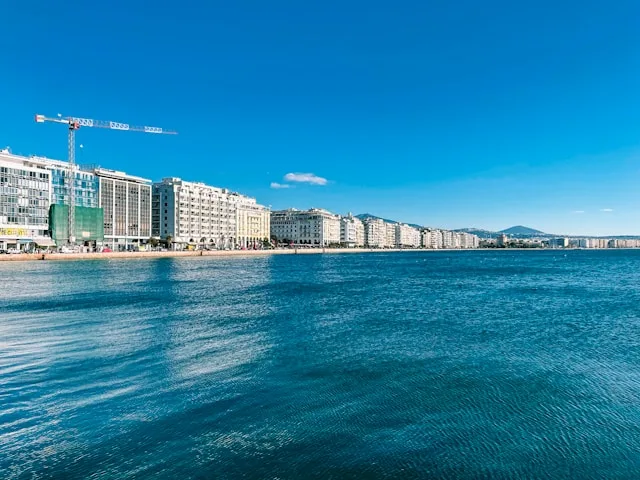
Thessaloniki Maritime Logistics in 2026: Why €350 Million in Port Investment Has Not Produced the Workforce to Match
Thessaloniki's port processed approximately 470,000 TEU in 2023. By end of 2026, throughput is projected to reach 520,000 TEU, a compound annual growth rate of 5.1%. The capital has followed: €200 million committed to Pier 6 electrification and automation, another €150 million anticipated in private logistics real estate across the Sindos corridor. By any infrastructure measure, this is a port in expansion mode.
The workforce has not kept pace. Vacancies in transport, storage, and communications across Central Macedonia rose 23% year-on-year in Q2 2024, nearly double the 12% national average. The Logistics Skills Observatory identifies an annual gap of roughly 1,200 qualified positions against domestic supply. The roles proving hardest to fill are not entry-level warehouse positions. They are licensed customs brokers, intermodal rail operations managers, and senior supply chain directors with Balkan-wide responsibility. These are the roles that determine whether capital investment translates into operational capacity, or whether new infrastructure sits underutilised.
What follows is a ground-level analysis of the forces shaping Thessaloniki's maritime logistics talent market in 2026. It examines where the hiring gaps are most acute, why conventional recruitment methods fail to reach the candidates who matter, and what organisations operating in this corridor need to understand before they commit to their next senior search.
The Post-Privatisation Context: Capital Moves Faster Than Human Capital
The 2022 acquisition of a 67% stake in ThPA S.A. by South Europe Gateway Thessaloniki (SEGT), the consortium led by Deutsche Invest Equity Partners and Belterra Investments, set the tempo for everything that has followed. The port authority committed €200 million in capital expenditure through 2025, targeting Pier 6 electrification and automated gate systems. That investment was designed to bring Thessaloniki's container handling closer to Northern European efficiency benchmarks.
The operational results are visible. Transit times on the Thessaloniki-Sofia rail corridor fell 15% after the TEN-T Corridor X upgrade. Rail punctuality improved from 62% in 2022 to 78%. Automated gate systems reduced truck processing times. The hardware side of the modernisation programme has largely delivered.
The human capital side has not. ThPA S.A. maintained static direct employment at approximately 280 staff through this period. Contracted stevedoring headcount actually declined 8% year-on-year, according to ThPA's own financial statements and ERGANI labour data. This is the core analytical tension in this market: Thessaloniki has invested in infrastructure that demands a more skilled, more specialised workforce, while the local talent pool has not grown to supply it.
This tension is not unique to ports. It recurs wherever capital investment in automation outpaces the technicians and managers required to operate new systems. But in Thessaloniki, it is compounded by a licensing bottleneck, a geographic competitor problem, and a tax regime that actively pushes mid-career professionals toward neighbouring markets. Each of these deserves separate examination.
The Customs Broker Bottleneck: A Licensing Problem No Salary Can Solve
The most acute talent shortage in Thessaloniki's maritime logistics sector is not in a glamorous specialism. It is in customs brokerage. Category A Licensed Customs Brokers represent the certification required to process non-EU cargo declarations at the port. Without them, containers sit in dwell.
Why the Pipeline Cannot Keep Up
The structural maths are stark. Thessaloniki's Chamber of Commerce and Customs Brokers Association records show that only two to three licensing examinations are held annually in the city. These produce fewer than 50 new Category A brokers per year. Sector demand exceeds 120. The deficit is not cyclical. It is baked into the credentialing system itself.
The consequences are measurable. According to ICAP Group's HR Trends Survey for 2024, roles for Category A Licensed Customs Brokers at major forwarders exhibit average time-to-fill of 140 to 180 days. Thirty-five percent of these searches fail to yield qualified candidates at all. Active unemployment in this specialism sits below 2%. The market is more than 85% passive: licence holders typically maintain tenure of seven to ten years with a single employer and change positions only through direct headhunting approaches, not job board applications.
The Dwell Time Penalty
This shortage carries a direct cost. Average dwell time for import containers from non-EU origins at Thessaloniki remains 3.2 days, compared to 1.8 days at the Port of Piraeus and 1.2 days at major North European ports, according to the World Bank Logistics Performance Index. The Thessaloniki Customs Office processes approximately 85,000 declarations monthly, running at 92% of rated capacity during peak Q4 periods. The European Commission's Customs Union Performance Reports estimate that these bottlenecks increase inventory carrying costs for logistics operators by 12 to 15%.
The 2023 implementation of the Integrated Customs Information System (ICIS) upgrade improved processing marginally. But technology without the licensed professionals to operate it delivers diminished returns. A customs broker shortage is not a hiring problem in the traditional sense. It is a credentialing infrastructure problem. And it means every organisation operating through this port is competing for a fixed, slow-growing pool of specialists who already know their scarcity value.
The salary data confirms it. Senior customs brokers and compliance managers command €38,000 to €52,000 at the specialist level, but acute shortages have driven top-tier brokers above €60,000. At the executive tier, Heads of Customs and Trade Compliance earn €65,000 to €85,000, with rare retention bonuses tied to licence maintenance. These figures, sourced from the Hellenic Federation of Enterprises and KPMG Greece's Executive Remuneration Survey, represent premiums that would have been unthinkable five years ago in the Greek logistics market.
The Intermodal Paradox: Better Rail Infrastructure, Same Modal Share
One of the most counter-intuitive findings in Thessaloniki's logistics data concerns the rail corridor. The TEN-T Corridor X upgrade between Thessaloniki and Sofia reduced transit times to Bulgaria by 15%. Punctuality rose materially. The infrastructure is measurably better than it was three years ago.
Yet rail's modal share for hinterland container transport has remained static at 18 to 20% of total throughput. Road freight volumes to the Balkans grew 8% annually through this period. Rail grew at only 3%. According to data from OSE and the Rail Freight Forwarding Association of Greece, the infrastructure improvement has not triggered the modal shift that regional development models predicted.
Where the Real Constraint Sits
This is where the original synthesis of this article sits. The binding constraint on Thessaloniki's rail adoption is not track capacity, though single-track segments on the Thessaloniki-Eidomeni line (covering 40% of the route to the North Macedonian border) do limit train frequency to six to eight daily departures against a theoretical capacity of twenty or more. The binding constraint is human: customs harmonisation procedures at border crossings and last-mile connectivity planning require a category of professional that barely exists in the Greek labour market.
Intermodal rail operations managers, those with experience in combined rail-road container handling and automated yard management systems, are among the hardest professionals to recruit in Southeastern Europe. These positions remain open for six to nine months on average. According to Michael Page Greece's Logistics Salary Guide, ThPA contractors and Hellenic Train frequently recruit from Balkan ports such as Burgas and Constanța because the local expertise base is insufficient.
The national pool of professionals with combined rail-road logistics planning experience numbers fewer than 200, according to Randstad Greece's sector analysis. Recruitment occurs exclusively through specialised headhunters or internal referrals. Public job postings generate negligible qualified applicant flow. Candidates with seven or more years of intermodal experience routinely receive two to three competing offers simultaneously.
This means the rail infrastructure upgrade has created a dependency on a workforce category that Greece does not produce in sufficient numbers. Capital investment in track and rolling stock has run ahead of human capital investment in the people who plan, schedule, and optimise intermodal operations. Until that gap closes, the rail corridor will continue to underperform its physical capacity, and Thessaloniki's ambition to capture modal shift from road transport will remain exactly that: an ambition.
Compensation Realities: The Three-Way Squeeze
Thessaloniki's logistics compensation market operates under pressure from three directions simultaneously. Understanding all three is essential for any organisation trying to structure a competitive offer in this market.
Piraeus Pulls Upward
Athens and Piraeus offer compensation premiums of 15 to 20% for equivalent logistics roles, particularly in ocean freight and supply chain analytics. The Piraeus port complex also offers greater exposure to Asia-Europe shipping routes, providing stronger career trajectories for maritime professionals seeking global carrier experience. For a mid-career supply chain planner in Thessaloniki earning €50,000, a Piraeus-based role at €58,000 to €60,000 with better long-term prospects represents a straightforward calculation.
The Balkans Compete on Tax
Sofia and Belgrade compete for a different segment: Balkan regional distribution centre managers. Bulgaria's flat 10% corporate and personal income tax rate versus Greece's progressive scale reaching 44% creates a 25 to 30% net income advantage for equivalent roles, according to Deloitte's Southeast Europe Tax Guide. Belgrade has specifically emerged as a hub for automotive logistics, drawing Greek supply chain planners with manufacturing experience through lower cost-of-living-adjusted packages. The pull is not just salary. It is take-home pay after tax.
Northern Europe Captures Digital Talent
For the most specialised digital supply chain roles, the competition is continental. AI-driven demand forecasting, blockchain logistics applications, and advanced technology implementations in the supply chain command €80,000 to €100,000 in Rotterdam or Hamburg. These levels are largely unattainable in the Greek market. The Foundation for Economic and Industrial Research (IOBE) documents an ongoing emigration pattern among Greek nationals with advanced logistics analytics skills. The "brain drain reversal" that Greek policy has targeted remains more aspiration than reality for these specialisms.
The result is a compensation environment where Thessaloniki must offer enough to retain mid-career professionals against Piraeus, enough net income to compete with Sofia's tax advantage, and enough career progression to prevent digital specialists from relocating to Northern Europe. At the executive level, Supply Chain Directors with Balkan-wide P&L responsibility command €85,000 to €120,000 in base salary, with multinational corporations such as DHL and Maersk subsidiaries reaching €130,000 to €150,000. Terminal Operations Managers at the pier-responsibility level earn €75,000 to €95,000 with additional maritime sector allowances. These are the benchmarks any executive search in this market must work against.
Regulatory Pressure and the 2027 Shore Power Deadline
The competitive and compensation challenges would be manageable if the regulatory environment were stable. It is not. Two regulatory forces are reshaping the operating economics of Thessaloniki's port and logistics sector, each carrying distinct talent implications.
EU Emissions Trading and Short-Sea Route Economics
The phased implementation of the EU Emissions Trading System for maritime transport through 2024 to 2026 imposes estimated additional costs of €8 to €12 per TEU for Thessaloniki's short-sea routes. The European Commission's ETS Impact Assessment for Greek Ports raises a specific risk: cost-sensitive transit cargo could divert to non-EU Adriatic ports where these charges do not apply. For logistics operators whose business models depend on Balkan transit volumes, this represents a margin compression that could reduce headcount requirements in some categories while simultaneously increasing demand for compliance and regulatory specialists who can manage the new reporting obligations.
The Green Deal Shore Power Mandate
Under the EU Green Deal maritime provisions, 50% of container vessels calling at Thessaloniki must have access to shore power connectivity by 2027. The Ministry of Maritime Affairs estimates this requires €40 million in portside electrical infrastructure. The talent implication is specific: shore power installation and maintenance requires marine electrical engineers with certifications that overlap between port operations and industrial power systems. Greece does not currently produce this hybrid profile in any meaningful volume.
The requirement for 100% union labour on stevedoring operations, regulated by the Port of Thessaloniki Collective Labour Agreement, further constrains the automation calculations. Terminal operators assessing the return on investment for automated systems must factor in labour agreement restrictions that their non-unionised competitors in the Black Sea do not face. This does not prevent automation. It changes the talent profile required to implement it: change management and industrial relations expertise become as important as technical capability.
The Candidate Market Structure: Why Conventional Hiring Fails Here
For hiring leaders accustomed to markets where a strong job posting generates a usable applicant pool, Thessaloniki's maritime logistics sector presents a fundamentally different challenge. The market divides cleanly into two tiers, and the recruitment methods that work for one tier are irrelevant for the other.
The Active Tier
Traditional warehousing supervisors, fleet dispatchers, and general logistics coordinators remain predominantly active candidates. Average unemployment duration in these categories sits at 3.4 months, according to the Greek Public Employment Service. Job boards, recruitment advertising, and standard agency processes reach this population effectively. These are not the roles where organisations struggle.
The Passive Tier
Every critical senior role in this market operates in a passive candidate environment. Licensed customs brokers, with their 85%-plus passive rate and sub-2% unemployment, do not respond to job advertisements. Intermodal rail planners, numbering fewer than 200 nationally, are recruited exclusively through direct headhunting or internal referral networks. Supply Chain Directors at the €90,000-plus tier are entirely passive, with average tenure of 4.2 years and retained search recruitment cycles running four to six months.
This bifurcation means an organisation that runs the same hiring process for a warehouse supervisor and a customs compliance director will fill the first role in weeks and fail the second entirely. The cost of that failure is not abstract. It is 3.2 days of dwell time per non-EU container instead of 1.8. It is rail infrastructure running at a fraction of its capacity because no one qualified is available to optimise the scheduling. It is capital expenditure on automation that delivers 60% of its potential because the integration specialists were never hired.
The pattern is consistent with what research on executive recruiting failures identifies across multiple sectors: the most damaging hiring failures are not the ones that produce bad hires, but the ones that produce no hire at all. A search that runs seven months and closes empty costs more than the recruiter's fee. It costs the operational capacity the role was supposed to unlock.
What This Means for Organisations Hiring in Thessaloniki's Logistics Sector
The hiring challenges described above are not temporary. They are embedded in the structure of this market: a licensing bottleneck that produces 50 customs brokers per year against demand for 120, a national intermodal talent pool of fewer than 200 professionals, a tax regime that pushes mid-career specialists toward Sofia and Belgrade, and an emigration pattern that sends digital supply chain talent to Northern Europe. These are conditions that worsen with each year of port throughput growth.
For organisations operating through Thessaloniki's port or investing in logistics and industrial operations in the Sindos corridor, three implications follow.
First, time-to-hire for any senior specialist or leadership role must be treated as a strategic variable. In a market where intermodal operations managers stay open for six to nine months and customs broker searches fail 35% of the time, a slow search process is not merely frustrating. It is a competitive disadvantage that compounds with every week of vacancy.
Second, compensation benchmarking against local market averages is insufficient. The relevant comparison is not what a role pays in Thessaloniki today. It is what the same professional earns after tax in Sofia, what Piraeus offers for a 15 to 20% premium, and what Rotterdam pays for the digital skills this market cannot retain. Any offer that ignores this three-way comparison will lose the candidate it targets.
Third, the candidates who can fill the most critical roles in this market are not visible on any job board, any recruitment platform, or any LinkedIn posting. They are employed, typically with long tenure, and they change positions only when approached directly by someone who understands their market value and can articulate a proposition worth the disruption of a move. For organisations competing for customs, compliance, and supply chain leadership in Greece's maritime logistics sector, where the candidates you need are passive and the cost of a failed search is measured in dwell time and underutilised infrastructure, start a conversation with our executive search team about how KiTalent approaches this market.
KiTalent delivers interview-ready executive candidates within 7 to 10 days through AI-powered talent mapping that reaches the 80% of senior professionals who never appear on public job markets. With a 96% one-year retention rate across 1,450-plus executive placements, our approach is built for markets where the conventional methods consistently fail. In a corridor like Thessaloniki, where the talent pool is small, passive, and contested by three competing geographies, that capability is not a convenience. It is the difference between filling a role and watching infrastructure sit idle.
Frequently Asked Questions
What is the average time-to-fill for senior logistics roles in Thessaloniki?
Time-to-fill varies sharply by specialism. Licensed customs broker roles average 140 to 180 days, with 35% of searches failing entirely. Intermodal rail operations managers typically take six to nine months. Supply Chain Directors at the €90,000-plus level require four to six months through retained search. General warehousing and dispatch roles fill in under four months. The critical variable is whether the role sits in the active or passive candidate tier. For roles requiring licensing or Balkan corridor experience, executive search through direct headhunting is typically the only viable method.
What do senior logistics executives earn in Thessaloniki in 2026?
Supply Chain Directors with Balkan-wide P&L responsibility earn €85,000 to €120,000 in base salary, rising to €130,000 to €150,000 at multinational corporations. Terminal Operations Managers at pier-responsibility level earn €75,000 to €95,000 with maritime allowances. Senior Customs Brokers earn €38,000 to €60,000 at the specialist level, while Heads of Customs and Trade Compliance reach €65,000 to €85,000. All figures should be benchmarked against competitor markets including Piraeus, Sofia, and Belgrade, where tax and cost-of-living differences alter effective take-home pay materially.
Why is customs brokerage talent so scarce in Thessaloniki?
The scarcity is structural rather than cyclical. Only two to three Category A licensing examinations are held annually in the city, producing fewer than 50 new brokers per year against sector demand exceeding 120. Active unemployment among licence holders sits below 2%, and more than 85% of the qualified pool is passive, with average tenure of seven to ten years at a single employer. The licensing examination itself creates a hard ceiling on supply that no amount of salary inflation can overcome in the short term.
How does Thessaloniki's port compare to Piraeus for logistics hiring?
Piraeus offers 15 to 20% compensation premiums for equivalent roles, greater exposure to Asia-Europe shipping routes, and stronger career trajectories for professionals targeting global carrier experience. However, Thessaloniki holds a distinct advantage for Balkan-facing distribution, with hinterland transit volumes to North Macedonia and Serbia growing 8.2% year-on-year. Organisations hiring for Thessaloniki need to articulate this Balkan corridor career path clearly, as it represents a differentiated proposition that Piraeus cannot match.
What regulatory changes affect Thessaloniki port operations in 2026 and 2027?
Two major regulatory pressures are converging. The EU Emissions Trading System for maritime transport, phased in through 2024 to 2026, adds €8 to €12 per TEU on short-sea routes. The EU Green Deal requires shore power connectivity for 50% of container vessels by 2027, demanding an estimated €40 million in portside electrical infrastructure. Both create demand for compliance specialists and marine electrical engineers that the local market does not currently supply in sufficient numbers.
How does KiTalent support executive hiring in maritime logistics?
KiTalent uses AI-enhanced talent mapping and direct search to identify and approach passive senior professionals who do not appear on job boards or recruitment platforms. In markets like Thessaloniki's maritime logistics sector, where more than 85% of critical candidates are passive and the national talent pool for key specialisms numbers in the low hundreds, this methodology reaches candidates that conventional processes miss entirely. KiTalent delivers interview-ready shortlists within 7 to 10 days and operates on a pay-per-interview model with no upfront retainer.