Wiltz Has Luxembourg's Richest Forests and Weakest Energy Grid: What That Means for Hiring

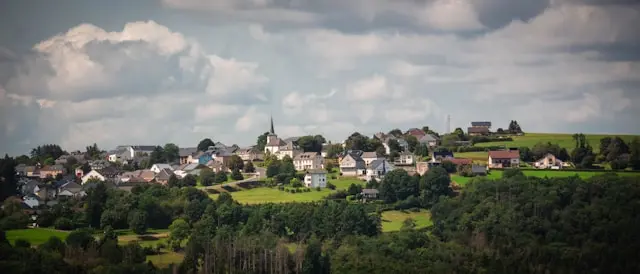
The canton of Wiltz covers 13,500 hectares of forest. That represents 62% of its total surface area, making it the most densely wooded territory in Luxembourg. Timber harvesting reached 48,000 cubic metres in 2023, a 12% year-on-year increase driven partly by sanitation felling after drought damage. By any resource measure, this small municipality of 6,400 residents in Luxembourg's northern Ardennes should be a centre for biomass energy, wood processing, and the broader renewable transition.
It is not. Wiltz hosts no industrial-scale sawmills, no pellet manufacturers, no anchor energy employers. Its electrical substation has reached 94% capacity utilisation during winter peaks. Commercial solar installations above 50 kWp face 14-month grid connection queues. The certified biomass boiler technicians and grid connection engineers required to build and maintain even modest local energy systems are being pulled toward Luxembourg City, where salaries run 15 to 25% higher, or across the border into Belgium and Germany, where living costs are lower and career paths are longer. The municipality declared a climate emergency in 2022. Four years later, the physical and human infrastructure required to act on that declaration remains largely absent.
What follows is an analysis of the forces pulling Wiltz's energy ambitions apart from its hiring reality: why the resource base has not translated into industrial capacity, where the specific technical talent gaps sit, what the 2026 grid and subsidy changes mean for employers in this market, and what organisations operating in the Éislek must do differently to secure the specialists they need.
A Forest Economy That Exports Its Own Value
The standard assumption in regional economic development is that a concentrated natural resource base attracts downstream processing. The canton of Wiltz contradicts that assumption entirely.
Despite possessing Luxembourg's highest forest density, the canton has no sawmill employing more than five people within municipal limits. Private forestry, which covers 72% of the canton's woodland, is managed by approximately 120 smallholders who rely on semi-automated harvesting contractors based in Bastogne, Belgium, and Bitburg, Germany. Timber harvested in Wiltz is transported out of the region as raw logs, processed in Wallonian and German sawmills, and in some cases re-imported as finished product.
The Cost of Missing the Processing Step
This export-extraction pattern has a direct consequence for local energy economics. Processing residues from sawmills, including sawdust, bark, and wood chips, are the cheapest feedstock for biomass heating plants. Where sawmills and heating plants sit in the same region, the fuel cost is minimal. Where they do not, transport adds €18 to €25 per tonne to biomass fuel costs. Wiltz's two municipal wood-chip boilers, a 500 kW unit at the Lycée du Nord and a 200 kW unit at the Château de Wiltz, pay that premium on every delivery.
Why the Cluster Never Formed
The nearest industrial wood-processing cluster sits 40 kilometres southeast in the Diekirch-Echternach corridor. Narrow Ardennes roads, higher transport costs, and the proximity of established Belgian sawmilling infrastructure locked Wiltz into extraction rather than processing decades ago. No single intervention, whether subsidy or planning decision, has reversed this. The result is an economy that harvests one of Luxembourg's most abundant renewable resources and then ships the economic value elsewhere.
For any employer planning biomass expansion or district heating investment in the Éislek region's energy and industrial sector, the absence of this processing step is not a detail. It is a foundational constraint that raises fuel costs, limits local supply chain employment, and narrows the technical workforce that would otherwise develop around an integrated wood-energy system.
A Grid Built for Consumption, Not Generation
Luxembourg's National Energy and Climate Plan targets an additional 200 MWp of photovoltaic capacity by 2030 and expanded biomass district heating. These are national figures. They describe an ambition distributed unevenly across a country where the south has grid capacity and the north does not.
The Wiltz substation, a 20 kV Creos distribution node, was designed for unidirectional rural electricity supply. It was not built to accommodate distributed generation feeding power back into the network. By late 2024, that substation had reached 94% capacity utilisation during winter demand peaks. Creos designated Wiltz a "red zone" for new renewable connections, placing commercial photovoltaic installations above 50 kWp into a first-come-first-served queue with an estimated 14-month backlog.
The municipality identified 12 buildings with viable rooftop solar potential, totalling approximately 850 kWp. As of late 2024, only 340 kWp had been installed across four school rooftops, with an additional 180 kWp under construction at the swimming pool complex. The local industrial zone, Zone Industrielle Wiltz-Berlé, hosted only two private PV installations above 30 kWp. Ageing 1970s warehouse roofs that cannot bear panel weight compound the problem, but the binding constraint is the grid itself.
The 2026 Upgrade and Its Conditions
Creos has scheduled transformer upgrades for the Wiltz substation in Q2 2026. If completed on time, these upgrades would unlock capacity for an estimated additional 1.2 MWp of renewable generation. That timeline, however, is contingent on administrative permits for overhead line modifications in Natura 2000 protected zones. Environmental permitting in these areas has historically introduced delays of six to eighteen months.
This creates a specific risk. Projects permitted and budgeted under 2024 subsidy schemes may lose eligibility if grid connection is delayed beyond scheme deadlines. A municipality that secured funding for a 150 kWp rooftop installation in 2024 could find itself unable to connect that installation to the grid before the subsidy window closes in 2026. National renewable capacity statistics, which show steady growth, mask this local reality. The growth is concentrated in Luxembourg's less-constrained south.
The tension between national renewable targets and local distribution grid investment rhythms is the single most important dynamic in Wiltz's energy transition. Capital and political commitment have moved faster than the physical infrastructure required to absorb what they produce.
The Talent Gap That Makes Everything Slower
Even where grid capacity exists and subsidies are available, the pace of installation depends on whether the right technicians can be found. In Wiltz, they largely cannot.
Luxembourg's energy and construction sectors reported a 34% year-on-year increase in job postings for renewable energy technicians through 2024, with a national median time-to-fill of 89 days, according to ADEM labour market data. In the Éislek region, the picture is materially worse.
Biomass Boiler Technicians: A Dual-Certification Bottleneck
The most acute shortage is in certified biomass boiler technicians holding both the CACES certification for biomass equipment maintenance and the RGIE qualification for electrical grid connection. These dual-qualified specialists are essential for any installation that both generates heat and feeds surplus electricity into the distribution network. Local artisanal firms in the Wiltz area report recruitment timelines of six to nine months for these roles, roughly double the three-to-four-month average in Luxembourg City.
The supply constraint is not just geographic preference. It is systemic. Experienced technicians with more than five years of service and dual RGIE/CACES certifications are predominantly retained on permanent contracts with large facility management groups. These profiles rarely enter the open market. Junior candidates from vocational programmes are available, but the hidden 80% of the senior talent pool remains locked inside employers who have no incentive to release them.
Grid Connection Engineers: Subcontracting by Default
Engineers experienced in medium-voltage and low-voltage connection protocols to Creos utility standards are scarce across all of northern Luxembourg. SMEs in the Éislek routinely subcontract grid-connection work to firms based in Ettelbruck or Diekirch because they cannot find certified local personnel. According to industry survey data from FEDIL, this subcontracting pattern increases project costs by 15 to 20%.
Unemployment among electrical engineers with grid expertise runs below 1.2% nationally. Average tenure at major employers such as Encevo and Creos exceeds seven years. Candidates qualified for municipal and SME-scale renewable projects in Wiltz are not actively applying to posted vacancies. Reaching them requires direct sourcing and referral networks rather than job board advertising.
Cross-Border Competition Is Pulling Talent in Three Directions
Wiltz does not compete for technical talent within Luxembourg alone. It sits inside the Greater Region labour market, where Belgium, Germany, and Luxembourg overlap, and where the competitive dynamics work against small northern municipalities.
Luxembourg City and Esch-sur-Alzette draw electrical engineers and project managers with salaries 15 to 25% above northern Luxembourg rates and clearer career paths into international consultancies and major energy groups. For a grid connection engineer earning €75,000 in Wiltz, a comparable role in Luxembourg City pays €90,000 or more, with access to employers such as Encevo and the energy advisory divisions of EY and PwC.
The Belgian province of Luxembourg, encompassing Arlon, Bastogne, and Marche-en-Famenne, competes on a different axis. Belgian firms offer lower nominal wages, with gross technician salaries of €35,000 to €45,000, but attract Luxembourg-based workers seeking lower housing costs. This creates what labour market researchers describe as a "reverse drain": Luxembourg-resident technicians commute south to Belgian-based roles, leaving Wiltz employers dependent on Belgian cross-border workers or less experienced local hires travelling in the opposite direction.
Germany's Trier-Saarland corridor adds a third vector. Strong vocational training pipelines produce certified HVAC and electrical technicians at comparable wages to rural Luxembourg but with lower living costs. A technician weighing Wiltz against Trier faces a straightforward calculation: similar pay, lower rent, and a training infrastructure that invests more consistently in career development.
The Career Progression Problem
The deeper disadvantage is not compensation. It is trajectory. Wiltz has no large EPC contractors, no renewable energy developers, and no research facilities. The nearest biomass R&D cluster is at LIST in Belvaux, 80 kilometres south. A senior technical professional assessing career marketability in Wiltz reaches a ceiling quickly. There is no next role above district heating manager or municipal energy director without relocating to the southern industrial belt or crossing the border to a larger energy group.
This is the dynamic that conventional recruitment cannot solve. The problem is not that Wiltz's compensation is too low, though the 5 to 8% rural discount does not help. The problem is that talented people who join Wiltz's energy transition run out of career runway within three to five years, and the cost of that turnover compounds with each departure.
The Subsidy Shift Changes the Competitive Arithmetic
Through 2025, Luxembourg's Klimabonus programme funded municipal renewable installations at up to 50% of eligible costs. For cash-constrained northern communes, this subsidy rate was the difference between project viability and project cancellation. In 2026, the programme transitions to a tender-based system for municipal projects above 100 kWp.
Tender-based allocation introduces competitive pressure that favours larger, better-resourced municipalities. A commune in the south with a full-time energy project team, established relationships with engineering consultancies, and grid capacity already in place will submit stronger tenders than a municipality of 6,400 people where the Service Technique employs 12 staff responsible for everything from building maintenance to PV project oversight.
Simultaneously, the national Fonds pour le Climat et l'Énergie reduced maximum subsidy rates for municipal PV from 50% to 35% of eligible costs for the 2024 to 2027 programming period. For Wiltz, this reduction arrives at exactly the moment when the municipality needs to invest most heavily in the installations that will utilise the grid capacity unlocked by the 2026 substation upgrade.
The subsidy environment is not merely tightening. It is restructuring in a way that disadvantages precisely the municipalities that need the most support. An employer expanding energy operations in northern Luxembourg's renewable sector must factor this fiscal trajectory into workforce planning, because projects that lose funding mid-execution lose the teams assembled to deliver them.
The Workforce That Is About to Retire
The forestry sector in the Éislek faces a demographic constraint that has no short-term remedy.
According to ONF workforce data, 43% of operational staff in the Nord region are aged over 50, with retirement waves projected between 2026 and 2028. Luxembourg's Brevet de Technicien Supérieur forestry programme graduated only eight students nationally in 2023. Even if every one of those graduates entered employment in the north, they would not replace the volume of retiring expertise, let alone the accumulated institutional knowledge of professionals who have managed these forests for decades.
The €4.2 million Nordstad regional energy infrastructure allocation for the 2024 to 2026 period targets expanding the SIE Nord biomass district heating network to connect 40 additional municipal buildings in Wiltz and Winseler. Delivering that expansion requires precisely the biomass technicians and grid engineers that the region cannot currently recruit, deployed alongside forestry expertise that is about to leave the workforce in significant numbers.
This is the convergence that makes Wiltz's energy transition fundamentally a talent problem rather than a capital or policy problem. The money has been allocated. The political commitment exists. The forest resource is abundant. The binding constraint is the people who can turn those inputs into functioning energy systems.
What Hiring in This Market Actually Requires
For organisations operating in or expanding into the Wiltz and Éislek energy market, the conventional recruitment playbook fails at nearly every step. Job postings reach only the small minority of junior candidates actively seeking roles. The senior specialists who can deliver biomass installations and grid connections are employed, retained, and not monitoring vacancy boards.
The recruitment challenge breaks into three distinct problems, each requiring a different method.
First, the dual-certified biomass and HVAC technicians needed for boiler installation and maintenance are held by large facility management groups on permanent contracts. Moving them requires a proposition that addresses both compensation and career progression. A 10 to 15% salary increase is typical for successful switches, but the career trajectory gap described above means that compensation alone is insufficient. The role itself must offer something the candidate cannot access in their current position: project ownership, cross-border scope, or a path into municipal leadership.
Second, grid connection engineers with Creos protocol expertise are a population of fewer than several hundred qualified professionals nationally, with unemployment below 1.2%. Identifying and approaching these candidates requires systematic talent mapping across the Greater Region, including Belgium and Germany, combined with cross-border regulatory knowledge that most in-house recruitment teams do not possess.
Third, executive roles such as the Responsable Transition Énergétique or Directeur Technique for district heating networks are hybrid positions requiring public procurement expertise, EU subsidy management, and technical oversight. These profiles do not exist in volume anywhere in Luxembourg. They must be assembled from adjacent sectors and adjacent geographies, often requiring candidates to accept a transition into the public or semi-public sector from private industry. Understanding what moves a passive senior candidate into a new sector is essential to building a credible shortlist.
KiTalent works with organisations facing exactly this configuration: a market where the candidates are real but invisible, where cross-border sourcing is a necessity rather than an option, and where the search must move faster than the 89-day national average because grid connection windows and subsidy deadlines do not wait. Using AI-enhanced talent identification to map qualified professionals across Luxembourg, Belgium, and Germany, and then approaching them directly with a structured proposition, KiTalent delivers interview-ready candidates within 7 to 10 days.
With a 96% one-year retention rate across 1,450 executive placements and a pay-per-interview model that removes the upfront retainer risk, the approach is designed for markets where the margin for error is narrow and the cost of a failed or delayed search is measured in lost subsidy windows and stalled infrastructure.
For organisations hiring biomass engineers, grid connection specialists, or energy transition leadership in the Éislek region, where the qualified candidate pool spans three countries and the timeline is set by infrastructure permitting rather than internal preference, start a conversation with our executive search team about how we source and deliver in this market.
Frequently Asked Questions
What is the current salary range for renewable energy engineers in Luxembourg?
Renewable energy engineers with grid integration or biomass specialisation earn between €65,000 and €85,000 at senior specialist level in Luxembourg, rising to €95,000 to €130,000 in total compensation at executive or function leadership level. Roles in the northern Éislek region, including Wiltz, typically carry a 5 to 8% discount compared to Luxembourg City benchmarks. This discount is partially offset by housing cost differentials: median apartment prices in Wiltz sit around €4,800 per square metre compared to €13,200 in Luxembourg City. Candidates considering a move north often weigh net purchasing power rather than gross salary alone.
Why is it so difficult to hire biomass boiler technicians in northern Luxembourg?
The shortage stems from a dual-certification requirement. Biomass boiler technicians in Luxembourg need both the CACES certification for biomass equipment maintenance and the RGIE qualification for electrical grid connection. Technicians holding both certifications are predominantly employed on permanent contracts by large facility management groups such as Engie Solutions and Cofely. They rarely appear on job boards. Local firms in the Éislek report recruitment timelines of six to nine months for these roles, compared to three to four months in Luxembourg City. Reaching these candidates requires direct headhunting approaches rather than job advertising.
What grid constraints affect renewable energy projects in Wiltz?
The Wiltz substation, a 20 kV Creos distribution node, has reached 94% capacity utilisation during winter peaks. Commercial photovoltaic installations above 50 kWp face a 14-month connection backlog. Creos has scheduled transformer upgrades for Q2 2026, which would unlock an additional 1.2 MWp of renewable generation capacity. However, this timeline depends on permits for overhead line modifications in Natura 2000 zones, which carry historic delays of six to eighteen months. Projects funded under current subsidy schemes risk losing eligibility if grid connection is delayed beyond scheme deadlines.
How does Wiltz compete for energy talent against Luxembourg City and cross-border markets?
Wiltz competes within the Greater Region labour market spanning Luxembourg, Belgium, and Germany. Luxembourg City draws engineers with salaries 15 to 25% above northern rates and deeper career progression into international energy consultancies. The Belgian province of Luxembourg attracts technicians with lower living costs. Germany's Trier-Saarland corridor offers strong vocational pipelines and comparable wages with lower rents. The most material disadvantage for Wiltz is career trajectory: with no large EPC contractors, renewable developers, or research facilities, senior professionals reach a progression ceiling within a few years.
What is the Nordstad framework and how does it affect energy hiring in Wiltz?
Nordstad is the cross-border regional development framework designating Wiltz as the "green capital" of a Luxembourg-Belgium conurbation. The 2024 to 2026 action plan allocates €4.2 million in regional energy infrastructure subsidies aimed at expanding the SIE Nord biomass district heating network to connect 40 additional municipal buildings. Delivering this expansion requires biomass technicians, grid engineers, and project management leadership that the region currently cannot recruit locally. The framework creates demand but does not directly address the supply-side constraint of a technically specialised workforce distributed across three countries.
How can executive search help fill renewable energy roles in rural Luxembourg?
The qualified candidate pool for biomass, grid engineering, and energy transition leadership in the Éislek spans Luxembourg, Belgium, and Germany. With unemployment below 1.2% among electrical engineers with grid expertise nationally, the most capable professionals are not responding to job postings. KiTalent uses AI-enhanced talent mapping across cross-border markets to identify and approach these passive candidates directly, delivering interview-ready shortlists within 7 to 10 days. The pay-per-interview model means organisations only invest when they meet qualified candidates, reducing the risk inherent in lengthy traditional searches.