
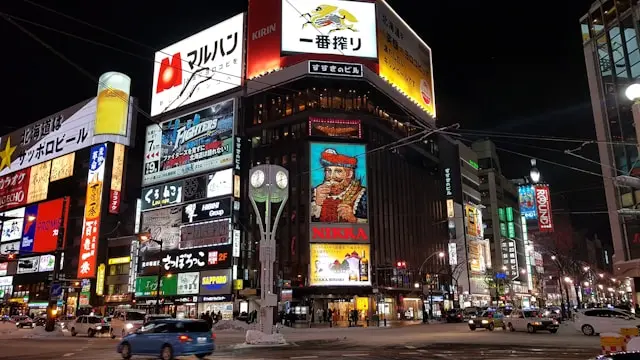
Sapporo Tourism: Define the Destination and Seasonal Mandate
A source-scoped brief separating the distinct operating and leadership accountabilities behind a Sapporo Tourism search.
Sapporo, Japan Executive Search
KiTalent brings sector-specific intelligence and direct headhunting capability to senior leadership searches across Sapporo.
Track record on suitable mandates: 7–10 working days to validated shortlist · 96% one-year retention · NPS 72. How we measure performance.
Searches in Sapporo are managed from KiTalent's Almaty hub, with support from our other hubs when the candidate pool crosses markets. Sapporo's hiring environment does not behave like Tokyo's. The city offers lower costs, high liveability, and genuine research depth. But those advantages mask a set of dynamics that make conventional recruitment methods unreliable for senior roles.
Job postings and database searches produce thin results here. The visible candidate pool is small relative to the city's ambitions. The professionals who matter most for Sapporo's next phase of growth are either embedded in local institutions they have no reason to leave, or they are in Tokyo and Osaka and have never seriously considered a move north. Reaching them requires a different approach entirely.
Sapporo's approximately 930,000 private-sector workers are concentrated in services, retail, and hospitality. The city's emerging high-value sectors, including biotech, semiconductor design, and green-energy finance, draw from far smaller candidate pools. A search for a Head of Clinical Development or a CTO with embedded-systems expertise is not competing within a large, fluid market. It is competing for a handful of qualified individuals, many of whom sit inside Hokkaido University's research network or in satellite operations of Tokyo-headquartered firms. The gap between the city's economic ambitions and its leadership supply is the central challenge any hiring organisation faces here.
Japan's ageing workforce is a national constraint. In Sapporo, the pressure is acute. The city's fertility rates track below national averages, and the pipeline of younger professionals entering senior roles is narrowing year on year. Every leadership vacancy that stays open for three or four months is not just a delayed hire. It is a position that becomes harder to fill as the cohort of qualified successors shrinks. Firms that rely on time-consuming traditional search processes are structurally disadvantaged in this environment. Speed is not a luxury. It is a necessity.
Sapporo's senior business community is compact. The executives running Nitori Holdings, Hokkaido Electric Power, JR Hokkaido, and the city's biotech ventures know one another. They attend the same industry events, serve on the same advisory boards, and share intelligence informally. A poorly managed search process, a retracted offer, or a clumsy approach to a passive candidate does not stay private. It circulates. The quality of every interaction during a search directly affects the hiring organisation's standing in this market. These dynamics call for a directly engaged search partnership approach rather than a transactional search engagement. The firm that serves Sapporo well is one that already understands the market before a mandate arrives, that can reach the passive majority of senior talent through discreet and credible outreach, and that treats process quality as a non-negotiable.
Sapporo is not one talent pool. It is a series of overlapping but distinct professional communities, each with its own competitive dynamics, compensation norms, and candidate motivations. A credible search partner must operate fluently across the sectors that matter here.
Design, equipment support, testing, and materials operations serving Hokkaido's growing fab ecosystem. Semiconductor and electronics executive search
Biotech spinouts, clinical development, translational research, and medical-device commercialisation. Healthcare and life sciences executive search
Hotel operations, event management, and tourism-driven services in Hokkaido's primary visitor hub. Travel and hospitality executive search
Branded food processing, agricultural value-chain management, and export-oriented production. Food, beverage, and FMCG executive search
Mixed-use redevelopment, asset management, and project leadership for Sapporo's city-centre transformation. Real estate and construction executive search
Software engineering, digital services, and AI-driven operations centres using Sapporo's cost and talent advantages. AI and technology executive search
Sapporo's executive search market is strongest where its economic specialisation is deepest.
The Rapidus advanced chip plant under construction in Chitose has triggered a regional chain reaction. While the fab itself sits outside Sapporo, the city is absorbing design houses, equipment support firms, testing operations, and specialist suppliers that service the broader semiconductor value chain. Hokkaido University has strengthened its semiconductor education and research institute to…
Sapporo positions itself as northern Japan's life-sciences hub, and the claim has substance. Hokkaido University's COI programmes, the Hokudai Research & Business Park, Sapporo Medical University, and the Hokkaido Prime Bio Community form a concentrated research corridor. The Sapporo Innovation Fund, a public-private vehicle of approximately ¥760 million, is explicitly oriented towards health…
The Sapporo Station and Odori district redevelopment projects represent a combined investment estimated at ¥144 billion, according to Heiwa Real Estate's 2025 reporting. These projects are expanding office capacity, adding hotel beds, and reshaping the retail leasing market. Construction employment is elevated, but the leadership demand is concentrated in asset management, project direction,…
Sapporo's major facilities attracted 14.54 million visitors in FY2023, and the city's event calendar, including the Snow Festival and year-round food tourism, sustains a hospitality and food-service cluster that employs tens of thousands. Hokkaido's agricultural and marine output feeds a branded food-processing sector with value-chain links into retail and export. The leadership challenge here…
Sapporo's Invest Sapporo programme actively promotes the city as a cost-competitive base for IT operations, and the strategy is working. Software firms, digital content studios, and AI-focused operations have established or expanded Sapporo offices, drawn by a university-linked talent pipeline and office costs well below Tokyo levels. The constraint is at the senior end: CTOs, engineering…
Sapporo's semiconductor ecosystem involves multinational supply chains, and its biotech corridor attracts international research partnerships. Organisations here increasingly need leaders comfortable operating across Japanese and international reporting structures, often with bilingual capability. This is where international executive search coordination matters, connecting Sapporo mandates…
Companies rarely need only reach in Sapporo. They need interpretation, calibration, and a search architecture that reflects the real structure of the market.
Our team runs Sapporo mandates through KiTalent's four regional hubs, combining local market intelligence with cross-border execution across Europe, the Americas, the Middle East, and Asia Pacific.
The strongest executives in Sapporo are passive. Our direct headhunting approach engages the passive majority of senior talent through discreet outreach rooted in real market knowledge.
Our parallel mapping methodology means we already hold live intelligence on restructuring, transition windows, compensation patterns, and candidate attraction opportunities when a brief arrives.
In Sapporo, the cost of a wrong executive hire extends far beyond the recruitment fee. Our Proof-First Search model lets clients see real market output and qualified candidates before the bulk of the investment is committed.
Related city stories from the same regional talent cluster.
Fukuoka is Japan's fastest-growing regional city and the commercial capital of Kyushu, with a metropolitan catchment of roughly 2.5 to 3 million people. The city's startup…
Kobe is where Japan's port-driven industrial base meets its most ambitious bets on biomedical innovation and supercomputing. With global headquarters for Sysmex, ASICS, and Kobe…
Kyoto is where six global electronics and precision-manufacturing headquarters, a world-leading gaming company, and Japan's most concentrated cultural-tourism economy compete for…
Nagoya is Japan's manufacturing capital: the epicentre of the world's largest automotive supply chain, a global leader in advanced ceramics and materials science, and a city where…
These resources provide deeper market intelligence and explain how KiTalent turns insight into a faster, more transparent search process.
A source-scoped brief separating the distinct operating and leadership accountabilities behind a Sapporo Tourism search.

Sapporo sits at the centre of a ¥1.4 trillion agricultural and marine product supply chain, serving as the primary consolidation node for everything Hokkaido grows, catches,...
Sapporo's agri food processing and beverage manufacturing sector now contributes approximately ¥1.8 trillion to the metropolitan economy annually. That figure represents 18.4%...
Use these pages to navigate between parent markets, sector pages, and supporting articles.
These are the questions most closely tied to how executive search really works in Sapporo.
Sapporo's senior talent market is small and highly networked. The professionals best suited for leadership roles in biotech, semiconductor services, and city-centre redevelopment are not actively seeking new positions. They are embedded in organisations where they are well compensated and visible in the local community. Reaching them requires discreet, individually crafted outreach from consultants with genuine sector credibility. A job posting on a major platform will attract mid-level applicants. It will not surface the CTO running a semiconductor equipment operation or the clinical development leader at a Hokkaido University spinout.
Tokyo offers scale: large candidate pools across every sector, intense competition for talent, and high fluidity. Sapporo offers depth in specific domains, including life sciences, food tech, and semiconductor support, but within a much smaller professional community. Compensation expectations are lower in aggregate, yet senior roles in emerging sectors command nationally competitive packages. The candidate experience in Sapporo carries more weight because reputations travel faster. A search process that would be anonymous in Tokyo is visible here.
Through continuous talent mapping across Sapporo's core sectors, maintained independently of any single mandate. When a client engages us, we already hold intelligence on who occupies key leadership positions, how compensation structures compare across employers, and which candidates may be open to a compelling proposition. Search execution combines direct headhunting into passive candidate pools with rigorous structured assessment: technical competency evaluation, cultural-fit interviews, and optional psychometric analysis for senior roles. Every interaction protects the client's employer brand in a community where discretion matters.
Our standard delivery is an interview-ready shortlist within 7 to 10 days of mandate confirmation. This speed comes from parallel mapping: the ongoing intelligence work that means research does not start from zero. In Sapporo's biotech and semiconductor sectors, where the pool of qualified leaders is narrow, pre-existing relationships with potential candidates are what make rapid delivery possible without compromising on quality.
The Rapidus project and associated investments in Chitose have created a regional ecosystem effect. Sapporo is absorbing design firms, equipment support operations, testing businesses, and specialist service providers that sit around the manufacturing core. This has intensified competition for engineers, automation specialists, and technical leaders. It has also pushed housing costs up in nearby municipalities, making Sapporo itself more attractive as a residential base for senior professionals commuting to Chitose or managing distributed operations. The net effect is a tighter leadership market in Sapporo across multiple adjacent sectors, not just semiconductors alone.
Whether you are hiring a CTO for a semiconductor design operation, a Head of Clinical Development for a biotech venture, a General Manager for a new hospitality property, or a Chief Sustainability Officer for Hokkaido's green-energy transition, this is the right starting point.
What we bring to Sapporo executive mandates:
Executive search and direct headhunting · Talent mapping and market intelligence · Compensation benchmarking and mandate calibration · Connection to KiTalent's Asia Pacific hub and international executive search network.
Whether you are running a live mandate or want to pressure-test a brief before going to market, this is the right place to start the conversation.
Author of record: Katia Belous, Director, Middle East & Asia. Based on local market intelligence and executive-search data.
Share your CV and a sentence on the mandate types you'd consider. We respond within five working days.