Denpasar's Handicraft Export Boom Is Running on a Workforce That Cannot Replace Itself
Bali's handicraft exports hit USD 142 million in the first nine months of 2024. Silver jewellery alone accounted for 62% of that value, and wholesale order volumes rose 34% year on year as tourist foot traffic returned to 85% of pre-pandemic levels. From the outside, Denpasar's creative economy looks like a recovery story.
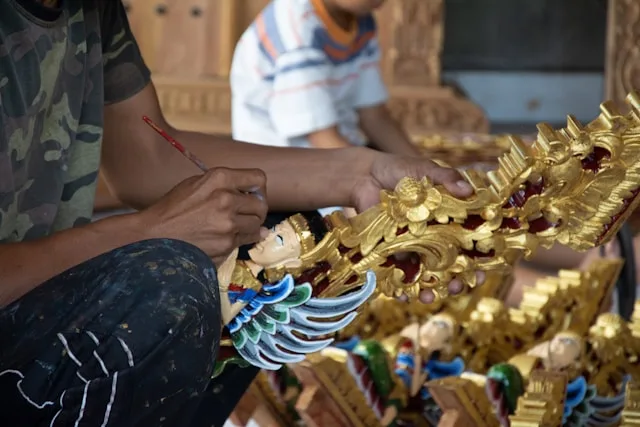
It is not. Or rather, the recovery is real but the foundation underneath it is eroding. The master artisans who produce the highest-value goods in this sector have a median age of 54 in woodcarving. Only 12% of apprentices complete the five-year training programmes required to replace them. Export compliance specialists number fewer than 50 across the entire island. And the e-commerce managers whom SMEs trained to reach international buyers are being recruited out of Bali entirely, poached by Jakarta lifestyle brands at premiums of 60 to 80%.
What follows is an analysis of the forces reshaping Denpasar's creative and handicraft sector, the employers caught in the middle, and what leaders responsible for hiring in this market need to understand before the supply of irreplaceable talent runs out.
The Export Gateway That Does Not Make What It Sells
Denpasar's role in Bali's handicraft economy is frequently misunderstood. The city is not the primary production centre. It is the commercial, administrative, and export-consolidation node for a decentralised production network spread across a 25-kilometre radius.
The actual production geography tells a different story from the one most outsiders assume. Tohpati, on the Klungkung border, remains the batik production nucleus. Celuk in Gianyar Regency hosts more than 2,800 silver and goldsmith SMEs. Mas village on the Ubud periphery concentrates woodcarving talent. According to BPS Bali's 2023 micro and small industry statistics, 78% of registered handicraft production SMEs sit in Gianyar Regency, not Denpasar proper.
Denpasar's function is logistics and settlement. Pasar Kumbasari operates as a mid-market tourist retail anchor with 1,200 stalls averaging 2.3 full-time employees each. The serious export operations have migrated to specialised showrooms in Kerobokan, Seminyak, and the Denpasar-Gianyar corridor. Finishing workshops and some silverwork ateliers remain in the Panjer-Sesetan corridor, but the city's value lies in port access, customs documentation, and financial settlement.
This geographic separation between production and commerce creates a specific hiring challenge for leaders building executive teams in this market. The people who run the commercial side need to manage relationships, compliance regimes, and digital channels from Denpasar while coordinating with artisan communities who operate on entirely different professional norms. That dual fluency is rare. And it is getting rarer.
A Sector Shaped by Fragmentation and a Handful of Exporters
The structure of Denpasar's handicraft economy is one of extreme fragmentation at the base and thin concentration at the top. Understanding this structure is essential before discussing talent, because the structure determines where hiring pressure actually falls.
Micro-Enterprise Saturation
Ninety-four percent of handicraft business units in Denpasar employ fewer than five workers. These micro-enterprises are the backbone of production but they are not the entities competing for executive talent. They operate through family labour, informal apprenticeship, and seasonal scaling. Their hiring challenges are real but are fundamentally different from the challenges faced by the mid-tier exporters who drive the sector's economic output.
The Mid-Tier Exporters Who Drive Volume
Approximately 45 medium-scale exporters employing between 50 and 200 people dominate export volumes. These include firms such as CV Suarti in silverwork, which maintains flagship retail and export administration in Denpasar while headquartering production in Celuk with 120 staff in production and 35 in Denpasar-based export management. PT Bali Alus operates batik and textile production with over 80 full-time employees based in Denpasar.
These mid-tier firms face the most acute talent pressure. They are large enough to need professional management, export compliance officers, and digital commerce capabilities. But they are too small to compete with Jakarta conglomerates on salary, too informal to offer the benefits packages that Surabaya's industrial zones provide, and too dependent on a handful of irreplaceable specialists whose departure can halt operations.
The talent pipeline challenge in this sector is therefore concentrated in a narrow band of employers who cannot afford to lose any of the 30 to 50 critical professionals they depend on, yet have limited tools to retain them.
Three Roles the Sector Cannot Fill
The shortages in Denpasar's handicraft economy are not generic labour gaps. They are concentrated in three specific role categories where demand has surged while supply remains structurally constrained.
Export Compliance and International Trade Specialists
The most acute shortage is in professionals capable of managing EUDR requirements, CITES documentation for protected woods, and US Customs and Border Protection paperwork. Demand for these specialists has risen 300% since 2022 according to the Indonesia Export Training Network's regional skills gap analysis. Only an estimated 45 qualified individuals serve the entire Bali export sector.
This shortage will intensify. The EU Deforestation Regulation took effect in December 2025, requiring geolocation data for wood products. The Ministry of Trade's Export Licensing Directorate estimated in November 2024 that only 15% of Denpasar-area woodcarving exporters were compliant at that time. Firms that cannot hire or retain a compliance specialist face exclusion from their largest export market.
The wage dynamics compound the problem. According to industry data cited in ASEPHI's Q4 2024 quarterly briefing, multinational hospitality developers have recruited export compliance managers away from established silverwork exporters at salary premiums of 35 to 40%. Hotels and resort developers need these same professionals to manage import and export logistics for furnishings and fit-outs. The result is a wage spiral among the 30 to 40 professionals in Denpasar qualified in HTS code classification and SVLK certification.
For any organisation searching for this profile, the hidden 80% of passive talent is closer to 85%. Average tenure in these compliance roles runs 4.2 years, retention is high because the professional's value is relationship-dependent, and only around 15% of the qualified pool is actively looking at any given time.
Digital Commerce and Cross-Border E-commerce Managers
The second gap sits in digital commerce management. Forty-three percent of Denpasar-based handicraft traders now use export platforms such as Amazon Handmade, Etsy, and Tokopedia Export, up from 12% in 2019. But the people who can run these operations are in desperately short supply.
Demand exceeds supply by five to one. The average vacancy duration for a bilingual English-Indonesian e-commerce manager in Bali is 4.5 months according to JobStreet Indonesia's H1 2024 labour market report. That duration reflects a deeper problem than simple scarcity.
The deeper problem is a training drain. E-commerce managers developed by Denpasar handicraft SMEs through government-funded Bekraf programmes are systematically recruited by Jakarta-based lifestyle brands offering remote-work flexibility with Jakarta-level salaries. These represent a 60 to 80% premium over Denpasar market rates. Denpasar employers have effectively become unpaid training grounds for the national talent market, a pattern documented in the Indonesia Creative Economy Agency's 2023 Talent Retention Study.
This dynamic means that traditional executive recruiting methods fail almost by design. A posted vacancy attracts junior candidates or candidates who have already been passed over by Jakarta recruiters. The professionals who can actually run a cross-border e-commerce operation for a handicraft exporter are either happily employed in Jakarta or running their own freelance operations.
Design Innovation and Product Development Specialists
The third gap is the hardest to quantify because the role itself is still being defined. Handicraft exporters need professionals who can bridge traditional Balinese motifs with contemporary functional design for millennial and Gen Z export markets. This requires cultural fluency in Asta Kosali spatial symbolism and Candi motif vocabulary alongside technical competence in CAD/CAM.
The candidate pool for heritage design specialists is restricted to specific artisan families in Tohpati and Mas. The passive candidate ratio exceeds 95%. There is effectively no active job market for this profile. Recruitment occurs through lineage apprenticeship or targeted approaches via community leaders known as Kelihan Banjar.
This is a market where direct headhunting methodology is not a preference. It is the only viable approach.
The Generational Cliff Behind the Export Numbers
Here is the analytical claim that the headline data does not reveal on its own: Denpasar's 28% export growth in 2024 does not reflect sustainable capacity expansion. It reflects the extraction of accumulated artisan inventory and the deferred maintenance of human capital. The sector is selling faster while replacing its workforce slower. These two curves will intersect, and when they do, export demand that has been growing at double digits will meet a supply wall that no recruitment campaign can fix in time.
The numbers supporting this claim are stark. The retirement rate of master artisans in traditional woodcarving exceeds the entry rate of youth apprentices by two to one. The average age of a master carver is 54. Only 12% of apprentices complete the five-year training programmes necessary to achieve mastery.
The economic logic driving this attrition is straightforward. A young person in Denpasar or Gianyar can earn more in tourism services within months than an apprentice carver earns in years. The opportunity cost of a decade-long apprenticeship has become prohibitive when a hotel front-desk position pays more and demands less.
The cost of a failed or delayed senior hire in this market has a different character than in financial services or technology. When a master Undagi retires without a successor, the loss is not a vacancy that can eventually be filled. It is the permanent extinction of a production capability. The institutional knowledge embedded in a master carver's understanding of ritual symbolism and wood grain mechanics cannot be reconstructed from documentation. It can only be transmitted through practice.
For hiring leaders in this sector, the implication is that talent strategy cannot be limited to filling current vacancies. It must encompass the preservation of capabilities that will become unfillable within a five-to-seven-year window.
Compensation Reality: What These Roles Actually Pay
Denpasar's handicraft sector sits in a compensation trough between Jakarta's premiums and Yogyakarta's even lower cost base. Understanding where the money actually sits is essential for any organisation trying to structure a competitive offer.
Manager and Senior Specialist Level
An export or supply chain manager with seven to ten years of experience commands IDR 180 to 300 million per annum (approximately USD 11,400 to 19,000), typically supplemented by one to two months of performance bonus tied to export volume targets. An e-commerce or digital marketing manager earns IDR 144 to 240 million (USD 9,100 to 15,200), with high variance based on English fluency and platform-specific expertise.
Senior artisans and production managers at the master craftsman tier earn IDR 120 to 200 million (USD 7,600 to 12,700), often supplemented by profit-sharing arrangements on high-value commissioned pieces. This profit-sharing element is critical. It represents a form of compensation that does not appear in salary surveys but can substantially increase total earnings for the most skilled practitioners.
Executive and Director Level
Export directors and commercial directors at handicraft SMEs earn IDR 420 to 720 million per annum (USD 26,600 to 45,600). Long-term incentives sometimes include equity participation in family-owned export businesses, though this is uncommon in formally incorporated entities. Creative directors and brand directors earn IDR 360 to 600 million (USD 22,800 to 38,000), with a premium of 20 to 25% for candidates who bring established international buyer networks including contacts at trade fairs like NY Now and Ambiente Frankfurt.
The Jakarta Gap
The compensation context that matters most for hiring leaders is the gap with Jakarta. Denpasar's handicraft sector pays 35 to 45% below equivalent roles in Jakarta's manufacturing and export sectors. This gap is the primary mechanism through which the sector loses its best commercial talent. A compliance specialist earning IDR 250 million in Denpasar can earn IDR 375 million or more in Jakarta for comparable work. When Jakarta-based conglomerates such as Lippo Group and Agung Podomoro's retail divisions recruit from Bali for their lifestyle and hospitality verticals, the offer arithmetic is difficult to resist.
Yogyakarta presents a different dynamic. It pays 10 to 15% less than Denpasar but competes on prestige, academic affiliation, and government patronage opportunities, particularly for batik designers and research-oriented artisans. Understanding how to negotiate salary expectations in a market where non-monetary factors carry this much weight requires local expertise that generic compensation benchmarking cannot provide.
Internationally, the competitive pressure from Chiang Mai and Hoi An is real but operates on a different axis. Vietnam's silverwork and tailoring sector offers labour costs 30 to 40% below Bali's, which draws bulk buyers rather than talent. Thailand's digital nomad visa programme attracts international designers who might otherwise base in Bali, creating competition for the design innovation roles this sector most needs.
Regulatory Headwinds That Will Reshape the Workforce
The regulatory environment bearing down on Denpasar's handicraft exporters is not a background condition. It is an active force that is rewriting job descriptions and creating entirely new role categories.
EUDR and the Compliance Wall
The EU Deforestation Regulation's requirement for GPS coordinates of harvest plots will exclude approximately 60% of current wood suppliers who source from smallholder community forests without formal mapping. This figure comes from the EU-Indonesia FLEGT VPA Joint Implementation Committee's 2024 report and represents the scale of the compliance challenge.
For woodcarving exporters, EUDR compliance is not optional. It is a condition of market access. The firms that can hire or develop a sustainability compliance officer will retain their European buyers. Those that cannot will lose them.
The SVLK timber legality verification system, mandatory since 2015, already imposes audit costs of USD 800 to 1,200 per SME. These costs effectively exclude micro-enterprises from legal export channels, forcing them to rely on larger Denpasar consolidators who capture 15 to 20% margin for their trouble. The EUDR layer adds geolocation documentation requirements on top of SVLK, compounding the administrative burden.
Raw Material Pressure
The regulatory challenges intersect with raw material constraints that further squeeze margins. Silver prices averaged USD 23.50 per ounce in 2024, up 18% year on year, and Bali has no native silver mining. All bullion is imported from PT Aneka Tambang in Jakarta or sourced as recycled scrap. Two Denpasar-based bullion dealers control 70% of silver supply to workshops, enabling price-setting power that compresses SME margins further.
For wood, the 2023 Ministry of Environment moratorium on native hardwood logging intensified reliance on imports from Kalimantan. Eighty percent of hardwood inputs arrive from Java and East Kalimantan, with shipping costs from Surabaya increasing 22% following fuel subsidy adjustments.
These pressures mean the sector needs a different kind of leader than it needed five years ago. The export director who managed straightforward FOB shipments to Australian department stores now needs to manage supply chain traceability, regulatory compliance across multiple jurisdictions, and raw material procurement in volatile commodity markets. The role has fundamentally expanded, but the compensation has not kept pace with the expanded scope.
This is precisely the environment where market benchmarking becomes essential. Without accurate data on what these expanded roles command in competing markets, employers will continue to offer packages calibrated to the old role description and wonder why their searches stall.
What This Means for Hiring Leaders in 2026
The Bali Provincial Government has targeted 8.5% growth in the creative economy sector for 2026, contingent on foreign tourist arrivals reaching 6.5 million. That growth target assumes a workforce that can deliver. The evidence suggests otherwise.
The core tension is this: the demand side of Denpasar's handicraft economy is expanding through digital channels, recovering tourism, and growing export volumes. The supply side of human capital is contracting through artisan retirement, training-to-Jakarta talent drain, and a compliance specialist pool that numbers in the dozens. Capital and demand have moved faster than human capital could follow.
For senior hiring executives responsible for filling leadership positions in this sector, several realities apply simultaneously. First, the most critical hires are in roles where job boards and inbound applications reach less than 20% of the qualified pool. Export compliance specialists, master artisans, and heritage design professionals are almost entirely passive candidates. Reaching them requires targeted talent mapping and community-level engagement that bears no resemblance to conventional recruitment.
Second, the counteroffer risk in this market is acute. When only 40 to 50 people in Bali hold a specific certification, any approach to a candidate will trigger a retention response from their current employer. The offer strategy must be structured to survive a counter, which means understanding the full picture of what the candidate values, including non-monetary factors like proximity to family, workshop autonomy, and participation in ceremonial production cycles.
Third, international executive search capability matters here more than it might appear. The strongest candidates for commercial leadership roles in Denpasar's handicraft sector may be Indonesian professionals currently working in Jakarta, Singapore, or even European trade hubs who could be attracted back with the right proposition. The assumption that hiring for Bali means searching in Bali is one reason searches in this market take so long.
KiTalent's approach to markets like this one is built on exactly the conditions described above: a fragmented employer base, a predominantly passive candidate pool, and a requirement for speed that traditional search firm models cannot deliver. With interview-ready executive candidates delivered within 7 to 10 days and a pay-per-interview model that eliminates upfront retainer risk, the methodology is designed for markets where the margin for error is thin and the cost of a vacant leadership role compounds daily.
For organisations competing for the scarce commercial and compliance leadership that Denpasar's handicraft sector needs to sustain its growth trajectory, start a conversation with our search team about how we approach this market.
Frequently Asked Questions
What is the biggest hiring challenge in Denpasar's handicraft and creative economy sector?
The most acute challenge is the extreme scarcity of export compliance specialists. Fewer than 50 professionals across all of Bali hold current SVLK and EUDR certifications, and demand for their skills has risen 300% since 2022. These candidates are almost entirely passive, with 85% employed and not actively seeking new roles. Vacancy durations for bilingual e-commerce managers average 4.5 months. For master artisans in woodcarving or silverwork, the active candidate pool drops below 5%, making direct headhunting the only viable sourcing method for senior roles.
What do executive roles in Denpasar's handicraft sector pay in 2026?
Export directors and commercial directors at mid-tier handicraft exporters earn IDR 420 to 720 million per annum (approximately USD 26,600 to 45,600). Creative directors command IDR 360 to 600 million (USD 22,800 to 38,000), with a 20 to 25% premium for candidates with international buyer networks. Manager-level export and supply chain roles pay IDR 180 to 300 million (USD 11,400 to 19,000). These figures sit 35 to 45% below Jakarta equivalents, which is the primary driver of talent outflow from the sector.
Why are master artisans so hard to recruit in Bali?
Master artisans in woodcarving (Undagi) and silverwork (Pandai Perak) operate in an effectively zero-unemployment market. All qualified practitioners are either self-employed with established buyer networks or permanently attached to legacy workshops. Recruitment occurs exclusively through lineage apprenticeship or targeted community engagement via village leaders. The average master carver is 54 years old, and only 12% of apprentices complete the required training programme, creating a generational replacement crisis with no short-term solution.
How does the EU Deforestation Regulation affect Bali's handicraft exports?
EUDR implementation requires GPS coordinates for the harvest plots of all wood used in exported products. Approximately 60% of current wood suppliers to Denpasar-area exporters source from smallholder community forests without formal mapping, meaning they cannot meet this requirement. Only 15% of woodcarving exporters were compliant as of late 2024. Firms unable to hire sustainability compliance officers with EUDR expertise face potential exclusion from European markets, which represent a major share of high-value woodcarving exports.
Which cities compete with Denpasar for handicraft sector talent?
Jakarta is the primary competitor for commercial and digital talent, offering 40 to 60% salary premiums and proximity to the Ministry of Trade and customs headquarters. Yogyakarta competes for artisan and design talent through lower living costs, established art academies producing 400 graduates annually, and stronger cultural prestige for traditional batik. Surabaya draws supply chain managers with superior port infrastructure and formal employment benefits. Internationally, Chiang Mai and Hoi An compete for artisan tourism positioning and bulk buyer attention respectively.
How can KiTalent help with executive hiring in Bali's creative economy?
KiTalent uses AI-enhanced talent mapping across creative industry and manufacturing sectors to identify passive candidates who are not visible on job boards. In a market where 85% of qualified compliance specialists and 95% of heritage design experts are passive, this approach reaches candidates that conventional recruitment cannot. KiTalent delivers interview-ready candidates within 7 to 10 days on a pay-per-interview basis, with a 96% one-year retention rate across 1,450 completed executive placements globally.