Differdange's Metalworking Cluster Is Upgrading Faster Than Its Workforce Can Follow
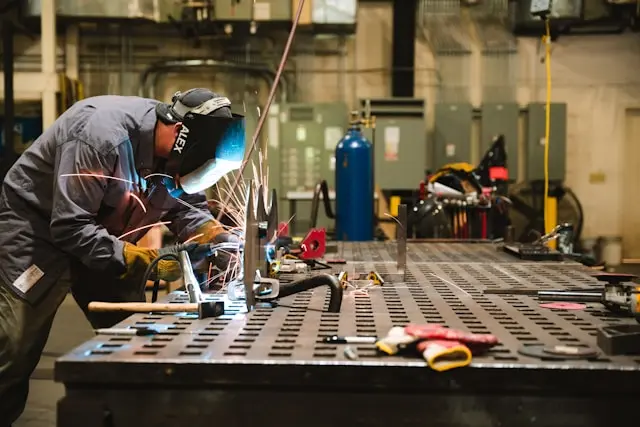
Differdange's metalworking economy employed roughly 2,850 people across 48 active enterprises at the start of 2025. By every conventional measure, this is a stable industrial cluster: headcount at ArcelorMittal's heavy sections mill has held near 1,820 since 2022, order books for structural steel fabricators still stretched nine to ten months through mid-2024, and the SME cluster feeding the steelworks continued to generate technically advanced maintenance and machining services. The numbers suggest equilibrium. They conceal a labour market that is splitting in two.
The split runs along a single fault line: skill intensity. ArcelorMittal's Smart Carbon and hydrogen-DRI readiness programme is rewriting the technical requirements for every maintenance, machining, and fabrication role within the Belval site's orbit. Predictive maintenance, large-format CNC programming, and automation retrofitting demand capabilities that did not appear in job descriptions five years ago. Meanwhile, standardised fabrication work faces margin compression from lower-cost French competitors, and Luxembourg's residential construction permit decline of 18.4% in 2024 is shortening order books for the structural steel subcontractors who once provided a reliable counterweight to steelworks dependency. The investment in upgrading Differdange's anchor employer has not reduced the need for workers. It has replaced one category of worker with another that the local and cross-border labour market cannot yet produce at the scale required.
What follows is an analysis of the forces reshaping this small but consequential industrial cluster. It covers the structural dynamics creating the talent gap, the specific roles where shortages are most acute, the cross-border labour mechanics that both sustain and constrain the workforce, and the compensation realities that hiring leaders in this market must understand before they commit to a search.
The Anchor That Shapes Everything
No analysis of Differdange's talent market makes sense without first understanding how completely ArcelorMittal dominates it. The Belval site's 1,820 direct employees make it the largest single employer in the municipality by a wide margin. An additional 400 to 500 contract maintenance personnel work on site at any given time. Approximately 65% of surrounding SMEs derive between 40% and 70% of their annual revenue from ArcelorMittal or its tier-one contractors, according to the FEDIL Supply Chain Survey 2024.
This is not simply a large employer in a small town. It is the gravitational centre of a supply chain that extends across three countries and shapes hiring decisions, wage expectations, and career trajectories for thousands of workers who never appear on ArcelorMittal's own payroll.
The Green Steel Investment and Its Workforce Consequences
ArcelorMittal's Smart Carbon and hydrogen-DRI readiness investments at Belval represent the most consequential shift in this cluster's technical requirements in a generation. The programme is designed to decarbonise heavy sections production. Its workforce implications are less widely understood.
Retrofitting a steel mill for hydrogen-based direct reduced iron processing demands technicians who can work across electro-mechanical systems, automation controls, and high-pressure hydraulics simultaneously. The predictive maintenance technologies now being installed, including vibration analysis, thermography, and ultrasound monitoring, require certifications and operational experience that most of the current maintenance workforce does not hold. The Ministry of the Economy's 2025 Industry Outlook projected that direct employment in Differdange metal fabrication would decline 2 to 3% by headcount through 2026 while increasing 3 to 4% in value-added terms. That single statistic captures the entire dynamic: fewer people, doing harder work, for higher stakes.
The knock-on effect reaches every SME in the cluster. A maintenance contractor serving ArcelorMittal's roll refurbishment needs cannot simply replace a retiring mechanic with a younger one. The replacement must operate in an environment that is materially more complex than the one the retiree entered. The cost of that gap, when it goes unfilled, is not merely an HR inconvenience. It translates directly into mill downtime, overtime premiums of 150 to 200%, and a progressive hollowing of the technical knowledge base that sustains industrial manufacturing operations across the region.
The Dependency Risk No One Can Diversify Away
The City of Differdange's own Economic Resilience Report identified the concentration risk plainly: 60 to 70% of metalworking SMEs derive more than 40% of revenue from ArcelorMittal or its primary contractors. Any shift in ArcelorMittal's procurement strategy, whether toward centralised international maintenance providers or in-house automation of services currently outsourced, would cascade through the SME cluster within a single contract cycle.
This dependency creates a paradox for hiring leaders in the cluster. Investing in workforce development makes commercial sense only if ArcelorMittal's demand remains stable. But the very investments ArcelorMittal is making in Smart Carbon technology are raising the technical bar for every supplier, forcing SMEs to upgrade their workforce capabilities without any guarantee that the upgraded capabilities will remain in demand if procurement shifts. The firms that do not upgrade lose contracts. The firms that do upgrade carry workforce investment risk that sits entirely on their balance sheets.
Three Roles the Market Cannot Fill
The shortages in Differdange's metalworking cluster are not generalised. They concentrate in three specific role categories, each with distinct causes and distinct consequences.
Industrial Maintenance Technicians: The 14% Vacancy Rate
The vacancy rate for electro-mechanical maintenance technicians requiring dual electrical and mechanical certification with steel-industry-specific experience stands at an estimated 14%, according to ADEM's 2024 Professions en Pénurie report. This is not a marginal gap. It means that roughly one in seven positions requiring this profile sits unfilled at any given time.
The typical pattern is consistent and well documented. SMEs report maintenance technician roles remaining open for 120 to 180 days on average. Contract staffing firms, including Manpower Luxembourg Industrial and Randstad, report being unable to fill approximately 40% of six-month maintenance contracts despite billing rates of €38 to €45 per hour. One Differdange-based maintenance contractor in the 20 to 30 employee range reported at FEDIL sector briefings that it left a senior electro-mechanic position unfilled for seven months in 2024 before promoting an internal junior technician and funding external certification at a cost of €12,000.
That last detail is the most revealing. The employer eventually solved its problem not through recruitment but through internal development at considerable expense and with a months-long capability gap in the interim. When the hidden 80% of passive talent is already employed and showing no search activity, the economics of internal promotion and external certification begin to look rational even at €12,000 per head.
CNC Machinists: The Housing Cost Rejection
The second critical shortage is in CNC machinists capable of programming and operating large-format equipment for steel mill roll resurfacing. These are specialists operating roll grinders handling loads up to 60 tons, using Siemens 840D and Heidenhain TNC control systems.
The constraint here is geographic as much as it is technical. Employers targeting the Greater Region (Grand Est in France and Saarland in Germany) face 60% offer rejection rates driven primarily by housing cost differentials. A three-room apartment in Differdange or Luxembourg's southern region averages €2,400 per month. The equivalent in Thionville, thirty minutes across the French border, costs €850. For a CNC machinist aged 30 to 45 with a family, the arithmetic of commuting versus relocating resolves decisively against Luxembourg residency.
Positions remain unfilled for four to six months. Overtime among existing staff runs at 150 to 200% premium rates. One precision machining SME in the Fonds de Gras industrial zone paid a €5,000 signing bonus to secure a CNC machinist from a competitor in Thionville in Q3 2024, a 12% premium over the standard entry salary. The cost of a prolonged vacancy at this skill level is not simply the overtime premium. It is the downstream risk of delayed roll refurbishment, which directly affects mill productivity.
EN 1090 Certified Welders: The Poaching Spiral
The third shortage is in welders certified for structural steel execution class 3 under EN 1090, the standard required for high-consequence construction applications such as bridges and industrial buildings. This certification requires both technical skill and quality management coordination experience. The supply is structurally insufficient for the demand.
According to the Fédération des Artisans' 2024 Metalworking Sector Survey, the shortage has triggered systematic poaching within the Differdange-Esch industrial basin. Employers report paying 15 to 20% salary premiums to attract certified welders from competitors during peak project phases. One regional fabricator lost four of twelve certified welders to a Differdange competitor in a three-month period during Q2 2024. That is a third of its certified welding workforce, gone in a single quarter.
The poaching spiral is self-reinforcing. Each firm that loses a welder must either pay more to retain the remainder or accept a reduction in its EN 1090 execution capability, which limits the contracts it can bid for. The net effect is not more welders in the market. It is the same welders circulating at progressively higher cost, with no new supply entering the pipeline at the rate required to break the cycle.
The Cross-Border Labour Machine and Its Vulnerabilities
Differdange's metalworking sector does not operate as a Luxembourg labour market. It operates as a Saar-Lor-Lux labour market, with 72% of production workers commuting from France, predominantly from Meurthe-et-Moselle and Moselle, according to the General Social Security Inspectorate's 2024 cross-border employment statistics. Smaller contingents commute from Belgium and Germany.
This cross-border dependency is the mechanism that has allowed the cluster to function despite Luxembourg's tiny domestic technical workforce. It is also the mechanism most vulnerable to disruption.
The Compensation Paradox for Cross-Border Workers
Luxembourg gross salaries for metalworking roles run 15 to 25% above equivalent positions across the French border. But the comparison is more complex than it appears. Cross-border workers residing in France benefit from a favourable tax credit mechanism on Luxembourg-sourced income and lower social charges. They typically negotiate gross salaries 8 to 12% below Luxembourg-resident benchmarks, because their net purchasing power, calculated against French housing costs, can be comparable or superior.
This creates a specific problem for salary negotiations in the sector. A Differdange employer offering €75,000 to a maintenance engineer currently earning €62,000 in Thionville is not offering a 21% raise in real terms. Once the candidate factors in commuting costs, the loss of the French lunch voucher system, and the higher marginal tax rate on the incremental income, the effective premium shrinks to single digits. For a CNC machinist who would need to relocate rather than commute, the €2,400 per month housing differential eliminates the salary advantage entirely.
The employers who understand this arithmetic structure their offers differently. They lead with net take-home comparisons rather than gross figures. They factor in commuting subsidies or flexible scheduling that reduces travel days. The employers who do not understand it post gross salary ranges that look competitive on paper and watch 60% of their offers get rejected.
The French Border Risk
The structural reliance on French commuters introduces a category of risk that sits outside any individual employer's control. Potential renegotiation of cross-border worker tax treaties or social security coordination between Luxembourg and France could alter the economic calculus that makes cross-border commuting attractive. French political uncertainty, identified in ADEM's 2023 Cross-Border Dependency Report, remains an ambient risk that no workforce planning model within the cluster can fully hedge.
Transport infrastructure compounds the exposure. The A31 autoroute and the CFL/TER rail line connecting Thionville to Luxembourg carry the daily flow of 72% of Differdange's production workforce. Any sustained disruption to either corridor, whether from infrastructure failure, strikes, or regulatory change, would create an immediate staffing crisis across the cluster. This is not a theoretical concern. It is a recurring operational reality that shapes shift scheduling and contingency planning for every employer in the basin.
Compensation That Tells the Real Story
Executive and senior specialist compensation in Differdange's metalworking sector reflects the tension between industrial margins and the scarcity premiums the market demands.
A Maintenance Manager at the senior specialist level, carrying 10 to 15 years of experience and team leadership responsibility, earns between €78,000 and €95,000 in base salary. At the executive level, a Head of Maintenance with multi-site responsibility commands €125,000 to €160,000 base plus a 15 to 20% bonus, according to Michael Page Luxembourg's 2024 Engineering and Manufacturing Salary Benchmark.
Production Directors at the operations manager level in metal fabrication SMEs employing 50 to 200 people earn €68,000 to €88,000. At the director or general manager level, compensation rises to €115,000 to €145,000, with performance bonuses tied to ArcelorMittal contract retention and safety metrics. Senior CNC Programming Specialists, operating as individual contributors on large-format equipment, earn €62,000 to €80,000.
These figures position Differdange's industrial employers at a material disadvantage against Luxembourg City and Kirchberg, where the financial and IT sectors offer 30 to 40% salary premiums above industrial manufacturing for STEM-qualified professionals. According to the Hays Salary Guide Luxembourg 2024, younger technicians with digital skills increasingly choose facility management or data centre operations in Luxembourg's financial district over heavy industry in the south. The talent pipeline is not simply constrained by supply. It is being actively diverted by a compensation gradient that pulls digital-capable technical workers away from the sector that most needs them.
This is the original synthesis this analysis demands: the green steel transition at ArcelorMittal Belval requires exactly the category of digitally literate, multi-disciplinary technician that Luxembourg's financial services sector is simultaneously recruiting at a 30 to 40% premium. The competition for this talent is not between Differdange metalworking firms and their French or German counterparts. It is between Differdange metalworking firms and data centre operators in Kirchberg. The losing side is heavy industry, and the gap is widening at exactly the skill level where the hydrogen-DRI transition needs it most.
The Regulatory Squeeze on Small Employers
Two regulatory frameworks are compressing margins and raising the operational threshold for SMEs in the cluster, with direct implications for their ability to invest in the workforce upgrades the market demands.
CBAM Compliance Costs
The Carbon Border Adjustment Mechanism reaches full implementation in 2026, creating compliance documentation requirements for every SME supplying carbon-intensive steel processing. For fabricators under 20 employees, the administrative burden of embedded emissions reporting is estimated at €8,000 to €12,000 annually in external consultancy costs alone, according to the Ministry of the Economy's 2024 CBAM Preparation Guide.
This is not a cost that generates revenue or improves capability. It is a pure administrative overhead that falls disproportionately on the smallest firms in the cluster. A micro-enterprise with four welders and annual revenue of €600,000 absorbing €10,000 in CBAM compliance costs is losing margin that could otherwise fund a certification course for an employee or contribute to a competitive salary offer. The regulatory intent, reducing carbon emissions, is not in question. The workforce consequence, reducing the investment capacity of the firms most dependent on skilled labour, is real.
EN 1090 Certification Burden
Mandatory factory production control audits for structural steel contractors cost €8,000 to €15,000 annually. Combined with CBAM, a small fabricator may face €16,000 to €27,000 in annual regulatory costs before it hires a single additional person. These costs create barriers to market entry that thin the competitive field and concentrate certified fabrication capacity among fewer, larger firms. For executive recruitment in this sector, the implication is that hiring leaders at these surviving firms carry disproportionate operational responsibility and command correspondingly higher retention premiums.
What This Means for Hiring Leaders in the Cluster
The market dynamics outlined above create a specific set of conditions that any organisation hiring in Differdange's metalworking sector must account for.
First, the talent pool for senior maintenance engineers and CNC programming specialists is overwhelmingly passive. ADEM data shows unemployment rates below 2% for these occupational codes in the Greater Region, with average tenure exceeding eight years at current employers. Active candidate pools exist only for entry-level welding and general machine operating roles. At the executive and senior specialist level, 85 to 90% of viable candidates must be identified and approached directly. Job advertising will not reach them. A conventional recruitment process that begins with a posting and waits for applications will produce a shortlist drawn from the weakest 10 to 15% of the available talent.
Second, cross-border compensation dynamics require a level of offer engineering that most industrial employers are not accustomed to providing. The effective value of an offer to a French-resident commuter is not the gross figure on the contract. It is the net take-home after tax credit adjustments, commuting costs, and housing cost comparisons. Employers who fail to present offers in these terms will continue to experience the 60% rejection rates that characterise the CNC machinist market.
Third, the timeline for filling a critical role in this market is not weeks. It is months. Maintenance technician positions average 120 to 180 days unfilled. CNC machinist roles run four to six months. The counteroffer risk when a passive candidate is identified and engaged is substantial, given that current employers facing the same shortages have every incentive to retain.
For organisations competing for senior maintenance leadership, production directors, or specialist technical talent in Differdange's metalworking cluster, where the candidates who can fill these roles are not on any job board and the cost of a vacant position compounds daily in overtime and lost productivity, KiTalent delivers interview-ready executive candidates within 7 to 10 days through AI-enhanced talent mapping of the passive market. With a 96% one-year retention rate across 1,450 executive placements, our methodology is built for exactly this kind of constrained, specialised market. Start a conversation with our industrial sector search team about how we approach the Greater Region talent pool.
The 2026 Outlook: Selective Contraction, Selective Intensity
The trajectory established through 2025 is continuing into 2026 with sharpening contrasts. Direct employment in Differdange metal fabrication is declining modestly in headcount while increasing in value-added intensity. Order books for structural steel subcontractors are shortening from nine to ten months in mid-2024 to a projected five to six months by Q4 2026, driven by the residential construction permit decline. The construction downturn will compress margins for fabricators who have not diversified beyond residential and commercial building work.
At the same time, ArcelorMittal's hydrogen-DRI readiness investments will sustain and likely increase demand for the high-skill maintenance, automation retrofitting, and precision machining services that the SME cluster provides. The firms that survive the next two years will be those that can hold their technical workforce together through a construction slowdown while positioning for the green steel maintenance contracts that are already being scoped.
For hiring leaders, the implication is direct. The window to secure senior technical talent in this market is not closing because demand is falling. It is closing because the firms that act now will lock in the specialists they need before the hydrogen transition accelerates demand further. The firms that wait will find themselves competing for the same candidates at higher cost, in a market where every competitor has already learned that traditional recruitment methods do not work.
The Differdange metalworking cluster is small, concentrated, and deeply technical. It is also a market where the difference between a firm that has its senior maintenance engineer in place and one that does not is measured in mill downtime, lost contracts, and a competitive disadvantage that compounds with every month of vacancy. The investment in green steel has not reduced the need for human expertise. It has raised the bar for what that expertise must include. The firms and search partners who understand this will define the next chapter of this cluster's industrial story.
Frequently Asked Questions
What are the hardest metalworking roles to fill in Differdange, Luxembourg?
The three most difficult roles to fill are industrial maintenance technicians with dual electro-mechanical certification, large-format CNC machinists specialising in roll refurbishment, and EN 1090 execution class 3 certified welders. Vacancy durations range from 120 days for maintenance technicians to six months for CNC specialists. The shortage is driven by a passive candidate market with unemployment below 2% in these occupational categories across the Greater Region, combined with housing cost differentials that deter relocation from neighbouring France and Germany.
What do senior metalworking executives earn in Luxembourg?
Maintenance Managers with 10 to 15 years of experience earn €78,000 to €95,000 base salary. At the executive level, Heads of Maintenance with multi-site responsibility earn €125,000 to €160,000 plus a 15 to 20% bonus. Production Directors at metal fabrication SMEs earn €115,000 to €145,000. Senior CNC Programming Specialists earn €62,000 to €80,000. Cross-border workers residing in France typically negotiate 8 to 12% below these benchmarks due to favourable tax treatment. More detail on structuring competitive offers is available through KiTalent's market benchmarking service.
Why do CNC machinist offers get rejected at such high rates in Luxembourg?
Offer rejection rates for CNC machinists targeting the Greater Region run at approximately 60%. The primary driver is the housing cost differential between Luxembourg and neighbouring France. A three-room apartment in Differdange averages €2,400 per month compared to €850 in Thionville. When commuting costs and tax treatment adjustments are factored in, a headline salary premium of 15 to 25% above French levels can shrink to single digits in real terms. Employers who present offers in net take-home terms rather than gross figures reduce rejection rates materially.
How does ArcelorMittal's green steel transition affect hiring in Differdange?
ArcelorMittal's Smart Carbon and hydrogen-DRI readiness investments at the Belval site are increasing demand for technicians with predictive maintenance, automation, and high-pressure hydraulics capabilities. The Ministry of the Economy projects that employment in the sector will decline 2 to 3% by headcount but increase 3 to 4% in value-added terms through 2026. This means fewer positions overall but materially higher skill requirements for each one. SMEs in the ArcelorMittal supply chain must upgrade workforce capabilities to retain contracts.
How does KiTalent approach executive search in niche industrial markets like Differdange?
KiTalent uses AI-enhanced direct headhunting to identify and engage passive candidates in markets where 85 to 90% of viable talent is not actively searching. In the Differdange metalworking cluster, this means mapping senior maintenance engineers, production directors, and CNC specialists across the Saar-Lor-Lux Greater Region, including French and German candidates who would not respond to conventional job postings. KiTalent delivers interview-ready candidates within 7 to 10 days under a pay-per-interview model with no upfront retainer.
What regulatory pressures affect metalworking SMEs in Luxembourg in 2026?
Two frameworks are compressing margins. The Carbon Border Adjustment Mechanism, reaching full implementation in 2026, imposes embedded emissions reporting costs estimated at €8,000 to €12,000 annually for fabricators under 20 employees. EN 1090 factory production control audits add €8,000 to €15,000 per year. Combined, a small fabricator may face up to €27,000 in annual regulatory compliance costs, reducing the capital available for competitive hiring and workforce development investment.