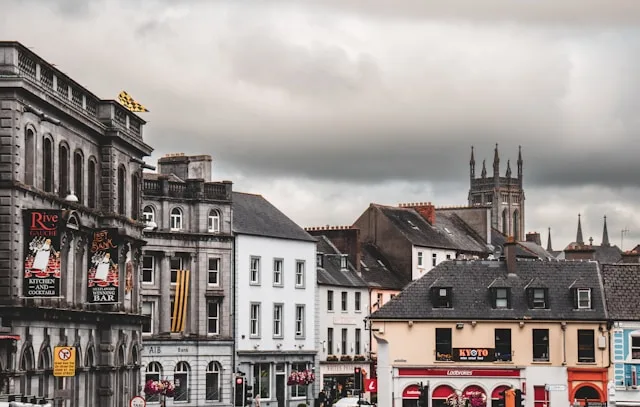
Kilkenny's Heritage Tourism Is Booming. Its Medieval Core Won't Let the Hotels Follow.

Kilkenny Castle drew roughly 550,000 visitors in 2023. The Medieval Mile generates millions in annual footfall spend. Festival programming through 2026 is guaranteed by three-year Fáilte Ireland funding extensions. By every demand-side metric, Kilkenny's visitor economy is working. The constraint is not whether people want to come. It is whether the city can house, feed, and serve them when they arrive.
The problem is architectural, geographic, and structural all at once. Kilkenny's Architectural Conservation Area designation limits where new hotels can be built, how tall they can stand, and what materials they can use. Development costs inside the medieval core run 15 to 20% above greenfield equivalents. No major hotel opening is scheduled for 2026 within the city walls. The accommodation stock is effectively frozen at a moment when occupancy during peak months already touches 95%. The result is a market where the buildings themselves impose a ceiling on how many people the sector can employ and how fast it can grow.
What follows is a structured analysis of the forces shaping Kilkenny's hospitality market in 2026: why the sector's most valuable roles are nearly impossible to fill through conventional methods, where compensation is heading, and what the interaction between heritage preservation and commercial ambition means for any leader trying to build or retain a senior team in this market.
A Visitor Economy Running at Capacity With Nowhere to Expand
Kilkenny's tourism sector operates at roughly 94 to 96% of its pre-pandemic output as of early 2025. Annual hotel occupancy averaged 78.4% across the county, a figure that masks extreme seasonal variation. June through August, occupancy reaches 92 to 95%. November through February, it falls to 55 to 62%. The county offers approximately 1,800 hotel rooms, 450 B&B establishments, and more than 200 self-catering units.
Average daily rates reflect the supply pressure. Kilkenny's hotel ADR reached €142 in 2024, up 12% over two years. Luxury properties command €220 to €280 during festival periods. These are not Dublin prices, but they are climbing on a Dublin trajectory without a Dublin pipeline of new supply behind them.
The Kilkenny County Council Local Area Plan identifies only two key development sites suitable for large-scale tourism accommodation: the former brewery site and the McDonagh Junction environs. Both are constrained by infrastructure capacity. Within the medieval core itself, the conservation designation functions as an effective ban on the kind of development that would meaningfully increase bed stock. The plan's height restrictions and material specifications add 15 to 20% to construction costs, which means the economics of a new city-centre hotel project must clear a higher bar than an equivalent build in Waterford or Wexford. Few developers are clearing it.
This creates a market dynamic that is unusual in Irish tourism. Demand is growing. Supply is not. ADR inflation is a predictable consequence, but so is a structural limit on the number of hospitality roles the city can create. A hotel that cannot be built is a general manager who will never be hired, a kitchen brigade that will never be assembled, a revenue team that will never be formed. The ceiling is not metaphorical. It is made of medieval stone.
The €18.4 Million Festival Engine and Its Staffing Problem
Kilkenny's cultural programming is, in economic terms, the most efficient visitor spend generator in Ireland's southeast. The Kilkenny Arts Festival and Cat Laughs Comedy Festival together produced €18.4 million in direct visitor expenditure in 2024. Both have secured three-year funding extensions through Fáilte Ireland's Platform for Growth initiative, guaranteeing programming through at least 2026.
Why Festival Demand Intensifies the Seasonal Hiring Gap
The guaranteed funding is good news for the destination. It is complicated news for employers. Festival periods coincide with peak season, compressing an already tight labour market into its most extreme configuration. Properties running at 92 to 95% occupancy during summer months need full staffing precisely when every other property on the Medieval Mile needs the same thing. The 34 licensed premises and 12 hotels within 800 metres of the High Street and Parliament Street corridor create agglomeration effects that benefit supplier efficiency but intensify staff competition.
The seasonal pattern is stark. Fourth-quarter hospitality employment in Kilkenny drops 18 to 22% below peak summer levels annually, according to the Central Statistics Office Labour Force Survey. This volatility makes permanent recruitment harder. A candidate weighing a Kilkenny role against a Dublin equivalent must account for the fact that the Dublin role offers year-round stability while the Kilkenny role exists in a market where Q1 revenues average just 45% of Q3 peaks.
The proposed extension of the off-season VAT rate reduction at 9% beyond 2025 remains under government review. Reversion to the standard 13.5% would compress margins by two to three percentage points. For properties already managing tight winter economics, that compression could accelerate the shift toward seasonal contracts rather than permanent hires, further reducing the market's attractiveness to senior talent seeking career stability.
Three Shortages That Are Not the Same Problem
The phrase "hospitality talent shortage" is used broadly enough to be nearly useless. In Kilkenny, the shortage manifests in three distinct categories, each driven by different forces, each requiring a different response. Treating them as a single problem guarantees failure on all three.
Culinary Leadership: A Zero-Sum Regional Market
Sous chef and head chef vacancy rates run at 28 to 35% nationally. Kilkenny's position is worse than the national average because it sits in a regional talent pool that is mathematically insufficient. SOLAS Skills Bulletin data estimates the total qualified chef pool in Ireland's southeast region at 1,200 individuals against 1,800 open positions. The arithmetic does not work. Every placement is a displacement.
The consequence is direct poaching. It is typical for luxury properties in Kilkenny and the surrounding county to recruit sous chefs from competitor kitchens in Cork and Kilkenny city with signing bonuses of €3,000 to €5,000 and accommodation subsidies. This is not a recruitment strategy. It is a redistribution mechanism. The total pool does not grow. The cost of accessing it does.
Post-Brexit visa pathways have compounded the problem. The UK's Youth Mobility Scheme and Skilled Worker visas have created a drain of Irish-qualified chefs to London and Edinburgh, where sous chef salaries reach £35,000 to £42,000. At current exchange rates, that effectively matches Kilkenny head chef compensation. A 28-year-old chef weighing career options can earn a sous chef wage in Edinburgh that equals a head chef wage in Kilkenny, in a city with vastly more restaurant diversity and career density. The pull is not subtle.
Heritage Facilities Management: A Role That Barely Exists Elsewhere
This is the shortage that most clearly reflects Kilkenny's unique market position. Maintenance engineers and facilities managers with protected structure experience combined with hospitality operations tempo are critically scarce. The Irish Hotels Federation's submission to the Department of Tourism identifies this as a systemic gap. Standard hospitality maintenance training does not cover HVAC conservation in medieval buildings or period restoration requirements.
Search durations for maintenance manager roles in Kilkenny's medieval properties typically extend to 90 to 120 days, against a 45-day national average. Industry reporting describes a pattern where a four-star city centre property operated for 11 months with interim facilities management outsourced to a Dublin agency at a 40% cost premium because no permanent local candidate could be secured. The specialised nature of heritage property management makes this a role where the candidate pool is not just small. It is structurally unable to grow without a training pathway that does not currently exist at scale.
Revenue Management: Competing With Dublin for a Technical Function
Revenue managers with STR/CoStar analytics proficiency and distribution channel management expertise represent the third critical gap. This is a technical function with 80% or higher passive candidate characteristics. Qualified professionals with IDeaS or Duetto certification receive three to five unsolicited recruiter approaches monthly.
Kilkenny properties compete for these candidates against Dublin's four- and five-star hotels, which offer 25 to 35% salary premiums for equivalent roles. The typical solution is a relocation stipend of €10,000 to €15,000 to attract Dublin or Cork-based revenue managers. The stipend compensates not for higher living costs but for lower career density. A revenue manager in Dublin can move between employers without moving house. In Kilkenny, the next role may require leaving the county entirely.
The compensation data tells the story clearly. A Kilkenny revenue manager earns €48,000 to €62,000. Boutique properties pay 8 to 10% below resort properties. The gap between Kilkenny and Dublin is not closing. It is most pronounced in exactly this kind of technical, data-driven role where the career trajectory matters as much as the current salary.
The Compensation Map: What Senior Hospitality Roles Pay in Kilkenny
Kilkenny hospitality salaries track approximately 12 to 15% below Dublin equivalents. They run 8 to 10% above Waterford or Wexford, reflecting the higher concentration of luxury inventory. The premium is real but not large enough to offset Dublin's career advantages for most candidates under 35.
At the general manager level, a 100-plus-room property pays €85,000 to €125,000 base, with performance bonuses of 15 to 25% tied to gross operating profit targets. The county's top-tier properties occupy the €110,000 to €130,000 band. Executive chefs earn €58,000 to €75,000 at standalone properties, rising to €65,000 to €85,000 for multi-outlet operations with conference catering responsibility. Directors of sales and marketing command €65,000 to €85,000, with premiums for candidates holding international tour operator relationships and MICE sector experience.
The tension identified in aggregate data is worth examining closely. Irish hospitality wage growth moderated to 3.2% in 2024, down from 6.1% in 2022. That headline figure applies to frontline roles. At the executive level, the pattern is reversed. Kilkenny-specific general manager search data indicates compensation premiums of 10 to 15% over 2023 levels, according to executive search firms active in the market.
This bifurcation is the most important compensation dynamic in the market. Frontline wages are stagnant or modestly growing. Executive packages are inflating materially. The "talent shortage" narrative applies unequally across role tiers. Leadership gaps pose genuine business continuity risk. Service roles face attrition driven by seasonality and housing cost, which is a different kind of problem requiring a different kind of intervention.
Wedding and event sales comprise 35 to 40% of Kilkenny hotel revenue, which means the commercial director role carries outsized P&L exposure. A weak hire in this function does not merely underperform. It threatens a revenue line that subsidises the entire off-season operating model. The cost of a wrong senior appointment in this context is not abstract. It is measurable in lost bookings across a 12-month cycle.
A Market Where 85% of the Best Candidates Are Not Looking
The passive candidate dynamics in Kilkenny hospitality are among the most pronounced of any regional market in Ireland. Understanding them is essential to understanding why conventional recruitment fails here.
Hotel general manager unemployment in Ireland's southeast is functionally zero. The market operates on 85 to 90% passive candidate recruitment, with roles filled through direct headhunting rather than job board postings. Average tenure in role has increased to 4.2 years from 3.1 years before the pandemic, reducing the number of candidates in motion at any given time.
Executive chef placements follow a similar pattern. Approximately 75% occur through passive channels. Active job seekers in this function often signal relocation necessity or performance concerns rather than career ambition. The candidate pool skews 70/30 passive to active in rural markets like Kilkenny, compared to 60/40 nationally. The smaller the market, the fewer alternatives exist, and the longer incumbents stay. This is good for retention. It is catastrophic for recruitment.
Revenue management specialists exhibit the most extreme passive characteristics. Active applications in this function typically come from candidates transitioning from adjacent roles without full technical qualifications. The qualified, certified professionals are receiving multiple unsolicited approaches monthly and evaluating opportunities on criteria that a standard job advertisement cannot communicate: team structure, technology stack, autonomy, and career trajectory.
The implication for any hiring leader in this market is direct. Posting a role and waiting for applications reaches, at best, 15 to 25% of the viable candidate pool. In certain functions, it reaches less than 10%. The candidates who define whether a property succeeds or fails are already employed, not actively looking, and unlikely to respond to anything short of a targeted, credible approach that addresses their specific situation.
The Original Synthesis: Capital and Stone Are Moving Faster Than Human Capital Can Follow
Here is the observation that the data points toward but does not state explicitly. Kilkenny's investment trajectory and its talent supply are operating on fundamentally different timescales, and the medieval core is the mechanism that turns a solvable hiring challenge into a structural one.
The Lyrath Estate's €4.2 million conference facility expansion will complete in the first half of 2026, creating an estimated 25 additional full-time hospitality roles. The festival economy is funded and growing. US visitor numbers to Ireland have surged 34% above 2019 levels. ADR is climbing. Every capital and demand signal points upward.
But the same heritage protections that make Kilkenny a compelling destination prevent the accommodation base from expanding to absorb that demand. And without accommodation expansion, the labour market cannot grow in volume. It can only intensify in competition. Every new conference delegate seat at Lyrath, every additional festival visitor, every incremental percentage point of occupancy increases pressure on the same constrained pool of qualified professionals.
Most hiring markets have a release valve. New employers enter, training programmes scale, housing stock grows, and the ecosystem gradually adjusts to meet demand. Kilkenny's release valve is partially blocked by the very thing that creates its value. The medieval architecture that draws half a million castle visitors annually is the same architecture that prevents the hotel that would house the next 200 of them from being built.
This is not a temporary imbalance. It is an embedded feature of the market. Capital can flow into conference facilities, festival programming, and experience design. Physical capacity, in a heritage-protected city centre, cannot follow at the same pace. The result is a market where leadership talent becomes the binding constraint on growth, because the only way to extract more value from a fixed physical base is through operational excellence. And operational excellence requires exactly the senior professionals this market cannot easily attract or retain.
What Hiring Leaders in This Market Must Do Differently
A hospitality employer in Kilkenny faces a set of constraints that Dublin, Cork, and Galway employers do not. Acknowledging those constraints is the starting point. Building a hiring strategy around them is the requirement.
The first adjustment is timeline. Every senior role in this market takes longer to fill than its Dublin equivalent. Heritage facilities management runs 90 to 120 days. General manager searches operate almost entirely through passive channels with 4.2-year average tenure reducing candidate flow. Revenue management requires relocation incentives that add complexity and cost. Any executive search process designed around Dublin timelines will fail in Kilkenny. Properties that begin searching for summer peak staffing in April are already too late.
The second adjustment is proposition. A Kilkenny role cannot compete with Dublin on salary alone. The 12 to 15% gap is real and unlikely to close. The proposition must include what Dublin cannot offer: lower housing costs (median house prices of €280,000 versus €430,000), lifestyle factors that appeal to candidates in family formation stages, and the distinctive professional challenge of running operations in heritage environments. These are genuine advantages, but they must be articulated specifically to candidates whose personal circumstances make them receptive.
The third adjustment is method. In a market where 75 to 90% of viable candidates for senior roles are passive, relying on job postings and inbound applications is not a strategy. It is a hope. The 80% of senior hospitality leaders who are not actively seeking new roles must be identified, approached, and engaged through a process that understands their current situation and presents a credible reason to consider a move.
The emerging regulatory environment adds further complexity. The EU Corporate Sustainability Reporting Directive will impose new compliance requirements on hotels exceeding 250 employees. Lyrath Estate, Kilkenny's largest private hospitality employer with 220 to 240 peak-season staff, sits at this threshold. The sustainable tourism management competencies required for carbon accounting and GTBS certification represent yet another skills layer that the existing workforce largely lacks.
For organisations competing for general management, culinary leadership, and revenue management talent in Kilkenny's heritage hospitality market, where the candidate pool is structurally constrained and the best professionals must be found rather than attracted, start a conversation with our executive search team about how KiTalent approaches markets where conventional hiring methods consistently fall short. KiTalent's direct headhunting methodology delivers interview-ready candidates within 7 to 10 days, with a 96% one-year retention rate and a pay-per-interview model that eliminates upfront retainer risk. In a market this tight, speed and precision are not optional. They determine whether a property enters peak season fully staffed or begins it already behind.
Frequently Asked Questions
What is the average salary for a hotel general manager in Kilkenny?
A hotel general manager overseeing a 100-plus-room property in Kilkenny earns €85,000 to €125,000 in base salary, with performance bonuses of 15 to 25% tied to gross operating profit targets. The county's top-tier properties, including resort and estate operations, occupy the €110,000 to €130,000 band. These figures track approximately 12 to 15% below Dublin equivalents but command 8 to 10% premiums over comparable roles in Waterford or Wexford, reflecting Kilkenny's higher concentration of luxury hospitality inventory.
Why is it so hard to hire chefs in Kilkenny?
The qualified chef pool in Ireland's southeast region numbers roughly 1,200 professionals against approximately 1,800 open positions. This mathematical deficit means every hire is a displacement from another property. Kilkenny faces additional pressure from UK recruitment, where post-Brexit visa pathways allow Irish-qualified sous chefs to earn salaries in London or Edinburgh that match Kilkenny head chef compensation. Properties typically resort to direct poaching with signing bonuses of €3,000 to €5,000 and accommodation subsidies to secure culinary talent.
How does Kilkenny's heritage status affect hospitality hiring?
Kilkenny's Architectural Conservation Area designation limits new hotel development inside the medieval core, capping accommodation supply and therefore limiting the volume of new hospitality roles the city can create. Properties in protected structures also require maintenance staff with specialised heritage building expertise, a combination of skills so rare that search durations for facilities management roles run 90 to 120 days versus a 45-day national average. The heritage that drives visitor demand simultaneously constrains the workforce that serves it.
What percentage of senior hospitality candidates in Kilkenny are passive?
The market is overwhelmingly passive at senior levels. Hotel general manager recruitment operates at 85 to 90% passive candidate engagement, meaning these professionals are employed and not responding to job advertisements. Executive chef placements run at approximately 75% passive, and revenue management specialists exceed 80%. KiTalent's approach to identifying passive senior professionals is designed specifically for markets where the strongest candidates are not visible through conventional channels.
How does Kilkenny compare to Dublin for hospitality careers?
Dublin offers 25 to 35% salary premiums for equivalent hospitality roles, greater density of career progression opportunities, and superior public transport. Kilkenny counters with substantially lower housing costs, a median house price of €280,000 versus Dublin's €430,000, and quality-of-life advantages that appeal particularly to professionals with family formation priorities. The trade-off favours Dublin for career-maximising professionals under 35 and Kilkenny for experienced leaders seeking lifestyle balance alongside senior operational responsibility.
What new hospitality roles will open in Kilkenny in 2026?
The Lyrath Estate's €4.2 million conference facility expansion, adding 120 delegate capacity, will complete in the first half of 2026 and require an estimated 25 additional full-time roles. No major hotel openings are scheduled within the city walls due to planning constraints. Emerging regulatory requirements, particularly EU CSRD compliance for larger employers, will also create demand for sustainability and compliance skill sets not currently present in most Kilkenny hospitality teams.