Kristiansand's Food Processing Sector Spent NOK 300 Million on Automation and Made Its Hiring Problem Worse
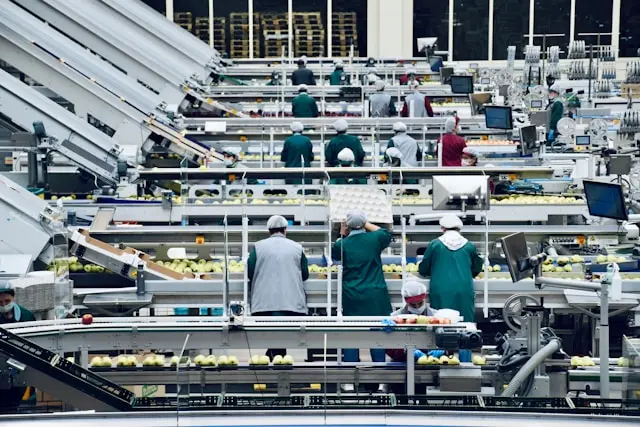
Kristiansand's food processing and aquaculture support sector entered 2026 carrying a contradiction that its leaders did not plan for. The region's anchor employer, Hennig-Olsen Is AS, completed a NOK 300 million facility expansion in 2024 that increased automated production capacity by 40%. Regional seafood processors invested in robotic filleting lines and IoT-enabled cold-chain systems. The capital deployed was substantial. The expectation was straightforward: automation would reduce dependency on scarce labour.
The opposite happened. Automated production lines did not eliminate the need for skilled workers. They replaced one category of worker with another that barely exists in Southern Norway. The PLC programmers, automation maintenance technicians, and cold-chain digitisation specialists required to run these new systems are scarcer than the production operatives the technology was designed to replace. Job postings across Agder's food processing and aquaculture support sector rose 14% year-over-year by Q4 2024. The vacancy fill rate fell to 58%, down from 67% the year before.
What follows is a ground-level analysis of why Kristiansand's food processing market is harder to hire in than its size suggests, where the real talent gaps sit, and what organisations operating in this corridor need to understand before they attempt their next senior search. The data covers the region's anchor employers, its cold-chain export infrastructure, the compensation dynamics pulling talent toward Bergen and Oslo, and the specific roles where conventional recruitment methods consistently fail.
A Logistics Node, Not a Production Hub: Kristiansand's True Market Position
The first thing any hiring leader entering this market must understand is what Kristiansand actually is within Norway's food and seafood value chain. The city is not Bergen. It is not Ålesund. It does not host large-scale primary fish processing operations of the kind that define those West Coast clusters.
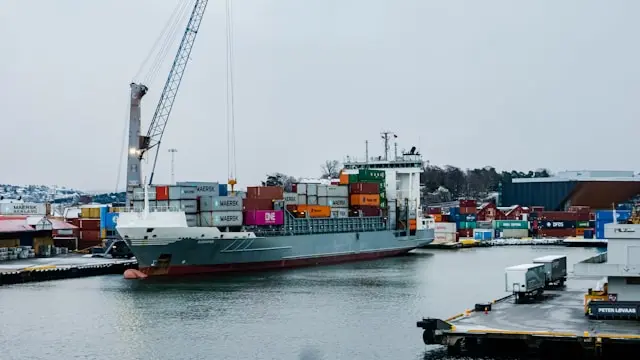
Kristiansand's role is more specialised and, in some ways, more vulnerable. The city functions as a southern logistics and distribution node. The Port of Kristiansand handles approximately 150,000 to 200,000 tonnes of seafood-related cargo annually. Cold-storage capacity within 10km of the port stands at 45,000 cubic metres. Direct weekly reefer container services run to Rotterdam, Hamburg, and Dunkirk with transit times of 24 to 48 hours. In 2023, the port handled 18,500 TEU of refrigerated seafood exports, representing 12% of total Norwegian salmon exports by volume through southern corridors.
Yet primary fish processing employment in the municipality declined 8% between 2020 and 2024, even as national aquaculture volumes grew 12% over the same period. The port's cold-chain infrastructure is thriving. The processing employment around it is not. Kristiansand is capturing logistics value while losing production value to centralised northern facilities. This matters enormously for hiring leaders because it means the local talent pool skews toward logistics, distribution, and technical maintenance rather than traditional fish processing.
Only two EU-approved fish processing establishments operate within Kristiansand proper as of early 2025. The broader Agder region adds more capacity through Agder Seafood AS in the Lillesand corridor and outlying municipal operations. But the integrated "food cluster" that might naturally produce a deep, self-renewing talent pool does not exist here in the way it does in Bergen or Stavanger. Every senior hire in this market requires either attracting passive candidates from other regions or finding the rare local specialist who has not already been approached by three competitors.
The Anchor Employer Effect: Hennig-Olsen and Agder's Single-Point Dependency
Hennig-Olsen Is AS is the fact that shapes everything else about this market. The family-owned, fourth-generation ice cream manufacturer employs 140 to 160 people year-round at its Hannevika industrial zone headquarters, expanding to 250 or more during summer production peaks. The company produces over 30 million litres of ice cream annually, distributed through NorgesGruppen and Rema 1000 networks nationally.
The Scale of the Dependency
Hennig-Olsen represents approximately 35 to 40% of Agder's total food processing employment. This level of single-employer concentration creates a market dynamic that hiring leaders in diversified cities never encounter. When Hennig-Olsen hires, the ripple runs through the entire regional logistics and supplier network. When it invests, the local skills mix shifts. When it completed its NOK 300 million automated expansion, it did not just change its own workforce requirements. It changed the region's.
The company's strategy presentation for 2025 to 2027, cited in Finansavisen in October 2024, projected 8 to 10% revenue growth driven by premium product lines in organic and sugar-free segments. Meeting that target requires 15 to 20 additional technical specialists by mid-2026. In a regional food processing workforce of roughly 2,847 FTEs, adding 20 highly skilled technical roles is not a rounding error. It represents a material increase in demand for exactly the profiles that are already hardest to find.
What the Expansion Actually Requires
The automation investment at Hennig-Olsen created demand for a specific kind of professional. The new production lines run on Siemens S7 and Allen-Bradley programmable logic controllers. Maintaining them requires PLC programmers who also understand food-grade hygiene protocols. Operating them efficiently requires technicians who can interpret IoT sensor data from cold-chain monitoring systems. Managing them strategically requires CTOs and Technical Directors capable of integrating Industry 4.0 automation while maintaining the artisanal quality standards that underpin Hennig-Olsen's premium market positioning.
These are not profiles that exist in abundance anywhere in Norway. In Kristiansand, with its limited educational pipeline and distance from the oil-sector engineering talent base in Stavanger, they barely exist at all. The University of Agder produces approximately 180 students annually across food and agriculture technology tracks, but offers no dedicated aquaculture management specialisation. That requires relocation to the University of Bergen or Nord University in Bodø. The educational gap feeds directly into the recruitment challenge that executive search firms working this market encounter repeatedly.
The Automation Paradox: Capital That Creates the Problem It Was Meant to Solve
This is the analytical claim at the heart of this market's story, and it is not one that the headline investment numbers reveal on their own.
The food processing sector in Agder invested in automation to reduce its dependency on seasonal and semi-skilled labour. The investment was rational. Collective bargaining agreements pushed wages up 4.5% in 2024. Non-EEA seasonal worker availability dropped 30 to 40% following the 2023 Immigration Act amendments. Automation was the obvious answer. But it solved the wrong problem.
The production operatives who could be replaced by machines were available, if not always in sufficient numbers. They operated in active candidate markets where 40 to 50% of hires came through NAV channels and job boards. The automation maintenance technicians, cold-chain digitisation specialists, and PLC engineers needed to run the new systems operate in passive candidate markets where over 80% of qualified professionals are employed and not looking. According to Tekna's 2024 engineering survey, 80% of qualified automation engineers in the food sector receive unsolicited approaches monthly.
Capital moved faster than human capital could follow. Hennig-Olsen's facility expansion and Agder Seafood's robotic filleting investment both assumed that the skilled workers required to operate new systems would be findable once the systems were installed. The data from 2024 and into 2025 suggests that assumption was wrong. Job postings rose while the fill rate dropped. The shortage did not move down the skills ladder. It moved up.
This dynamic has implications beyond Kristiansand. It is visible wherever food processing firms invest in technology and automation without first mapping whether the talent required to operate the new systems exists within their accessible labour market. In Agder, the answer is that it largely does not.
Three Roles That Define the Hiring Crisis
Not every position in Kristiansand's food processing sector is difficult to fill. Production line operatives and seasonal processing workers remain accessible through conventional channels. The crisis concentrates in three specific categories where demand is acute, supply is thin, and the candidates who do exist must be found rather than attracted.
Aquaculture Veterinarians and Fish Health Biologists
National unemployment among aquaculture veterinarians sits below 2%. Average tenure is 4.2 years. Qualified candidates typically hold multiple standing offers at any given time. According to the Norsk Veterinærforening's 2024 labour market report, this is the tightest specialist market in Norwegian food production.
The Agder region's need for fish health expertise is driven by Mowi ASA's smolt production operations and smaller aquaculture support firms. According to industry reporting cited in Khrono in June 2024, a pattern of aggressive poaching characterises this market segment. In one instance consistent with this pattern, a senior fish health manager was recruited from a competitor facility in Stavanger to an Agder-adjacent operation at a total compensation increase of NOK 450,000 annually, moving from approximately NOK 1.1 million to NOK 1.55 million in base salary plus incentives. The relocation package was part of the offer. At these price points, the cost of a failed hire extends well beyond the recruitment fee.
Cold-Chain Supply Chain Directors
This is perhaps the most telling role in the market. A search for a Supply Chain Director at a major Kristiansand food manufacturer, responsible for temperature-controlled distribution across Nordic markets from minus 25°C to plus 2°C, remained open for 11 months during 2023 to 2024. The position required dual competency in HACCP protocol management and automated warehouse logistics including AS/RS systems. According to NHO Agder's competency needs report and anonymised executive search reporting cited in Dagens Næringsliv, the search concluded only after recruiting a candidate from a Bergen-based seafood group at a compensation premium of approximately 18% above the initial budget.
Seventy percent of cold-chain logistics director placements nationally occur through executive search rather than advertised vacancies, according to NHO Logistikk's 2024 recruitment channels survey. The active candidate pool for these roles is negligible. Any firm attempting to fill this role through job boards is competing for the 30% of placements that do not require direct identification and approach of employed professionals.
Automation Maintenance Technicians
The third shortage category is a direct consequence of the automation investment cycle described above. Food manufacturing facilities running Siemens S7 and Allen-Bradley PLC systems need technicians who understand both the programming environment and the food-grade regulatory context in which the systems operate. These professionals exist in Stavanger's oil services sector, where they earn 30 to 40% more than food processing can offer. They exist in Oslo, where career progression paths are clearer. They do not exist in meaningful numbers in Kristiansand.
Agder Seafood AS illustrated the severity of this gap when it restructured its technical hierarchy in 2024. After failing to fill separate maintenance engineer and quality manager positions over six months, the firm combined both functions into a hybrid "Production Technology Manager" role at a 35% salary premium above standard single-function rates. According to NHO sector reporting and the Agder County Council's industry transition analysis, the candidate was ultimately recruited from the oil services sector in Sandnes. The restructuring was not a strategic choice. It was a concession to a market that would not supply the talent the original structure assumed.
Compensation: Competitive Within Limits, Structurally Disadvantaged Against Bergen and Oslo
Kristiansand's executive compensation levels for food processing and seafood roles trade at approximately 85 to 90% of Oslo equivalents. When adjusted for cost of living, they offer 12 to 15% higher real compensation than comparable roles in Ålesund or Bergen, according to Statistics Norway's 2024 regional cost analysis and Econa's executive salary report.
On paper, this should make Kristiansand competitive. In practice, three factors erode that advantage.
First, equity participation and long-term incentive plans are less common in Kristiansand's family-owned enterprises than in Oslo-listed seafood groups. A Senior Fish Health Manager considering a move from Mowi's Oslo headquarters to an Agder facility gives up LTIP exposure for a higher base salary. For candidates in their forties building retirement capital, that trade-off is often unattractive. Understanding how salary negotiations work in this context requires recognising that base salary is not the only number that matters.
Second, Bergen offers 15 to 20% higher base salaries for senior aquaculture roles alongside proximity to the headquarters functions of Mowi, Lerøy, and SalMar. Bergen also provides international schooling options and stronger dual-career opportunities for partners. For professionals aged 30 to 40 with families, the spousal employment market and education infrastructure often outweigh the compensation differential.
Third, Stavanger competes for every automation and engineering profile Kristiansand needs, offering oil-sector salary premiums of 30 to 40% above food processing rates. The transferable skills in process automation mean that any PLC programmer or maintenance engineer in Kristiansand's food sector is one recruiter call away from a materially higher-paying role in offshore services. This retention pressure is not occasional. According to Agder County Council migration statistics from 2023 to 2024, the 30 to 40 age bracket is the most difficult to retain in the region.
| Role | Manager Level (NOK) | Director/VP Level (NOK) | |---|---|---| | Cold-Chain Supply Chain | 750,000 to 900,000 | 1,400,000 to 1,850,000 | | Fish Health / Aquaculture Biology | 680,000 to 820,000 | 1,200,000 to 1,600,000 | | Food Processing Operations | 650,000 to 800,000 | 1,100,000 to 1,450,000 | | Food Safety / Quality Assurance | 620,000 to 750,000 | 1,000,000 to 1,300,000 |
These figures, drawn from Tekna and NHO Mat og Drikke's 2024 compensation surveys, represent the range needed to compete. The lower end of each band will not attract a passive candidate from Bergen or Stavanger. The upper end, combined with relocation support and quality-of-life arguments, sometimes will. The gap between "sometimes will" and "reliably will" is where most searches in this market stall. Firms that rely on standard talent acquisition methods without a proactive identification strategy find themselves cycling through the same inadequate active candidate pool.
Regulatory Pressure and the Compliance Talent Premium
The food processing and seafood sector in Agder does not only face a skills shortage. It faces a compliance knowledge shortage, and the two are converging.
EU Export Compliance and Post-Brexit SPS Controls
Post-Brexit UK export requirements and new EU border controls scheduled for full implementation have created compliance costs estimated at NOK 0.45 to 0.60 per kilogram for processed seafood, according to the Norwegian Seafood Council's 2024 market access report. These are not abstract regulatory costs. They require Export Compliance Managers with dual competency in veterinary science and international trade law. That combination is extraordinarily rare.
The EU Corporate Sustainability Reporting Directive compounds the demand. CSRD requirements now mandate Scope 3 emissions tracking across seafood supply chains, creating demand for Sustainability and ESG Directors who understand both food-sector carbon accounting and EU reporting frameworks. These roles did not exist in this market five years ago. They are now being mandated by regulation, and the talent pipeline to fill them has not had time to develop.
The Traffic Light System and Production Caps
Norway's "traffic light system" for aquaculture licence management restricts production growth in certain zones. Agder regions face yellow and red zone designations limiting biomass growth to 1 to 2% annually, according to the Norwegian Directorate of Fisheries. This constrains upstream processing volumes and creates a ceiling on employment growth in primary seafood processing.
The hiring implication is counterintuitive. Because production volumes are capped, processors cannot grow through scale. They must grow through value-added processing, premiumisation, and export compliance sophistication. Each of these strategies requires more skilled leadership per unit of output, not less. The regulatory environment is simultaneously constraining the sector's size and increasing the seniority of the talent it needs.
Combined with seasonal workforce immigration restrictions that reduced available non-EEA labour by 30 to 40% following the 2023 Immigration Act amendments, the regulatory picture compresses this market from every direction. Firms cannot easily scale labour. They cannot easily scale volume. They can only scale capability, and capability lives in the heads of people they cannot easily recruit.
What This Market Requires from a Search Strategy
A hiring leader approaching Kristiansand's food processing sector with a standard playbook will encounter a series of compounding obstacles. The local talent pool is thin. The educational pipeline is incomplete. The three cities most likely to supply candidates all offer either higher pay, better career progression, or both. The roles that matter most operate in passive candidate markets where over 80% of qualified professionals are employed and not responding to advertisements.
The searches that succeed in this market share common characteristics. They begin with precise talent mapping that identifies every qualified candidate within a realistic commuting or relocation radius, including adjacent sectors like oil services and offshore logistics where transferable skills exist. They present compensation packages benchmarked not against Kristiansand norms but against Bergen and Stavanger, because that is who the employer is competing with. They move quickly. The 11-month search duration documented at Kristiansand's anchor employer is not an anomaly in this market. It is what happens when a search follows a conventional pace.
The firms that do recruit successfully in Southern Norway's food, beverage, and FMCG sector typically do so through direct identification of employed professionals, often working with specialists who understand the sector's regulatory context well enough to assess whether a candidate from Stavanger's oil services sector genuinely carries the HACCP and food-grade compliance knowledge required, or merely the automation engineering skills. The overlap between those two profiles is smaller than it appears.
KiTalent's approach to this market uses AI-powered talent mapping to identify candidates across adjacent sectors and geographies who would not surface through conventional advertising. With interview-ready candidates delivered within 7 to 10 days and a pay-per-interview model that eliminates retainer risk, the methodology is designed for exactly the kind of constrained, passive-heavy market Kristiansand represents. The 96% one-year retention rate for placed candidates matters particularly here, where a failed hire does not just cost money. It costs 11 months.
For organisations hiring senior supply chain, technical, or compliance leadership in Southern Norway's food processing and aquaculture corridor, where the candidates you need are employed, not looking, and being approached by competitors monthly, speak with our executive search team about how we identify and deliver the professionals this market cannot surface on its own.
Frequently Asked Questions
What is the current state of Kristiansand's food processing sector in 2026?
Kristiansand's food processing sector is experiencing bifurcated conditions. Value-added food manufacturing, led by Hennig-Olsen Is AS, is expanding following a NOK 300 million automation investment and pursuing premium product growth. Seafood processing employment is stagnant due to regulatory production caps and automation-driven efficiency gains. Total food processing employment in Agder stood at approximately 2,847 FTEs in late 2024, with projections indicating flat to modest growth in 2026. The sector's primary challenge is not headcount but skills mix: automation has shifted demand toward technical specialists who are acutely scarce in the region.
Why is it so difficult to hire cold-chain supply chain directors in Southern Norway?
Cold-chain supply chain directors require an unusual combination of HACCP protocol expertise, automated warehouse systems knowledge, and temperature-controlled logistics management. Seventy percent of placements at this level occur through direct headhunting rather than advertised vacancies. The active candidate pool is negligible. Bergen, Oslo, and Stavanger all compete for the same professionals at higher compensation levels. One documented search in the Kristiansand region took 11 months to fill and required an 18% compensation premium above original budget to secure a candidate from Bergen.
What salaries do senior food processing executives earn in Kristiansand?
Senior manager roles in cold-chain supply chain management pay NOK 750,000 to 900,000. Director and VP-level positions in supply chain command NOK 1,400,000 to 1,850,000. Fish health and aquaculture biology directors earn NOK 1,200,000 to 1,600,000. Operations directors in food processing earn NOK 1,100,000 to 1,450,000. These figures represent 85 to 90% of Oslo equivalents but offer 12 to 15% higher real compensation than Bergen or Ålesund when adjusted for cost of living. However, family-owned enterprises in the region offer less equity participation than Oslo-listed seafood groups.
How does automation affect food processing employment in Norway?
Automation in Norway's food processing sector has not reduced total workforce demand. It has shifted demand from semi-skilled production operatives, who were accessible through standard recruitment channels, toward PLC programmers, IoT integration specialists, and automation maintenance technicians who operate in passive candidate markets. According to Tekna's 2024 engineering survey, 80% of qualified automation engineers receive unsolicited approaches monthly. Capital investment in automation has intensified rather than resolved the skilled talent shortage in this sector.
What regulatory challenges affect food processing hiring in Agder?
Three regulatory pressures converge on Agder's food sector. Norway's aquaculture traffic light system caps biomass growth at 1 to 2% annually in the region. Post-Brexit UK export requirements add NOK 0.45 to 0.60 per kilogram in compliance costs requiring specialist export compliance managers. The 2023 Immigration Act amendments reduced non-EEA seasonal worker availability by 30 to 40%, compressing the labour supply at the production level. These constraints collectively force firms to compete for higher-skilled professionals rather than growing through volume.
How can KiTalent help with executive hiring in Norway's food and seafood sector?
KiTalent uses AI-enhanced direct search to identify senior professionals in passive candidate markets where conventional advertising reaches fewer than 20% of qualified individuals. For food processing and aquaculture roles in Southern Norway, this means mapping talent across adjacent sectors and geographies, including oil services and offshore logistics where transferable automation and cold-chain skills exist. KiTalent delivers interview-ready candidates within 7 to 10 days under a pay-per-interview model, with a 96% one-year retention rate across 1,450 completed executive placements.