Kristiansand Port Cannot Expand. It Is Automating Instead. But the Talent to Run That Automation Does Not Exist Locally
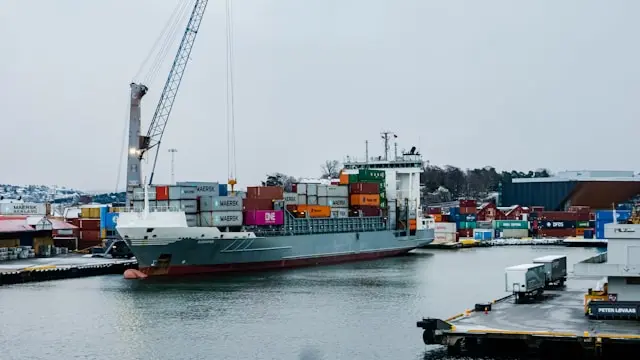
Kristiansand Port processed 4.2 million tonnes of goods in 2023. It operates at over 85% physical capacity during peak periods. The municipality has rejected two expansion proposals in consecutive years, citing environmental protections and urban development priorities. Growth, for this port, does not mean building more quayside. It means extracting more throughput from the same 3,200 metres of quayage through technology, automation, and process compression. The port authority and its anchor tenant, Color Line, are investing accordingly: NOK 450 million in berth electrification and shore power, AI-powered truck processing gates, and terminal operating system upgrades.
The problem is not the investment. The problem is who will operate, maintain, and manage these systems once they are installed. A Terminal Development Manager search at Color Line Cargo ran seven months before being filled by an internal transfer from Denmark. Two Shore Power Technical Coordinator roles at the port authority itself remained vacant for over eight months, forcing the hire of contract consultants from Siemens Energy at 180% of standard salary costs. The roles that define Kristiansand Port's future are precisely the roles this market cannot fill.
What follows is an analysis of the forces reshaping Kristiansand's port and logistics sector: the physical constraints driving its automation strategy, the talent market realities that threaten to stall that strategy, and what organisations hiring into this cluster need to understand before they commit to a search that conventional methods cannot complete.
A Port Hemmed In by Geography and Politics
Kristiansand's harbour occupies a city-centre location. Vestre Havn handles ferry and ro-ro traffic. Østre Havn manages cruise and bulk. Gravane serves as marina and leisure space. There is no spare land. The Bystranda beach zone sits immediately adjacent, protected by environmental designation and local political will. Two expansion proposals have been rejected by the municipal council since 2022, and there is no indication a third would fare differently.
This is not a temporary constraint. The harbour's classification under the Pollution Control Act as "particularly vulnerable" waters restricts dredging and prevents any expansion of bulk cargo handling. The Norwegian Environmental Agency's permit database confirms this designation, and no regulatory pathway to reclassification is currently active.
The port authority's response has been to invest in efficiency rather than footprint. Container yard density reached 94% utilisation in the second quarter of 2024, forcing a near-total reliance on just-in-time trucking. Color Line maintains 45-minute turnaround protocols for freight units at its two primary berths. The automated gate system scheduled for Vestre Havn, projected to reduce terminal dwell time by 22%, is not an upgrade. It is a survival mechanism for a port that cannot physically accommodate the volume growth its anchor tenant generates.
For organisations operating within this cluster, the constraint is not abstract. It means every operational role carries higher stakes. A terminal manager who can reduce dwell time by minutes across thousands of units per week is not performing an incremental improvement. That person is preventing a capacity collapse.
Color Line's Outsized Footprint and the Risk It Creates
Color Line AS constitutes 78% of Kristiansand Havn's total freight volume. The company moves approximately 2.5 million passengers and 450,000 freight units through Vestre Havn annually. It employs 380 shore-based staff locally, with an additional 1,200 indirect jobs flowing through crew services, catering, and maintenance contracts. In practical terms, Kristiansand's logistics cluster does not exist without Color Line.
A Cluster Built Around a Single Operator
The 12 to 15 logistics providers directly affiliated with Color Line's operations, including Color Line Cargo, Steen & Lund Logistics, and Aduro Logistik, depend on the ferry operator's schedule and volume for their own revenue. The cluster as a whole employs approximately 2,800 people across 145 enterprises, generating NOK 4.1 billion in annual turnover. But the ratio of dependency is extreme. According to Color Line Bondholder Reports from 2023 and 2024, the company's pandemic-era financial restructuring discussions created temporary uncertainty about terminal investments. Any material reduction in Color Line's service would cascade through every logistics employer in the region.
What the Cluster Lacks
Unlike Bergen or Stavanger, Kristiansand has no maritime insurance headquarters, no shipbroking firms, and no offshore service company presence of note. The cluster is operationally focused on freight forwarding and warehousing. It lacks the professional services layer that provides resilience and career variety in larger maritime cities. This matters for talent. A senior terminal operations manager in Oslo or Stavanger can move between employers, between subsectors, and between operational and advisory roles without relocating. In Kristiansand, the equivalent professional has one employer of scale and a handful of mid-sized alternatives. The career ceiling is visible from the ground floor.
This concentration risk is not just a strategic concern for the port authority. It is a recruitment concern for every employer in the cluster. Candidates assessing a move to Kristiansand must weigh the economic fragility of a single-operator port against whatever the role offers in compensation and responsibility.
The Hinterland Problem: Isolated by Incomplete Infrastructure
Kristiansand sits at the intersection of the E39 coastal highway and the E18 Oslo-Stavanger corridor. On paper, this is a strategic junction. In practice, the connections are incomplete, and the delays are material.
The E39 between Kristiansand and Stavanger still requires a ferry crossing at Boknafjorden, adding 90 minutes to truck transit times. The Rogfast tunnel project, which was supposed to eliminate this crossing by 2028, now faces a revised completion date of 2032 according to the Norwegian Public Roads Administration. For the next six years at minimum, Kristiansand remains functionally isolated from the southwestern industrial zones it should be feeding.
Rail freight is negligible. The Sørlandsbanen railway carries just 3% of port hinterland modal share due to single-track limitations. The nearest intermodal rail terminal sits 14 kilometres east at Kjevik airport, with no direct shuttle to the port. The inland logistics node at Tveit, where DSV Road and Posten Norge operate, is 12 kilometres from the waterfront and disconnected from the quayside supply chain.
Competition comes from three directions. Larvik Port, 135 kilometres northeast, offers deeper harbour access and 15% lower municipal port fees on the same Denmark routes. The Oslofjord corridor captures long-haul freight with superior rail connectivity. And Hirtshals, the Danish counterpart, offers competitive ro-ro rates that divert potential transshipment volume. Kristiansand retains dominance in fresh produce distribution, holding 35% of the national market share for Danish food imports due to Color Line's cold-chain capabilities. But it has been losing containerised manufacturing cargo to Oslo since 2019.
For talent, the hinterland problem compounds the career ceiling issue. A logistics executive relocating to Kristiansand is not moving to a transport hub with multiple connectivity options. They are moving to a regional terminal with a single dominant trade route and limited intermodal flexibility. The role itself may be compelling. The surrounding infrastructure is not.
The Talent Gap That Automation Widens
Here is the analytical claim that sits beneath all the infrastructure investment data: Kristiansand's automation strategy has not reduced the workforce. It has replaced one category of worker with another that does not exist in sufficient numbers locally. Capital has moved faster than human capital can follow.
The port authority's NOK 450 million investment programme, the AI-powered gate systems, the shore power electrification, the LNG bunkering facilities: these are responses to a physical constraint. But each creates a new dependency on specialists who were not part of the port's traditional labour force. The Terminal Development Manager role that Color Line Cargo could not fill for seven months required expertise in Navis N4 Terminal Operating Systems alongside ro-ro optimisation. According to reporting in Fædrelandsvennen from August 2024, no Norwegian candidate possessed this hybrid IT-maritime profile. The role was filled only by transferring a Danish national from Color Line's Hirtshals terminal.
Shore Power: A Green Mandate Without a Workforce
The shore power programme is the clearest example. Only 40% of berths currently offer high-voltage connections. Full electrification depends on grid upgrades from Agder Energi, scheduled for the second quarter of this year. The port authority created three Shore Power Technical Coordinator roles in 2024. According to board meeting minutes reported by Teknisk Ukeblad, two remained unfilled as of December 2024. The gap was covered by Siemens Energy contractors at 180% of standard salary cost.
This is not a transient staffing problem. The demand for high-voltage maritime electrical specialists will only increase as Norway's green transition mandates accelerate. Every Norwegian port is pursuing electrification. Every Norwegian port needs the same specialists. And the domestic pipeline of professionals with combined maritime operations and high-voltage electrical credentials is far too thin to serve the demand.
The Training Pipeline That Does Not Exist
Agder County has no dedicated port automation training programme. The University of Agder offers logistics and supply chain management at the graduate level, but the curriculum does not cover Terminal Operating Systems, shore power engineering, or the AI-driven gate processing technology now being deployed at Vestre Havn. The practical result, confirmed by recruitment data from FINN.no showing 127 days-to-fill for terminal management roles in Agder versus 89 days nationally, is that every technical hire in this market must either be found domestically and relocated from another region, or sourced internationally. Neither pathway is simple.
Compensation in a Market That Cannot Buy Its Way Out
Norwegian logistics salaries rank among Europe's highest. Senior terminal operations managers in the Agder region earn between NOK 850,000 and NOK 1,050,000 in base salary. Those with automation expertise command premiums of 12 to 15% above that band. Maritime technical superintendents earn NOK 900,000 to 1,100,000. At the executive level, Terminal Directors and Port Operations VPs earn between NOK 1,350,000 and 1,800,000, with bonus structures averaging 20 to 30% of base for KPI achievement.
These are strong figures. And they are not solving the shortage.
The Oslo and Stavanger Drain
Kristiansand offers approximately 8 to 12% lower executive compensation than Oslo for equivalent roles. The cost of living differential, with housing costs 35% below Oslo according to Statistics Norway's municipal index, partially offsets this. But "partially" is the operative word. Oslo offers something Kristiansand cannot match with salary alone: career trajectory. The Oslofjord region houses multinational headquarters, e-commerce fulfilment centres, and the technology-logistics convergence businesses that define the sector's future. Since 2020, 23% of Agder County's logistics management graduates have relocated to Oslo.
Stavanger presents a different threat. Offshore vessel operators competing for the same maritime technical officers offer 18 to 20% salary premiums, driven by the oil and gas sector's willingness to outbid port employers for electrical and hybrid systems expertise. The Tekna Engineering Association's 2024 salary survey confirms this gap. A shore power coordinator in Kristiansand earns well. The same professional working on offshore electrification in Stavanger earns materially better.
Gothenburg: The International Pull
For candidates considering the Danish-Norwegian trade corridor from an international perspective, Gothenburg offers an English-language working environment, EU regulatory experience, and a larger port ecosystem. Kristiansand cannot match any of these attributes. The hiring implication is clear: international candidates with the right hybrid profile have alternatives that do not require learning Norwegian or accepting a narrower career path.
The market for negotiating executive compensation packages in this region must account for all three competitive pulls simultaneously. An offer that beats Kristiansand's internal benchmarks but ignores what Oslo, Stavanger, and Gothenburg are paying for the same skills will fail.
Why Conventional Search Methods Fail in This Market
The passive candidate ratios in Kristiansand's port logistics sector are among the most extreme in any Norwegian industry vertical.
For terminal operations and smart port technology roles, 85 to 90% of qualified candidates are not actively looking. Average tenure in these positions across Norway is 6.2 years. For maritime technical officers specialising in high-voltage systems, the ratio is approximately four passive candidates for every active job seeker. At the executive level, the market is 95% passive. According to Michael Page Norway's logistics practice data, every VP-level appointment in the Kristiansand region over the past 24 months involved executive search or direct headhunting. Zero successful fills came from public advertisement for roles above NOK 1.2 million.
The driver shortage operates differently. Heavy truck drivers with Class CE and ADR hazardous goods certification are an active market with high turnover and frequent job changes. But the absolute supply is insufficient. The Norwegian Logistics and Freight Association reports 340 unfilled driver positions in Agder County, representing 18% of total demand. Aduro Logistik has introduced NOK 50,000 signing bonuses for ADR-certified drivers. National unemployment in this category sits at 1.2%, which is effectively full employment.
For hiring leaders in this market, the implication divides sharply by role type. Driver recruitment is a volume and retention problem addressable through compensation and conditions. Every other critical role in the cluster is a passive candidate identification problem that requires fundamentally different methods.
The organisations that post and wait will not fill these roles. The candidates are employed. They are not looking. They are performing well in their current positions. And they will not appear on any job board in Norway, Denmark, or Sweden.
What the 2026 Market Demands of Hiring Leaders
The immediate outlook for Kristiansand's port and logistics sector is defined by a paradox. Volume growth of 2 to 3% is constrained not by demand but by Color Line's fleet capacity ceiling. Cruise traffic will decline 15% following the municipality's imposition of daily passenger caps. The infrastructure investments now entering their delivery phase, from automated gates to shore power to LNG bunkering, are each individually manageable. Together, they represent a simultaneous demand for technical talent that the local market has already demonstrated it cannot supply.
Agder County's working-age population is projected to decline 2.3% by 2030 according to Statistics Norway. This is not a correction. It is a structural demographic trend that will make every talent shortage in this region worse over time, regardless of sector growth or compensation adjustments. The hidden cost of leaving these roles unfilled is not measured only in contractor premiums. It is measured in delayed infrastructure, reduced throughput capacity, and regulatory non-compliance as green mandates tighten.
For organisations hiring terminal operations managers, shore power specialists, maritime technical officers, or logistics executives in this market, the search methodology matters as much as the offer. A retained executive search process that reaches passive candidates in Oslo, Stavanger, Gothenburg, and Denmark, and that presents a compelling case for Kristiansand as a destination rather than simply advertising and hoping, is not optional. It is the only approach that has produced results at the senior level in this region.
KiTalent delivers interview-ready executive candidates within 7 to 10 days through AI-powered talent mapping that identifies the passive specialists conventional methods miss entirely. In a market where 95% of executive talent is invisible to job advertising, the search method determines the outcome. With a 96% one-year retention rate across 1,450 executive placements, the approach is built for markets exactly like this one: small candidate pools, high passive ratios, and roles where the cost of a failed search is measured in operational disruption rather than simply lost time.
For organisations competing for terminal automation leadership, shore power engineering talent, or senior logistics executives in Norway's most constrained port market, start a conversation with our executive search team about how we approach searches where conventional methods have already failed.
Frequently Asked Questions
What are the biggest hiring challenges in Kristiansand's port and logistics sector?
The most acute challenges centre on three role categories: terminal operations managers with port automation expertise, maritime technical officers specialising in high-voltage shore power systems, and Class CE truck drivers with ADR hazardous goods certification. Terminal management roles average 127 days to fill in the Agder region compared to 89 days nationally. Shore power coordinator roles have remained vacant for over eight months at the port authority itself. The underlying problem is a domestic training gap: no programme in Agder County produces graduates with the hybrid IT-maritime or electrical-maritime profiles these roles demand.
What do senior logistics and port executives earn in Kristiansand?
Terminal Operations Managers earn NOK 850,000 to 1,050,000 in base salary, with automation specialists commanding 12 to 15% premiums. Maritime Technical Superintendents earn NOK 900,000 to 1,100,000. At VP level, Terminal Directors and Port Operations VPs earn NOK 1,350,000 to 1,800,000 with performance bonuses of 20 to 30%. Kristiansand compensation runs 8 to 12% below Oslo equivalents, though housing costs are 35% lower. Stavanger's oil and gas sector offers 18 to 20% premiums for the same maritime technical profiles, creating persistent retention pressure.
Why is Kristiansand Port investing in automation rather than expanding?
Physical expansion is not available. The harbour occupies a city-centre location surrounded by environmentally protected waters and urban development zones. The municipality has rejected two expansion proposals since 2022. The port authority's NOK 450 million investment programme focuses instead on throughput efficiency: AI-powered truck processing gates, shore power electrification, and terminal operating system upgrades. The goal is to increase effective capacity without increasing physical footprint. This strategy works only if the port can recruit the technical specialists required to operate and maintain these systems.
How does KiTalent approach executive search in Norway's port and logistics sector?
KiTalent uses AI-enhanced direct headhunting to identify and engage passive candidates who are not visible through job advertising. In a market where 85 to 95% of qualified candidates for senior port and logistics roles are passively employed, this methodology reaches the professionals that conventional search cannot. KiTalent delivers interview-ready candidates within 7 to 10 days, with full pipeline transparency and weekly reporting throughout the process. The pay-per-interview model means clients only invest when they meet qualified candidates.
What makes hiring in Kristiansand different from Oslo or Stavanger?
Three factors distinguish this market. First, the candidate pool is smaller: Kristiansand's logistics cluster employs 2,800 people compared to tens of thousands in the Oslofjord region. Second, career trajectory is narrower: Color Line represents 78% of port revenue, limiting the variety of senior roles available. Third, the market is actively losing talent to competing cities. Oslo draws logistics management graduates with career breadth and higher compensation, while Stavanger draws maritime technical officers with oil and gas salary premiums. Effective executive search in this market must source nationally and internationally rather than locally.
What is the outlook for Kristiansand's logistics sector through 2026 and beyond?
Ro-ro volume growth of 2 to 3% is projected through 2026, constrained by fleet capacity rather than demand. Cruise traffic will decline 15% under new municipal passenger caps. The E18 road improvement to Arendal completed in late 2025, improving northbound trucking times. However, the E39 to Stavanger remains incomplete until at least 2032. Agder County's working-age population is projected to decline 2.3% by 2030, compounding talent shortages. The defining challenge is whether the port can recruit the technical workforce needed to operate the automation infrastructure it is currently building.