Maribor's €42 Million Automation Bet Created the Talent Crisis It Was Supposed to Solve
Slovenia's second city invested heavily in Industry 4.0. The factory floors got smarter. The talent pipeline did not follow. For hiring leaders in Maribor's metalworking sector, the math no longer works.
Between 2022 and 2024, manufacturers in Maribor's Tezno industrial zone absorbed €42 million in EU Recovery and Resilience Facility grants for automation and digital manufacturing upgrades. The investment was supposed to reduce dependence on scarce skilled tradespeople. Instead, it replaced one category of worker with another that barely exists in the regional labour market. Basic CNC operators found their roles eliminated. Senior CNC programmers capable of optimising automated cells became the most sought and least available professionals in northeastern Slovenia. Vacancy durations for these advanced specialists stretched from 4.5 months to 7.5 months over the same period the automation money arrived.
What follows is an analysis of why Maribor's manufacturing sector is stuck in a middle-skill trap, where the investment intended to solve the workforce problem deepened it. This article maps the specific roles and skills in shortest supply, the compensation dynamics that push senior talent north to Austria, and what organisations hiring in this market need to do differently when 85% of the candidates they need are not looking for a new role.
The Tezno Zone: Slovenia's Industrial Core Under Pressure
Maribor's Tezno industrial zone remains the heaviest concentration of metalworking capacity in northeastern Slovenia. Approximately 120 registered industrial entities carry metalworking as their primary classification, clustered along Kovinarska cesta and Ptujska cesta. The zone houses the anchor employers that define Maribor's position in the European automotive supply chain: TPV Group, with 1,850 employees producing pressed metal components and welded assemblies for BMW, Magna Steyr, and Volvo; Unior, operating the largest toolmaking facility in southeastern Europe from its Tezno base; and Yaskawa Slovenia, the Japanese robotics manufacturer's regional hub with 220 employees.
The broader Maribor statistical region recorded 847 enterprises in fabricated metal products and machinery manufacturing as of 2023, according to the Statistical Office of the Republic of Slovenia. A critical detail sits beneath that headline figure: 68% of those enterprises are micro-firms with fewer than ten employees. This is not the cohesive industrial cluster that the region's promotional materials suggest. A 2024 survey by the Chamber of Commerce and Industry of Slovenia found that only 23% of Tezno SMEs report regular business-to-business contracting with neighbouring zone facilities. The zone functions as a collection of autonomous subcontractors, not an integrated manufacturing ecosystem.
That fragmentation matters for talent. A senior CNC programmer considering a role at a micro-firm in Tezno faces a career ceiling that does not exist at TPV or Unior. The anchor employers attract the strongest candidates. The SMEs, which collectively employ more people, compete for the remainder. In Maribor's advanced manufacturing sector, the talent market is not one market. It is two, divided by employer size, and the smaller segment is losing.
Export performance reinforces the split. Unior exports 85% of its production. TPV ships 90% abroad. But only 34% of Tezno SMEs engage in direct export at all; the majority serve as tier-3 suppliers to Ljubljana-based exporters, absorbing margin pressure from every link above them in the chain. The firms with the most urgent hiring needs are frequently the firms least equipped to pay what the market now demands.
The Middle-Skill Trap: How €42 Million in Automation Widened the Gap
The central paradox of Maribor's manufacturing labour market is visible in two data points that appear to contradict each other but describe the same phenomenon from different angles.
Capital Moved Faster Than Human Capital Could Follow
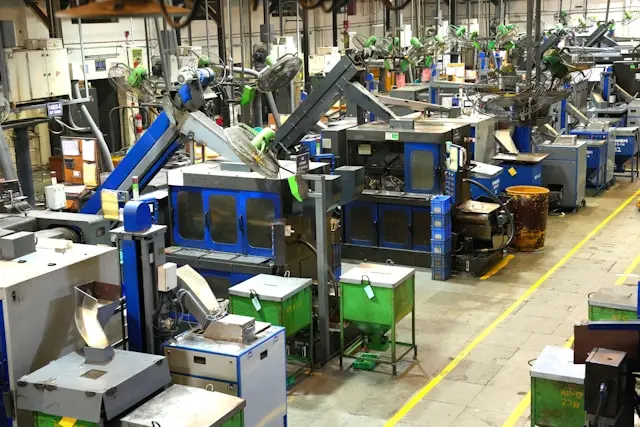
Tezno-zone manufacturers invested €42 million in Industry 4.0 upgrades between 2022 and 2024, funded largely through EU RRF disbursements recorded in the Ministry of the Economy's implementation report. The money went into robotic welding cells, automated CNC machining centres, and cobot integration lines. In theory, this should have eased pressure on the skilled trades workforce by reducing the number of manual operators required per production line.
In practice, it did the opposite for the most critical roles. Vacancy durations for senior CNC specialists, the programmers who configure and optimise automated five-axis machining cells, lengthened from 4.5 months to 7.5 months over the same 2022 to 2024 period. The Slovenian Employment Service's analysis of vacancy durations found that 34% of metalworking vacancies in the Podravska region exceeded 180 days to fill in 2024. In general manufacturing, that figure was 12%.
This is not a shortage that automation can solve. It is a shortage that automation created.
The Skills the Machines Require Do Not Yet Exist in Sufficient Numbers
The University of Maribor's Faculty of Mechanical Engineering graduates approximately 180 BSc and 45 MSc engineers annually. These are theoretical mechanical engineers. Meanwhile, vocational school enrolment in toolmaking trades has fallen 18% since 2019, according to the Ministry of Education. The education pipeline is producing fewer tradespeople at the entry level and fewer practice-oriented engineers at the degree level. The professionals who can bridge both worlds, combining hands-on machining knowledge with the programming fluency to run a Siemens NX or Heidenhain five-axis cell, are a population that the education system was never designed to produce at scale.
Maribor Technology Park's "Factory of the Future" demonstration centre for additive manufacturing and cobot integration is one attempt to close this gap. But demonstration centres train awareness. They do not produce the seven to ten years of accumulated experience that a senior CNC programmer carries. For organisations facing this constraint today, the hidden 80% of passive candidates in this specialisation are not reachable through job postings or vocational programme graduates. They must be found where they currently work.
The Graz Problem: A 60-Kilometre Border That Drains Senior Talent
Maribor sits 60 kilometres south of Graz, Austria. That proximity defines every compensation negotiation and every retention challenge in the region's metalworking sector.
The wage differential is not subtle. According to the Austrian Public Employment Service's Styria wage data and Slovenian comparisons, a toolmaker in Graz earns €4,500 or more net monthly. The equivalent role in Maribor pays €1,800 to €2,200 net. The multiple is 2.5 to 3.0 times. At the executive level, operations directors in Maribor earn €85,000 to €120,000 gross annually. Equivalent roles in Austrian manufacturing sit 20 to 30% higher, according to the Hays Slovenia salary guide.
The Delo newspaper reported in March 2024 on what it described as a persistent northward drain of Slovenian-speaking skilled tradespeople into Styria. This is not a new phenomenon, but it has intensified as Austrian employers have grown more aggressive in targeting Slovenian talent. A documented case from 2023, referenced in Delo's business section, involved TPV Group recruiting a senior toolroom manager from a competitor in Graz by paying a relocation premium of approximately 25% above the Maribor market rate. The fact that a Maribor employer had to pay above-market rates to pull someone back from Austria illustrates the gravitational pull of the border wage gap.
Ljubljana presents a different kind of competition. It does not match Graz's wage multiples, but it offers 10 to 15% higher net pay than Maribor for senior engineers, combined with R&D roles in pharmaceutical and medtech automation at firms like Krka and Lek. These companies actively recruit Maribor-trained mechanical engineers for maintenance and facility engineering positions. The talent loss is not always to direct competitors. It is to adjacent sectors in a more attractive city.
Maribor's retention arguments are real but limited. Housing costs run 40% below Ljubljana and 60% below Graz. Proximity to the Austrian border enables daily cross-border shopping. But senior professionals seeking career trajectory breadth, the kind who eventually become operations directors and plant managers, consistently cite Maribor's limited upward mobility as the reason they leave. For organisations trying to attract and retain senior manufacturing leaders, the counteroffer conversation in this market is not primarily about money. It is about what the next five years look like.
Workforce Aging: The Retirement Wave Behind the Vacancy Numbers
The vacancy data tells only half the story. The other half sits in the age distribution of Maribor's existing metalworking workforce.
Twenty-eight percent of employees in Maribor's metalworking sector are aged 55 or older, compared to 19% in the national economy, according to the 2024 Labour Force Survey. At Unior's Tezno facility specifically, internal data disclosed in their sustainability report indicates that 31% of the production workforce will be eligible for retirement by 2030.
This creates a compounding effect. The sector is already unable to fill current vacancies at competitive speed. Within four years, it will need to replace nearly a third of its experienced production workforce simultaneously. The professionals retiring are not interchangeable with new graduates. A senior tool and die maker with 25 years of forging specialisation carries process knowledge that no formal qualification replicates. When these individuals leave, they take institutional knowledge that was never documented because it never needed to be. It lived in their hands and their judgment.
The Toolmakers Association of Slovenia, representing 45 Maribor-region firms, coordinates apprenticeship standards. But apprenticeship intake cannot scale fast enough to offset the retirement curve when vocational enrolment in toolmaking has dropped 18% since 2019. The pipeline is narrowing at exactly the moment it needs to widen.
For hiring executives planning talent pipelines and succession strategies, the implication is direct. Waiting until retirement actually occurs means competing for replacements in a market where 85 to 90% of qualified candidates are already employed and not applying to job postings. The firms that begin identifying and engaging these passive candidates now will fill the roles. The firms that wait will face a market where every competitor is looking for the same people at the same time.
The Compensation Paradox: Record Exports, Stagnant Wages
The Podravska region reported €1.2 billion in metalworking export revenue in 2023, an 8% increase year on year. Large exporters operated at 90% capacity utilisation. By the standard logic of labour economics, this level of demand should have driven meaningful wage growth for the scarce skills the sector needs most.
It did not. Real wage growth for skilled trades in CNC machining and toolmaking stagnated at 2.1% annually against Slovenian inflation of 3.2%. In real terms, these workers' purchasing power declined even as their employers' revenues grew.
Two forces explain the disconnect. First, German OEM price pressure. Eighty percent of the automotive supplier revenue flowing through Maribor originates from German manufacturers. When orders from Maribor's tier-2 suppliers declined 12% during the Q2 to Q3 2024 German manufacturing contraction, it exposed the vulnerability of a supply chain where pricing power sits entirely with the customer. Slovenian suppliers absorb cost increases rather than pass them through. Second, energy costs. Industrial electricity prices in Slovenia ran €120 to €140 per megawatt hour in 2024, according to Eurostat's electricity price data. While below the EU peak, these prices sit materially above 2020 baselines, compressing margins for the energy-intensive forging and aluminium processing that anchor firms like Unior rely upon.
The result is a sector that generates strong top-line revenue but cannot translate that revenue into the compensation packages required to retain senior talent against Austrian and Ljubljana competition. This is the analytical tension that makes Maribor's hiring challenge genuinely different from markets where the solution is simply "pay more." Maribor's manufacturers do not have the margin structure to pay more. Not because they are unsuccessful, but because the value chain they serve does not permit it.
For senior hiring leaders evaluating this market, the implication is that compensation benchmarking alone will not solve the problem. The offer must include elements that Graz and Ljubljana cannot easily replicate: project significance, technical challenge, and the kind of role scope that a smaller, more entrepreneurial operation can credibly offer. The salary will not win. The proposition might.
What the 2026 Hiring Market Actually Looks Like
Two projects entering production in the second half of 2026 will add approximately 140 technical positions to the Maribor market. TPV Group's €18 million EV-component line and Unior's forged aluminium expansion represent the next wave of automotive transition investment. The Institute of Macroeconomic Analysis and Development projects 3.2% year-on-year growth for fabricated metals in 2026, constrained explicitly by workforce availability rather than order book demand.
The sector is entering 2026 with a 4.8% vacancy rate in metalworking and machinery against a national average of 3.9%. The Tezno zone reports 96% occupancy with no greenfield expansion possible. New entrants must acquire existing facilities at €450 to €600 per square metre, which constrains SME growth and concentrates hiring demand among incumbents.
The Roles That Will Be Hardest to Fill
The positions most resistant to conventional recruitment in this market share three characteristics: they require a combination of theoretical and hands-on knowledge, they demand experience measured in years rather than certifications, and the professionals who hold them are almost entirely passive.
Senior CNC programmers working with five-axis systems carry a passive candidate ratio of 85 to 90%, according to a 2024 manufacturing talent market analysis. Tool and die makers with forging specialisation sit at approximately 80% passive. These candidates hold what the Toolmakers Association describes as "lifetime" positions and transition only through personal network referrals. Automation engineers combining PLC and robotics integration skills show 75% passivity, with average tenure of 7.2 years and segment unemployment of just 1.8%.
Active candidate markets exist for junior three-axis CNC operators and quality inspectors, with 40 to 50% applying through standard channels. But quality is variable, and these roles are not the ones keeping operations directors awake.
The CSRD Compliance Layer
A new cost burden compounds the hiring challenge. Implementation of the EU Corporate Sustainability Reporting Directive imposes annual audit and reporting costs of €50,000 to €100,000 on mid-sized metalworking SMEs, according to the CCIS's impact assessment for the Podravska region. For Tezno firms with 50 to 250 employees, this is not trivial. It diverts resources that might otherwise fund the compensation premiums or talent acquisition infrastructure needed to compete for scarce specialists. The firms most in need of talent investment are simultaneously absorbing a new regulatory cost that constrains their ability to invest.
What Hiring Leaders in This Market Need to Do Differently
The conventional recruitment playbook fails in Maribor's metalworking sector for a specific, measurable reason. When 85 to 90% of the senior CNC programmers and 80% of the tool and die makers you need are employed, satisfied enough not to be looking, and averaging more than seven years of tenure, a job posting reaches at most 15% of the viable candidate population. In a market this small, 15% is often no one qualified at all.
Yaskawa Slovenia recognised this in 2024. According to a Dnevnik interview with the company's country manager, Yaskawa established a satellite office in Ljubljana specifically to attract PLC and robotics integration engineers who refused to relocate to Maribor. The company accepted a remote and hybrid cost premium to secure three senior automation engineers it could not source locally. This is not a failure of recruitment. It is an adaptation to a market where the traditional assumptions about where candidates live, where they will work, and what moves them no longer hold.
The synthesis that emerges from Maribor's data is this: the €42 million automation investment did not reduce the workforce. It replaced one kind of worker with another that does not yet exist in sufficient numbers. Capital moved faster than human capital could follow. The factories are ready. The people to run them are not, and they will not appear through job advertisements or vocational programme graduations within the timeline that 2026 production schedules demand.
For senior hiring leaders responsible for filling operations director, plant manager, and specialist engineering roles in this market, the strategic question is not whether to invest in direct candidate identification. It is whether you can afford not to. KiTalent's AI-enhanced talent mapping capability is built for exactly this profile: a small, specialist, heavily passive candidate market where the professionals you need must be found individually rather than attracted through advertising. With interview-ready candidates delivered within 7 to 10 days and a pay-per-interview model that eliminates upfront retainer risk, the approach is designed for markets where speed and precision both matter.
Maribor's metalworking employers are not short of orders, investment, or ambition. They are short of the people who make the machines run. The organisations that solve this problem will be the ones that stopped waiting for applications and started finding candidates directly.
For organisations competing for CNC programming, toolmaking, and automation leadership in Slovenia's most concentrated manufacturing zone, start a conversation with our executive search team about how we approach passive candidate markets where conventional methods do not reach.
Frequently Asked Questions
Why is there a CNC machinist shortage in Maribor?
Maribor's CNC machinist shortage stems from three converging forces. Vocational school enrolment in toolmaking trades fell 18% since 2019, reducing the entry-level pipeline. Simultaneously, €42 million in automation investment across the Tezno zone upgraded skill requirements from basic operation to advanced five-axis programming. The third factor is geographic: Graz, Austria, 60 kilometres north, pays 2.5 to 3.0 times Maribor wages for equivalent CNC roles, creating a persistent drain of experienced professionals. The result is a 4.8% vacancy rate in metalworking against a 3.9% national average.
What do CNC programmers and toolmakers earn in Maribor in 2026?
Senior CNC programmer/technologists in Maribor earn €45,000 to €58,000 gross annually, representing a 15% premium over general mechanical engineers. Toolroom managers earn €52,000 to €68,000 gross, with variation based on forging versus machining specialisation. Operations directors in metalworking command €85,000 to €120,000 gross. Plant managers at tier-2 automotive suppliers earn €75,000 to €95,000 gross. These figures sit 20 to 30% below equivalent roles in Graz, Austria, which remains the primary compensation competitor for Maribor's senior manufacturing talent.
How long does it take to fill a senior manufacturing role in Maribor?
Senior CNC specialist roles in the Podravska region averaged 7 to 11 months open in 2024, according to the Slovenian Employment Service. Thirty-four percent of metalworking vacancies exceeded 180 days to fill, compared to 12% in general manufacturing. The duration reflects a passive candidate market where 85 to 90% of qualified senior CNC programmers and 80% of tool and die makers are employed and not actively seeking new roles. KiTalent's direct headhunting methodology delivers interview-ready candidates within 7 to 10 days by reaching these passive professionals directly.
What is the Tezno industrial zone in Maribor?
Tezno is Maribor's primary heavy-industry agglomeration in northeastern Slovenia, hosting approximately 120 registered industrial entities with metalworking as their primary activity. Major employers include TPV Group (1,850 employees, tier-2 automotive stamping and welding), Unior (southeastern Europe's largest toolmaking facility), and Yaskawa Slovenia (industrial robotics manufacturing). The zone operates at 96% occupancy with no greenfield expansion available, concentrating hiring demand among incumbent manufacturers competing for the same specialist talent pool.
Why does Maribor lose manufacturing talent to Austria?
The wage differential is the primary driver. A toolmaker in Graz earns €4,500 or more net monthly. The same role in Maribor pays €1,800 to €2,200 net. At executive level, the gap narrows to 20 to 30% but remains material. Graz also offers greater R&D density and career progression breadth. Maribor retains talent through housing costs 60% below Graz and lower cost of living overall, but these advantages diminish for senior professionals prioritising long-term career development over near-term affordability.
How can manufacturers in Maribor hire passive CNC and toolmaking specialists?
Standard job postings reach at most 15% of the qualified candidate pool in Maribor's specialist manufacturing roles. The remaining 85 to 90% must be identified through direct search methods: AI-enhanced talent mapping to identify specific professionals across Slovenian and cross-border Austrian markets, followed by confidential direct approach. The proposition must extend beyond salary to include project scope, technical challenge, and career trajectory. Firms like Yaskawa have already adapted by offering hybrid arrangements and satellite offices. Speed matters: a 96% one-year retention rate depends on matching the right candidate to the right role, not just filling the vacancy fastest.