Norfolk's Ship Repair Sector Is Expanding Capacity It Cannot Staff: The Security Clearance Bottleneck Reshaping Defence Hiring
Norfolk's ship repair cluster entered 2026 with a paradox that no amount of capital investment can resolve on its own. BAE Systems completed a $70 million dry dock modernisation in late 2024, expanding heavy-lift capacity for destroyer and amphibious ship repairs. General Dynamics NASSCO Norfolk operates at near-peak utilisation. The Norfolk Naval Shipyard in Portsmouth employs roughly 12,000 civilian personnel. And yet the sector's ability to meet the Navy's maintenance requirements is not constrained by steel, dry dock space, or contract volume. It is constrained by the speed at which human beings can be cleared to touch a warship.
The binding constraint is specific and measurable. The Defense Counterintelligence and Security Agency reported average processing times of 132 days for Secret clearances and 214 days for Top Secret in the Norfolk adjudication facility's jurisdiction as of late 2024. That means a qualified marine electrician, fully trained and willing to start work, sits idle for four to seven months before they can legally step onto a naval vessel. The Navy's maintenance plan projects a 12% increase in surface ship availabilities home-ported at Naval Station Norfolk, requiring an estimated 2,140 additional personnel by late 2026. Regional workforce pipelines produce approximately 1,200 maritime-qualified entrants annually. The arithmetic does not work, and the clearance timeline makes it worse.
What follows is a structured analysis of the forces shaping Norfolk's ship repair sector in 2026: where the workforce gaps sit, why conventional hiring methods fail in a cleared defence environment, what the compensation market looks like at every level, and what hiring leaders responsible for filling these roles need to understand before their next search.
The Demand Signal No One Can Ignore
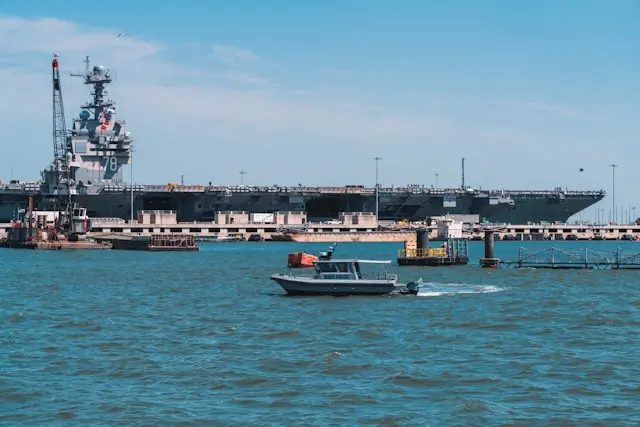
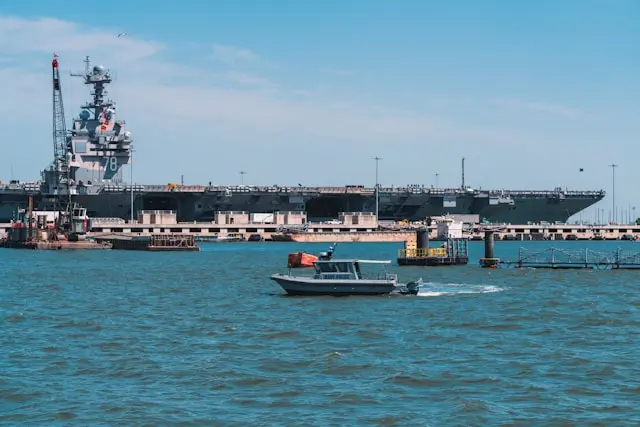
Naval Station Norfolk is home to approximately 75 ships. It is the largest naval installation in the world. The maintenance, repair, and overhaul requirements generated by that fleet represent roughly $4.2 billion in annual spending, according to the U.S. Navy's Report to Congress on the Long-Range Plan for Maintenance and Modernization of Naval Vessels. This figure is not discretionary. Ships require scheduled maintenance. Deferred maintenance creates cascading readiness failures. The Navy's surface ship maintenance backlog reached a historic high of 4,200 delay-days for vessels home-ported at Norfolk, a figure that represents real operational consequence.
Private yards in the Norfolk MSA operate at 85 to 92% dry dock utilisation. BAE Systems Norfolk Ship Repair employs approximately 1,800 personnel, with surge capacity to 2,400 during peak availabilities. General Dynamics NASSCO Norfolk employs around 900, specialising in auxiliary ship repair and conversion. Colonna's Shipyard, a family-owned operation with roughly 150 employees, handles smaller commercial and government vessels under 300 feet.
The total direct employment in ship building and repair across the Norfolk-Newport News MSA stood at approximately 28,400 as of early 2025, a 4.2% year-over-year increase. But that increase, while positive, tells a misleading story.
Why Hiring Growth Lags Demand Growth
The 12% increase in projected surface ship maintenance availabilities required a proportional workforce expansion. Actual hiring velocity in private yards increased by only 2.1% year-over-year. That gap is not explained by a lack of willing employers or available funding. It is explained almost entirely by the security clearance pipeline.
Every production worker who touches a naval vessel requires at minimum a Secret clearance. Many roles in combat systems integration, cybersecurity, and programme management require Top Secret. The 132-day average for Secret and 214-day average for Top Secret means that even when a yard identifies and offers a qualified candidate, the candidate cannot begin productive work for months. During that waiting period, they may accept another offer, relocate, or simply lose patience. The clearance process functions as a hard cap on hiring velocity regardless of how effective the talent pipeline might be.
This is the core analytical insight that separates Norfolk's hiring challenge from other tight labour markets. In most sectors, a skills shortage can be addressed through higher compensation, better sourcing, or faster processes. In cleared defence, the federal government controls the single longest step in the hiring cycle, and neither the employer nor the candidate can accelerate it. Capital has moved faster than human capital can follow, and the bottleneck is not training or willingness. It is administrative.
Who Competes for Norfolk's Workers
Norfolk does not exist in isolation. Its talent pool is contested by three distinct competitor markets, each pulling on different segments of the workforce.
San Diego and the Mid-Career Drain
San Diego is Norfolk's primary competitor for cleared engineering and management talent. Base salary premiums of 12 to 18% for comparable roles draw mid-career professionals between ages 30 and 45, particularly those seeking dual-career opportunities in Southern California's broader defence market. The cost-of-living penalty is steep: 38 to 42% higher than Hampton Roads, according to the Council for Community and Economic Research's Cost of Living Index. But for a dual-income household where both partners work in defence, the calculus often favours relocation.
The typical pattern involves senior project managers and estimators receiving relocation packages that include 20 to 25% base salary premiums plus cost-of-living adjustments. This outbound migration removes exactly the experience level that is hardest to replace.
Newport News and the Internal Competition
Huntington Ingalls Industries in Newport News sits within the same MSA but competes directly for welding and pipefitting talent. HII's work centres on aircraft carrier and submarine new construction rather than surface ship repair, but the trade skills overlap substantially. HII has implemented aggressive retention bonuses for nuclear-certified welders, and that retention strategy has an indirect but material effect on Norfolk's repair yards. By raising the floor for what a certified welder expects to earn, HII constrains the uncertified welding pipeline that feeds surface ship repair. A welder deciding between pursuing NAVSEA 248 certification for repair work or nuclear certification for new construction will follow the compensation signal.
Jacksonville's Emerging Pull
Jacksonville-Mayport represents a newer but growing competitor following Navy home-porting decisions. It offers a cost of living approximately 8% below Norfolk, but fewer dual-career opportunities for spouses. This makes it most attractive to single-income households and most disruptive to the 35 to 50 age demographic where family economics weigh heavily on relocation decisions. For organisations competing to retain senior leaders in this age band, Jacksonville's emergence adds another variable to an already complex retention equation.
The Three Shortage Categories Driving Executive Attention
The workforce gaps in Norfolk's ship repair sector are not evenly distributed. They concentrate in three categories where the combination of technical skill, certification, and clearance creates an almost impossibly narrow candidate pool.
Cleared Marine Electricians and Electronics Technicians
These roles require expertise in high-voltage distribution, PLC troubleshooting, and combat systems integration covering SPY radar and AEGIS platforms. Standing vacancies at Tier 1 contractors regularly exceed 90 to 120 days. The typical pattern involves a maintenance electrician role posted continuously for 110 or more days, with signing bonuses escalating from $5,000 to $15,000 during the vacancy period as the employer becomes increasingly desperate. The escalation itself sends a market signal that further raises expectations among candidates who might otherwise have accepted the initial offer.
NAVSEA-Certified Structural Welders
Welders holding NAVSEA 248 and ASME Section IX certifications represent the most passive segment of the entire workforce. Over 90% of the most qualified tradespeople in this category are currently employed and receiving regular counter-offers. Active application rates for posted vacancies run below 15%. The majority of hires result from direct outreach or competitor poaching rather than any job board. These are not professionals browsing LinkedIn. They are professionals whose phones ring with offers they did not request.
The demand for advanced welding has expanded beyond traditional steel work. Aluminium welding for littoral combat ships, stainless piping, and submarine hull repair techniques each require distinct certifications. A welder qualified in one is not necessarily qualified in another, fragmenting the pool further.
Programme Managers with Ship Repair Experience
This category operates in what can only be described as a near-zero active candidate environment. Available supply is generated almost exclusively by contract expirations or facility closures at competing yards. A programme manager with active Secret or Top Secret clearance and direct ship repair experience cannot be found through conventional executive search methods that rely on active applicants. The pool is finite, known by name within the industry, and effectively unreachable through job advertising.
Compensation: Where the Averages Mislead
Aggregate defence sector wage growth in the Norfolk MSA moderated to 3.8% in 2024, down from 5.2% in 2023. That headline figure has led some hiring leaders to believe that compensation pressure is easing. It is not. The moderation reflects cooling at junior and mid-level commodity roles. At the senior and executive levels where the most consequential hiring decisions are made, compensation is accelerating.
VP-level operations directors and cleared senior programme managers saw annual increases of 8 to 11% through 2024 and into 2025. This bifurcation is critical. A sector-wide salary survey does not reflect the market for leadership talent capable of managing multi-ship maintenance availabilities, where the penalty for failed delivery far exceeds the cost of any salary premium.
At the senior specialist and manager level, roles such as senior marine engineer or programme manager carry base salaries of $128,000 to $162,000, with security clearance retention bonuses of 15 to 20% and performance incentives pushing total cash compensation to $147,000 to $194,000. At the executive level, VP of ship repair operations or programme director roles command base salaries of $185,000 to $245,000, with total compensation packages reaching $240,000 to $320,000 when clearance premiums, profit sharing, and restricted stock units at publicly traded defence firms are included.
On the trades management track, master shipfitter and welding supervisor roles pay $78,000 to $95,000 base, with overtime pushing total compensation to $105,000 to $125,000. Director of production or VP of maintenance roles at large private yards such as BAE or NASSCO carry base salaries of $165,000 to $210,000, typically overseeing 800 or more production personnel.
Average hourly earnings for production workers in ship repair reached $28.45 as of early 2025, a 6.8% year-over-year increase that outpaced the regional CPI increase of 3.9%. The workers who remain are being paid more. The question is whether enough of them remain.
The Structural Risks Beyond the Labour Market
The workforce challenge does not exist in a vacuum. It intersects with regulatory pressure, demographic shifts, and supply chain fragility in ways that compound the difficulty for anyone responsible for talent acquisition in this sector.
Budget Uncertainty and the Continuing Resolution Problem
The Navy's maintenance backlog provides near-term demand certainty. But that certainty evaporates when Congress fails to pass appropriations on time. A Continuing Resolution extending beyond 120 days delays maintenance availabilities by an average of 45 days, according to the Congressional Research Service. Those delays create hiring freezes at private yards. Skilled trades workers, unwilling to wait, migrate to commercial sectors. When funding resumes, the yards must recruit them back at premium rates. The cycle is predictable, recurring, and destructive.
Regulatory Overhead Squeezing Mid-Tier Yards
Environmental compliance costs are rising. Virginia DEQ Vessel General Permit enforcement and upcoming EPA NPDES modifications impose capital costs of $2 to $4 million per yard for stormwater and bilge water management upgrades. These costs fall disproportionately on mid-tier yards like Colonna's, which lack the balance sheet of a BAE or General Dynamics parent company. OSHA enforcement has also intensified, with Norfolk yards experiencing 23% more inspections in 2024 than 2023. The administrative overhead of compliance constrains small contractor participation in Navy bidding, concentrating work among larger players and narrowing the competitive field.
The Demographic Cliff
Thirty-four per cent of the current shipyard workforce is over age 55. Regional apprenticeship programmes, including Tidewater Community College and the Norfolk Naval Shipyard Apprentice School, graduate approximately 400 maritime trades workers annually. That meets only 45% of replacement demand. The arithmetic is unforgiving. Even if every apprentice stayed in the region and passed their clearance on the first attempt, the sector would still lose more workers to retirement than it gains through training.
This demographic pressure intersects with the clearance bottleneck in a particularly damaging way. A retiring welder with 30 years of experience and an active Secret clearance cannot be replaced by a newly graduated apprentice who must wait 132 days for clearance adjudication. The gap between departure and productive replacement is not a training cycle. It is a training cycle plus a clearance cycle. In practice, that means 18 to 24 months of reduced capacity for every senior trade worker who retires.
What This Means for Senior Hiring Leaders
The Norfolk ship repair market in 2026 presents a hiring challenge that is categorically different from a conventional talent shortage. A conventional shortage responds to conventional solutions: raise compensation, expand sourcing, improve your employer brand. Norfolk's market does not respond to these interventions alone because the binding constraint is not within the employer's control.
The security clearance bottleneck means that speed of candidate identification matters more here than in almost any other sector. Every week saved at the front end of a search is a week regained from the months-long clearance queue. An organisation that identifies and secures a cleared candidate who already holds the required access level eliminates the single largest delay in the hiring process. This is why the passive candidate market is not merely important in Norfolk's defence sector. It is the only market that matters for time-sensitive roles.
Eighty to eighty-five per cent of qualified cleared naval architects and marine engineers are employed and not actively looking. Over 90% of NAVSEA-certified welders are engaged and receiving counter-offers. Programme managers with ship repair experience exist in a near-zero active candidate environment. These figures mean that any search methodology built on job postings and inbound applications will reach, at best, 10 to 15% of the viable candidate pool. The other 85 to 90% must be identified through direct methods: talent mapping, industry-specific networks, and approaches calibrated to professionals who are not looking but might listen.
Several defence contractors in the Norfolk MSA have already adapted their retention strategies. Restructuring from traditional office-based models to hybrid and flexible arrangements, introducing compressed workweeks, and opening satellite offices in Chesapeake and Suffolk to reduce commute burden to the naval base. These adaptations target systems engineers aged 35 to 45 with family constraints, a demographic previously assumed to require full on-site presence. The organisations making these changes understood something important: retention in this market is cheaper than replacement, and the cost of a failed senior hire in a cleared defence environment extends far beyond the recruitment fee.
Finding the Candidates This Market Hides
Norfolk's defence hiring challenge requires a search methodology designed for exactly this kind of market: one where the best candidates are not visible, the clearance requirement eliminates most of the active pool, and the compensation negotiation involves variables that most recruiters have never encountered, including clearance premiums, profit sharing at publicly traded defence primes, and relocation packages competing against San Diego's 18% salary premiums.
KiTalent's AI-enhanced direct search methodology is built for passive candidate markets where 80% or more of qualified professionals are not actively seeking new roles. With a 96% one-year retention rate across 1,450 executive placements, and a pay-per-interview model that eliminates the upfront retainer risk, KiTalent operates on the principle that senior hiring leaders should meet qualified candidates before committing financially.
For organisations in Norfolk's aerospace, defence, and maritime sector competing for cleared programme directors, VP-level operations leaders, or senior marine engineers in a market where every viable candidate is already employed and most hold active clearances worth more than their signing bonus, start a conversation with our executive search team about how direct headhunting reaches the professionals no job board can surface.
Frequently Asked Questions
What is the average time to fill a cleared marine electrician role in Norfolk?
Standing vacancies for marine electricians requiring active Secret clearances regularly exceed 90 to 120 days at Tier 1 contractors in the Norfolk MSA. This figure reflects not only the scarcity of qualified candidates but the 132-day average for Secret clearance processing through the local DCSA adjudication facility. Employers who can identify candidates already holding active clearances through direct headhunting approaches eliminate the single largest delay in the hiring timeline, often reducing time to productive employment by four months or more.
How much do ship repair programme managers earn in Norfolk in 2026?
Senior programme managers in Norfolk's ship repair sector earn base salaries of $128,000 to $162,000, with total cash compensation reaching $147,000 to $194,000 when security clearance retention bonuses of 15 to 20% and performance incentives are included. At the VP and programme director level, base salaries range from $185,000 to $245,000, with total packages of $240,000 to $320,000 at publicly traded defence firms including restricted stock units and profit sharing.
Why is Norfolk losing ship repair talent to San Diego?
San Diego offers 12 to 18% base salary premiums for comparable cleared engineering and management roles, along with a broader defence sector providing dual-career opportunities for both partners in a household. Mid-career professionals aged 30 to 45 are the demographic most likely to relocate. While San Diego's cost of living runs 38 to 42% higher than Hampton Roads, dual-income defence households often absorb that differential. Norfolk employers competing for this demographic must address total household economics, not just individual compensation.
What are the biggest risks to Norfolk's ship repair workforce pipeline?
Three risks converge: 34% of the current workforce is over age 55 and approaching retirement; regional apprenticeship programmes meet only 45% of annual replacement demand; and security clearance processing times of 132 to 214 days cap hiring velocity regardless of candidate availability. Budget uncertainty from Continuing Resolutions adds a fourth risk by triggering hiring freezes that drive skilled workers to commercial sectors. KiTalent's talent mapping capability helps organisations identify cleared candidates before vacancies become critical.
How does security clearance processing affect defence hiring in Hampton Roads?
The DCSA reports average processing times of 132 days for Secret clearances and 214 days for Top Secret within the Norfolk adjudication jurisdiction. These timelines function as a hard cap on hiring velocity. A fully qualified candidate who does not already hold a clearance cannot begin productive work on a naval vessel for four to seven months after accepting an offer. This makes passive candidate identification among already-cleared professionals the most effective strategy for reducing time to fill in this market.
What certifications are most in demand for Norfolk shipyard welders?
NAVSEA 248 and ASME Section IX certifications are the baseline requirements for structural welders working on Navy vessels. Beyond these, demand has expanded to include aluminium welding for littoral combat ships, stainless steel piping, and submarine hull repair techniques. Each certification represents a distinct qualification, and a welder holding one is not automatically qualified for another. Over 90% of welders holding these certifications are currently employed and receiving regular counter-offers, making direct search the only reliable method for sourcing this talent.