Oradea's Automotive Sector Is Hiring Fast on Low Costs and Losing Talent to the Same Economics
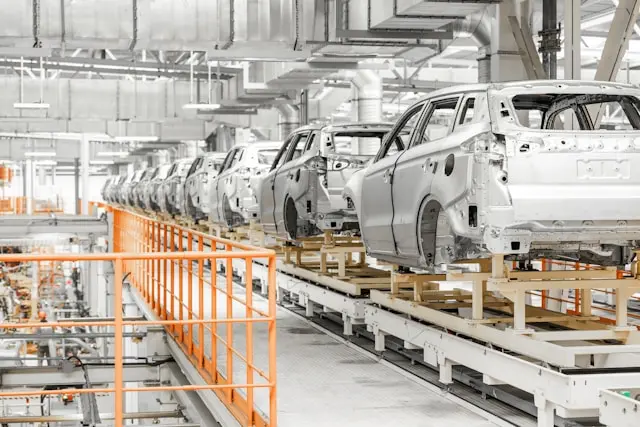
Oradea's automotive and electromechanical cluster directly employs between 8,500 and 9,200 people across more than 45 manufacturing entities in Bihor County. Continental ContiTech, Valeo Lighting Systems, Kromberg & Schubert, and BorgWarner anchor a supplier ecosystem that ships 35 to 40 per cent of its output across the Hungarian border, feeding just-in-time lines at BMW's Debrecen plant and Audi Hungaria in Győr. The investment story looks strong. BorgWarner has committed €20 million to convert its facility for high-voltage EV connectors. Valeo has spent €12 million upgrading to LED matrix headlamp production. Kromberg & Schubert invested €8.5 million in high-voltage wiring harness lines.
Yet behind these capital commitments sits a structural contradiction that no amount of investment alone can resolve. The very wage differential that attracts foreign direct investment to Oradea's industrial parks is simultaneously pushing the most skilled segment of the workforce across the border to Debrecen or south-east to Cluj-Napoca. Technical roles take an average of 68 days to fill. Senior tooling positions have gone unfilled for more than four months. One precision components manufacturer spent six months searching for a plant operations manager before splitting the role in two and hiring a Hungarian commuter at a 40 per cent premium.
What follows is a ground-level analysis of the forces reshaping Oradea's automotive sector in 2026: the investment that is arriving, the talent that is leaving, and what organisations operating in this market need to understand before they make their next senior hire.
The Bifurcation Driving Everything: ICE Decline Meets EV Acceleration
Oradea's automotive sector is not growing or shrinking. It is splitting in two. Traditional internal combustion engine component manufacturing, including standard wiring harnesses and fluid hoses, faces projected volume declines of 3 to 5 per cent. At the same time, EV-adjacent electromechanical systems such as high-voltage connectivity and sensor fusion modules are forecast to grow 12 to 15 per cent year on year through 2026, according to ACAROM's industry forecast.
This bifurcation is not merely a product mix shift. It is rewriting every job description in the cluster. A maintenance technician who spent a decade working on pneumatic assembly lines now needs PLC programming certification and familiarity with collaborative robotics. A quality manager whose expertise covered conventional hose assemblies must now understand IATF 16949 audit requirements for 800-volt EV architectures. The physical assets on the factory floor are changing faster than the people operating them.
The Debrecen Amplifier
The ramp-up of BMW Group's Debrecen plant to full production by mid-2026 is expected to increase demand for Oradea-based suppliers by 8 to 10 per cent. This is good news for order books. It is difficult news for hiring managers. The same BMW plant, sitting just 120 kilometres north-west, offers net wages 35 to 40 per cent higher than equivalent roles in Oradea. More than 15,000 Romanian workers already commute daily to Hungary from Bihor and Satu Mare counties, according to Romanian Border Police data. Every new position BMW fills in Debrecen tightens the labour market in Oradea.
BorgWarner's Conversion Bet
BorgWarner's plan to convert its former Delphi Connection Systems facility into a high-voltage electrical connector production site, with 200 additional technical roles projected by Q3 2026, illustrates both the opportunity and the constraint. The roles require embedded software competencies, high-voltage safety certification, and familiarity with ARM architecture microcontrollers. The University of Oradea's Faculty of Electrical Engineering and Computer Science produces 180 to 220 graduates annually. ADR Nord-Vest estimates a regional deficit of more than 450 engineers with automation and embedded systems competencies. Capital moved faster than human capital could follow.
The Low-Cost Trap: Why Oradea's Advantage Is Also Its Weakness
Oradea's pitch to foreign investors rests on labour costs 20 to 25 per cent below Debrecen and 15 per cent below Cluj-Napoca. This differential has successfully attracted Continental, Valeo, Kromberg & Schubert, and BorgWarner. It has also created a self-undermining cycle that no individual employer can break on its own.
The mechanism is straightforward. A German Tier-1 supplier selects Oradea for cost arbitrage. It builds a facility. It hires and trains a workforce. Within three to five years, the most capable technicians and engineers, precisely the individuals who received the most investment in training, discover they can earn 25 to 40 per cent more by commuting to Debrecen or relocating to Cluj-Napoca. Oradea firms report losing 8 to 12 per cent of their certified maintenance workforce annually to Hungarian competitors, according to the CCD Bihor Employer Survey 2024.
This is not a cyclical retention problem. It is an embedded feature of the market's positioning. The cost advantage generates investment inflows that cannot be operationally staffed at sustainable quality levels. The cluster's long-term viability is at risk despite headline FDI metrics that look healthy. Hiring leaders operating in this market need to understand that the talent problem is not separate from the business model. It is a direct consequence of it.
The implications for executive hiring in the automotive and manufacturing sector are material. A plant manager accepting a role in Oradea faces a compensation environment 35 to 40 per cent below what Debrecen offers and 18 to 22 per cent below Cluj-Napoca. Average tenure for plant managers in Oradea is 4.2 years, compared with 6.8 years in Timișoara. Senior executives treat Oradea as a stepping stone rather than a destination.
Three Scarcity Profiles That Define the Market
The aggregate numbers, 1,200 to 1,400 monthly open positions, 68-day average time-to-fill for technical roles, tell only part of the story. The real constraint becomes visible in specific role categories where the qualified candidate pool has effectively collapsed.
Automation and Maintenance Technicians with PLC Certification
Unemployment among automation engineers with PLC and SCADA competencies in this market sits below 2 per cent. The active-to-passive candidate ratio is estimated at 1:4. For every qualified technician responding to a job board posting, four others are employed, performing well, and not looking.
The competitive dynamics are fierce. In the pattern typical of this market, Tier-1 manufacturers in the Eurobusiness Industrial Park have engaged in direct poaching cycles. According to reporting in Profit.ro on the "war for technicians" in Western Romania, senior maintenance technicians with Siemens S7 PLC certification have commanded premiums of 25 to 30 per cent to move between employers, with net monthly compensation rising from approximately RON 6,500 to RON 8,500. Positions have remained vacant for more than 90 days before employers resort to external recruitment drives.
For organisations facing this dynamic, the conventional approach of posting a role and waiting for applications reaches at most 20 per cent of viable candidates. The other 80 per cent must be identified and approached directly.
Tooling Engineers with German Language Proficiency
This is perhaps the most constrained profile in Oradea's automotive market. The CCD Bihor Employer Survey 2024 found that 45 per cent of automotive firms resorted to international recruitment or cross-border commuting arrangements for senior tooling roles. The combination of Catia V5 expertise, hot-runner mould knowledge, and German at B2 level or above narrows the candidate universe to a handful of individuals.
The typical search duration for this profile exceeded four months in 2024. One major lighting manufacturer, unable to source locally, ultimately repatriated a Romanian engineer from its subsidiary in Tunisia, offering a housing allowance of €400 per month and a signing bonus equivalent to two months' salary. The local candidate pool for the role produced four applicants. None met the combined technical and language requirements.
Production Managers with EV Component Experience
At the most senior level, the gap is equally acute. Executive search market reports from MRI Worldwide Romania document cases where automotive manufacturers in Bihor County spent six months with two search firms without filling plant operations manager roles. In one pattern confirmed in the Bihor County Council Economic Development Report, a company ultimately split a single role into two positions and hired a Hungarian national commuting from Debrecen at approximately €4,200 net monthly, roughly 40 per cent above the Oradea market median.
This is the market that organisations attempting to fill leadership roles in Oradea actually face. The question is not whether qualified candidates exist. They do. But they are passive, they are employed, and moving them requires a proposition that addresses more than compensation alone.
The Skills Transition Risk No One Has Solved
By 2026, approximately 30 per cent of current production roles in Oradea's automotive sector require fundamental reskilling: PLC programming, collaborative robot operation, and basic data analytics. In 2023, that figure was 12 per cent. The World Economic Forum's Future of Jobs Report identified Romania's automotive sector specifically in its deep dive on this acceleration.
Oradea's automation density stands at 85 to 95 robot units per 10,000 employees. That is below the Romanian automotive average of 120 but above the national manufacturing average of 45, according to the International Federation of Robotics' World Robotics 2024 report. The gap between current automation levels and the automation levels required for EV component production is where the hiring crisis concentrates.
Continental's restructuring illustrates this perfectly. The global programme announced in August 2023 targeted 7,000 administrative job reductions. In Oradea, back-office functions consolidated to shared service centres in Cluj-Napoca and Timișoara. The restructuring headlines created a perception of contraction. The reality on the production floor was the opposite: simultaneous aggressive hiring for Industry 4.0 technicians and thermal management engineers for EV lines. The same site was shedding administrative roles and struggling to fill technical ones. The layoffs and the shortages were not contradictory. They were two expressions of the same force: skill-biased technological change eliminating one kind of work and creating another that does not yet exist in sufficient numbers locally.
For organisations investing in AI and technology-driven manufacturing processes, this mismatch between available skills and required competencies is the defining constraint of the next two years.
Compensation Realities: What Roles Actually Pay and Why It Matters
The compensation picture in Oradea's automotive sector is shaped by three forces: global MNC pay bands, local cost-of-living advantages, and the gravitational pull of higher-wage markets nearby.
A plant manager overseeing a facility of 500-plus employees in Oradea earns between €75,000 and €110,000 in gross annual remuneration. That same role in Debrecen commands 35 to 40 per cent more. In Timișoara, the premium is 12 to 15 per cent. In Cluj-Napoca, 18 to 22 per cent. These are the numbers from the Hays Romania Salary Guide 2024 and the Michael Page Romania Executive Compensation Report 2024. They explain why salary negotiation for senior roles in Oradea almost always becomes a conversation about total proposition rather than base pay.
At the specialist level, automation engineering managers earn €28,000 to €36,000 at the senior level, competing directly with Cluj-Napoca's IT sector, where comparable technical talent commands two to three times manufacturing rates. The BrainSpotting Romania Automotive Salary Benchmark 2024 identifies a passive candidate premium of 20 to 25 per cent for automation engineers: the additional cost required to move someone who is not looking.
German language proficiency adds €6,000 to €8,000 annually to tooling engineer compensation. This premium reflects scarcity, not skill complexity. The language itself is not especially difficult to teach. But the combination of language, technical expertise, and willingness to remain in Oradea rather than pursue opportunities in Germany or Hungary reduces the candidate pool to a size where standard recruitment methods simply fail.
The housing market compounds the challenge. Oradea's residential vacancy rate sits at 2.1 per cent, the lowest in Romania. Average rents rose 18 per cent year on year in 2024. For a senior hire relocating from another city, the compensation package must now account for a housing market that has tightened considerably faster than wages have risen.
Infrastructure and Regulatory Pressures Tightening the Operating Environment
Beyond talent, Oradea's automotive cluster faces operational constraints that directly affect hiring strategy. These are not background factors. They shape which roles are hardest to fill and why.
The Bors Border Bottleneck
The Bors-Ártánd crossing handled more than 2.4 million trucks in 2023. Despite modernisation, customs clearance times average 45 to 60 minutes per truck during peak periods. For a just-in-time supply chain delivering to BMW Debrecen, a 45-minute delay is not an inconvenience. It is a production-line stoppage risk. This creates specific demand for logistics professionals with cross-border customs expertise, a profile that barely existed five years ago and now commands a premium in a market where talent mapping across borders is essential.
Energy and Sustainability Compliance
Bihor County's industrial electricity consumption is approaching substation limits. New investments exceeding 10 megawatts face connection delays of 12 to 18 months. Simultaneously, the EU Corporate Sustainability Due Diligence Directive requires Tier-1 manufacturers to map human rights and environmental compliance across their Tier-2 and Tier-3 suppliers by 2026. For Oradea's dense network of SME subcontractors, compliance costs estimated at €50,000 to €150,000 per entity threaten consolidation. CSRD reporting obligations for companies with more than 250 employees further divert capital from automation investment toward ESG data infrastructure.
These regulatory requirements create demand for sustainability officers, compliance managers, and ESG data analysts in a market that has historically hired production engineers and maintenance technicians. The roles are new. The candidate pool is nonexistent locally. And the competition for these profiles extends far beyond Oradea's borders.
What Hiring Leaders in This Market Need to Do Differently
The conventional approach to filling roles in Oradea's automotive sector has been to post on local job boards, engage a generalist recruitment agency, and wait. For production operators and junior engineers, this still works. Response rates from eJobs.ro and BestJobs.ro remain strong for these profiles.
For every role above that level, it does not work. The data is unambiguous. Automation engineers: active-to-passive ratio of 1:4. Senior quality managers: predominantly passive, moving only through trusted networks or direct executive search mandates. Tooling engineers with OEM relationships: average tenure exceeding five years, moves triggered only by plant closures or extraordinary relocation packages.
The 68-day average time-to-fill for technical roles disguises a bimodal distribution. Junior roles fill quickly. Senior roles take months or fail entirely. When a search fails, the cost is not limited to the recruiter's fee. It is measured in delayed production ramp-ups, overtime costs for the team covering the vacancy, and in the most serious cases, JIT delivery failures that damage OEM relationships built over years.
The organisations succeeding in this market share three characteristics. First, they identify passive candidates through systematic talent pipeline development before the vacancy arises. Second, they construct total propositions that address not just compensation but career trajectory, housing support, and family considerations. The repatriation package that one lighting manufacturer offered, housing allowance plus signing bonus, is now standard practice for senior technical roles, not an exception. Third, they move fast. In a market where qualified candidates receive multiple approaches, the cost of a slow search is measured in candidates lost to competitors who moved first.
KiTalent's approach to this market reflects these realities. With interview-ready executive candidates delivered within 7 to 10 days and a pay-per-interview model that eliminates upfront retainer risk, the methodology is built for markets where speed determines outcome. A 96 per cent one-year retention rate across more than 1,450 executive placements demonstrates that rapid identification does not come at the cost of candidate quality.
For organisations competing for automation engineers, plant managers, and senior technical leaders in Oradea's automotive sector, where the candidates who can fill these roles are employed, passive, and receiving competitive approaches from Debrecen and Cluj-Napoca simultaneously, speak with our executive search team about how KiTalent approaches this market through AI-powered talent mapping and headhunting methodology designed specifically for candidate-short environments.
Frequently Asked Questions
What is the average time-to-fill for technical roles in Oradea's automotive sector?
Technical roles in Oradea's automotive and electromechanical sector take an average of 68 days to fill, compared with 22 days for unskilled operator positions. Senior specialist roles such as tooling engineers and automation managers frequently exceed 90 to 120 days. In documented cases, plant manager searches have run for six months without a successful hire. The disparity reflects a market where junior talent remains accessible through job boards, but qualified senior professionals are overwhelmingly passive and must be identified through direct search and headhunting approaches.
Why is it so hard to hire automation engineers in Oradea?
Unemployment among automation engineers with PLC and SCADA competencies in Bihor County sits below 2 per cent. The active-to-passive candidate ratio is approximately 1:4, meaning four qualified professionals are employed and not looking for every one who is visible on the market. Oradea's wage levels sit 20 to 25 per cent below Debrecen and 15 per cent below Cluj-Napoca, creating constant outward pressure on the most mobile segment of the workforce. Employers report losing 8 to 12 per cent of certified maintenance staff annually to Hungarian competitors.
How does Debrecen's BMW plant affect hiring in Oradea?
BMW Group's Debrecen plant, ramping to full production by mid-2026, sits 120 kilometres from Oradea and offers net wages 35 to 40 per cent higher for equivalent technical roles. More than 15,000 Romanian workers already commute daily to Hungary. The plant simultaneously increases demand for Oradea-based suppliers by 8 to 10 per cent while pulling the most skilled workers across the border. This dual effect, growing order books and shrinking talent pools, is the central tension facing every manufacturing executive hiring decision in the region.
What do plant managers earn in Oradea compared to other Romanian cities?
A plant manager overseeing 500-plus employees in Oradea earns between €75,000 and €110,000 in gross annual remuneration. Timișoara pays 12 to 15 per cent more. Cluj-Napoca pays 18 to 22 per cent more. Debrecen, Hungary, pays 35 to 40 per cent more. Average tenure for plant managers in Oradea is 4.2 years versus 6.8 years in Timișoara, reflecting the role's function as a career stepping stone rather than a long-term position.
What skills are most in demand for Oradea's EV transition?
The EV transition is driving acute demand for high-voltage safety certification for 800V-plus architectures, collaborative robotics programming for Universal Robots and Fanuc platforms, embedded software development in C/C++ for automotive microcontrollers, and IATF 16949 and VDA 6.3 quality system expertise. By 2026, approximately 30 per cent of current production roles require fundamental reskilling. The University of Oradea produces 180 to 220 engineering graduates annually against a regional deficit exceeding 450 engineers with the required competencies.
How does KiTalent approach executive search in candidate-short manufacturing markets?
KiTalent uses AI-powered talent mapping to identify passive candidates who are not visible through job boards or standard recruitment channels. In markets like Oradea where 80 per cent of qualified senior professionals are employed and not actively seeking, this direct identification methodology is the difference between a successful placement and a prolonged vacancy. KiTalent delivers interview-ready candidates within 7 to 10 days, operates on a pay-per-interview model with no upfront retainer, and maintains a 96 per cent one-year retention rate across more than 1,450 completed placements.