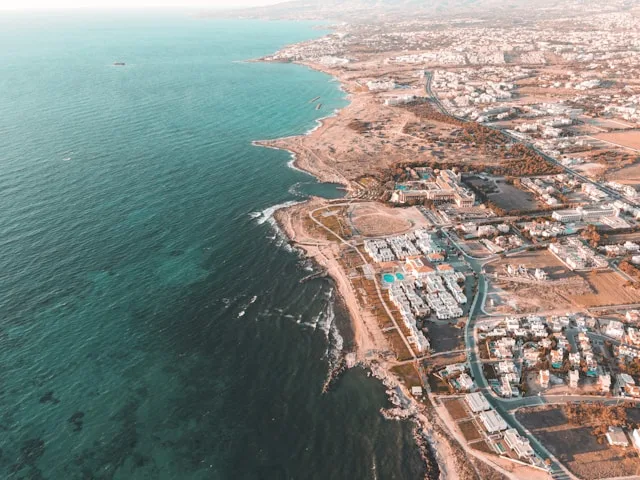
Paphos Real Estate in 2026: €580 Million in Investment, Zero Growth in the Workforce That Builds It

Paphos District absorbed €580 million in direct real estate investment in 2023. Construction permits covered 1,156 new residential units. The Permanent Residency Program alone channelled €330 million into the district through 1,102 applications. By every capital metric, this is a property market running hot.
Yet construction employment in the Paphos region has flatlined at approximately 8,200 workers since 2022. The pipeline of projects is expanding. The workforce building them is not. The gap between the money entering this market and the professionals available to deploy it is the defining constraint of Paphos real estate in 2026, and it is widening in ways that aggregate statistics do not reveal.
What follows is a structured analysis of the forces reshaping Paphos's property sector, the employers driving that change, and what senior leaders need to understand before they make their next hiring or talent retention decision in this market.
A Market Reshaped by a New Kind of Buyer
The conventional narrative about Paphos real estate centres on British retirees buying villas in the sun. That narrative is roughly five years out of date. Foreign buyers still dominate, accounting for 52% of property transfers by value in the first half of 2024, according to the Department of Lands and Surveys. But the composition of those buyers has shifted decisively.
Israeli nationals now represent 35% of foreign purchasers. Chinese investors using the Permanent Residency Program form a growing segment. The "active retirement" and digital nomad demographics, buyers under 50 with no intention of retiring, constitute 40% of foreign purchases according to the Central Bank of Cyprus. Meanwhile, British demand has declined 18% year on year, driven by post-Brexit residency complications that have made Cyprus a harder proposition for UK nationals than it was a decade ago.
This is not a cosmetic shift. It rewrites the service requirements for every firm operating in the Paphos property ecosystem. A market built around English-speaking retirees who wanted a villa and a maintenance contract now serves Hebrew-speaking investors who want residency compliance, rental yield optimisation, and a multilingual point of contact. The firms that have adapted to this new buyer profile are growing. The firms that have not are losing market share to those that have.
The Permanent Residency Program as Market Architecture
The €300,000 minimum investment threshold for the Permanent Residency Program is not merely a policy detail. It is the single most important price-setting mechanism in the Paphos residential market. Construction permits are concentrated in the €300,000 to €600,000 bracket for a reason: that is the window where a property qualifies for the programme while still offering developers viable margins.
The May 2023 amendments tightened requirements further: the minimum investment rose from €200,000 in some categories, applicants must demonstrate €50,000 in annual income, and resale properties in certain districts are now excluded. Processing times have extended to 18 to 24 months due to enhanced due diligence. For developers reliant on milestone payments tied to residency approvals, this creates material cash-flow exposure. A project that breaks ground expecting a 12-month residency timeline and encounters a 24-month reality faces a capital gap that no amount of sales activity can close on schedule.
The consequence is a market that looks strong at the headline level but operates under considerable internal stress. Demand is concentrated in a narrow price band. Cash flow depends on regulatory timelines that the developer cannot control. And the €300,000-plus segment is showing early signs of oversaturation while affordable housing for Cypriot nationals remains chronically underdeveloped.
The Bifurcation Hiding Behind the Headlines
Paphos residential property prices appreciated 7% year on year as of mid-2024, according to the Central Bank of Cyprus Residential Property Price Index. That figure describes two entirely different markets averaged into one number.
The investment-migration segment, cash buyers spending €300,000 and above, remains stable. These purchasers are insensitive to European Central Bank rate movements because they are not borrowing. They buy for residency, for rental yield, or for capital preservation. Their demand is driven by geopolitical factors in their home markets, not by Cypriot mortgage conditions.
The local residential segment tells a different story. New housing loans across Cyprus fell 12.3% year on year in Q2 2024. Average interest rates on new mortgages reached 4.85%. In Paphos, where domestic buyers historically constitute only 30% of the market, mortgage-dependent Cypriot buyers have experienced a 40% deterioration in affordability since 2022, according to the Bank of Cyprus Housing Affordability Index. First-time buyer participation has contracted sharply.
This creates a market where foreign capital sets prices that local salaries cannot match. The 7% headline appreciation is real, but it is being driven almost entirely by the cash-buyer segment. For Cypriot nationals working in the property sector itself, the market they serve is increasingly one they cannot afford to live in. That affordability gap is not just a social concern. It is a retention problem. Every property manager, every junior surveyor, every estate agent coordinator earning a local salary in Paphos is doing the arithmetic on whether Limassol or Athens offers a better cost-of-living equation.
The Employers Shaping the Market
Paphos's property sector is dominated by a small number of developers whose project pipelines determine hiring demand across the district.
The Major Developers
Leptos Estates is the largest operator, with approximately 220 group-wide employees and €340 million in assets under development as of its 2023 annual report. Pafilia Property Developers, headquartered in Paphos with around 180 staff, has built its business specifically around the investment-migration market, positioning itself for the buyer demographic that now drives the district. Aristo Developers, listed on the Cyprus Stock Exchange, manages substantial projects including Minthis Hills and Venus Rock, with approximately 150 Paphos-based employees. Konia Construction occupies the mid-tier segment, focusing on the €250,000 to €400,000 bracket with around 80 employees.
On the agency side, Purple International operates with 45 Paphos-based agents focused entirely on foreign buyers. BuySell, the largest agency network in Cyprus, handles approximately 18% of Paphos district transactions through its local branch. Fox Smart Estate Agency has built a technology-integrated platform with growing Paphos operations.
Institutional Anchors
The Paphos Chamber of Commerce and Industry represents over 1,200 businesses, including 180 construction and real estate firms. The Cyprus Land Development Corporation maintains a regional office overseeing affordable housing schemes. The Paphos Regional Tourism Board is a critical node for holiday-rental managers whose businesses depend on the seasonal visitor economy.
What is notably absent is a Tier 1 research university. The Cyprus University of Technology is based in Limassol, not Paphos. Young Cypriot engineers and architects trained at TEPAK are far more likely to begin their careers in Limassol, where the university is located and where larger-scale commercial developments offer faster career progression. Paphos has an investment pipeline but lacks the educational infrastructure that would naturally feed local talent into it.
Where the Talent Gaps Are Most Acute
The capital pouring into Paphos has not produced a proportional increase in the people required to manage it. Construction employment has held at roughly 8,200 workers since 2022. The workforce relies on 65% non-Cypriot labour, primarily from Sri Lanka, Vietnam, and EU member states. Post-Brexit restrictions on UK workers and EU labour mobility toward higher-wage German construction markets have tightened supply at the exact moment the project pipeline is expanding.
Three role categories face the most severe shortages.
Quantity surveyors with EU public procurement compliance experience are the scarcest technical professionals in the Paphos market. Construction firms report average vacancy periods of 5.7 months for senior quantity surveyor roles, compared to 2.1 months for general administrative positions, according to the Cyprus Employers and Industrialists Federation skills shortage survey. Qualified professionals in this category exhibit 85% passive candidate characteristics: they are employed, not applying to job postings, and reachable only through direct identification and approach.
Construction project managers with experience on schemes valued at €5 million or above are similarly constrained. The passive candidate ratio sits at approximately 80%. These professionals hold three-to-five-year tenures and move through network referrals, not applications. The development pipeline scheduled for 2026, including the €120 million Paphos Marina expansion and Leptos Group's €85 million Coral Bay Residences Phase III, will require an estimated 35 mid-to-senior management professionals. The current market cannot supply them without pulling from Limassol, where those same professionals command a 15 to 25% salary premium.
Multilingual property consultants fluent in Hebrew, Arabic, or Mandarin represent the third critical gap. With Israeli buyers comprising 35% of foreign purchases, the ability to serve these clients in their own language is not a differentiator. It is a baseline requirement. Estate agencies report offering commission splits of 3.5% versus the standard 2.5% to acquire consultants with established Israeli buyer networks. That is not a salary adjustment. It is a poaching premium of 20 to 25% above market, paid because the alternative is losing deal flow entirely.
The executive sales directors who manage these relationships present the most extreme passive candidate profile in the market: an estimated 90% are passive, locked into 12 to 24 month non-compete agreements and equity arrangements that make them expensive and difficult to move.
Compensation in Context: What Paphos Pays and Why It Loses
The compensation data for Paphos real estate roles reveals a market that pays enough to function but not enough to compete with its nearest rivals for senior talent.
A senior quantity surveyor or contracts manager in Paphos earns €48,000 to €68,000 annually, with project completion bonuses of €5,000 to €15,000. At the executive level, a VP or director of construction commands €95,000 to €140,000 base, with total cash compensation reaching €120,000 to €180,000. Senior property consultants earn €32,000 to €45,000 base, but top performers with strong foreign buyer networks reach €80,000 to €120,000 in total compensation through commissions. Sales directors at high-volume agencies can earn €150,000 to €250,000 in total packages.
These figures are competitive within Paphos itself. They are not competitive against Limassol, where construction managers command 15 to 25% premiums driven by larger-scale commercial developments. The City of Dreams Mediterranean casino-resort project and Limassol's marine developments have absorbed an estimated 30% of Cyprus's available senior project management talent since 2022, according to Deloitte Cyprus.
Dubai represents the more existential competitive threat. Tax-free compensation packages for comparable real estate sales roles are 40 to 60% higher than Paphos, according to Knight Frank's Global Buyer Survey. Dubai also offers a clearer career trajectory into global markets. The pattern of experienced sales directors leaving Paphos for Dubai and Abu Dhabi is consistent and ongoing, with an estimated 15 to 20 departures annually inferred from mobility data and recruitment reports.
Athens competes for Greek-speaking technical professionals. Salary ranges for senior architects and civil engineers are similar, €40,000 to €60,000, but Athens offers superior cultural amenities and professional development opportunities. For younger Cypriot professionals weighing their options, the pull of Athens or Limassol against the constraint of Paphos's limited career ecosystem is a calculation that Paphos consistently loses.
The compensation gap between Paphos and its competitors is not closing. It is widening fastest at exactly the seniority level where the most critical roles sit. A junior sales associate in Paphos faces a modest differential against Limassol. A construction director faces a gap that only personal lifestyle preference can bridge. And for the executive talent that determines whether a €120 million marina project delivers on time, lifestyle preference is not enough when the alternative market offers both a premium and a larger stage.
The Regulatory Pressures Compounding the Problem
The talent constraints in Paphos are not operating in isolation. Three regulatory forces are simultaneously increasing the complexity of operating in this market, which in turn increases the seniority and specialisation required of the people running these businesses.
EU Short-Term Rental Regulation
The EU's proposed regulation on short-term rentals, expected for implementation in 2026, will require platform data sharing and municipal registration for all holiday-let properties. The European Commission's proposal estimates compliance costs of €2,000 to €4,000 per property annually. In Paphos, where coastal vacation rental occupancy swings from 94% in July-August to 38% in January-February, that per-property cost falls on revenue that is already highly seasonal. An estimated 15 to 20% of current holiday rental stock may be removed from legal operation due to the requirement for Energy Performance Certificates at a minimum Class E standard, a threshold that much of Paphos's aging building stock cannot meet without capital investment.
This regulation will filter out smaller, less professional operators. The surviving firms will need property managers who understand platform optimisation, energy compliance, and municipal registration processes across jurisdictions. That is a more sophisticated role than the market has traditionally required.
Environmental Constraints on New Supply
Forty-two percent of Paphos District's coastal areas fall under Natura 2000 environmental protection designations, according to the European Environment Agency. This severely constrains new beachfront development, concentrating construction activity in inland zones and driving up the premium on existing coastal stock. For developers, it means every permitted coastal project carries higher stakes. For hiring leaders, it means the project managers and planning consultants who can deliver within these constraints are even scarcer than the headline vacancy data suggests.
Water Scarcity as an Operating Cost
Paphos faces chronic water stress. The Asprokremmos Dam operates at approximately 35% capacity annually, forcing reliance on desalination plants that increase construction operating costs by 8 to 12%. This is not a temporary condition. It is a permanent feature of the operating environment that affects project budgets, timeline assumptions, and ultimately the profitability calculations that determine whether compensation packages can compete with Limassol or Dubai.
What This Means for Hiring Leaders in Paphos
The original insight that emerges from this data is not that Paphos has a talent shortage. Every growing property market has a talent shortage. The insight is that capital investment has moved faster than human capital could follow, and the market's own structure prevents it from catching up.
Paphos is capital-rich and labour-constrained. €580 million flows in. Construction employment stays flat. The money is absorbed by imported materials and technology rather than translating into local job creation or workforce expansion. The development pipeline for 2026 assumes a workforce that does not yet exist in Paphos in sufficient numbers. The competitive dynamics of Limassol and Dubai ensure that the most experienced professionals have better-paying alternatives. And the absence of a local research university means there is no natural feeder of young technical talent into the district's pipeline.
For any organisation hiring into Paphos's property sector at the senior level, three realities must inform strategy.
First, the candidates who matter most are not looking. At the senior quantity surveyor level, 85% are passive. At the project management level, 80%. At the executive sales director level, 90%. A job posting strategy in this market reaches, at best, the least experienced slice of the available pool. The professionals with the track records, the language capabilities, and the foreign buyer networks that justify their compensation are already employed, already performing, and already being courted by competitors offering more.
Second, the search timeline in Paphos is structurally longer than in larger markets. A senior quantity surveyor search runs 5.7 months on average. That is not because recruiters are slow. It is because the addressable talent pool is small, the passive candidate ratio is extreme, and the competitive offers from Limassol require counter-proposals that take time to construct and approve.
Third, the multilingual requirement is not optional. With 52% of transactions driven by foreign buyers and 35% of those buyers being Israeli nationals, the ability to engage in Hebrew, Arabic, or Mandarin is a functional requirement for client-facing roles. This narrows the effective candidate pool even further, because language capability combined with real estate expertise combined with willingness to work in Paphos is a triple filter that eliminates most applicants before the first conversation.
KiTalent's approach to this market begins with AI-powered talent mapping that identifies the passive professionals who match all three filters simultaneously. Rather than advertising and waiting, our methodology identifies where these candidates sit, what would move them, and what package structure is required to make the transition viable. With interview-ready candidates delivered within 7 to 10 days and a pay-per-interview model that eliminates upfront retainer risk, the approach is built for markets where conventional search consistently underperforms.
For organisations hiring senior construction leadership, multilingual sales directors, or property management executives in Paphos, where 80 to 90% of the candidates you need will never see your job posting and the cost of a six-month vacancy is measured in project delays and lost deal flow, start a conversation with our executive search team about how we identify and deliver the talent this market requires.
Frequently Asked Questions
What are the biggest hiring challenges in Paphos real estate in 2026?
The three most acute shortages are senior quantity surveyors with EU procurement compliance experience, construction project managers capable of overseeing schemes above €5 million, and multilingual property consultants fluent in Hebrew, Arabic, or Mandarin. Vacancy periods for senior quantity surveyors average 5.7 months. Passive candidate ratios exceed 80% for all three categories, meaning job advertising reaches only a fraction of viable candidates. Competition from Limassol and Dubai compounds the difficulty, with both markets offering 15 to 60% salary premiums for comparable roles.
What do senior real estate professionals earn in Paphos?
Senior quantity surveyors earn €48,000 to €68,000 base with project bonuses up to €15,000. Construction directors command €95,000 to €140,000 base, reaching €180,000 in total compensation. Sales directors at high-volume agencies earn €75,000 to €110,000 base with total packages of €150,000 to €250,000 through commission overrides. Top-performing property consultants with established foreign buyer networks can reach €120,000 in total earnings. KiTalent provides detailed compensation benchmarking for real estate leadership roles across Cyprus and competing markets.
How has the Paphos property buyer profile changed?
The market has shifted decisively from British retirees toward investment-migration buyers. Israeli nationals now represent 35% of foreign purchasers. Chinese investors using the Permanent Residency Program form a growing segment. Buyers under 50 classified as "active retirement" or digital nomad demographics constitute 40% of foreign purchases. British demand has declined 18% year on year following post-Brexit residency complications. This shift has transformed service requirements from basic property maintenance toward integrated management, rental optimisation, and residency-compliance consulting.
Why is it hard to recruit construction managers in Paphos?
Three factors create the constraint. First, Limassol's larger-scale projects, including the City of Dreams Mediterranean, have absorbed approximately 30% of Cyprus's senior project management talent since 2022. Second, Paphos lacks a local research university, so young Cypriot engineers and architects gravitate toward Limassol or Athens for their first roles and rarely return. Third, 65% of the construction workforce is non-Cypriot, and labour supply from EU states has tightened as workers move toward higher-wage German markets. The result is a talent pipeline that cannot refill as fast as projects demand.
What impact will EU short-term rental regulation have on Paphos?
The EU regulation expected in 2026 requires platform data sharing, municipal registration, and Energy Performance Certificates at minimum Class E standard. Compliance costs are estimated at €2,000 to €4,000 per property annually. An estimated 15 to 20% of current Paphos holiday rental stock may be removed from legal operation because aging building stock cannot meet energy standards without capital investment. Surviving operators will need property managers with more sophisticated regulatory, platform optimisation, and compliance capabilities than the market has traditionally required.
How does KiTalent find passive real estate talent in Paphos?
KiTalent uses direct headhunting methods enhanced by AI-driven talent mapping to identify the 80 to 90% of senior professionals who are employed, not actively searching, and invisible to job boards. In Paphos, where the addressable talent pool is small and language requirements narrow it further, this methodology identifies candidates across Cyprus, the wider Mediterranean, and competing markets like Dubai. Interview-ready shortlists are delivered within 7 to 10 days, with a 96% one-year retention rate on placed candidates and a pay-per-interview pricing model that removes upfront retainer risk.