Aalborg's Offshore Wind Paradox: Denmark's Largest Energy Talent Pipeline and a Workforce That Keeps Disappearing
Aalborg produces more energy engineers per capita than any other city in Denmark. Aalborg University graduates 350 to 400 specialists annually in energy-related disciplines. The city's heavy fabrication yards ran at 85 to 90 per cent capacity through 2025. Port of Aalborg processed an estimated 180,000 tonnes of offshore wind components in 2024 alone, a 40 per cent increase on the prior year.
And yet, by late 2024, the North Denmark Region reported 1,340 vacant positions in energy technology and heavy industry, a vacancy rate of 6.8 per cent, double the regional average across all sectors. Offshore-certified welding roles sat open for an average of 127 days. Senior project management searches stretched across quarters, not weeks. Electrolyzer process engineering roles went unfilled for 8 to 12 months because the regional talent pool for PEM specialists numbered fewer than 20 individuals.
The contradiction is not accidental. It is the product of a specific structural failure that investment alone cannot fix. What follows is an analysis of how Aalborg became one of the most productive and simultaneously one of the most talent-constrained nodes in the European offshore wind supply chain, what the 2026 contract pipeline means for hiring leaders, and why filling the most critical roles in this market requires a method that reaches the professionals who are not looking.
Aalborg's Role in the North Sea Offshore Wind Supply Chain
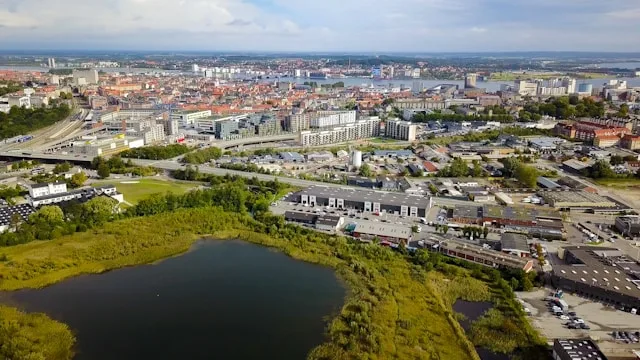
Aalborg's position within European offshore wind is specialised and deliberate. The city is not a turbine assembly centre. It does not host major OEM nacelle production. What it does, it does at scale: heavy steel fabrication for monopiles, transition pieces, and offshore substations, coupled with thermal energy systems for district heating and concentrated solar power.
Bladt Industries, the city's largest private employer in the sector, maintained approximately 1,100 to 1,300 full-time equivalents in direct manufacturing roles through 2024, with an additional 400 to 500 indirect positions in sub-tier coating, logistics, and engineering services. The company's order book included the Changfang and Xidao offshore wind projects in Taiwan and the Hollandse Kust Zuid array in the Netherlands, securing production volume into early 2026 with firm orders for East Anglia THREE in the UK and preliminary work on Baltica 2 in Poland.
Siemens Energy maintains a service and engineering facility in Aalborg's renewable energy and industrial cluster employing 400 to 450 staff, focused on grid integration and service logistics. Semco Maritime contributes approximately 200 employees in offshore wind service and modification engineering. Aalborg CSP, now an Alfa Laval subsidiary, retains 150 to 180 engineers and technicians specialising in thermal storage and heat-exchanger systems for district heating.
The concentration matters for talent analysis. Aalborg's workforce is not diversified across the full wind energy value chain. It is concentrated in fabrication and heavy engineering, with a parallel but smaller vertical in thermal systems. This means the talent requirements are specific, the certifications are demanding, and the competitive set for candidates is narrow. When a search fails in this market, there is no adjacent sector to draw from.
The Missing Generation: Why Graduate Volume Has Not Solved the Shortage
The most counter-intuitive feature of Aalborg's talent market is the coexistence of Denmark's richest per-capita output of energy engineers with its most persistent mid-career shortage. Aalborg University's Department of Energy Technology produces 350 to 400 MSc and BSc graduates annually. Energy Cluster Denmark coordinates 140 member companies in the region. The institutional architecture for a self-sustaining talent ecosystem is in place.
Graduate supply is not the problem
Among engineers with zero to three years of experience, 80 per cent are active job seekers. The pipeline from university to first employment functions. The failure occurs later.
Retention beyond three years falls below 50 per cent, according to Aalborg University's own graduate survey data from 2023. Mid-career professionals, specifically those in the 35 to 45 age bracket with 10 to 15 years of experience, leave Aalborg at higher rates than they enter. They leave for Esbjerg, where Ørsted, Vestas, and Cadeler offer multinational corporate trajectories. They leave for Copenhagen, where headquarters functions in finance, legal, and strategy sit alongside flat-hierarchy career progression. They leave for Hamburg and Bremerhaven, where GW-scale offshore projects and diverse exit opportunities to EPC majors such as Heerema and Boskalis await.
The retention failure creates a structural gap
The result is a "missing generation" in Aalborg's talent pyramid. The city has graduates at the base and a small cohort of senior specialists at the top who have chosen to stay for personal or lifestyle reasons. The layer between them, the project directors, fabrication managers, and principal engineers who should be running the next decade of production, is thin and shrinking.
This is not a gap that expanding university intake can fill. Producing more graduates does not create more professionals with a decade of offshore-specific project leadership experience. The shortage is generational, and it is self-reinforcing: the fewer mid-career leaders remain, the fewer mentors exist for the graduates, and the faster those graduates conclude that career progression requires leaving.
The implication for hiring leaders is direct. Any senior role in this market is competing not only against other employers but against the gravitational pull of three larger cities, each offering something Aalborg structurally cannot match.
Compensation in Context: What Aalborg Pays and Why It Is Not Enough
Aalborg's compensation for energy sector specialists is competitive on paper. An offshore wind project manager at the senior specialist level earns DKK 850,000 to 1,050,000 (approximately €114,000 to €141,000). At executive and VP level, that range extends to DKK 1,600,000 to 2,200,000 (€215,000 to €295,000). A welding engineer or QC manager with offshore certifications commands DKK 650,000 to 780,000, reflecting an 18 per cent shortage premium over land-based construction equivalents.
These figures track 10 to 15 per cent below Copenhagen benchmarks. But adjusted for housing costs, Aalborg offers 8 to 12 per cent higher disposable income. The economics, on a spreadsheet, favour staying.
The problem is that career economics are not household economics. Esbjerg offers 15 to 25 per cent salary premiums for senior project managers alongside international schooling and direct flight connections to London and Hamburg. Hamburg and Bremerhaven compete for German-speaking welding engineers and project directors with 20 to 30 per cent gross salary premiums. The premiums are partially offset by higher German taxation, but the project scale and career optionality are not.
Bladt Industries reported EBIT margins of 3.2 per cent in 2023, down from 5.1 per cent in 2022. Steel price volatility and logistics cost inflation have compressed the margin available for aggressive salary competition. The company cannot simply outbid German or Dutch rivals because the manufacturing economics will not support it. This has led to creative retention solutions: employers in the market now offer commuter arrangements and four-day workweek contracts to retain senior project directors, including employer-funded weekly flights or long-distance rail at an estimated DKK 15,000 to 20,000 per executive per month.
When companies are paying DKK 180,000 to 240,000 annually in travel subsidies per executive just to prevent relocation, the compensation conversation has moved beyond salary benchmarking. It has become a total cost-of-retention calculation that most organisations in this market have not yet fully reckoned with.
Green Hydrogen: The Demand Shock That Arrives Before the Talent Does
The Aalborg Green Fuel consortium, involving Port of Aalborg, Aalborg CSP, and Copenhagen Atomics, anticipated a final investment decision on a 50 to 100 MW electrolyzer facility by Q3 2025, with operations targeted for 2027. The project was expected to create 80 to 120 specialised roles in electrolyzer maintenance, process engineering, and hydrogen logistics.
The talent market for these roles in Aalborg does not exist in any meaningful sense.
A new discipline with no local bench
The regional pool for PEM electrolyzer technicians contains fewer than 20 individuals with relevant experience. Nationally, Denmark holds fewer than 200 qualified professionals in this field. Recruitment patterns indicate that consortium partners experienced recruitment stalls of 8 to 12 months on senior electrolyzer technician roles, resulting in project timeline adjustments. The candidates who do exist in Europe tend to sit at Thyssenkrupp nucera in Germany or Nel Hydrogen in Norway, and they typically field three to four simultaneous offers at any given time.
This is not a hiring problem. It is a workforce-creation problem. You cannot recruit experience that does not yet exist in sufficient volume. The electrolyzer process engineer of 2027 must be trained from adjacent disciplines today, or imported from one of two countries, neither of which has surplus capacity.
The Danish Energy Agency's Power-to-X Strategy Implementation Report acknowledged the skills gap explicitly, and the implications for Aalborg are sharper than for larger cities because the green hydrogen cluster depends on a handful of anchor projects rather than a diversified employer base. If the Aalborg Green Fuel project clears its final investment decision and proceeds, the demand for 80 to 120 specialists will arrive in a market that cannot supply 20. If the project is delayed by Energinet commissioning schedules for the Danish Hydrogen Backbone, those projected roles evaporate entirely, and the talent investment question becomes moot.
Either outcome creates a planning problem for hiring leaders. The talent pipeline must be built before the demand materialises, because waiting until project launch guarantees failure.
Cyclicality and the Infrastructure Bet
Port of Aalborg committed DKK 400 million in capital expenditure between 2023 and 2026, deepening quays and reinforcing load-bearing capacity at the Østhavnen expansion specifically for offshore wind monopile storage and pre-assembly. The completed expansion added 200,000 square metres of heavy-load quayside. The port forecasts 220,000 to 250,000 tonnes of offshore wind component throughput for 2026, contingent on North Sea grid-connection schedules.
The infrastructure investment signals long-term confidence in Aalborg as a fabrication hub. The production reality signals something more volatile.
Bladt Industries' order book is concentrated in Taiwanese and Polish projects for the 2024 to 2026 period. The research indicates exposure to geopolitical permitting delays in Taiwan and currency fluctuation risk in the TWD/EUR pair. A delay in the Changfang/Xidao final commissioning would open production gaps at the Aalborg yard, risking temporary layoffs of 200 to 300 contracted welders. The gap between fixed infrastructure committed on a decade-long horizon and variable fabrication demand cycling on 12 to 18 month order windows creates a specific tension.
For talent, this cyclicality compounds the retention problem. A welder or project engineer considering whether to stay in Aalborg or accept a role in Esbjerg must weigh the possibility of a production gap against the stability of a larger, more diversified employer base. The infrastructure investment is a necessary condition for Aalborg's hub ambitions, but it is not a sufficient one. Without demand continuity, the investment creates capacity without certainty, and certainty is what mid-career professionals need to justify staying.
The Certification Bottleneck: A Supply Constraint No Salary Can Solve
Danish collective bargaining agreements require strict certification maintenance for offshore welding under EN ISO 9606-1, with refresher training mandated every six months. Roles requiring EN 1090 EXC4 certification and NORSOK M-501 coating experience represent the acute end of the shortage. These are not credentials that can be accelerated or substituted.
Aalborg Tech College, the regional training provider, is oversubscribed by 40 per cent. This means the pipeline of newly certified offshore welding specialists is physically constrained by classroom and workshop capacity, not by candidate willingness to train. Even if every graduate from the programme entered the local workforce immediately, the output would not match current vacancy volume, let alone the additional demand projected for 2026.
The specialised welding inspector market (CSWIP 3.2 and PCN Level 2 certifications) is approximately 65 per cent passive, with movement triggered only by contract completion or redundancy, never by job advertising. Senior offshore wind project directors with 15 or more years of experience are 75 to 80 per cent passive, according to McKinsey's Global Energy Talent Survey. Electrolyzer process engineers sit at 90 per cent or higher passivity, with a national pool too small to sustain conventional search methods.
The practical consequence is that a traditional recruitment approach, posting a role and waiting for applications, reaches at most 20 to 35 per cent of the viable candidate pool for most specialist positions in this market. For the most critical roles, it reaches fewer than 10 per cent. This is not a metaphor. It is a mathematical description of the gap between visible and actual talent supply.
What Hiring Leaders in This Market Need to Do Differently
The combination of forces acting on Aalborg's talent market, the missing mid-career generation, the compressed fabrication margins limiting salary competition, the certification bottleneck, the cyclical demand volatility, and the emergence of hydrogen as a new discipline with no existing workforce, produces a hiring environment where conventional methods are structurally inadequate.
Speed matters more than in most markets
When an offshore-certified welding specialist role sits open for 127 days in North Denmark compared to 45 days for a general manufacturing welder, the cost is not merely the vacancy. It is the production schedule risk on a monopile order with contractual delivery penalties. When a senior project director search stretches across quarters, the cost includes DKK 180,000 or more in annual commuter subsidies for the interim arrangement that keeps the project moving.
The organisations that fill these roles are not posting them more widely. They are reaching candidates who are not looking. In a market where 75 to 80 per cent of senior offshore wind professionals are passively employed and averaging 4.2 years of tenure at their current employer, the search methodology determines the outcome more than the compensation package does.
Cross-border sourcing is not optional
The electrolyzer talent gap alone demonstrates that Aalborg's hiring future is international by necessity. With fewer than 200 qualified PEM process engineers in Denmark and a projected demand for 80 to 120 in a single consortium project, the arithmetic requires international executive search capability that can identify and engage candidates in Germany, Norway, and beyond. Domestically focused sourcing will not solve a problem that domestic talent supply cannot address.
The cost of a failed search is higher than the cost of a better one
When a wrong senior hire costs multiples of their annual salary in a market this constrained, the economics favour investment in precision. KiTalent's approach to this market combines AI-enhanced talent mapping with direct headhunting to reach the passive majority that job boards and inbound applications miss. Interview-ready candidates are delivered within 7 to 10 days, with a pay-per-interview model that eliminates the retainer risk of conventional search. With a 96 per cent one-year retention rate across 1,450 executive placements, the method is designed for markets where the margin for error is narrow and the cost of delay is measured in production schedules and regulatory timelines.
For organisations hiring into Aalborg's offshore wind, thermal systems, or emerging hydrogen sectors, where the candidates you need are not visible on any job board and the production calendar does not wait for a conventional search cycle, speak with our executive search team about how KiTalent approaches this market.
Frequently Asked Questions
What are the hardest offshore wind roles to fill in Aalborg?
Three categories present the most acute difficulty. Offshore-certified welding specialists with EN 1090 EXC4 and NORSOK M-501 credentials average 127 days to fill in North Denmark. Senior EPC project managers with 15 or more years of experience are 75 to 80 per cent passive and frequently retained through commuter arrangements rather than local residence. PEM electrolyzer process engineers represent an emerging category where the regional talent pool numbers fewer than 20 qualified individuals. Each requires direct headhunting methodology rather than conventional job advertising.
What do offshore wind project managers earn in Aalborg?
At senior specialist and manager level, offshore wind project managers in Aalborg earn DKK 850,000 to 1,050,000 annually (approximately €114,000 to €141,000), including base salary and expected bonus but excluding pension contributions of 12 to 17 per cent. At executive and VP level, compensation ranges from DKK 1,600,000 to 2,200,000 (€215,000 to €295,000). These figures track 10 to 15 per cent below Copenhagen but offer 8 to 12 per cent higher disposable income when adjusted for housing costs.
Why does Aalborg struggle to retain mid-career energy professionals?
Aalborg produces Denmark's highest per-capita volume of energy engineering graduates, but retention beyond three years of experience falls below 50 per cent. Mid-career professionals aged 35 to 45 migrate to Esbjerg for multinational corporate trajectories at firms such as Ørsted and Vestas, to Copenhagen for headquarters functions and career progression, or to Hamburg for larger project scale and diverse exit opportunities. The result is a missing generation of 10 to 15 year experienced professionals that university expansion alone cannot replace.
What is the outlook for green hydrogen jobs in Aalborg?
The Aalborg Green Fuel consortium planned a final investment decision on a 50 to 100 MW electrolyzer facility, with operations targeted for 2027. If the project proceeds, it is expected to create 80 to 120 specialised roles in electrolyzer maintenance, process engineering, and hydrogen logistics. However, grid connection and regulatory uncertainties around the Danish Hydrogen Backbone could delay the timeline. Organisations planning to hire into this sector should begin building a talent pipeline before demand materialises, given that domestic supply is effectively zero.
How does KiTalent approach executive search in Aalborg's offshore wind market?
KiTalent uses AI-enhanced talent mapping combined with direct headhunting to identify and engage the passive professionals who represent 65 to 90 per cent of the qualified candidate pool in Aalborg's energy sector. The method delivers interview-ready candidates within 7 to 10 days and operates on a pay-per-interview model with no upfront retainer. With cross-border sourcing capability spanning German, Norwegian, and wider European markets, the approach addresses the international recruitment requirement that Aalborg's emerging hydrogen and specialist fabrication roles demand.
Is Aalborg or Esbjerg the better base for an offshore wind career?
Esbjerg is Denmark's primary offshore wind service port and offers 15 to 25 per cent salary premiums for senior roles, superior international schooling, and direct flight connections. Aalborg offers higher disposable income after housing costs, a strong university pipeline, and specialisation in heavy fabrication and thermal systems rather than turbine service. The choice depends on career trajectory: Esbjerg suits professionals seeking multinational OEM or installation vessel careers, while Aalborg suits those focused on manufacturing leadership, thermal energy systems, or the emerging green hydrogen cluster.