Düsseldorf's Creative Industry Is Splitting in Two: What That Means for Every Senior Hire in This Market
Düsseldorf's creative sector employs between 18,500 and 20,000 people across advertising, design, publishing, and event services. An additional 8,000 work in ancillary tech and logistics roles that depend on the same ecosystem. By any measure, this is one of Germany's most concentrated creative economies. It is also a market where the old operating model is breaking apart faster than the new one can absorb it.
The fracture runs along a line most hiring leaders have not yet fully mapped. On one side sit the premium brand agencies anchored in Medienhafen, serving luxury and B2B clients, paying top-quartile rents and retaining senior creative talent through reputation and proximity. On the other sit the performance marketing, MarTech, and digital event operations migrating outward to Flingern-Süd, Derendorf, and satellite towns. These are not just two real estate strategies. They are two different labour markets with different role profiles, different compensation structures, and different competitive dynamics. An executive search that treats Düsseldorf's creative sector as a single market will reach the wrong candidates or, more likely, no candidates at all.
What follows is a structured analysis of the forces reshaping this sector, the employers driving that change, and what senior leaders need to understand before they make their next hiring or retention decision.
The Medienhafen Paradox: Why a Full District Does Not Mean a Full Talent Pool
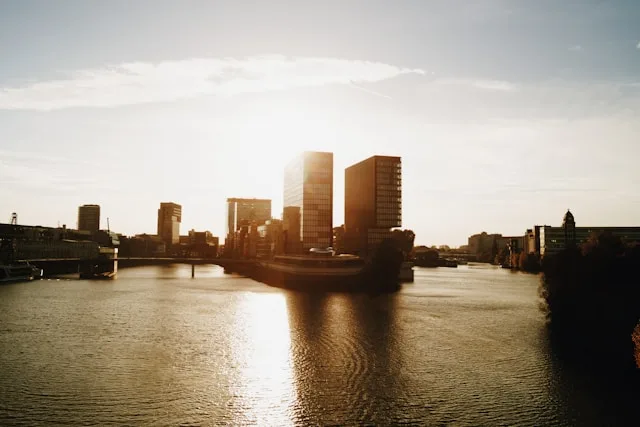
Medienhafen remains, architecturally and commercially, the centrepiece of Düsseldorf's creative economy. Frank Gehry's buildings, the Rheinische Post Mediengruppe headquarters, more than 200 companies in architecture, design, and brand experience: the district functions as a client-facing showroom for the city's highest-value creative work. Vacancy rates sit below 5%, with waiting lists for waterfront offices reported by CBRE in late 2024.
Yet the district's commercial health masks a compositional shift that matters for anyone trying to hire creative leadership here. Prime rents have climbed 18% since 2021, reaching €25 to €28 per square metre per month. Lease renewals signed through 2024 carried 12 to 15% escalations. At that price, the tenants who can afford to stay are not necessarily the tenants who built the cluster's creative reputation. Law firms and consultancies can absorb Medienhafen rents. A 60-person independent advertising agency with 15% margins cannot.
Where the Mid-Market Agencies Have Gone
The result is what JLL's Office Market Outlook for 2025 calls "creative spillover." Mid-sized advertising agencies and production studios have relocated to Flingern-Süd and Derendorf, where rents are materially lower and the space better suited to production workflows. JLL projects 6 to 8% net absorption of creative-sector office space in Derendorf, against flat demand in Medienhafen proper. The creative cluster is not shrinking. It is dispersing.
For hiring, this dispersion creates a practical problem. The senior creative directors and strategy leads who built their networks in the harbour district are not necessarily following their former employers to Flingern. Some are staying at the premium agencies that remain. Others are moving to Cologne or Hamburg entirely. The geographic signal that once made sourcing in this market relatively straightforward has weakened. A talent mapping exercise that stops at Medienhafen now misses a growing share of the viable candidate pool.
Three Roles the Market Cannot Fill, and Why Each One Is Different
Düsseldorf's creative sector faces acute shortages in three distinct professional categories. Each has a different cause, a different competitive dynamic, and a different implication for how a search must be run.
Senior MarTech Architects and Marketing Data Scientists
Demand for professionals who bridge Adobe Experience Cloud or Salesforce Marketing Cloud implementation with first-party data strategy exceeds supply by an estimated 3:1 ratio, according to the Hays Fachkräftemangel Index for marketing and sales. These are not pure technologists. They sit at the intersection of IT infrastructure and GDPR-compliant customer data platform management, a combination that NRW's strict data protection authorities make more complex than in most German states.
The practical consequence is severe. IHK Nordrhein's analysis of the creative economy found that mid-sized B2B agencies serving Messe Düsseldorf exhibitors typically endure six to nine-month vacancy periods for Marketing Automation Lead roles. Many resort to freelance contractors at 40 to 50% hourly rate premiums to meet client CRM integration deadlines. The freelancers fill the delivery gap. They do not fill the strategic gap. An agency running its MarTech function on contract labour cannot build the proprietary data capabilities its clients are beginning to demand.
Creative Technologists for XR and AR Event Production
Düsseldorf's trade fair ecosystem requires an estimated 150 to 200 specialists in Unity and Unreal Engine development for augmented reality exhibition stands and virtual showrooms. Regional universities supply approximately 40 to 50 annually. The arithmetic is blunt and the gap is widening, not closing.
Aggregate data from StepStone's 2024 Talent Shortage Report shows 120-plus days average time-to-fill for Senior Creative Developer roles in the Düsseldorf event sector. A comparable general IT role fills in 45 days. Event production houses that need AR developers are poaching them from competing firms with total compensation packages 25 to 30% above standard software developer rates, including project-completion bonuses tied to trade fair cycles. This is a market where every hire creates a vacancy somewhere else. The sector is not growing its talent base. It is recirculating it.
Sustainability Compliance Managers for Events
This is the role that barely exists yet. The EU Green Deal's compliance requirements for temporary structures, combined with Messe Düsseldorf's own 2025 sustainability roadmap, anticipate that 30% of service contracts will include carbon-footprint reporting clauses by 2026. The professionals who combine exhibition logistics knowledge with EU taxonomy compliance and circular material science are, in the language of the GWA Zukunftsreport, "effectively nonexistent in current labour supply."
The implication for hiring executives is that you cannot recruit experience that has not yet been created. This is not a search problem. It is a development problem. Organisations that need this capability in 2026 had to begin building it internally in 2024, or they will need to import it from adjacent industries: construction sustainability consultants, packaging compliance specialists, or environmental engineers willing to cross into events.
The Cologne Drain: A Structural Constraint, Not a Temporary Inconvenience
Thirty kilometres north, Cologne's MediaPark hosts RTL Deutschland and WDR, offering broadcast-scale production infrastructure that Düsseldorf simply does not have. The absence of a major broadcast television network headquarters in Düsseldorf is not a gap that can be closed through economic development incentives. It is a permanent feature of the competitive geography.
The consequence is measurable. IHK Nordrhein's 2024 agency survey documented 25% annual turnover among video editors at Düsseldorf agencies, with departing talent specifically citing Cologne broadcast opportunities. The drain is concentrated in the 25 to 35 age cohort, precisely the demographic that agencies need to build their next generation of creative leadership. Salaries for motion designers and video producers in Cologne run 8 to 12% above Düsseldorf averages, according to Medienstadt Köln's employment report.
But compensation alone does not explain the pull. Cologne offers integrated campaign production: television, digital, and live events under one roof or within the same district. Düsseldorf agencies that need broadcast production must subcontract to Cologne partners. A senior creative professional who wants to direct a complete campaign, from television spot through augmented reality trade fair activation, will find that Düsseldorf can offer only part of that workflow. Cologne offers the whole thing.
For executive hiring in advertising and creative services, this constraint shapes every search for a Creative Director or Executive Creative Director in this market. The candidate pool is smaller than it appears because a meaningful portion of the talent that should be here has already left, and the value proposition required to bring them back must address the infrastructure gap, not just the salary.
What Roles Actually Pay in Düsseldorf's Creative Sector
Compensation data for this market, drawn from Hays, StepStone, Kienbaum, and the GWA Agenturreport, reveals a sector where pay varies enormously by function and seniority. Understanding these bands is essential for any search because the gap between what hiring managers expect to pay and what the market actually demands is where most searches stall.
At the senior specialist and manager level, a Senior Art Director or Copywriter with ten-plus years of experience commands €75,000 to €95,000 in base salary, plus project bonuses. A Head of Digital Design earns €85,000 to €105,000. In the event sector, a Senior Project Manager for exhibition stand construction sits at €65,000 to €82,000, while a Technical Director for event production reaches €70,000 to €90,000.
The step to executive level is steep. A Creative Director or Executive Creative Director commands €120,000 to €160,000 in base salary, with total compensation reaching €180,000 to €220,000 including profit-sharing at independent agencies. A Managing Director at a mid-sized agency of 50 to 150 employees earns €150,000 to €250,000 in base, with variable components tied to EBITDA performance.
The compensation picture shifts again in publishing. A Head of Digital Publishing at Rheinische Post Mediengruppe level earns €85,000 to €110,000. At CDO or Vorstand Digital level, publishers pay €180,000 to €280,000. Kienbaum's Digital Leadership Study notes this is materially below comparable FinTech roles but offers more stability.
Two observations matter here. First, Hamburg pays a 10 to 15% premium for Creative Director-level roles, making it the primary external competitor when Düsseldorf agencies lose Executive Creative Directors. Second, Berlin offers 15 to 20% higher salaries for senior UX/UI designers in tech contexts, though lower compensation for traditional account management. A Düsseldorf agency that benchmarks its offers against local competitors alone is benchmarking against an incomplete map. The candidates it needs are comparing offers from three other cities simultaneously. This is exactly the kind of compensation intelligence that market benchmarking for executive roles is designed to provide.
The Trade Fair Recovery That Did Not Bring Back the Jobs
Here is the tension most external observers miss, and the analytical core of this article.
Messe Düsseldorf returned to 85% of pre-2019 international exhibitor volume by Q4 2024. Boot, drupa, Interpack: the major fairs are running again, drawing exhibitors and generating the B2B revenue that feeds 35 to 40% of the creative sector's income. On the surface, this looks like recovery.
But permanent employment in dependent exhibition service agencies remains 12% below 2019 levels. The volume came back. The jobs did not.
The reason is that the pandemic did not merely pause the events industry. It forced a restructuring that turned out to be permanent. Hybrid event formats have reduced pure-play stand construction demand by 15 to 20%, according to the GWA Agenturreport for 2024. Digital catalogues replaced physical brochures. Virtual showrooms substituted for portions of the physical experience. AI tools now handle production design and copy adaptation tasks that previously required junior creative staff. The GWA's Zukunftsreport on AI in agencies projects that agencies intend to automate 20 to 25% of these tasks by 2026.
The capital investment moved faster than the human capital could follow. Messe Düsseldorf's recovery created demand for a different kind of worker: digital event platform integrators, AI-Creative Hybrid Leads capable of prompt engineering and brand-guardian oversight, sustainable exhibition architects versed in circular materials and EU taxonomy compliance. These roles did not exist in 2019. The workers who filled the 2019 roles have not automatically transformed into the workers these new roles require.
This is the pattern that makes Düsseldorf's creative sector one of the more challenging executive search environments in Germany. The sector has not contracted in absolute economic terms. It has undergone a skills substitution that the local graduate pipeline and internal training programmes have not caught up with.
The Graduate Glut That Makes the Shortage Worse
Heinrich-Heine-Universität and Hochschule Düsseldorf produce approximately 800 graduates annually in Medienkultur, Kommunikationswissenschaft, and Design. By any standard, this is a meaningful pipeline. Agencies should not be short of junior talent.
They are not. They are short of usable junior talent. Industry sources report that only 30% of these graduates possess practical digital production skills: Adobe Creative Cloud proficiency, 3D modelling, basic coding. The remaining 70% arrive with theoretical knowledge and academic portfolios that do not translate to agency workflows without six to twelve months of on-the-job training.
Simultaneously, generative AI is compressing the junior creative roles that once served as that training ground. If an agency automates 20 to 25% of its production design tasks, the entry-level positions that taught graduates how to work shrink. The pipeline narrows at precisely the stage where it should be widening. This is not a problem that solves itself with more graduates. It requires a fundamental rethinking of how the industry develops talent from trainee to senior practitioner.
The consequence for senior hiring is direct. When the junior-to-mid pipeline weakens, the only way to fill senior roles is to recruit laterally. And in a market where 80% of viable Creative Directors and 90% of Strategy Directors are passive candidates, lateral recruitment means direct headhunting of professionals who are not looking. Job boards reach the 10 to 20% who are actively searching. They do not reach the rest.
What This Means for Hiring Leaders in 2026
Düsseldorf's creative sector is not facing a single talent shortage. It is facing a market that has split along multiple lines simultaneously: geographic (Medienhafen versus Flingern/Derendorf), functional (traditional creative versus MarTech and sustainability), and competitive (Düsseldorf versus Cologne, Hamburg, and Berlin). A hiring strategy designed for a unified market will underperform in every segment.
The passive candidate ratios in this market make the challenge concrete. Approximately 80% of qualified Creative Directors, 75% of MarTech Solution Architects, and 90% of Strategy Directors are not actively looking for a new role. Average tenure at the senior creative level runs 4.2 years, according to LinkedIn Talent Insights data for Düsseldorf's advertising industry. These professionals move through network referral and direct approach, not through job advertisements. A search that relies on inbound applications will, at best, surface the least competitive fraction of the available talent.
For organisations hiring into Düsseldorf's creative, media, and events sector, where the strongest candidates are invisible to conventional sourcing, where counteroffers routinely derail processes, and where a single vacancy can run six to nine months, the cost of a slow or misdirected search is not measured in recruiter fees. It is measured in lost client revenue, missed trade fair cycles, and strategic capability gaps that compound with every quarter a role sits open.
KiTalent's direct headhunting methodology is built for exactly this kind of market. By combining AI-powered talent mapping with direct engagement of passive candidates, KiTalent delivers interview-ready executive candidates within 7 to 10 days. The pay-per-interview model means clients invest only when they meet qualified professionals, not before. A 96% one-year retention rate across 1,450-plus executive placements reflects a process that prioritises fit, not speed alone.
For senior hiring leaders competing for creative, MarTech, and event leadership talent in Düsseldorf's increasingly fragmented market, speak with our executive search team about how we approach searches where 80% of the candidates you need are not visible on any job board.
Frequently Asked Questions
What is the average salary for a Creative Director in Düsseldorf?
A Creative Director or Executive Creative Director in Düsseldorf's advertising and brand agency sector earns €120,000 to €160,000 in base salary. Total compensation, including profit-sharing at independent agencies, reaches €180,000 to €220,000. Hamburg pays a 10 to 15% premium at this level, making it the primary external competitor for Düsseldorf agencies replacing departing senior creative leaders. Compensation data is drawn from the Hays Salary Guide and GWA Agenturreport for 2024.
Why is it so hard to hire MarTech specialists in Düsseldorf?
Demand for professionals bridging marketing automation platforms like Salesforce Marketing Cloud or Adobe Experience Cloud with first-party data strategy exceeds supply by roughly 3:1 in the Düsseldorf region. North Rhine-Westphalia's strict GDPR interpretation adds a compliance layer that narrows the pool further. Mid-sized agencies serving Messe Düsseldorf exhibitors typically experience six to nine-month vacancies for Marketing Automation Lead roles, often filling gaps with freelancers at 40 to 50% hourly rate premiums. Building a proactive talent pipeline before the need becomes acute is the most effective countermeasure.
How does Cologne compete with Düsseldorf for creative talent?
Cologne's MediaPark hosts RTL Deutschland and WDR, offering broadcast-scale production facilities absent in Düsseldorf. Salaries for motion designers and video producers in Cologne run 8 to 12% above Düsseldorf averages. Düsseldorf agencies report 25% annual turnover among video editors citing Cologne broadcast opportunities. The drain is concentrated in the 25 to 35 age cohort, weakening Düsseldorf's future leadership pipeline in visual and motion-based creative roles.
What impact is AI having on Düsseldorf's creative agencies?
Agencies in the Düsseldorf market report intentions to automate 20 to 25% of production design and copy adaptation tasks using generative AI tools by 2026. This reduces demand for junior creative positions while creating a new role category: AI-Creative Hybrid Leads who combine prompt engineering with brand governance oversight. KiTalent's approach to sourcing senior talent in AI and technology-driven roles is designed for markets where the role definition itself is evolving rapidly.
How important are trade fairs to Düsseldorf's creative sector?
Düsseldorf's creative sector derives an estimated 35 to 40% of its B2B revenue from exhibition stand design, event marketing for Messe Düsseldorf fairs such as Boot, drupa, and Interpack, and corporate communications for retail and FMCG headquarters. While exhibitor volume recovered to 85% of pre-2019 levels by late 2024, permanent employment in dependent event agencies remains 12% below 2019 levels. Hybrid formats and automation have structurally reduced labour intensity even as revenue has stabilised.
What percentage of senior creative professionals in Düsseldorf are passive candidates?
Approximately 80% of viable candidates for Creative Director roles, 75% of MarTech Solution Architects, and 90% of Strategy Directors in Düsseldorf are passive: employed, not actively searching, and reachable only through direct headhunting and targeted engagement. Average tenure at the senior creative level is 4.2 years. Movement at this level occurs primarily through network referral, partner-level invitations, or direct approach by specialist executive search firms.