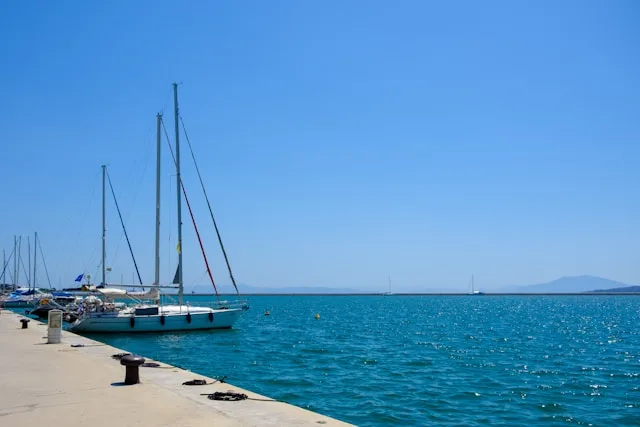
Volos Port Is Getting a €45 Million Upgrade. The Workforce to Run It Does Not Exist Yet

The Port of Volos handled approximately 4.8 million tonnes of cargo in 2023, making it Greece's third-largest cargo port by tonnage. By the end of 2024, the first nine months alone tracked toward surpassing that figure. The European Commission has committed €45 million in Connecting Europe Facility grants for port modernisation through 2027. On paper, Volos is entering a new phase as Thessaly's maritime gateway.
The problem is not capital. The problem is people. Enrolments in maritime transport and logistics programmes at the University of Thessaly fell 12% between 2020 and 2023. Local technical colleges report 30% dropout rates from port machinery operator courses. Certified RTG crane operators in Volos take an average of 94 days to hire. A regional agricultural exporter with revenue exceeding €50 million conducted a six-month executive search for a Supply Chain Director with ERP and TMS implementation experience. According to the Hellenic Federation of Enterprises (SEV) Regional Skills Observatory Report 2024, the role was eventually filled by a repatriated Greek national from Rotterdam at a 35% salary premium above the local market.
What follows is an analysis of the forces reshaping Volos and Thessaly's maritime logistics sector, the employers driving that change, and what senior leaders need to understand before they commit to hiring in a market where infrastructure is moving faster than the workforce can follow.
The Port That Thessaly's Economy Depends On
Thessaly accounts for 18% of Greece's agricultural GDP. Volos handles 40% of the region's cereal exports and 60% of its cotton seed shipments. The cement cluster anchored by AGET Heracles, a LafargeHolcim subsidiary, generates 850,000 tonnes of clinker and cement exports annually through the port. Liquid and dry bulk comprise 62% of total throughput. General cargo, including containers, accounts for 31%. Passenger traffic makes up the remaining 7%.
These are not abstract figures. They describe an economic chokepoint. When the September 2023 Thessaly floods disrupted port operations for 11 days and destroyed 23% of stored agricultural cargo, according to the Bank of Greece's Climate Risk Stress Testing report, the downstream consequences rippled across the regional economy. The port is not one of several options for Thessaly's exporters. For most, it is the only viable route to market.
Container throughput reached 142,000 TEUs in 2023, a 12% year-on-year increase. That figure sounds encouraging until you set it beside Piraeus at 5.4 million TEUs. Volos does not compete as a Mediterranean transhipment hub. It operates as an origin-destination port for domestic and short-sea shipping, served by feeder lines connecting to Piraeus and Thessaloniki rather than deep-sea mother vessels. Understanding this distinction matters, because it defines the type of talent the market needs: specialists in regional logistics optimisation, short-sea operations, and hinterland connectivity rather than the global terminal management profiles that dominate hiring in Piraeus.
The port's current workforce reflects its scale. Organismos Limenos Volou S.A. (OLV), 67% owned by Hellenic Republic Holdings, employs 180 permanent staff and 40 seasonal workers. The private container terminal operator, Volos Container Terminal S.A. (VCT), employs 85. Volos Shipyards S.A. employs 120 skilled technicians. The total direct port employment ecosystem, including local freight forwarders like N.J. Goumas S.A. and Transmagnesia, numbers in the low hundreds rather than thousands. This is a market where losing a single certified specialist can stall operations for weeks.
Capital Is Arriving. The Talent Pipeline Is Contracting
This is the core tension in Volos's maritime logistics market in 2026, and it is the analytical spine of this article: investment is accelerating into infrastructure that requires a larger, more technically sophisticated workforce, while the pipeline producing that workforce is simultaneously shrinking. Capital moved faster than human capital could follow.
The Pier I deepening project, co-financed through the Connecting Europe Facility, allocated €23 million to increase maximum draft from 10.5 metres to 12 metres. Completion is scheduled for late 2026. Once operational, the port's container vessel capacity increases from 1,500 TEU feeders to 3,000 TEU vessels. The Port Authority projects throughput capacity of 180,000 to 200,000 TEUs post-dredging. The proposed logistics free zone in the Exochi area, pending Ministry of Maritime Affairs approval, would create 300,000 square metres of bonded warehousing and a projected 400 to 600 direct logistics jobs by end of 2026.
Now set those expansion figures against the talent data. University of Thessaly produces 80 to 100 relevant graduates annually from its Department of Economics and the Naval Architecture and Marine Engineering division of its Department of Mechanical Engineering. Enrolments in maritime transport and logistics programmes fell 12% between 2020 and 2023. Local IEK technical colleges report 30% dropout rates from port machinery operator courses. The pipeline is not keeping pace with existing demand, let alone the expanded demand these investments will create.
The Crane Operator Problem
The most visible symptom is the RTG crane operator shortage. The Volos Port Employers Association, as reported by Thessalia newspaper in October 2024, documented an average 94-day time-to-fill for certified rubber-tired gantry operators. Three local forwarding companies reportedly kept equipment idle for two to four week periods during 2024 because operators were simply unavailable.
A 94-day vacancy for a crane operator is not a recruitment inconvenience. It is a throughput constraint. When equipment sits idle because there is no one certified to run it, cargo waits, vessel turnaround times extend, and shipping lines begin routing through competing ports. The infrastructure investment becomes less productive before it is even complete.
The Digital Skills Gap
The shortage extends beyond the quayside. Digital supply chain management, covering ERP systems, Transportation Management Systems, and Warehouse Management Systems, is where the scarcity is most acute at the management level. The documented case of a major Thessaly agricultural exporter spending six months on an executive search for a Supply Chain Director with ERP and TMS experience, according to the SEV Regional Skills Observatory, before filling the role with a repatriated professional at a 35% premium, illustrates the pattern. The skills required to modernise port-adjacent logistics operations are not being produced locally in sufficient numbers, and importing them costs materially more than local salary benchmarks suggest.
This is where the common perception of Volos as a low-cost alternative to Piraeus begins to break down. For senior technical and executive leadership roles in logistics and supply chain management, the total cost of employment is converging with Athens due to scarcity, while productivity differentials remain.
Compensation in Volos: The Bifurcation Hiring Leaders Miss
Aggregate Greek logistics salary data shows modest growth of 3.2% between 2023 and 2024. Volos salaries trail Piraeus and Athens by 18% to 25% at equivalent seniority levels, with cost of living approximately 15% lower according to Eurostat regional price data. This creates a surface impression that Volos is a straightforward value proposition for employers.
The surface impression is wrong for the roles that matter most.
Volos-specific executive recruitment shows compensation inflation of 15% to 20% for AEO-certified compliance officers and digital supply chain managers. According to Adecco Greece's 2024 Salary Guide, certified Dangerous Goods safety officers under the IMDG Code command premiums of 40% to 50% above standard logistics manager salaries, with positions remaining open for four or more months as a typical pattern.
The compensation data breaks down as follows at each level. Port Operations Managers earn €42,000 to €58,000 in base salary. Customs and Trade Compliance Managers earn €38,000 to €52,000. Fleet and Ship Agent Managers earn €35,000 to €48,000. At the executive level, a regional Logistics and Supply Chain Director earns €68,000 to €95,000, with multinational industrial employers in agribusiness and cement at the upper range. The Port Authority CEO or General Director role is compensated at €95,000 to €130,000 under private law arrangements. Commercial Directors at freight forwarding firms earn €60,000 to €82,000 plus performance bonuses linked to shipping volume.
These ranges look manageable until you consider what happens at the point of scarcity. The 35% premium paid to repatriate a Supply Chain Director from Rotterdam is not an anomaly. It is the emerging market rate for skills that cannot be sourced locally. Any hiring leader budgeting for a Volos-based role using aggregate Thessaly salary data will undershoot the actual cost of hiring the specific specialists they need. The salary benchmarking tools most organisations rely on reflect averages. The competition for scarce talent in this market operates well above the average.
Where Volos Loses Its Talent
The geographic dynamics are straightforward but consequential. Volos competes for talent against two larger markets, and it is losing on different terms to each.
The Piraeus Pull
Piraeus and the Athens conurbation draw mid-career logistics professionals aged 30 to 45 with salaries 20% to 30% higher for equivalent Port Operations Manager roles. More importantly, Piraeus offers exposure to global transhipment operations and a visible career pathway to regional or global supply chain leadership that simply does not exist in Volos's smaller market. According to LinkedIn Economic Graph data on talent migration patterns in Greece for 2023 and 2024, the pull is not purely financial. It is structural. A Port Operations Manager in Volos can become a senior Port Operations Manager in Volos. The same professional in Piraeus can become a Regional Terminal Director for a global operator. The career ceiling matters as much as the salary floor.
The Thessaloniki Drain
Thessaloniki competes specifically for northern Thessaly agricultural logistics talent, offering similar cost of living but superior rail connectivity and the presence of major third-party logistics providers like Kuehne+Nagel and DSV. These firms provide broader career portfolios and exposure to integrated European supply chain networks that Volos's smaller local operators cannot match. Thessaloniki's port automation investments create additional demand for technically skilled labour, actively drawing technicians away from Volos according to the Thessaloniki Port Authority's HR Development Report for 2024.
A third competitor is less obvious but increasingly relevant. Athens-based e-commerce logistics operations, including firms like Skroutz Last Mile, offer hybrid working arrangements to digital supply chain professionals. Port operations roles require physical presence by definition. According to the HR Community Greece Talent Retention Survey 2024, Volos employers face attrition of digital supply chain talent toward these hybrid-compatible roles. The professionals who have the digital logistics skills Volos needs most are precisely the ones who have the option to work remotely for employers elsewhere. This is not a compensation problem that can be solved with a higher salary. It is a working model mismatch that requires a fundamentally different approach to candidate identification and engagement.
The Regulatory Pressure Compounding Every Other Problem
The EU Emissions Trading System for maritime transport became fully operational in 2024. According to the Hellenic Chamber of Shipping's November 2024 policy brief, this is expected to increase operational costs for short-sea operators by 8% to 12%. For a port like Volos that depends on short-sea and feeder services rather than deep-sea transhipment, the cost impact is disproportionate. Some coastal traffic may divert to rail-road combinations via Thessaloniki, reducing the volume of work passing through Volos and simultaneously raising the cost per unit of what remains.
Shore power infrastructure, known as cold ironing, is absent at Volos. Retrofitting costs are estimated at €18 to €25 million according to the European Maritime Safety Agency's 2024 report on alternative fuels infrastructure. Without this investment, Volos faces a competitiveness gap against electrified Italian Adriatic ports like Ancona and Ravenna that are further ahead on EU Green Deal compliance. This is not a distant concern. Shipping lines making routing decisions for 2027 and beyond are evaluating port environmental compliance now.
The regulatory pressure creates its own talent demand. Volos needs professionals who understand EU Customs Code compliance, the AEO certification framework, IMDG Code requirements for dangerous goods, and the emerging alternative fuels handling protocols for LNG bunkering and ammonia. Only 12 AEO-certified customs brokers operate in the entire Magnesia prefecture, according to the Independent Authority for Public Revenue's AEO Registry as of January 2025. That number is insufficient for the growing compliance burden created by post-Brexit requirements and the EU Import Control System 2 (ICS2). These are not roles that can be filled quickly or from the active candidate market. The professionals who hold these certifications know exactly how scarce their credentials are, and they do not need to look for work.
Ongoing uncertainty about potential privatisation or concession of OLV, noted in the Privatisation Fund of Greece's 2024 Strategic Asset Review, adds a further layer of complexity. International terminal operators hesitate to invest in workforce development when governance structures may change. Local professionals hesitate to commit careers to an organisation whose ownership model may shift. The uncertainty itself becomes a talent repellent.
Why Conventional Recruitment Fails in This Market
The passive candidate dynamics in Volos are stark. According to Odgers Berndtson's Greece Industrial and Transport Practice market update for 2024, active candidates represent only 15% to 20% of the qualified market for Port Operations Directors and Terminal Managers. Between 80% and 85% are passively employed and require direct outreach.
For certified Marine Surveyors and Vetting Inspectors, the picture is more extreme. Fewer than 15 qualified professionals operate in the entire Magnesia region according to International Institute of Marine Surveying membership data. Over 90% of successful recruitment for these roles requires approaching professionals currently employed at competing ports or maritime agencies. These individuals are not browsing job boards. Their average tenure is 6.8 years, compared to a 3.2-year national average. Their LinkedIn activity is minimal.
A conventional recruitment approach, posting a role on job boards and screening inbound applicants, reaches the active 15% to 20%. In a market this small and this specialised, that approach consistently fails for the roles that matter most. When a traditional executive search process stalls after four to six months, the cost is not just the recruiter's fee. It is the operational capacity that sits unused, the cargo that routes through a competitor, the infrastructure investment that underperforms because the people to run it are not in place.
Entry-level logistics coordinators and documentation clerks represent an exception. High unemployment among business administration graduates creates active applicant pools of four to five candidates per vacancy, according to OAED (Greek Public Employment Service) data from Q4 2024. The hiring challenge in Volos is not universal. It is concentrated precisely at the senior technical and leadership levels where a single vacant role has the greatest operational impact.
The implications for hiring method are clear. Organisations competing for port operations leadership, certified compliance professionals, and digital supply chain management talent in Volos need a proactive search methodology that maps and engages passive candidates across Piraeus, Thessaloniki, and international markets. The 35% premium paid to bring a Supply Chain Director back from Rotterdam was not a failure of negotiation. It was the market price of reaching someone who was not looking.
What This Means for Hiring Leaders in Thessaly
The fundamental miscalculation most organisations make in the Volos maritime logistics market is budgeting for infrastructure while underestimating the cost and difficulty of staffing it. A €23 million berth deepening project creates physical capacity for 3,000 TEU vessels. That capacity means nothing without the crane operators, terminal managers, compliance officers, and digital logistics professionals to handle the increased volume.
The talent pipeline is not going to fix itself. University enrolments are declining, technical college completion rates are poor, and the professionals who do qualify face competing offers from larger markets with higher compensation and better career trajectories. Every hiring leader in this market faces the same arithmetic: the supply of senior specialists is shrinking while the demand is growing. The organisations that move first and move fastest will fill their roles. The rest will pay the 35% repatriation premium, or they will wait.
KiTalent works with organisations facing exactly this kind of market asymmetry, where leadership talent in industrial and manufacturing sectors is concentrated among passive professionals who must be identified and approached individually. With a methodology built around AI-powered talent mapping that identifies the 80% to 85% of qualified professionals who are not visible on any job board, and a pay-per-interview model that eliminates the risk of paying for a search that delivers nothing, the approach is designed for markets where conventional methods consistently fail. KiTalent has completed over 1,450 executive placements globally, with a 96% one-year retention rate for placed candidates.
For organisations building leadership teams in Volos's maritime logistics sector, where certified specialists take 94 days to hire and executive roles require international sourcing at premium compensation, speak with our executive search team about how we approach passive candidate markets like this one.
Frequently Asked Questions
What are the main challenges of hiring maritime logistics professionals in Volos?
Volos faces a convergence of shrinking talent pipelines and expanding infrastructure demand. University enrolments in maritime logistics programmes fell 12% between 2020 and 2023. Certified crane operators take 94 days to hire. Senior digital supply chain managers often require international sourcing at 35% salary premiums. Competition from Piraeus and Thessaloniki draws mid-career professionals away with higher salaries and broader career progression. The result is a market where 80% to 85% of qualified Port Operations Directors are passively employed and unreachable through conventional executive recruitment methods.
What do maritime logistics roles pay in Volos compared to Athens?
Volos salaries trail Athens and Piraeus by 18% to 25% at equivalent seniority for most logistics roles. A Port Operations Manager in Volos earns €42,000 to €58,000, while a regional Logistics and Supply Chain Director earns €68,000 to €95,000. However, scarcity-driven roles such as AEO-certified customs brokers and IMDG Code safety officers command premiums of 40% to 50% above standard logistics manager pay. For these specialist roles, the effective compensation gap with Athens is narrowing or has already closed.
How is the Port of Volos expanding in 2026?
The Pier I deepening project, funded through a €23 million CEF grant, is scheduled for completion in late 2026. It will increase maximum draft from 10.5 to 12 metres, enabling the port to receive 3,000 TEU container vessels instead of the current 1,500 TEU feeders. Projected throughput capacity post-dredging is 180,000 to 200,000 TEUs. A proposed 300,000 square metre logistics free zone in the Exochi area would add 400 to 600 direct logistics jobs, pending Ministry of Maritime Affairs approval.
Why is executive search necessary for maritime logistics roles in Volos?
The qualified candidate pool for senior port and logistics roles in Magnesia is extremely small. Fewer than 15 certified Marine Surveyors operate in the region. Only 12 AEO-certified customs brokers cover the entire prefecture. Senior professionals in these roles average 6.8 years of tenure and show minimal activity on job boards or LinkedIn. KiTalent's direct headhunting approach identifies and engages passive candidates who are not visible through conventional channels, delivering interview-ready candidates within 7 to 10 days.
What regulatory changes affect Volos port operations?
The EU Emissions Trading System for maritime transport, fully operational since 2024, increases short-sea operator costs by 8% to 12%. Volos currently lacks shore power infrastructure, with retrofitting estimated at €18 to €25 million. EU Import Control System 2 (ICS2) requirements and post-Brexit compliance procedures have increased demand for AEO-certified customs brokers beyond local supply. These regulatory shifts create both cost pressures on existing operations and new specialist hiring requirements that the local talent market cannot meet organically.
What industries in Thessaly drive demand for port logistics talent?
Thessaly generates 18% of Greece's agricultural GDP. Volos handles 40% of regional cereal exports and 60% of cotton seed shipments. The cement cluster led by AGET Heracles produces 850,000 tonnes of annual clinker and cement exports. Growing pharmaceutical and fresh produce exports are increasing demand for cold chain logistics specialists. Each of these sectors requires distinct logistics expertise, from agricultural bulk handling to temperature-controlled supply chain management, intensifying competition for the limited pool of qualified professionals based in the region.