Conegliano's Prosecco Superiore Trains the Talent It Cannot Keep: The Senior Hiring Crisis Behind the DOCG's Success

The Scuola Enologica di Conegliano graduates roughly 120 qualified enologists every year. Eighty-five per cent of them find sector employment within six months. By the numbers, this looks like a talent pipeline that works. It is not. The school produces entry-level professionals. The roles that remain unfilled for seven to nine months are not entry-level. They are senior technical directorships, export leadership positions requiring embedded US distributor relationships, and precision agriculture specialists who exist in quantities fewer than 200 across all of Northeast Italy.
This is the core tension running through Conegliano's wine economy in 2026. The Conegliano Valdobbiadene Prosecco Superiore DOCG zone commands record price premiums, generates €1.28 billion in export value, and sits at the centre of a UNESCO-listed production corridor. It also cannot hire the senior leaders it needs to sustain any of this. Franciacorta pays 20 to 30 per cent more for equivalent enologist roles. Champagne houses reportedly offer two and a half to three times the compensation for head winemakers with Italian-market expertise. And the compliance costs arriving with the EU's Sustainable Wine framework are about to accelerate consolidation among the 3,400 small growers who form the DOCG's productive base.
What follows is a sector intelligence analysis of Conegliano's Prosecco Superiore economy: its market structure, its competitive position for talent, and the forces that are reshaping what this region needs from its senior leaders. For anyone hiring into or managing talent within Italy's most prestigious sparkling wine zone, the picture is more complex than the export headlines suggest.
The DOCG Zone in 2026: Recovery Constrained by Design
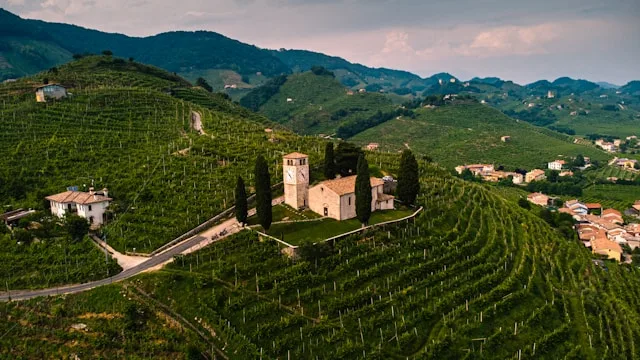
Conegliano functions as the institutional, educational, and administrative epicentre of the Prosecco Superiore DOCG zone. The Consorzio di Tutela, which regulates 15,000 hectares and approximately 3,000 growers, is headquartered here. The Scuola Enologica, founded in 1876, remains Italy's premier oenological training institution. The primary concentration of bottling facilities, logistics hubs, and cooperative headquarters sits within the Conegliano catchment. The Strada del Prosecco tourism corridor generates an estimated €400 million in annual economic impact centred on this hub.
Production, however, tells a different story from the institutional narrative. The 2024 harvest produced a structural contraction of roughly 12 per cent year-on-year, bringing total DOCG output down to 95 million bottles. Late frosts in April 2024 followed by summer drought drove the decline. ISMEA projects a modest recovery to 102 to 105 million bottles for the 2025 harvest feeding 2026 releases, but that recovery is contingent on normalised weather patterns.
Yield Caps That Block the Obvious Answer
Even if the weather cooperates fully, the Consorzio's yield restriction policies cap production at 13 tonnes per hectare, down from 13.5 in 2023. Geographic expansion is prohibited beyond the 15-commune DOCG boundary. This means volume growth is structurally limited regardless of demand. The DOCG system is designed to protect quality and provenance. It also prevents the kind of scaling that would ease margin pressure or reduce per-unit fixed costs. Producers cannot simply grow more grapes or plant more hectares. Every productivity gain must come from efficiency, premiumisation, or talent. That last category is where the system is failing.
The US Market Correction Arriving at the Wrong Moment
Export markets absorb 72 per cent of DOCG production. The United States alone accounts for 28 per cent of exports, with the UK at 19 per cent and Germany at 15 per cent. Through 2024, the DOCG's export value reached €1.28 billion, representing 4.2 per cent volume growth and 8.1 per cent value growth. These numbers look strong in isolation. They mask a timing problem.
US distributor inventories sat at 4.8 months of supply at the close of 2024, well above the 3.2-month optimal level. Rabobank's Wine Quarterly forecast a 5 to 7 per cent price correction in US wholesale pricing for Italian sparkling through the first half of 2026. For Conegliano producers who achieved record premiums of 30 to 40 per cent above Prosecco DOC in export markets, this correction arrives at precisely the moment when compliance costs are rising and climate adaptation investments are compounding. The margin compression is real, even as the headline value figures remain impressive.
Where the Money Goes and Where It Gets Stuck
The financial structure of the DOCG zone helps explain why senior hiring in this sector has become so difficult. Average Glera grape prices rose to €2.80 to €3.20 per kilogram in 2024, up 18 per cent from 2023. This benefits growers but squeezes the margins of the cooperatives and bottlers who must pay more for raw material while facing wholesale price corrections in their largest export market.
Climate adaptation adds another layer. Hail netting and anti-frost systems require €8,000 to €12,000 per hectare of investment. Sixty per cent of vineyards are held by growers with fewer than three hectares. Banks report 18 per cent rejection rates for agricultural improvement loans in this sector, according to Banco BPM data from 2024. The EU Sustainable Wine framework, reaching full implementation in 2026, mandates digital traceability for all DOCG exports and a 20 per cent reduction in chemical inputs. Compliance costs are estimated at €15,000 to €50,000 per winery.
The result is a paradox that sits at the heart of the talent problem. The DOCG commands premium prices. It generates over a billion euros in export value. It is also a market in which a large proportion of the 3,400 small growers face consolidation pressure. The senior roles going unfilled for the better part of a year are roles that could manage this transition: technical directors who understand both Glera vinification and cost optimisation, sustainability officers who can deliver EU compliance without destroying the artisanal character that justifies the premium, export leaders who can protect pricing in a softening US market. These are not roles that can wait seven to nine months to be filled.
The Talent Arithmetic That Does Not Add Up
The sector employs approximately 12,000 direct workers in the Conegliano catchment during peak season, with a permanent workforce of 3,800. Sector unemployment sits at 3.1 per cent, well below the provincial average of 4.8 per cent. This is effectively full employment for skilled roles.
Job postings in the Conegliano viticulture sector increased 23 per cent year-on-year in 2024, according to the Excelsior Information System maintained by Veneto Lavoro. But the demand is bifurcated in a way that aggregate numbers obscure. Seasonal harvesting labour faces its own crisis: a 22 per cent shortfall in registered vendemmia workers in 2024, forcing mechanisation acceleration and an estimated €18 million in crop losses across the broader Treviso province. That is an acute, visible problem. The less visible problem is at the senior technical and executive level, where the shortages are not seasonal. They are permanent.
Senior Enologists: Seven to Nine Months and Counting
Large cooperatives processing the equivalent of 100 or more hectares report average vacancy durations of seven to nine months for senior enologist positions requiring DOCG-zone experience. According to data compiled by Coldiretti Veneto and the Federation of Italian Wine Cooperatives, producers at the level of Cantine Maschio have reportedly engaged headhunters for Dirigente Tecnico roles, offering 15 to 20 per cent premiums above standard Veneto wine sector scales to attract talent from Franciacorta competitors.
This premium still falls short. The compensation gap between Conegliano and its nearest competitors is not closing. A Technical Director in Conegliano commands €110,000 to €150,000 with equity participation in larger groups. The equivalent role in Franciacorta starts at €130,000. In Champagne, LVMH and Roederer reportedly offer €180,000 to €250,000 for head winemakers with Italian-market expertise. The gap is widening fastest at exactly the seniority level where the most critical roles sit.
Precision Agriculture: A Pool of Fewer Than 200
The transition to organic and heroic hillside viticulture on steep slopes exceeding 30 per cent gradient has created demand for a role that barely existed five years ago. Precision agriculture specialists who can operate GPS-guided canopy management systems, manage drone-based vineyard monitoring, and implement AI-based disease prediction are not products of traditional oenological education. Unioncamere Veneto's Skill Mismatch Report from 2024 identifies fewer than 200 qualified professionals in all of Northeast Italy. Ninety-five per cent of them are already employed and not looking. Forty per cent of postings in the Conegliano area for viticulture technicians with these capabilities expired unfilled after 120 days. This is not a shortage that can be recruited through conventional methods. The talent pool is too small and too passive for any job board to reach.
Why the Pipeline Produces Entry-Level Talent but Not the Leaders This Market Needs
Here is the analytical claim that connects the data: Conegliano's educational institution is excellent at producing enologists and poor at producing the conditions that keep them. The Scuola Enologica graduates 120 qualified professionals a year into a sector that places 85 per cent of them within six months. That is an institutional success story. But the roles going unfilled for seven to nine months require 10 or more years of DOCG experience. The school's graduates enter the workforce at entry level. They gain three to five years of Conegliano experience. Then they encounter a decision point.
Franciacorta offers 20 to 30 per cent higher compensation plus proximity to Milan's lifestyle infrastructure. Trento offers stronger public research institutions like Fondazione Edmund Mach, higher R&D investment per hectare, and bilingual career pathways into Austrian and German markets. Champagne and Napa Valley offer compensation multiples of 2.5 to 3 times the Conegliano rate. The Scuola Enologica's alumni network becomes, perversely, the sourcing channel for competitors.
Conegliano offers a lower cost of living than Milan or Paris, but that advantage is eroded for mobile senior executives by the absence of international school infrastructure and dual-career opportunities. A head enologist's partner who works in finance, technology, or professional services faces limited options in Treviso province. This is not a factor that appears in salary surveys. It is a factor that determines whether an offer is accepted.
The production pipeline for senior talent works like this: Conegliano trains them, the local sector gives them their first formative years, and then competing regions and international employers recruit them away at the exact point when they become valuable for the roles this market cannot fill. The DOCG zone is a net exporter of the experienced professionals it most needs to retain.
The Employers Anchoring a Fragmented Market
Understanding the corporate structure of the DOCG zone clarifies why the talent challenge takes the shape it does. The sector is not dominated by a few large employers who might individually solve their hiring problems through employer brand or compensation scale. It is a market of fragmented producers overlaid with a few medium-sized anchor institutions.
The Corporate Tier
Cantine Maschio, based in Conegliano, operates with 280 employees and an annual capacity of 35 million bottles. Villa Sandi, with operations in the Conegliano zone, employs 180 permanent staff across 1,500 vertically integrated hectares. Mionetto, acquired by Henkell Freixenet in 2020, employs 150 people with 65 per cent of revenue from exports. Bottega S.p.A., positioned in the luxury segment with its distinctive gold bottles, reported €85 million in revenue in 2023 across 200 employees. These are the producers with the scale and budgets to engage in executive-level retained search.
The Cooperative Base
Cantina di Conegliano, with 1,200 associated growers and 85 employees, processes 55,000 tonnes annually. It functions as critical infrastructure for the smallholder supply chain. The three largest cooperatives collectively control 40 per cent of grape processing. Any insolvency or technical failure at one of these cooperatives creates systemic supply chain risk for over 2,000 dependent small growers.
The Parco Tecnologico Padano cluster in Conegliano hosts 45 SMEs specialising in vineyard robotics and precision agriculture. This cluster represents the technology future of the sector. It also concentrates the demand for exactly the kind of hybrid agronomy-data-science professional that is hardest to find.
The fragmentation matters for hiring because the vast majority of the 3,400 growers lack the resources to compete for senior talent individually. They depend on cooperatives and institutional bodies to provide the technical leadership that a large winery would employ directly. When those institutional roles go unfilled, the effects cascade across the entire smallholder base.
What Senior Roles Actually Pay and Why It Matters
Compensation data for the Conegliano wine sector, drawn from salary benchmarks published by Michael Page Italy, Hays Italy, and Korn Ferry, reveals a market that is not uncompetitive in Italian terms but fundamentally outmatched by its international competitors.
A Lead Enologist with five to ten years of experience managing Glera vinification and charmat method secondary fermentation earns €65,000 to €85,000 base plus performance bonus. A Technical Director overseeing multiple winery sites, DOCG compliance, and innovation programmes such as the Rive single-vineyard designations earns €110,000 to €150,000 with equity participation in larger groups.
Export Sales Directors command €55,000 to €75,000 at the senior manager level for North America and UK markets, rising to €90,000 to €130,000 for Global Export Directors with big-box retail and fine wine distribution relationships.
The emerging role of Precision Agriculture and Sustainability Manager pays €48,000 to €62,000 at the specialist level. The Chief Sustainability Officer role, still rare in pure-play wineries and more common in cooperatives, commands €75,000 to €95,000.
These figures are competitive within the Italian food and beverage sector. They are not competitive against the regions that are actively recruiting Conegliano-trained talent. A senior enologist weighing a Conegliano offer against a Franciacorta offer sees a 20 to 30 per cent premium for the move north. Against Champagne, the multiple is 2.5 to 3 times. The question is not whether Conegliano can afford to pay more. For many producers, particularly the cooperatives and smaller houses, the answer is that they cannot. The question is how to build a proposition that moves a passive candidate when compensation alone will not close the gap.
The Search Problem: 85 to 95 Per Cent of the Candidates You Need Are Not Looking
The passive candidate data for this sector is stark. According to Hays Italy's Passive Candidate Index for the wine and spirits sector, 85 per cent of qualified candidates with ten or more years of DOCG experience are employed and not actively seeking new roles. For Export Directors with embedded US market relationships, particularly those with established connections to major distributors, the figure rises to 90 per cent passive. For precision agriculture specialists, it reaches 95 per cent.
The active-to-passive ratio for senior technical roles is approximately 1:9. For every one qualified candidate visible on a job board or responding to a posting, nine more exist who will never see the advertisement. This ratio makes conventional recruitment methods functionally inadequate for the roles that matter most. A job posting for a Technical Director will reach, at best, 10 to 15 per cent of the viable candidate pool. The other 85 per cent must be identified through direct headhunting and talent mapping that reaches into competitor organisations, cross-sector networks, and international markets.
The seasonal labour shortage, by contrast, is a problem of supply volume. It is acute but addressable through mechanisation, policy intervention, and migrant labour programmes. The senior talent shortage is a problem of supply structure. The candidates exist. They are employed. They are not looking. And the proposition required to move them involves more than compensation. It involves career trajectory, lifestyle fit, institutional quality, and the credibility of the organisation making the approach.
This is where the search method matters as much as the offer. A retained search firm with AI-enhanced talent mapping capabilities can identify and reach the 85 to 95 per cent of candidates who are invisible to conventional recruitment. A contingency recruiter working from job board responses is fishing in a pool that contains, at most, one in ten of the people the client actually needs.
What Hiring Leaders in This Market Need to Do Differently
The forces converging on Conegliano's Prosecco Superiore sector in 2026 are not temporary. Yield caps are permanent by design. The geographic boundary is fixed. Climate adaptation costs will rise, not fall. The EU sustainability framework adds compliance costs that disproportionately burden small producers and accelerate consolidation. The US market correction may be cyclical, but the structural shortage of senior technical talent is not.
For hiring leaders at anchor producers, cooperatives, and the institutional bodies that serve the DOCG zone, the implications are specific. First, the cost of a failed senior hire in this market is measured not just in vacancy duration but in regulatory exposure, lost export relationships, and the cascading effect on dependent smallholders. A Technical Director vacancy that runs nine months is nine months without the leadership needed to manage EU compliance transition. Second, compensation benchmarking against the Veneto wine sector average is insufficient. The real competitor set includes Franciacorta, Trento, and increasingly Champagne and Napa Valley. Packages must be benchmarked against the markets that are actually recruiting your candidates, not the market you happen to sit in. Third, the traditional approach of posting a role and waiting for applications reaches roughly 10 per cent of the viable candidate pool for senior roles. The other 90 per cent require a fundamentally different method.
For organisations competing for senior winemaking, export, and sustainability leadership in the Conegliano DOCG zone, where the candidates you need are not visible on any job board and the margin for a slow or failed search is narrowing with every regulatory deadline, speak with our executive search team about how KiTalent approaches this market. With interview-ready candidates delivered within 7 to 10 days, a pay-per-interview model that eliminates upfront retainer risk, and talent mapping that identifies the passive professionals no conventional search will reach, KiTalent has completed over 1,450 executive placements with a 96 per cent one-year retention rate. The Prosecco Superiore sector does not have the luxury of waiting nine months for its next Technical Director.
Frequently Asked Questions
Why is it so difficult to hire senior enologists in the Conegliano Prosecco DOCG zone?
The difficulty stems from a structural mismatch between supply and demand. The Scuola Enologica di Conegliano produces approximately 120 graduates annually, but senior roles require ten or more years of DOCG-specific experience. Eighty-five per cent of qualified candidates at this level are already employed and not actively looking. Competing regions like Franciacorta offer 20 to 30 per cent higher compensation, while Champagne houses offer 2.5 to 3 times the salary. The result is vacancy durations of seven to nine months for Dirigente Tecnico roles, even when premiums of 15 to 20 per cent above standard sector scales are offered.
What does a Technical Director earn in the Conegliano wine sector?
A Lead Enologist with five to ten years of experience in Glera vinification earns €65,000 to €85,000 base plus performance bonus. At the executive level, a Technical Director overseeing multiple winery sites and DOCG compliance commands €110,000 to €150,000 with equity participation in larger groups. These figures are competitive within the Italian food and beverage sector but fall materially below what Franciacorta and international competitors offer for equivalent roles.
How will the EU Sustainable Wine framework affect hiring in the Prosecco sector?
The framework mandates digital traceability for all DOCG exports and a 20 per cent reduction in chemical inputs, with compliance costs estimated at €15,000 to €50,000 per winery. This creates urgent demand for precision agriculture specialists and sustainability officers, roles for which fewer than 200 qualified professionals exist in Northeast Italy. Wineries that delay hiring for these roles face regulatory penalties and potential loss of export certification.
What is the passive candidate ratio for senior wine industry roles in Italy?
For senior technical roles in the Conegliano DOCG zone, the active-to-passive candidate ratio is approximately 1:9. This means that for every one qualified candidate visible through job postings, nine more are employed and not searching. For Export Directors with US market relationships, the passive rate reaches 90 per cent. For precision agriculture specialists, it reaches 95 per cent. Reaching these candidates requires direct headhunting and AI-enhanced talent mapping rather than conventional recruitment.
How does KiTalent approach executive search in the Italian wine sector?
KiTalent uses AI-powered talent mapping to identify passive candidates who are invisible to job boards and standard recruitment channels. The firm delivers interview-ready candidates within 7 to 10 days through a pay-per-interview pricing model with no upfront retainer. With a 96 per cent one-year retention rate and over 1,450 executive placements completed globally, KiTalent specialises in reaching the senior professionals that conventional search methods consistently miss.
What are the biggest risks to the Conegliano Prosecco DOCG economy in 2026?
The primary risks are converging rather than isolated. US distributor inventory accumulation is creating wholesale pricing pressure. EU sustainability compliance costs disproportionately burden the 3,400 small growers who form the DOCG's productive base. Climate adaptation investments of €8,000 to €12,000 per hectare are required but difficult to finance for the 60 per cent of vineyards held by growers with fewer than three hectares. And the inability to fill senior technical and commercial leadership roles within reasonable timeframes compounds every other risk by leaving organisations without the leaders needed to manage the transition.