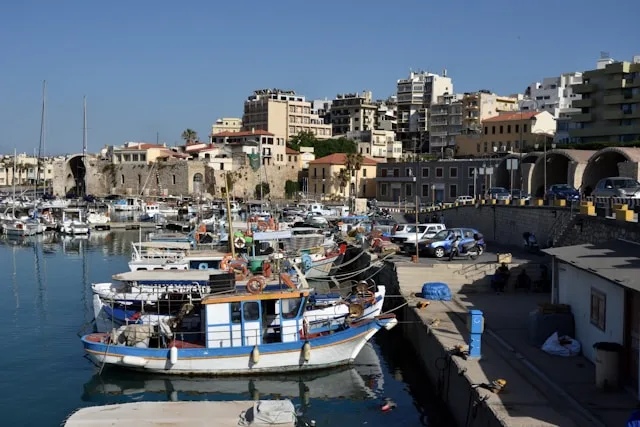
Heraklion's Agri-Food Sector Is Growing Fast and Hiring Slowly: The Talent Gap Behind Crete's Export Boom

Cretan agri-food exports, dominated by Heraklion Prefecture, grew 23% in value between 2020 and 2024. Direct employment in processing and packaging plants across the same period barely moved, holding flat at approximately 18,200. That divergence tells a story most regional development strategies have not caught up with. Revenue growth driven by premiumisation and automation is not generating the broad workforce expansion that local economic plans assumed. It is generating a narrow, acute need for specialists who largely do not exist in Heraklion.
The specific tension is this: Heraklion's agri-food sector now requires export compliance managers, cold-chain logistics engineers, precision agriculture specialists, and food safety directors at a pace the local talent pool cannot match. Average time-to-fill for a supply chain or export management role in the Cretan agri-food sector is 127 days. The equivalent role in Athens fills in 64. Meanwhile, Athens-based multinationals and EU agricultural hubs in Bologna and Barcelona are drawing the few qualified candidates away with salaries 25% to 100% higher than Heraklion can offer. The candidates Heraklion most needs are overwhelmingly passive, employed, and receiving multiple unsolicited approaches each month.
What follows is a structured analysis of the forces reshaping this sector, the employers driving that change, the specific roles and compensation levels that matter most, and what senior leaders need to understand before they make their next hiring decision in Crete's agri-food market.
The Market That Premiumisation Built
Heraklion Prefecture hosts approximately 42% of Crete's olive oil mills and 60% of its dairy processing capacity by volume. The Peza PDO zone, 15 kilometres southeast of Heraklion city, anchors olive oil and wine clustering. The Messara Plain in southern Heraklion concentrates large-scale greenhouse horticulture. Eight PDO and PGI designations in the prefecture, including Peza Olive Oil, Archanes Wine, and Cretan Graviera, have driven co-location of packaging designers, accredited laboratories, and logistics providers around these production clusters.
The 2024/2025 olive harvest in Heraklion is projected at 85,000 to 95,000 tonnes, down 12% year-on-year due to irregular rainfall. Yet export values rose 8%, because the product mix has shifted. PDO Peza oil commands €5.80 to €6.20 per litre FOB, compared with €4.10 for standard extra virgin. The premium is not incidental. It is the business model.
Dairy processing tells a similar story. Cretan cheese exports, with Heraklion representing 65% of volume, reached €312 million in 2024 export value, with 23% growth in the US and German markets. Vitam S.A., a Heraklion-based dairy processor with 185 employees and €42 million in turnover, supplies German discounters. EAS Peza, the largest olive oil bottler in Crete with €89 million in annual turnover, employs 280 people directly across 1,200 member-producers. These are not artisanal operations at the margins of the European food system. They are mid-sized industrial exporters competing in some of the most regulated, quality-sensitive markets on the continent.
The investment cycle confirms the trajectory. In 2024, €47 million in CAP and NextGenerationEU funds were absorbed by Heraklion agri-food SMEs for cold-chain upgrades and HACCP certification automation. The Port of Heraklion completed Phase 1 of its refrigerated storage expansion, adding 2,400 pallet positions. The sector is capitalising. The question is whether the people required to run these upgraded operations exist in the local market. Increasingly, they do not.
Why Export Value and Employment Have Decoupled
The central analytical fact about Heraklion's agri-food sector in 2026 is this: automation and premiumisation have decoupled revenue growth from job creation. The 23% increase in export value over four years was not matched by a proportional increase in processing jobs. Employment held flat. Capital moved into bottling lines, cold-chain infrastructure, and certification systems. What the sector needs now is not more workers. It is different workers.
This is the pattern that makes the Heraklion agri-food hiring challenge genuinely difficult rather than merely competitive. The roles going unfilled are not production line positions. They are export compliance managers, cold-chain logistics engineers, and food safety directors with international accreditation. These are roles that require years of specialised experience, often in regulatory environments (US FDA, EU EUDR) that did not exist or were not enforced five years ago. You cannot recruit experience that the local market has not had time to produce.
The Compliance Hiring Surge
The EU Deforestation Regulation reached its compliance deadline in December 2025. For Heraklion's olive oil exporters, this means geolocation mapping of every olive grove supplying export-bound oil and a traceability system capable of satisfying EU auditors. Industry associations estimate costs of €3,000 to €5,000 per SME for system upgrades alone. But the larger cost is human. Over 200 small olive oil exporters in the prefecture need traceability specialists. Demand for export compliance and traceability managers rose 40% year-on-year through late 2024, according to LinkedIn Economic Graph data for the Heraklion region.
Simultaneously, the US FDA Foreign Supplier Verification Program imposes its own requirements on any Cretan producer shipping to American buyers. The skill sets overlap but are not identical. A compliance manager fluent in EUDR does not automatically satisfy FSVP requirements. The firms that need both capabilities, and there are many in Heraklion's export-oriented dairy and olive oil sectors, face a compounding shortage.
The Cold-Chain Gap
Cold-chain logistics engineers are in short supply across all of Greece. In Heraklion, the vacancy rate for these roles hit 18% in Q4 2024. The Port of Heraklion's reefer container capacity utilisation averaged 89%, well above the 72% design optimum, causing export delays during the October-to-December peak season. Average dwell time for export containers at Heraklion stands at 3.2 days, compared with 1.8 days at Piraeus. Premium cold-chain products, including specialty cheeses and fresh herbs, increasingly route through Athens precisely because Heraklion lacks the infrastructure and the professionals to manage a more complex refrigerated export flow.
The infrastructure is being upgraded. The people to run it are not materialising at the same pace. That gap between capital investment and talent pipeline development is where the real constraint on growth sits.
What Roles Pay and Why It Matters
Compensation in Heraklion's agri-food sector tells a story of structural disadvantage. The gap between Heraklion and Athens is not a minor adjustment. It is a barrier to recruitment that compensation alone may not solve.
For Export Sales Managers with five to eight years of experience and mandatory German and English fluency, Heraklion offers €32,000 to €45,000 gross annual. Athens offers an average of €55,000 for the same role, according to the SEV Compensation Survey 2024. At the executive level, a Commercial Director or VP Sales in Heraklion commands €65,000 to €95,000, but top-tier candidates with multinational experience require premiums of 35% to 40% above this range simply to consider relocating from Athens.
Food Safety Managers with HACCP and FSSC 22000 certification earn €28,000 to €38,000 at senior manager level and €52,000 to €72,000 at executive level. A scarcity premium of €8,000 to €12,000 applies for dual English and German fluency combined with US FDA audit experience. These premiums reflect a market where salary negotiation is not optional. It is a condition of entry.
Supply Chain Directors, the role most acutely undersupplied in the prefecture, command €58,000 to €78,000. Sixty percent of these roles in Heraklion are filled by candidates relocating from Thessaloniki or Athens at 20% salary premiums. The cost of bringing someone in is built into the compensation structure by default.
The most revealing data point is the retention bonus. Heraklion-based dairy processors now offer 12-month retention bonuses equivalent to 20% to 25% of annual salary for Food Safety Managers with FSSC 22000 certification. These are not discretionary perks. They are defensive measures against poaching by Athens-based multinationals. When retention bonuses become standard rather than exceptional, the market has moved past competitive into structurally constrained territory. Understanding the counteroffer dynamic is essential for any hiring leader operating in this environment.
The Geography Problem: Competing with Athens, Thessaloniki, and Europe
Heraklion's compensation gap with Athens is the most visible part of a broader geographic disadvantage. Athens offers proximity to multinational headquarters including Barilla Hellas and Unilever, international schools, and direct flights to Frankfurt and London for buyer meetings. Forty percent of Heraklion-based Export Managers with ten or more years of experience relocate to Athens within five years. This is not a marginal attrition rate. It is a structural drain that empties the senior end of the local talent pool on a rolling basis.
According to Kathimerini, Minos-Miliarakis S.A., an integrated olive oil and wine exporter based in Heraklion, relocated its Export Director role to Athens in 2023 after being unable to secure a candidate with EU buyer network access who was willing to relocate to Heraklion. Operational staff remained local. The decision-making function left.
This pattern is consistent with a broader trend across regional Greek markets. The talent that connects a Cretan producer to a German supermarket buyer lives in Athens, not in Heraklion, because the buyer relationships, the logistics networks, and the career infrastructure all centre on the capital. A producer can invest millions in cold-chain equipment and PDO certification. If the person who opens the doors to Northern European retail is unwilling to live four hours from the nearest international hub, the investment stalls.
Thessaloniki presents a secondary competitive threat, with salaries 15% to 20% above Heraklion and a larger pool of supply chain professionals. Its advantage is a major logistics hub with rail connections to the Balkans. Its limitation for Heraklion recruiters is focus: Thessaloniki is strong in dairy and beverages but weaker in Mediterranean specialty crops, making it a competitor for dairy technologists but not for viticulture or oleology specialists.
The tertiary threat is European. Bologna and Barcelona compete for senior agrifoodtech professionals, particularly those with precision agriculture and blockchain traceability expertise, offering €80,000 to €120,000 for roles that pay €60,000 in Heraklion. For a specialist with drone-based crop monitoring certification and IoT sensor management skills, the calculation is straightforward. The role in Crete pays half what the role in Northern Italy pays. Lifestyle alone does not close a gap that wide. The implications for international executive search strategies in this market are direct: the search perimeter must extend well beyond the island, and the offer must compete on more than salary.
The Workforce Paradox: Young, Digital, and Absent
The average age of cooperative members in Heraklion is 61. Only 8% of agricultural holdings are managed by under-35s. Land fragmentation compounds the problem: 62% of olive groves in the prefecture are smaller than two hectares, preventing economies of scale in mechanised harvesting and quality control.
This is not a workforce that is ready to adopt AI-driven milk collection logistics or drone-based crop monitoring without a generational transition. Three major dairy processors, including Phaistos S.A. and Vitam S.A., are integrating AI-driven logistics systems expected to reduce transport costs by 18%. The same systems will displace approximately 120 mid-level logistics coordinator roles while creating 40 high-skill data analyst positions. The net job count drops. The skill requirement rises sharply.
Traditional agronomists are oversupplied in the local market. Agronomists certified in precision agriculture, drone operations, and IoT sensor management face effective zero unemployment. They receive two to three unsolicited approaches per month. The active-to-passive candidate ratio for these specialists is estimated at 1:9 for Export Directors and similarly lopsided for precision agriculture talent. Eighty-five percent of Export Director placements occur through executive search or direct headhunting rather than job postings.
The paradox is clear. The sector's transformation requires younger, digitally fluent leaders. Those leaders have no incentive to stay in or relocate to a prefecture where the infrastructure lags, the compensation trails Athens by 25% to 35%, and career progression beyond a certain point requires leaving. The investment in automation has not reduced the workforce. It has replaced one kind of worker with another that does not yet exist locally in sufficient numbers. Capital moved faster than human capital could follow.
Water, Regulation, and the Structural Limits on Growth
Even if every open role in Heraklion's agri-food sector were filled tomorrow, the sector faces constraints that no amount of hiring can resolve alone. Understanding these constraints is essential context for any executive talent assessment in the market.
Water Scarcity and the Greenhouse Paradox
The Aposelemis Dam, the primary irrigation source for northern Heraklion, stood at 64% capacity as of December 2024. The Ministry of Environment projects a 14% agricultural water deficit for Heraklion by summer 2026. Mandatory rationing for agricultural use is probable by Q2 2026.
Against this backdrop, investment in water-intensive hydroponic greenhouses in Messara accelerated 34% in 2024. New greenhouse acreage requires 40% more water per hectare than traditional olive cultivation. The sector's highest-value growth segment, year-round tomato and cucumber exports, is structurally incompatible with the region's water constraints. Yet market incentives and CAP subsidies continue to favour expansion over dry-climate alternatives.
Any senior leader entering this market needs to understand that the growth strategy and the resource base are on a collision course. The leaders who will be most valuable over the next three to five years are those who can manage production under constraint, not those who can simply scale volume in a resource-abundant environment.
The EUDR and CAP Compliance Squeeze
The EUDR deadline has already passed. For the 200-plus small exporters who needed traceability specialists, the clock ran out in December 2025. Some have achieved compliance. Others face exclusion from EU export channels. The CAP Strategic Plan 2023-2027 adds another layer: 35% of holdings must adopt organic or low-carbon practices by 2026. Heraklion's adoption rate stood at 28% through 2024, risking penalty reductions in subsidy payments.
Labour cost inflation compounds the margin pressure. New collective bargaining agreements in the Greek food processing sector mandated 6.5% wage increases in 2025. For cooperative processors operating on thin margins with fragmented land holdings, the combination of rising labour costs, compliance investment, and water constraints creates a squeeze that only the most commercially astute leadership teams will manage successfully. This is why the cost of a wrong senior hire in this market is disproportionately high. The margin for error is narrower than in larger, more diversified sectors.
What This Means for Hiring Leaders in Heraklion's Agri-Food Sector
The data points toward a market where traditional recruitment methods reach a shrinking fraction of the candidates that matter. Export Directors, Food Safety Managers, Cold-Chain Logistics Engineers, and Precision Agriculture Specialists are overwhelmingly passive. They are employed, well-compensated relative to the local market, and not looking at job boards. The active-to-passive ratio for the most critical roles is as extreme as 1:9.
A search that relies on job postings and inbound applications in this market will consistently miss the most qualified candidates. By the time a shortlist is assembled through conventional methods, the strongest options have already been approached directly by competitors or have accepted roles in Athens. The 127-day average time-to-fill for senior supply chain and export roles in Cretan agri-food, double the Athens equivalent, is a direct consequence of search methods that fail to reach passive talent.
KiTalent's approach to executive hiring in the food and agricultural sector is built precisely for this kind of market. AI-powered talent mapping identifies the passive candidates who are not visible through any public channel. Interview-ready candidates are delivered within seven to ten days. The pay-per-interview model means organisations only invest when they are meeting qualified professionals. In a market where 85% of Export Director placements happen through direct search rather than advertising, the method matters more than the budget.
For organisations competing for compliance, logistics, and commercial leadership in Heraklion's agri-food sector, where the candidates you need are solving problems at other firms and the cost of a slow search is measured in missed export windows and regulatory exposure, speak with our executive search team about how we approach this market. KiTalent has completed over 1,450 executive placements with a 96% one-year retention rate. The relationships we build with clients last an average of over eight years because the hires work.
Frequently Asked Questions
What are the hardest agri-food roles to fill in Heraklion?
Export Compliance and Traceability Managers, Cold-Chain Logistics Engineers, and Precision Agriculture Specialists are the three most difficult categories. Demand for compliance roles rose 40% year-on-year through late 2024, driven by EUDR and US FDA requirements. Cold-chain logistics roles carry an 18% vacancy rate across the prefecture. Precision agriculture specialists with drone and IoT certification face effective zero unemployment. These roles require direct search methods because the vast majority of qualified candidates are employed and not responding to job advertisements. KiTalent's talent mapping methodology identifies these professionals before they enter the visible market.
What does an Export Director earn in Heraklion's agri-food sector?
At executive level, a Commercial Director or VP Sales in Heraklion commands €65,000 to €95,000 gross annual compensation, with bonus potential of 15% to 30% based on export volume growth. However, candidates with multinational experience typically require premiums of 35% to 40% above this range to relocate from Athens, where equivalent roles average €55,000 at senior manager level. Retention bonuses of 20% to 25% of annual salary are now standard for Food Safety Managers with FSSC 22000 certification. Compensation benchmarking specific to the Cretan agri-food market is essential before launching a senior search.
Why is Heraklion losing senior agri-food talent to Athens?
Athens offers 25% to 35% higher base salaries, proximity to multinational headquarters, international schools, and direct flights to key European buyer markets. Forty percent of Heraklion-based Export Managers with ten or more years of experience relocate to Athens within five years. The career infrastructure for senior commercial and compliance roles is concentrated in the capital. At least one major Heraklion exporter has relocated its Export Director function to Athens after failing to attract a candidate willing to live in Crete, according to reporting in Kathimerini.
How does the EU Deforestation Regulation affect hiring in Crete's olive oil sector?
The EUDR required geolocation mapping of all olive groves supplying export-bound oil by December 2025. Over 200 small exporters in Heraklion needed traceability specialists to achieve compliance. Industry associations estimated system upgrade costs of €3,000 to €5,000 per SME, but the human capital cost was larger: the specialists required to implement and maintain these systems were already in short supply. Firms that did not secure compliance talent risk exclusion from EU export channels. The regulation created a concentrated hiring surge in a market already constrained by limited local supply.
How does executive search work differently in a regional agri-food market like Heraklion?
In Heraklion's agri-food sector, 85% of Export Director placements happen through direct search or referral rather than job postings. The active-to-passive candidate ratio for senior roles is estimated at 1:9. Traditional recruitment reaches a fraction of the viable candidate pool. Effective executive search in this market requires mapping talent across Athens, Thessaloniki, and European agri-food hubs, then building a proposition that addresses the specific barriers to relocation. Speed matters because the search window is narrow and the strongest candidates receive multiple approaches monthly.
What is the outlook for Heraklion's agri-food sector in 2026?
Export volume growth is forecast at 4% to 6%, constrained by logistics capacity rather than demand. Boutique winery exports from the Archanes Wine Road are projected to grow 15% following new EU sustainability labelling compliance. However, water scarcity presents a material risk: the Ministry of Environment projects a 14% agricultural water deficit by summer 2026, and mandatory rationing is probable. AI-driven logistics automation will continue to reduce mid-level coordinator roles while increasing demand for data analysts and digital farming specialists. The sector's growth depends on whether it can attract the leadership talent to manage these converging pressures.