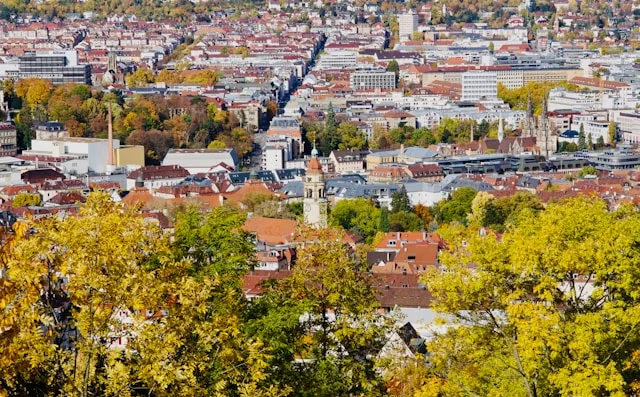
Stuttgart's Automotive Suppliers Are Cutting Thousands of Jobs and Cannot Fill the Ones That Matter
The Stuttgart metropolitan region filed more automotive patents than any other European city in 2023. It is also a market where a senior battery management systems architect takes eight to ten months to hire. These two facts describe the same economy, and together they expose the central paradox facing every hiring leader in Baden-Württemberg's manufacturing heartland.
The paradox runs deeper than a simple supply-demand mismatch. Stuttgart is not experiencing a talent shortage in the traditional sense. It is experiencing a talent replacement crisis. The region's 400-plus automotive suppliers built their workforce over decades around internal combustion engine expertise. That workforce is now contracting. The new workforce these same firms need, one defined by embedded software, battery chemistry, and industrial automation, does not exist in sufficient numbers anywhere in Germany. Capital is moving faster than human capital can follow.
What follows is a ground-level analysis of where the hiring gaps are most acute in Stuttgart's automotive and precision engineering sector, what is driving them, and why traditional recruitment methods reach less than 10% of the candidates these firms need. The data covers compensation benchmarks, passive candidate dynamics, competitive geography, and the regulatory pressures compounding every hiring decision Mittelstand leaders face heading into 2026.
The Scissors Crisis: Mass Layoffs and Acute Shortages in the Same Companies
Stuttgart's labour market is doing something that looks contradictory from the outside. The region's largest private employer, Robert Bosch GmbH, announced in November 2024 the elimination of 3,500 positions across Germany by end of 2027, with an estimated 1,500 of those in Stuttgart-region plants. The roles being cut are concentrated in ICE fuel injection and transmission control units. These are the functions that defined Bosch's Stuttgart operations for a generation.
At the same time, Bosch maintains over 800 active job postings for embedded systems and AI roles in the same region. Fill times for these positions exceed 120 days. Regional unemployment for engineers sits at 1.8%.
This is not a surplus of workers. It is a qualitative mismatch where ICE-mechanical skills are becoming obsolete faster than electrical and software skills can be sourced. The restructuring headlines created a false impression that qualified talent was available. The layoffs targeted legacy hardware functions. The simultaneous shortage in software, battery systems, and AI-driven manufacturing roles deepened through the same period.
MAHLE GmbH illustrates the same dynamic from a different angle. Headquartered in Stuttgart-Stammheim with approximately 13,000 regional employees, MAHLE completed its divestment of the traditional pistons business in 2024 to concentrate on thermal management for batteries and electric powertrains. According to its Q3 2024 investor presentation, the company reported an inability to scale its new Stuttgart-based R&D centres because of talent scarcity. The strategy exists. The capital exists. The people do not.
For hiring leaders across the region, this scissors crisis means that workforce planning cannot be treated as a single problem. The contraction side and the growth side require completely different approaches, different pipelines, and different compensation strategies. Treating them as one challenge produces paralysis.
Inside the Mittelstand Digitalization Trap
Why 80% of Suppliers Lack the HR Infrastructure to Hire What They Need
The Mittelstand subset comprises roughly 80% of the region's 400-plus automotive suppliers. These are family-owned enterprises, typically generating €20 million to €500 million in revenue with 250 to 2,000 employees. They are the backbone of Stuttgart's precision engineering cluster. They are also the firms least equipped to recruit the talent the transformation demands.
According to a 2024 McKinsey study on the German Mittelstand in transformation, 68% of these firms report lacking the HR infrastructure to recruit outside traditional mechanical engineering pipelines. They need CNC operators capable of programming 5-axis machines for EV housing production. They need embedded software engineers for vehicle-to-grid interfaces. Their recruitment processes were built to hire mechanical engineers from the University of Stuttgart and the regional Fachhochschulen. Those processes do not reach software engineers, data scientists, or battery chemists.
The University of Stuttgart produces 1,800 engineering graduates annually. Only 12% specialise in software or electrical engineering, compared to 45% in mechanical engineering. The pipeline itself is misaligned with the market it feeds.
The Capital Constraint That Compounds the Talent Problem
The digitalization trap is not only a recruitment problem. It is a financing problem that makes the recruitment problem worse. Regional banks have tightened lending standards for automotive suppliers with more than 30% ICE exposure. According to KfW Research's Mittelstandsbarometer, 40% of Stuttgart-area Mittelstand suppliers report difficulty securing transition loans at viable interest rates. Current SME lending rates sit between 5.5% and 7.2%.
A Mittelstand firm that cannot finance its €50 million to €200 million retooling for e-mobility platforms also cannot offer the compensation premiums required to attract senior embedded systems talent. The capital constraint and the talent constraint reinforce each other. Firms that cannot retool cannot attract the people who would run the retooled operations. Firms that cannot attract those people cannot demonstrate to lenders that the retooling will succeed. This loop is pushing 15 to 20% of Stuttgart-area suppliers toward exit or acquisition by Q4 2026, according to BDI projections.
This is the original synthesis this analysis rests on: the Mittelstand transformation is not stalling because of a shortage of engineers in the abstract. It is stalling because capital markets and talent markets are failing simultaneously, and each failure deepens the other. The firms that break this loop will be the ones that secure both financing and senior technical leadership in the same 12-month window. The firms that treat these as sequential problems, addressing capital first and talent second, will find that the talent has been hired by someone else before they are ready to make an offer.
Where the Shortages Are Most Acute: Three Role Categories
Embedded Systems and E/E Architecture
Senior specialists and team leads in electrical and electronic architecture command €95,000 to €120,000 in base salary in the Stuttgart region. Total compensation with bonus reaches €110,000 to €140,000. At the executive level, a Leiter Entwicklung E/E or Mittelstand CTO earns €150,000 to €190,000 base, with total compensation reaching €200,000 to €260,000 including profit-sharing arrangements common in family-owned firms.
These figures carry a 10 to 15% premium over the German average for engineering roles. Yet they trail Munich by 15 to 20%, where senior embedded engineers command €115,000 to €140,000 base. The gap is widening fastest at exactly the seniority level where the most critical roles sit. Stuttgart leads Europe in automotive patent output, but its wage growth for senior engineers, 3.2% year-on-year through 2024, lagged behind Munich's 4.8% and failed to compensate for regional housing cost inflation running at 6.5%.
For a hiring leader at a Mittelstand firm trying to recruit an embedded systems architect, the arithmetic is stark. The candidate you need earns more in Munich, commands a higher premium at Porsche or Bosch than you can match, and faces a cost of living in Stuttgart that erodes the salary advantage your region once held over Berlin.
CNC Machining and Precision Tooling
Production leaders and lean managers in precision engineering earn €85,000 to €105,000 base, with total compensation of €95,000 to €120,000. At the Werkleiter or Mittelstand COO level, base salaries range from €130,000 to €160,000 with total packages of €150,000 to €200,000. Many Mittelstand COOs hold equity stakes or silent partnerships not reflected in published salary data.
The CNC machinist shortage is the most structurally embedded problem in the region. VDMA survey data from October 2024 shows that CNC machining positions with Siemens NX or Heidenhain programming capabilities remain unfilled for an average of 6.2 months at mid-sized precision engineering firms. Forty percent of surveyed firms now offer signing bonuses of €3,000 to €8,000 for these roles. Before 2022, signing bonuses for CNC machinists were virtually unknown in this market.
Unemployment among qualified CNC programmers with ten or more years of experience sits below 1.5%. Average tenure exceeds eight years. The ratio of active to passive candidates is approximately 1:9. Only 10% of the people you need are actively looking for work. The other 90% must be found through direct approach.
Battery and Powertrain Systems Engineering
Senior battery systems architects command €100,000 to €130,000 base, with top performers reaching €140,000. At the department head level, base salaries range from €160,000 to €210,000, with meaningful variation by company size. Venture-backed battery ventures such as Cellforce Group, the Porsche and BASF joint venture headquartered near Stuttgart, offer equity supplements that traditional Mittelstand firms cannot match.
Cellforce is scaling production of high-performance battery cells and creating 250 new engineering positions by end of 2026, with salaries 20% above regional mechanical engineering averages. This investment is positive for the region's trajectory. It also intensifies competition for the same constrained talent pool.
According to Handelsblatt, embedded software engineers specialising in automotive battery management systems represent the most difficult category to fill in the Stuttgart labour market. The vacancy rate for these roles is 18.3%, against a general unemployment rate of 3.2%. Candidates with five or more years of BMS experience receive an average of 4.2 simultaneous offers. Both MAHLE and Bosch Mobility Solutions have publicly acknowledged extending search durations for senior battery software architects to eight to ten months. In several cases, according to the same reporting, these firms have resorted to acquiring entire startup teams rather than hiring individuals. When the cost of a failed executive search includes buying a company, the recruitment market has moved well beyond normal parameters.
The Competitive Geography Pulling Talent Out of Stuttgart
Stuttgart does not compete for talent in isolation. Four distinct geographies are drawing qualified engineers away from the region, each through a different mechanism.
Munich offers 15 to 20% salary premiums for the same embedded systems roles, along with a more developed tech startup ecosystem in autonomous driving and AI. Cost of living in Munich runs 8 to 12% higher than Stuttgart, but the salary differential more than compensates. For a senior engineer weighing two offers, the financial calculation favours Munich.
Berlin and Brandenburg present a different proposition. The Tesla Gigafactory in Grünheide has hired over 1,000 engineers since 2022. Berlin salaries run approximately 10% below Stuttgart levels, but the city offers what younger engineers describe as higher lifestyle value. Stuttgart's traditional Mittelstand culture, with its emphasis on stability, hierarchy, and long tenure, struggles to compete with Berlin's perception as a dynamic, flexible market. This is not a compensation problem. It is a cultural and employer brand problem that no signing bonus resolves.
Switzerland represents the most financially aggressive competitor. For senior CNC and precision engineering specialists, Swiss manufacturers including ABB and Georg Fischer offer 40 to 50% wage premiums. Approximately 12,000 German engineers commute across the Swiss border from Baden-Württemberg. This cross-border drain removes experienced 35-to-45-year-old technical talent from the Stuttgart market on a daily basis, without those professionals ever appearing as "leavers" in German labour statistics. They remain Baden-Württemberg residents. They simply work elsewhere.
Eastern Germany's emerging battery clusters in Saxony and Thuringia, including CATL's Erfurt facility and VW PowerCo's Salzgitter plant, offer lower costs of living and government relocation subsidies. These compete for mid-level production engineers willing to trade Stuttgart's premium costs for lifestyle arbitrage. The competitive pressure here is newest and growing fastest.
For any firm running an executive search in the Stuttgart industrial and manufacturing sector, the search perimeter cannot be Stuttgart alone. The candidates are distributed across a geography that spans four countries and half a dozen competing value propositions. Reaching them requires talent mapping that covers the full competitive field.
Regulation Is Compressing Budgets at the Worst Possible Moment
The EU Corporate Sustainability Due Diligence Directive, transposed into German law by 2026, imposes compliance liability on firms with 1,000 or more employees. Approximately 60 of the region's largest suppliers fall under this threshold. According to a BDI and PwC joint study, a Stuttgart-based precision engineering firm with 1,000 employees faces estimated annual compliance costs of €1.2 million to €2 million. For many Mittelstand firms, this is equivalent to 15 to 20% of their annual R&D budget.
This is not an abstract regulatory concern. It is a direct competitor for the same budget line that funds transformation hiring. Every euro spent on supply chain compliance documentation is a euro not spent on the senior battery systems architect the firm cannot find.
The existing German Supply Chain Due Diligence Act, the Lieferkettensorgfaltspflichtengesetz, already imposes material compliance costs. The CSDDD layer compounds these. Mittelstand firms now need compliance professionals, a role category that barely existed in Stuttgart's manufacturing sector five years ago. They also need the technical talent to transform their operations. They cannot afford both at the salaries the market demands.
Energy costs add a further layer. German industrial electricity prices of €0.20 to €0.25 per kilowatt-hour remain two to three times higher than US or French levels. Energy-intensive precision manufacturing, including forging and surface treatment, is becoming uncompetitive in Stuttgart without subsidies. This cost pressure constrains the margin available for compensation premiums, further weakening the region's position in the talent competition with Munich, Switzerland, and government-subsidised Eastern German facilities.
The firms that will survive this compression are those that make their leadership hiring decisions before the budget window closes. Waiting for regulatory clarity or cost stabilisation before hiring transformation leaders is the strategy most likely to fail, because the talent these firms need is being hired now by competitors who have already committed.
Why Conventional Search Methods Cannot Reach This Market
The passive candidate data for Stuttgart's three critical role categories tells a clear story about why traditional executive recruiting approaches fail in this market.
Industrial software architects working on automotive MES and SCADA systems are effectively at 0% unemployment. Average time in role exceeds six years. The ratio of active to passive candidates is approximately 1:12. For every one qualified professional browsing job boards, twelve are employed, satisfied, and unreachable through conventional channels.
Battery systems engineers show an active-to-passive ratio of approximately 1:4. They are not applying to jobs, but they are what the market calls "active listeners." They are responsive to targeted outreach about genuinely innovative platforms but invisible to standard recruitment advertising.
General mechanical engineering, by contrast, shows a roughly 1:1 active-to-passive ratio with 2.8% unemployment and higher willingness to relocate. This is the one segment where job boards and inbound applications still produce results.
The implication is that the roles where supply is adequate are the roles the market no longer needs at the same volume. The roles where demand is critical are the roles where 80 to 90% of candidates must be found through direct headhunting, not advertising. A Mittelstand firm that posts a job for a senior embedded systems engineer on StepStone or Indeed is addressing approximately 10% of the viable candidate pool. The other 90% require a fundamentally different method.
Stuttgart's cluster infrastructure, including the Fraunhofer IPA and IAO institutes, the ARENA2036 research campus, the Steinbeis Foundation, and the University of Stuttgart's engineering faculty, serves as a talent pipeline. The Fraunhofer IPA reports that 30% of its junior researchers are hired directly by regional Mittelstand firms. But these pipelines produce entry-level and early-career professionals. They do not produce the senior battery systems architects, the experienced embedded software leads, or the Mittelstand CTOs capable of leading a €100 million transformation programme. Those leaders are already employed. They are performing well. They are not looking. And the proposition required to move them must address compensation, role scope, and strategic vision simultaneously.
What Hiring Leaders in This Market Need to Do Differently
The trajectory established through 2025 has continued into 2026. Consolidation is accelerating. The firms that secured both capital and senior technical leadership in the same cycle are now pulling ahead. The firms that waited are running out of time as the financing window narrows and the talent pool shrinks further.
KiTalent works with organisations across Stuttgart's automotive and precision engineering sector facing exactly this dynamic. The challenge is not that qualified leaders do not exist. It is that they are invisible to conventional search methods, already employed in roles they have no reason to leave, and receiving multiple competing approaches from firms with larger compensation budgets. Reaching them requires AI-enhanced talent mapping that identifies candidates across Stuttgart, Munich, Switzerland, and the emerging Eastern German clusters before a single outreach is made.
KiTalent delivers interview-ready executive candidates within seven to ten days, with a pay-per-interview model that eliminates upfront retainer risk. The firm's 96% one-year retention rate reflects a search methodology built for markets where the wrong hire costs more than the search itself. In Stuttgart's current environment, where a senior battery architect vacancy runs eight to ten months under conventional methods, that speed differential is the difference between leading the transformation and watching competitors complete it first.
For organisations competing for embedded systems leadership, battery engineering talent, or Mittelstand CTO appointments in Stuttgart's compressed and bifurcating market, speak with our executive search team about how we approach this specific challenge.
Frequently Asked Questions
Why is Stuttgart experiencing engineering talent shortages when major employers are announcing layoffs?
The layoffs and the shortages are happening in different skill categories within the same companies. Robert Bosch, for example, is reducing 1,500 ICE-related positions in the Stuttgart region while maintaining over 800 open vacancies in embedded software and AI. Regional unemployment for engineers is 1.8%. The problem is a qualitative mismatch: internal combustion engine mechanical skills are becoming obsolete while electrical, software, and battery expertise cannot be sourced fast enough. The restructuring headlines suggest labour market slack that does not exist for the roles that matter most to the transformation.
What do senior embedded systems engineers earn in the Stuttgart region?
Senior specialists and team leads in E/E architecture earn €95,000 to €120,000 base salary in Stuttgart, with total compensation of €110,000 to €140,000 including bonuses. At the executive level, a Mittelstand CTO or Head of E/E Development earns €150,000 to €190,000 base, with total packages reaching €200,000 to €260,000 including profit-sharing. Stuttgart salaries carry a 10 to 15% premium over the German average but trail Munich by 15 to 20% for comparable roles, creating a competitive disadvantage for regional employers. Accurate salary benchmarking is essential before making offers.
How long does it take to fill critical engineering roles in Stuttgart's automotive sector?
Average vacancy duration for engineering roles across the region is 143 days, according to the IHK Region Stuttgart. Senior battery software architects take eight to ten months under conventional search methods. CNC machining positions requiring Siemens NX or Heidenhain programming remain unfilled for an average of 6.2 months at mid-sized firms. These durations reflect the predominantly passive nature of the candidate market, where 80 to 90% of qualified professionals are not actively searching and require direct headhunting to reach.
What makes Stuttgart's Mittelstand hiring challenges different from larger employers?
Mittelstand firms, typically family-owned with 250 to 2,000 employees, face a compounding challenge. Sixty-eight percent lack the HR infrastructure to recruit outside traditional mechanical engineering pipelines. They cannot match the 20 to 30% compensation premiums that OEMs like Porsche offer. And regional banks have tightened lending for firms with significant ICE exposure, constraining the capital available for both retooling and competitive hiring. KiTalent's direct search approach reaches passive candidates in this market through targeted outreach rather than job advertising, addressing the infrastructure gap that prevents Mittelstand firms from competing on their own.
Which geographies compete with Stuttgart for automotive engineering talent?
Stuttgart faces competition from four directions. Munich offers 15 to 20% salary premiums for embedded systems roles. Switzerland draws approximately 12,000 engineers from Baden-Württemberg through 40 to 50% wage differentials. Berlin attracts younger engineers with lifestyle value despite lower pay. Eastern German battery clusters in Saxony and Thuringia offer government relocation subsidies and lower living costs. Effective executive search in this market must cover the full competitive geography, not just the Stuttgart region.
How can automotive suppliers in Stuttgart improve their chances of hiring transformation leaders?
Three priorities: first, treat capital strategy and talent strategy as simultaneous rather than sequential, because the leaders you need are being hired by competitors who committed earlier. Second, accept that job advertising reaches at most 10% of viable candidates for the most critical roles and invest in proactive talent pipeline development. Third, structure compensation to compete not only with other Mittelstand firms but with OEMs, Swiss manufacturers, and venture-backed startups that offer equity upside. Speed matters enormously in this market. The firms filling battery and embedded systems leadership roles in seven to ten days rather than eight to ten months are the ones securing the talent the transformation requires.