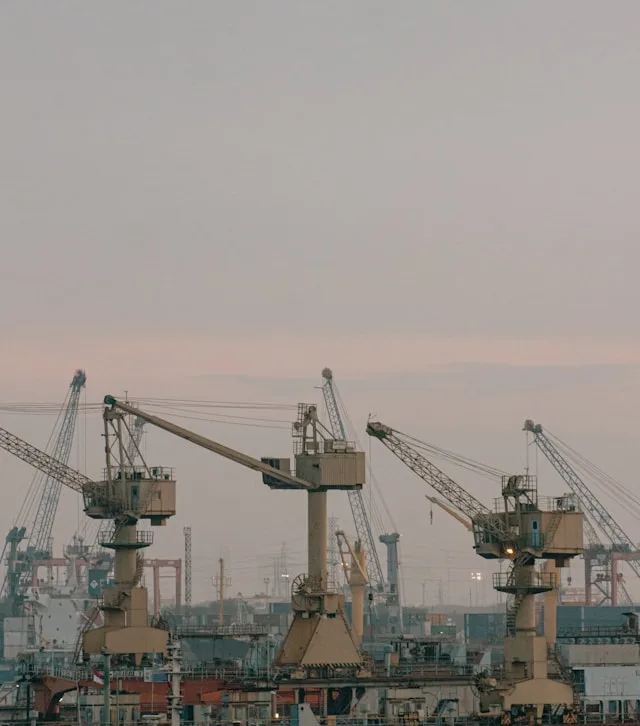
Surabaya's Shipbuilding Paradox: Abundant Labour, Zero Certified Talent Where It Counts

Surabaya's shipyards have never been busier on paper. PT PAL Indonesia's order book reached IDR 9.8 trillion by Q3 2024, driven by the Indonesian Navy's Minimum Essential Force programme. Private yards across the Gresik and Lamongan corridors project 8 to 12 per cent revenue growth into 2026, fuelled by offshore support vessel maintenance for the Masela Block. The port of Tanjung Perak continues to handle roughly 4.2 million TEUs annually as Indonesia's second-busiest container terminal. Capital is flowing. Orders are stacking. The yards are running above 90 per cent dock occupancy.
Yet behind these numbers sits a hiring crisis that no amount of government investment or order book growth can resolve on its own. The Surabaya-Gresik corridor employs approximately 28,000 direct workers in shipbuilding and repair. It is simultaneously short 3,400 certified welders and 600 marine engineers. Only 12 per cent of welding personnel in the region hold the American Bureau of Shipping or American Welding Society certifications required for international-class vessel construction. The deficit is not a labour shortage. It is a certification bottleneck that locks out the most valuable work even as headcount grows.
What follows is a ground-level analysis of why Surabaya's maritime and industrial manufacturing sector cannot convert its cost advantages and strategic position into higher-value shipbuilding, where the talent constraints are most severe, and what organisations hiring in this market must understand about the dynamics that make conventional recruitment methods inadequate.
The Certification Paradox: Why More Workers Cannot Solve This Problem
The core tension in Surabaya's shipbuilding talent market is not one of volume. East Java has no shortage of workers willing to enter the yards. The constraint is strictly credential-based and quality-controlled by international classification societies. A welder without ABS or AWS certification cannot perform structural work on vessels destined for international classification. A marine engineer without dual-fuel system training cannot service the LNG-capable engines that every major shipping line now requires. The market has abundant general labour. It has an acute shortage of the specific certified talent required to use that labour productively.
This paradox explains why Surabaya struggles to capture higher-value shipbuilding segments despite maintaining a labour cost advantage of 40 per cent below Batam and 60 per cent below Singapore. The cost advantage is real. It is also irrelevant for contracts that require internationally certified personnel, because those personnel do not exist locally in sufficient numbers.
According to IPERINDO's 2024 Skills Audit, only 12 per cent of welding personnel in the Surabaya-Gresik corridor hold internationally recognised certifications. To put that in operational terms: for every ten welders on a yard floor, fewer than two can perform work that meets the standards of Bureau Veritas, Lloyd's Register, or ABS. The remaining eight are productive on domestic-specification vessels. They cannot touch an export-class hull or a vessel under international classification without an upgrade that takes 12 to 18 months of training and examination.
The result is that yards chasing higher-value contracts must either recruit from outside the region or invest years in developing their own workforce. Most do both, and neither approach is fast enough to match the pace of incoming orders. The hidden 80 per cent of qualified passive candidates in this market are not simply employed elsewhere. They hold certifications so scarce that their current employers will counter any approach with retention packages designed to make movement uneconomical.
PT PAL and Defence Spending: The Capacity Squeeze That Affects Everyone
PT PAL Indonesia, the state-owned anchor of Surabaya's shipbuilding ecosystem, employs 3,850 permanent staff and 2,100 contract workers. It supports 147 SME subcontractors in steel cutting, piping, and electrical systems. The company anticipates IDR 12.5 trillion in new orders for 2026, primarily from the Ministry of Defence's MEF phase III programme, which includes two additional Nagapasa-class submarines and four frigates.
Defence Orders Absorb Capacity That Commercial Clients Need
This defence spending is a double-edged dynamic. It guarantees revenue and employment stability. It also absorbs 70 to 75 per cent of PT PAL's Lamongan capacity, based on the company's own investor briefings. The Lamongan facility's two graving docks and one floating dock already operate at 94 per cent occupancy. When defence orders consume three-quarters of the remaining capacity, commercial repair clients face scheduling delays that push them toward competing yards in Batam or Vietnam.
The Subcontractor Talent Drain
For the 147 subcontractor firms that depend on PT PAL's ecosystem, the defence priority creates a secondary pressure. PT PAL's ability to offer state-enterprise compensation structures, including performance bonuses capped at 200 per cent of base salary under government guidelines, makes it the employer of first choice for certified welders and engineers in the corridor. Private yards and subcontractors report that their most experienced technical staff are regularly approached for roles within PT PAL's defence programmes, where job security and benefits exceed what smaller firms can match.
The implication for hiring leaders at private yards is straightforward. You are not competing for talent against each other. You are competing against a state-owned enterprise with guaranteed order flow, government-backed compensation, and the prestige of building warships for the Indonesian Navy. The value proposition required to retain or attract certified personnel must account for this asymmetry.
The Roles That Define the Shortage
Three role categories concentrate the most severe hiring pressure in Surabaya's shipbuilding market. Each has distinct dynamics, and understanding those dynamics is essential for any organisation planning a senior technical hire in this corridor.
Classification Society-Certified Welding Supervisors
Tier-one yards in the Lamongan corridor typically experience four to six month vacancy periods for AWS D1.1 or ABS-certified welding supervisors. Recruitment pattern data from the Ministry of Manpower's job vacancy monitoring indicates that a senior welding inspector search at a Lamongan-based yard ran 167 days in 2024. The position was ultimately filled by recruiting from a competitor in Batam, with a 35 per cent salary premium and a relocation package.
The 167-day figure is not an outlier. It is consistent with what executive search specialists in industrial sectors see across Southeast Asian manufacturing when the required credential is held by fewer than one in ten candidates in the local market. Job boards and active candidate pools are functionally irrelevant for this role. An estimated 75 to 80 per cent of qualified welders and NDT technicians in this market are employed and not actively looking. They move through networks and direct approaches, not advertisements.
Naval Architects with 3D CAD/CAM Proficiency
Mid-level naval architects with five to eight years of experience and proficiency in CATIA or NAPA represent the second critical shortage. These professionals are concentrated in Jakarta-based design consultancies and Singapore-based ship management firms. Surabaya employers must typically offer a 28 per cent premium above standard East Java rates to induce relocation from Jakarta, where headquarters roles at classification societies and shipping companies already pay 25 to 35 per cent more than Surabaya equivalents.
The cost-of-living differential partially offsets this gap. Housing costs in Jakarta run 80 per cent above Surabaya, according to BPS Consumer Price Index comparisons. But cost of living is only persuasive when the candidate is already considering relocation. For the 50 per cent of senior specialist naval architects classified as passive candidates, the proposition must address career trajectory and project quality, not just net purchasing power.
Dual-Fuel Marine Engineers
The Masela Block development and tightening IMO greenhouse gas regulations have created urgent demand for engineers experienced with MAN Energy Solutions and Wärtsilä dual-fuel engines. These profiles are typically sourced from Singapore-based ship management firms or Batam's oil and gas sector. The compensation gap is the widest in this category: VP-level technical roles in Singapore command SGD 15,000 to 25,000 monthly, representing a 2.5 to 3x premium over equivalent Surabaya positions.
Surabaya employers offset this gap with housing allowances and education sponsorships. These are necessary but not sufficient. The deeper issue is that dual-fuel expertise barely exists in Surabaya's local talent pool. Only PT PAL and three private yards currently hold LNG containment system repair certifications from classification societies. The talent pipeline for this specialism must be built from scratch or imported, and importing it means competing with every other yard in Southeast Asia chasing the same green transition.
The Green Transition: A Deadline That the Talent Market Cannot Meet
By 2026, Surabaya yards must demonstrate capability for LNG bunkering and dual-fuel engine retrofits to retain contracts with international shipping lines. The IMO's 2023 greenhouse gas strategy requires scrubber and ballast water management system retrofits across the global fleet. These are not aspirational goals. They are contract prerequisites.
The gap between the deadline and the readiness is stark. Four facilities in the entire Surabaya-Gresik corridor hold the relevant LNG containment system certifications. The equipment needed for compliant retrofits faces six-month import lead times due to customs classification disputes at the Ministry of Trade. Environmental Impact Assessments for yard expansions that would accommodate LNG infrastructure average 14 to 18 months for approval, compared to eight to ten months in Batam's Free Trade Zone.
This is the analytical point that hiring leaders in this market must absorb: the investment in green transition capability has not reduced workforce requirements. It has replaced one kind of worker with another that does not yet exist locally in sufficient numbers. Capital can purchase LNG bunkering equipment. It cannot purchase the five to ten years of dual-fuel engineering experience that a classification society surveyor will verify before certifying the work. The yards that solve their green-transition talent acquisition challenge first will capture the retrofit contracts. The yards that solve it second will find those contracts already allocated.
The urgency is compounded by Tanjung Perak's bunkering infrastructure limitations. The port handles approximately 1.2 million metric tonnes of bunker fuel annually, insufficient for the East Java fleet's growing demand for low-sulphur fuel oil and alternative fuels. As bunkering infrastructure expands, the talent required to operate and maintain it must expand in parallel. Neither is happening fast enough.
Compensation Realities: What Roles Pay and Why the Gaps Persist
Understanding what Surabaya's shipbuilding roles actually pay is essential for any organisation calibrating an offer or assessing whether a salary negotiation is likely to succeed.
At the senior specialist and manager level, marine engineering and naval architecture roles command IDR 18 to 28 million monthly, roughly USD 1,100 to 1,700. Welding engineering and quality assurance managers sit at IDR 15 to 22 million. Shipyard operations and project management roles, which carry profit-and-loss accountability, reach IDR 22 to 35 million.
At executive and VP level, the numbers shift materially. Marine engineering executives earn IDR 85 to 140 million monthly. Quality assurance VPs command IDR 60 to 95 million. Operations and project management VPs reach IDR 110 to 180 million, the highest band in the sector, reflecting the direct commercial responsibility these roles carry.
The gap between specialist and executive compensation is wider in Surabaya's shipbuilding sector than in most Indonesian industries. A senior welding engineer earns roughly IDR 20 million. A VP of quality assurance earns IDR 80 million. The four-to-one ratio reflects the extreme scarcity of executives who combine technical certification, commercial judgement, and the ability to interface with international classification societies and foreign naval clients.
The Singapore Premium and Persistent Brain Drain
The compensation data becomes most revealing when placed against regional competitors. Singapore VP-level technical roles pay IDR 180 to 300 million monthly. That is a 2.5 to 3x premium over Surabaya. This gap drives persistent brain drain among Indonesian naval architects with more than ten years of experience. The pattern is well-documented by the Maritime and Port Authority of Singapore and salary benchmarking firms: Indonesia trains the talent, and Singapore absorbs it once it matures.
For Surabaya employers, the implication is not that they must match Singapore salaries. They cannot, and the cost structure of Indonesian shipbuilding would collapse if they tried. The implication is that retention strategy must begin earlier and must involve non-monetary elements. Housing allowances, education sponsorships for dependants, and clear promotion pathways toward executive roles are the tools that slow the outflow. They do not stop it. But they extend the window during which a certified professional remains in the Surabaya market.
Understanding how market benchmarking works in these constrained environments is critical for any employer making offers in this corridor. The wrong benchmark, whether Jakarta office rates or Singapore maritime rates, will either undershoot and lose the candidate, or overshoot and distort the local compensation structure for everyone.
Structural Constraints: Steel, Regulation, and Regional Competition
The talent crisis does not exist in isolation. It sits inside a broader set of constraints that amplify its effects and limit the options available to employers and policymakers.
Import Dependency and Margin Pressure
Surabaya's shipyards import 65 to 70 per cent of high-grade steel plate and 90 per cent of marine engines, according to Ministry of Industry data. East Java lacks integrated steel mills producing shipbuilding-grade plate, which means every order depends on three to four month delivery lead times from POSCO in South Korea or Baosteel in China. When the rupiah weakened to an average of IDR 15,600 against the dollar through 2024, input costs rose 12 to 15 per cent. On fixed-price contracts, that cost increase comes directly out of margins.
Compressed margins reduce the budget available for talent investment. A yard operating on thin margins cannot offer the 35 per cent salary premiums needed to recruit certified welders from Batam. It cannot fund the 12-month certification programmes that would develop its own workforce. The input cost problem and the talent problem are not separate. They feed each other.
Regulatory Fragmentation
The 2024 split of maritime regulatory authority between the Coordinating Ministry for Maritime Affairs and Investment and the Ministry of Transportation has created uncertainty in domestic shipping subsidy programmes, particularly the Tol Laut programme that supports newbuild demand. According to the Indonesian National Shipowners' Association (INSA), this fragmentation delays procurement decisions and makes it harder for yards to plan workforce scaling against confirmed orders.
Vietnamese and Chinese Competition
Surabaya competes not only for talent but for contracts. Vietnam's Haiphong yards offer 30 per cent lower labour rates for basic hull repairs, according to Drewry Maritime Research. Chinese and Korean yards undercut standard bulk carrier pricing by 15 to 20 per cent. Surabaya's competitive position depends on its ability to move up the value chain toward specialised, certified work. That move requires exactly the talent the market cannot currently supply.
The strategic picture is clear. The Indonesian government's Global Maritime Fulcrum policy positions Surabaya as a shipbuilding hub. State-backed demand through PT PAL guarantees a floor of activity. But state demand growth may simply transfer value to foreign steel suppliers and engine manufacturers if the domestic industrial base and talent pool do not develop in parallel. Investment moved faster than human capital could follow.
What This Means for Organisations Hiring in Surabaya's Shipyards
The data presented throughout this analysis points to a market where conventional hiring methods are structurally inadequate for the roles that matter most. The certified welding supervisors, dual-fuel marine engineers, and senior naval architects who define a yard's capacity to take on higher-value work are overwhelmingly passive candidates. An estimated 85 per cent of executive-level technical managers in this market are not in active application pools. They transition through confidential search processes or counter-offer situations.
Posting a vacancy on JobStreet and waiting for applications will surface the 15 to 20 per cent of the market that is actively looking. In a talent pool this small and this credential-constrained, that fraction is insufficient to build a competitive shortlist. The typical recruitment failures in this market, searches running 167 days and ending with a 35 per cent premium hire from another island, are not caused by bad HR processes. They are caused by using methods designed for abundant talent markets in a market defined by scarcity.
KiTalent works with industrial and manufacturing organisations across markets where the qualified candidate pool is narrow, passive, and credential-gated. Through AI-enhanced talent mapping and direct headhunting, we identify and approach the specific professionals who hold the certifications, experience, and willingness to consider a move, delivering interview-ready candidates within 7 to 10 days. Our pay-per-interview model means clients invest only when they meet qualified candidates, not before.
For shipbuilders and maritime operators in the Surabaya-Gresik corridor facing the dual pressure of defence capacity crowding and green transition deadlines, where the cost of leaving a critical technical role unfilled is measured in lost contracts and classification delays, speak with our industrial sector search team about how we approach this market.
Frequently Asked Questions
What is the average salary for a senior marine engineer in Surabaya's shipbuilding sector?
Senior specialist and manager-level marine engineers in Surabaya earn IDR 18 to 28 million monthly, approximately USD 1,100 to 1,700. At executive and VP level, compensation reaches IDR 85 to 140 million monthly. These figures reflect 2024 Ministry of Manpower data and Willis Towers Watson benchmarks. The wide range between specialist and executive bands reflects extreme scarcity at senior levels, where international certification and commercial experience command substantial premiums. Singapore-based equivalents earn 2.5 to 3 times more, creating persistent brain drain pressure on Surabaya's most experienced professionals.
Why is there a shortage of certified welders in Surabaya?
Surabaya's welder shortage is a certification problem, not a labour supply problem. The region employs 28,000 direct workers in shipbuilding, but only 12 per cent of welding personnel hold ABS or AWS certifications required for international-class vessel construction. Certification requires 12 to 18 months of specialised training and examination. Yards cannot accelerate this timeline, and the candidates who already hold certifications are predominantly passive, with 75 to 80 per cent not actively applying for vacancies. This makes direct headhunting of passive certified professionals the only reliable sourcing method for these roles.
How does PT PAL's defence spending affect private shipyard hiring?
PT PAL's defence orders are projected to absorb 70 to 75 per cent of its Lamongan facility capacity through 2026. This creates two effects on private yards. First, commercial repair clients displaced from PT PAL's docks seek alternative capacity, creating demand for private yards but not the talent to service it. Second, PT PAL's state-enterprise compensation and job security attract certified welders and engineers away from private competitors. Private yards must develop retention strategies that compete on career development and project variety rather than matching PT PAL's benefits structure.
What green transition capabilities do Surabaya shipyards need by 2026?
Yards must demonstrate capability for LNG bunkering infrastructure, dual-fuel engine retrofits, and compliance with the IMO's 2023 greenhouse gas strategy requirements including scrubber and ballast water management system installations. Currently, only four facilities in the Surabaya-Gresik corridor hold LNG containment system repair certifications. The talent required includes engineers experienced with MAN Energy Solutions and Wärtsilä dual-fuel engines, profiles that must typically be recruited from Singapore or Batam at substantial compensation premiums requiring careful benchmarking.
How can companies recruit senior shipbuilding professionals in Surabaya?
Conventional job advertising reaches at most 15 to 20 per cent of qualified candidates in Surabaya's shipbuilding market. The remainder are passive professionals in stable roles who will only consider a move when approached directly with a compelling proposition. Effective recruitment in this market requires AI-enhanced talent mapping to identify certified professionals across the Surabaya-Gresik corridor, Batam, Jakarta, and Singapore, combined with direct confidential outreach. KiTalent delivers interview-ready executive candidates within 7 to 10 days through this approach, with a 96 per cent one-year retention rate for placed candidates.
What makes Surabaya's shipbuilding talent market different from Batam or Singapore?
Surabaya offers a 40 per cent cost advantage over Batam and 60 per cent over Singapore for equivalent roles. However, this advantage is neutralised for higher-value work by the scarcity of internationally certified personnel. Batam's free trade zone status provides faster environmental permitting and higher net salaries. Singapore offers 2.5 to 3 times the compensation for senior technical roles. Surabaya's competitive position depends on developing its certified talent base faster than competitors, making proactive talent pipeline development essential rather than optional for yards pursuing international-class contracts.