Münster, Germany Executive Recruitment
Executive Search in Münster
KiTalent brings sector-specific intelligence and direct headhunting capability to senior leadership searches across Münster.
days to qualified shortlists in many searches
of relevant passive talent reached through direct headhunting
faster time-to-hire than traditional search benchmarks
one-year retention from KiTalent's broader methodology
Learn more about our track record on our about, services, and methodology pages.
Executive Recruiters in Münster, Germany
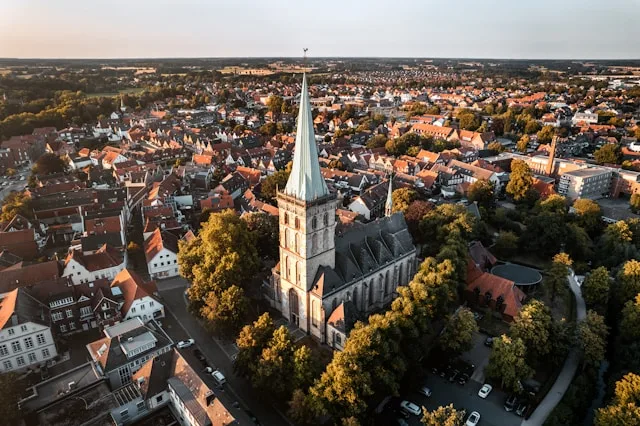
Münster is Germany's most concentrated insurance capital outside Munich and Cologne, a city where actuarial tradition is being rewritten by climate-risk modelling and AI-driven claims automation. With the University Hospital Münster employing over 11,200 people, a deep-tech corridor maturing in the Hafenviertel, and a residential vacancy rate of 0.4%, this is a market where the leaders you need are already employed, already housed, and not looking. KiTalent delivers executive search built for exactly these conditions: direct, discreet, and grounded in pre-existing intelligence on who holds what role across Münster's tightly interconnected professional clusters.
Discuss a Münster Brief → Contact How We Work → Methodology
7–10 days average time to qualified shortlist 80% of relevant passive talent reached 42% reduction in time-to-hire 96% one-year retention rate
Figures based on global KiTalent engagement data. Details: About | Services | Methodology
Beyond candidate lists: what Münster mandates actually require
A shortlist of names is the minimum output of a search. In Münster, it is not close to sufficient. The dynamics described above mean that any serious executive recruitment mandate requires three layers of intelligence that most search firms do not provide. The first is access. With 72% of Münster's workforce in services and the dominant employers operating within overlapping professional networks, the strongest candidates are identifiable but not reachable through conventional channels. They are not on LinkedIn's "open to opportunities" list. They are not attending career fairs. They are the hidden majority, the passive executives who make up roughly 80% of the relevant talent pool, who will only engage with a direct, individually crafted approach from someone who understands their sector and speaks their professional language. The second is compensation calibration. Commercial rents in the Hafenviertel are approaching Cologne levels at €18 to €22 per square metre. Industrial power costs remain 40% above 2021 baselines. These cost pressures affect how companies structure executive packages and how candidates evaluate opportunities. A market benchmarking exercise that maps total compensation across Münster's insurance, health, and tech clusters is not optional. It is what prevents offer-stage failures that waste months and damage employer credibility. The third is risk mitigation. The cost of a failed executive hire in a market this interconnected extends well beyond severance and lost productivity. In Münster's tight professional community, a bad placement at LVM is discussed at Provinzial. A withdrawn offer at UKM travels through the health sciences network within a week. The interview-fee model KiTalent operates, where the primary financial commitment occurs only after a qualified shortlist and comprehensive market intelligence have been delivered, aligns the firm's incentives with the client's outcome. It also means the assessment process is rigorous from the start. Three-tier evaluation covering technical competency, cultural alignment, and motivation is what produces the 96% one-year retention rate that justifies the investment. See our full service range → Services How we use compensation data → Market Benchmarking
Insurance and InsurTech
Climate-risk modelling, parametric insurance, and AI-driven claims automation leadership for Germany's densest mutual insurer concentration.
Healthcare and Life Sciences
Clinical research directors, hospital operations leaders, and MedTech commercialisation executives for UKM's ecosystem and the Health Campus North development.
AI and Technology
Deep-tech CTOs, sensor systems leaders, and health informatics executives for the Fraunhofer FHR network and the Digital Hub Münsterland's 340+ startups.
Food, Beverage and AgriTech
Digital farming leadership, precision agriculture R&D directors, and vertical farming operations executives for the Münsterland agricultural innovation corridor.
Industrial Automation and Sensor Systems
Radar systems engineers and autonomous logistics leaders for Fraunhofer spin-offs and automotive supplier networks.
Why companies partner with KiTalent for executive search in Münster
Companies rarely need only reach in Münster. They need interpretation, calibration, and a search architecture that reflects the real structure of the market.
We operate across Germany
Our team coordinates Münster mandates from our European headquarters in Turin, with direct access to the talent intelligence, compensation dynamics, and sector developments that drive search outcomes.
We reach the candidates that matter
The strongest executives in Münster are passive. Our direct headhunting approach engages the hidden 80% of passive talent through discreet outreach rooted in real market knowledge.
We do not start from scratch
Our parallel mapping methodology means we already hold live intelligence on restructuring, transition windows, compensation patterns, and candidate attraction opportunities when a brief arrives.
Our model de-risks the investment
In Münster, the cost of a wrong executive hire extends far beyond the recruitment fee. Our interview-fee model lets clients see real market output and qualified candidates before the bulk of the investment is committed.
What this means for search design
In a city with 4.1% unemployment and severe housing constraints, time-to-hire is not an abstract metric. Every week a leadership position sits vacant is a week of delayed strategic initiative, whether that is LVM's climate-risk product rollout, UKM's clinical trial expansion, or a Hafenviertel startup's Series B preparation. Search design must be built around speed without sacrificing depth.
1. Parallel mapping before the brief is live
KiTalent continuously tracks career movements, compensation evolution, and organisational changes across the insurance, health, and technology sectors in cities like Münster. This is the methodology behind the 7 to 10 day shortlist speed. When a client needs a CDO with BaFin regulatory expertise or a clinical operations director for a UKM-affiliated venture, the firm is not starting from a blank page. It is activating intelligence that already exists.
2. Direct headhunting into the hidden 80%
In a market where the strongest candidates are embedded in LVM, Provinzial NordWest, UKM, or Fraunhofer FHR and are not considering a move, the only effective approach is direct, individually crafted outreach. Each candidate receives a proposition that reflects genuine understanding of their current role, their sector's trajectory, and the specific opportunity being presented. This is what separates a search that reaches the best from one that settles for the available.
3. Market intelligence as a search output
Every Münster mandate produces a comprehensive market benchmarking document. This includes compensation mapping across the relevant sector, candidate response analysis that reveals how the market perceives the client's proposition, and competitive intelligence on which other employers are actively recruiting for similar profiles. Clients do not just receive candidates. They receive the data they need to make informed decisions about role design, compensation, and timing.
The leadership roles Münster clients hire us for
These resources provide deeper market intelligence and explain how KiTalent turns insight into a faster, more transparent search process.
Quick links for Münster mandates
Use these pages to navigate between parent markets, sector pages, and supporting articles.
Parent market pages
Sector pages
Essential reading for Münster hiring decisions
These are the questions most closely tied to how executive search really works in Münster.
Why do companies use executive recruiters in Münster?
Münster's 4.1% unemployment rate and 0.4% residential vacancy rate mean the visible candidate market is effectively empty for senior roles. The insurance cluster alone, anchored by LVM and Provinzial NordWest, employs thousands of professionals who are well compensated, well housed, and not browsing job boards. Accessing them requires direct, discreet outreach that only a specialised executive search firm can execute at scale. Companies also use recruiters here because the professional community is small enough that a poorly managed process damages the employer's reputation with future candidates, not just the current one.
What makes Münster different from Cologne or Düsseldorf for executive hiring?
Cologne and Düsseldorf offer larger, more diverse talent pools across a wider range of industries. Münster's market is more concentrated: insurance, life sciences, and deep tech dominate, and the talent pools for these sectors overlap significantly. This means competition for the same hybrid profiles, data scientists with regulatory knowledge, CTOs with both SaaS and legacy system experience, is more intense in Münster than in cities five times its size. Spatial constraints further amplify the challenge. A search approach that works in a large, liquid labour market will underperform here.
How does KiTalent approach executive search in Münster?
KiTalent's approach begins before the mandate. Through continuous talent mapping, the firm maintains a live view of who holds what role across Münster's insurance, health, and technology sectors. When a brief is activated, candidates are identified and engaged within 7 to 10 days. Each search includes direct headhunting into passive talent, three-tier candidate assessment covering technical fit, cultural alignment, and motivation, and a comprehensive compensation benchmarking report that calibrates the client's offer to Münster's specific market conditions.
How quickly can KiTalent present candidates in Münster?
Interview-ready candidates are typically presented within 7 to 10 days of mandate activation. This speed comes from parallel mapping, the continuous intelligence-gathering that means the firm has already identified relevant professionals and built preliminary relationships before a client defines the need. It does not come from cutting corners on assessment. The same rigorous evaluation that produces a 96% one-year retention rate applies regardless of timeline.
How does Münster's housing crisis affect executive recruitment?
The 0.4% residential vacancy rate is not a background statistic. It is the single most common reason external candidates withdraw from advanced-stage processes. For roles that require relocation, the search must account for housing as part of the proposition from day one, not as an afterthought after an offer is signed. This reality also reinforces the importance of identifying candidates already based in Münster or the Münsterland region, which requires the kind of granular local market knowledge that only pre-existing talent intelligence can provide.
Start a conversation about your Münster search
Whether you are hiring a Chief Data Officer for a DORA compliance transformation, a clinical research director for UKM's expanding trial portfolio, a CTO to integrate InsurTech platforms into legacy systems, or a sensor engineering leader for a Fraunhofer spin-off, this is where the conversation starts.
What we bring to Münster executive mandates:
Executive search and direct headhunting · Talent mapping and market intelligence · Compensation benchmarking and mandate calibration · Connection to KiTalent's European headquarters in Turin and international executive search network.
How does Münster's housing crisis affect executive recruitment?
Whether you are running a live mandate or want to pressure-test a brief before going to market, this is the right place to start the conversation.