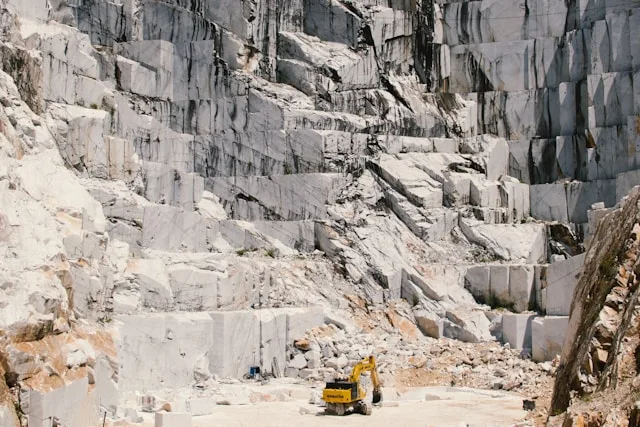
Carrara Marble Extraction in 2026: How Automation Outpaced the Workforce Built to Run It
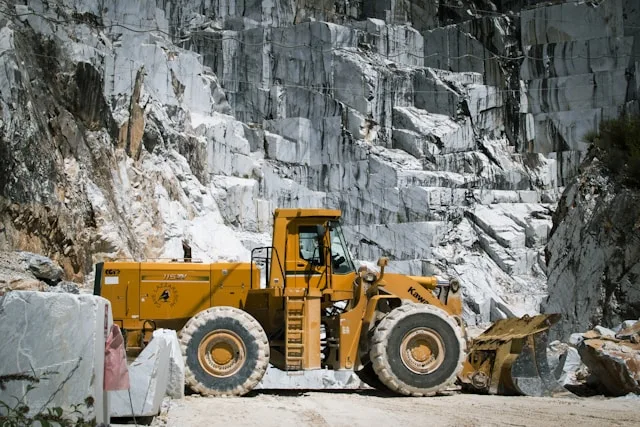
Carrara's quarries produced roughly 1.4 to 1.5 million metric tons of raw marble blocks through 2024 and into 2025. Diamond-wire cutting systems now operate in 75% of active quarries, up from 60% in 2020. The Apuan Alps district has modernised faster than almost any comparable extractive operation in Europe. And yet the sector cannot find the people it needs to keep those machines running.
This is the central paradox facing the 30 to 40 active extraction firms operating across the Carrara, Massa, and Versilia basins. Automation has reduced total headcount requirements by approximately 15% since 2020. But the roles it eliminated were manual, semi-skilled positions. The roles it created require electro-mechanical expertise, CNC wire saw programming, and drone-based photogrammetry for quarry face surveying. Vacancy times for these specialists have increased by 40% over the same period. Capital moved faster than human capital could follow.
What follows is an analysis of the forces reshaping Carrara's marble extraction sector, the specific talent gaps those forces have created, and what organisations operating in this market need to understand before they attempt their next critical hire.
The Apuan Alps District: A Sector That Defies Simple Description
The marble industrial complex stretching across the Carrara-Valdicastello Carducci catchment area accounts for approximately 38% of total private-sector employment. But the extraction segment itself is a different proposition from the broader marble economy. Extraction directly employs roughly 1,200 to 1,400 workers. Processing employs 3,800 to 4,200. Marble-machinery manufacturing and maintenance adds another 1,600.
The extraction segment's economic weight is disproportionate to its headcount. Those 30 to 40 extraction firms generate an estimated €280 to €320 million in annual turnover, according to Confindustria Marmomacchine's 2024 sector analysis. The processing segment, despite employing roughly three times as many people, generates €450 million. Revenue per employee in extraction dwarfs every other segment of the marble economy.
This ratio matters for anyone hiring into extraction. The firms are small by headcount but generate high value. A single quarry technical manager oversees operations worth tens of millions annually. A senior maintenance engineer's downtime directly translates to blocked production in a quarry face worth hundreds of euros per cubic metre. The cost of a vacancy in this sector is not measured in recruitment fees. It is measured in lost extraction days.
Consolidation Is Accelerating the Pressure
The number of active extraction concessions is contracting. Through 2025, the district operated approximately 120 concessions. By 2026, projections from the Consorzio Marmisti Carrara indicate this will fall to roughly 105, as smaller cooperatives exit due to inability to finance mechanisation upgrades.
This consolidation is not random. The four largest integrated firms increased their collective market share from 35% to 48% between 2020 and 2024. They have the capital to invest in diamond-wire systems, remote-operated excavators, and the environmental compliance infrastructure that Regional Law 34/2023 now demands. Smaller cooperative operators do not. Regulatory intent to limit industrial impact through extraction volume limits and stricter rehabilitation requirements has inadvertently concentrated extraction activity among the firms best positioned to absorb compliance costs.
For hiring leaders at these larger firms, consolidation creates a double pressure. They are absorbing the production capacity of exiting operators, which increases their need for qualified personnel. But the talent pool is not growing. It is shrinking. The professionals who ran the exiting cooperatives are overwhelmingly owner-operators in their late fifties and sixties. They are leaving the industry, not joining the consolidated firms.
The Mechanisation Paradox: Fewer Workers, Harder Searches
This is the original analytical claim at the heart of this article, and it is not stated directly in any single data source. It emerges from combining two concurrent trends.
Trend one: automation adoption across the Apuan Alps district, driven by diamond-wire cutting, remote-operated excavators, and CNC-programmed saw systems, has reduced total extraction headcount requirements by approximately 15% since 2020. This is a material workforce reduction in a sector that was already small.
Trend two: vacancy times for electro-mechanical specialists capable of servicing this automated equipment have increased by 40% over the same period. The district's vocational pipeline, anchored by the Scuola di Alta Formazione del Marmo (SAFM), has seen enrolment decline by 15% since 2020.
The investment in automation has not reduced the workforce problem. It has replaced one kind of worker with another that does not yet exist in sufficient numbers. The quarry labourer whose role was eliminated by a diamond-wire system required physical fitness and basic training. The maintenance engineer who keeps that system operational requires electro-mechanical qualifications, familiarity with pneumatics and hydraulics for 50-ton excavators, and CNC programming literacy. These are different people, educated through different pipelines, motivated by different career expectations.
A senior cell therapy specialist search in Boston takes longer than a financial services compliance search in London. But a diamond-wire maintenance engineer search in Carrara takes longer still. The candidate pool is smaller, more geographically fixed, and almost entirely passive.
Four Roles the District Cannot Fill
The extraction sector faces systemic shortages in four specific categories. Each has its own dynamics, its own candidate profile, and its own failure pattern.
Quarry Managers With Combined Geotechnical and Regulatory Expertise
The quarry manager role in the Apuan Alps is not equivalent to a site manager in conventional construction. It requires geostructural analysis of fracture patterns in marble deposits, management of the Documento di Valutazione dei Rischi (DVR) under Title IV of D.Lgs. 81/08, and the ability to manage Valutazione di Impatto Ambientale (VIA) procedures for concession renewals. Finding someone who combines field extraction experience with regulatory fluency is the challenge. These are typically separate career tracks that converge only in candidates with 15 or more years in the Apuan system.
At the executive level, a Direttore Tecnico di Cava commands €95,000 to €130,000 base compensation, with performance bonuses tied to extraction volume and safety metrics adding 20% to 30%. Even at these levels, searches are difficult. The pool of qualified candidates is small and entirely passive.
Heavy Machinery Maintenance Engineers for Diamond-Wire Systems
Diamond-wire cutting has reached 75% adoption across active quarries. Maintenance of these systems requires a profile that barely existed a decade ago: an engineer comfortable with high-tension wire tensioning systems, CNC programming interfaces, and the hydraulic systems that position 50-ton excavators on near-vertical quarry faces. A chief maintenance engineer earns €48,000 to €62,000, but the scarcity premium for Carrara-specific experience pushes real compensation 10% to 15% above equivalent manufacturing roles in Florence or Bologna.
Safety Compliance Officers With Mining-Specific Certification
Italy's INAIL data shows marble extraction at 3.2 times the national manufacturing average for serious industrial incidents. This is not a peripheral statistic. It shapes every hiring conversation in the sector. Safety manager positions requiring D.Lgs. 81/08 mining-specific certification and Apuan Alps field experience remain unfilled for an average of seven to nine months. A comparable general construction safety role fills in three to four months. The RSPP (Responsabile Servizio Prevenzione e Protezione) role commands €52,000 to €65,000 at senior specialist level. At executive level, an Environmental and Sustainability Director managing VIA processes and EU Green Deal compliance earns €85,000 to €110,000.
The cost of a bad hire in a safety-critical role goes beyond financial metrics. A poorly qualified safety officer in a quarry with 3.2 times the average incident rate is a regulatory, legal, and human liability.
Environmental Remediation Specialists
The Parco Naturale Regionale delle Alpi Apuane oversight and Regional Law 34/2023 mandate progressive restoration of exhausted quarry faces. Environmental compliance costs now represent 12% to 15% of operational budgets, driven by dust suppression systems and landscape rehabilitation bonds. The professionals who manage this compliance sit at the intersection of geology, environmental science, and Italian regulatory procedure. They are scarce across Italy and almost non-existent with Apuan-specific experience.
The Passive Candidate Problem in a Micro-Market
The standard executive search challenge of reaching passive candidates takes on an extreme form in Carrara marble extraction. The most critical talent category, Senior Quarry Masters (Maestri di Cava), exhibits passive candidate characteristics that would be unusual even in much larger labour markets. An estimated 80% to 85% are not active on any public job board. Average tenure exceeds 12 years. Unemployment in this specific cohort is functionally zero.
These are typically male professionals aged 45 to 60 with 20 or more years of Apuan-specific experience. Recruitment occurs through industry network referrals or direct headhunting approaches. They are not reading job advertisements. They are not on LinkedIn. Many do not have a digital professional presence of any kind. The conventional recruitment methods that work tolerably well in technology, financial services, or even general manufacturing are structurally incapable of reaching this population.
The picture is different at the junior end. Mining engineering graduates from Politecnico di Torino and Università di Bologna apply directly to Carrara firms. They are an active candidate market. But retention is the problem: 35% leave for Verona or overseas within three years. Safety technicians are similarly active, filling in 45 to 60 days. The crisis is not in entry-level hiring. It is in the experienced, specialised roles where the work requires decades of site-specific knowledge that cannot be taught in a classroom.
Geologists specialising in ornamental stone deposits present another passive market with acute constraints. Professionals with expertise in Carrara marble's metamorphic stratigraphy rely on the academic pipeline from the University of Pisa's Carrara campus. Vacancy fill times average six to eight months. The pipeline is small and mobility is limited.
For any organisation attempting to fill a senior extraction role, the search strategy must begin with the recognition that traditional job advertising fails in markets this small and this passive. A targeted mapping of the 1,200 to 1,400 extraction workers, identification of the specific individuals with the right certification and experience profile, and a direct approach is the only method that reaches the candidates who matter.
Where Carrara's Talent Goes: The Competitive Drain
Carrara does not lose talent to abstract market forces. It loses talent to specific competitors offering specific advantages. Understanding these competitors is essential for any firm trying to retain or attract experienced extraction professionals.
Domestic Competition: Verona and Sardinia
The Verona marble and stone processing hub, centred on Sant'Ambrogio di Valpolicella, offers comparable extraction roles in Lessinia stone with salaries 5% to 8% higher than Carrara equivalents. Superior motorway connectivity to Northern European markets gives Verona firms a logistical advantage that translates into perceived career progression opportunities in larger stone-export conglomerates. Mid-level quarry technicians from Carrara are drawn to Verona for this combination of better pay and better infrastructure.
Sardinia's Olbia-Tempio mining provinces compete for mining engineers and heavy equipment mechanics with salary premiums of 10% to 12%. The locations are more remote, but for a young engineer weighing options, a 12% salary increase in granite extraction may outweigh loyalty to the Apuan marble tradition.
International Competition: The Swiss and German Premium
The most damaging talent drain is international. For senior quarry managers and environmental compliance officers, the Swiss market (Ticino) and German Bavarian quarrying regions offer gross compensation 40% to 50% above Carrara levels. The cost of living is higher, but not enough to close that gap. The drain is most acute among professionals with bilingual Italian-German capabilities and EU mining safety certifications. These are precisely the candidates Carrara can least afford to lose.
An extraction firm in Carrara paying a safety compliance director €85,000 to €110,000 is competing with Swiss employers offering the equivalent of €120,000 to €165,000. When the candidate is not actively looking and must be persuaded to move, the compensation differential must be addressed before any other part of the proposition can be heard.
The Tourism Alternative
Perhaps the most counterintuitive competitor is not another quarry at all. The Versilia coast's tourism and hospitality sector competes for manual and logistics labour, offering lower wages but air-conditioned environments, seasonal flexibility, and a working environment that does not carry 3.2 times the national average for serious industrial incidents. For workers in quarry logistics roles, the calculation is straightforward. This is not a compensation battle. It is a working conditions battle.
Regulation, Risk, and the Narrowing Operating Window
The operating environment for Carrara extraction firms has narrowed materially since 2022. Regional Law 34/2023 imposes strict limits on new quarry openings and mandates progressive restoration of exhausted faces. Forty percent of active operators have had their expansion frozen. The Parco Naturale Regionale delle Alpi Apuane oversight adds another layer of environmental constraint.
Transport infrastructure compounds the regulatory pressure. The SS445 "Carrarese" state road and narrow mountain access routes limit block transport to 40-ton capacity vehicles. This logistical bottleneck increases costs by 12% to 15% compared to competing districts with rail access. Industry associations forecast 3% to 4% volume growth in 2026, but only conditional on resolution of these transport constraints.
Energy cost volatility adds a third dimension. Quarrying is energy-intensive: diamond-wire saws and dewatering pumps consume significant electricity. Through 2024, energy costs remained 35% above 2020 baselines, compressing margins for non-integrated operators unable to hedge effectively.
Geopolitical export dependence creates the fourth risk. Between 60% and 65% of raw blocks export to China and the Middle East. Chinese real estate stagnation reduced demand for lower-grade Bianco Carrara by 18% year-on-year through 2024, forcing greater reliance on high-grade Statuario and Calacatta deposits. These deposits represent limited reserve volumes. Demand drivers for 2026 include renewed Gulf State infrastructure projects under Saudi Vision 2030 and U.S. high-end residential construction. But the export mix is shifting toward higher-value, lower-volume production. This demands more skilled extraction (the premium grades require more precise cutting and more experienced quarry masters) at exactly the moment when those skills are hardest to find.
The regulatory, infrastructural, and market forces converging on Carrara all point in the same direction. The firms that survive and grow will be those that combine mechanisation investment with the human expertise to operate within tighter environmental, logistical, and market constraints. Talent mapping across the full extraction workforce is no longer optional for firms planning their next concession cycle. It is foundational.
What This Means for Hiring Leaders in Marble Extraction
The Carrara marble extraction talent market in 2026 is a micro-market with macro-level complexity. The total directly employed workforce is under 1,400. The candidate pool for any senior specialised role is measured in dozens, not hundreds. Standard recruitment methods reach perhaps 15% to 20% of viable candidates. The rest must be found through direct identification and approach.
For organisations hiring quarry managers, maintenance engineers, safety directors, or environmental specialists in this sector, three realities must shape the search strategy.
First, speed matters more here than in almost any other market. The candidate pool is so small that a slow search does not just delay the hire. It eliminates it. By the time a conventional process assembles a shortlist, the strongest candidates have already been approached by a competitor. The firms achieving results in this market are those running searches that deliver interview-ready candidates within days, not months.
Second, compensation benchmarking must account for the Swiss and German premium. A firm that benchmarks against Italian manufacturing norms will consistently lose candidates to cross-border competitors offering 40% to 50% more. The salary negotiation for a senior quarry professional must begin with an honest assessment of the international alternative.
Third, the proposition must address more than money. Working conditions, safety investment, career trajectory within the consolidated firm structure, and the intangible pull of working with Statuario and Calacatta marble at the world's most historic quarries are all part of the offer. For a passive Maestro di Cava with 20 years of Apuan experience, the role itself must be worth the disruption.
KiTalent works with organisations operating in precisely these conditions: small candidate pools, highly passive talent, and a premium on speed and precision. Through AI-powered talent identification and direct headhunting methodology, KiTalent delivers interview-ready candidates within 7 to 10 days, with a 96% one-year retention rate across 1,450 completed executive placements.
For extraction firms competing for the shrinking pool of qualified quarry managers, maintenance engineers, and compliance specialists in the Apuan Alps, where conventional recruitment cannot reach the candidates who matter, speak with our executive search team about a targeted approach to this market.
Frequently Asked Questions
What is the average salary for a quarry manager in Carrara in 2026?
A senior quarry technical manager with 8 to 12 years of experience in the Apuan Alps district earns €58,000 to €72,000 in base annual compensation, with hazardous environment premiums adding 15% to 20%. At executive level, a Direttore Tecnico di Cava earns €95,000 to €130,000 base, with performance bonuses tied to extraction volume and safety metrics adding 20% to 30%. These figures reflect the market benchmarking data for Tuscany's extractive sector and include a scarcity premium above equivalent roles in other Italian industrial districts.
Why is it so hard to hire extraction specialists in Carrara?
The Carrara marble extraction workforce totals only 1,200 to 1,400 direct employees. Within this population, 80% to 85% of senior quarry masters are passive candidates with average tenure exceeding 12 years and zero unemployment. The recent mechanisation push has replaced manual roles with specialist maintenance and programming positions, but vocational training enrolment has declined 15% since 2020. The result is a candidate pool measured in dozens for any senior role, with Swiss and German quarrying operations competing at salary premiums of 40% to 50%.
What certifications are required for quarry safety roles in Italy?
Quarry safety managers in Italy must hold D.Lgs. 81/08 mining-specific certification, with particular expertise in Title IV provisions covering extractive industries. The RSPP (Responsabile Servizio Prevenzione e Protezione) designation is mandatory. Marble extraction carries 3.2 times the national manufacturing average for serious industrial incidents according to INAIL, making safety certification both a legal requirement and an operational necessity. Candidates must also demonstrate competence in Documento di Valutazione dei Rischi (DVR) management specific to quarrying environments.
How does Carrara marble extraction compensation compare to other Italian industrial sectors?
Carrara extraction roles command a scarcity premium of 10% to 15% above equivalent manufacturing positions in Florence or Bologna. However, the sector faces a disadvantage against international competitors: Swiss Ticino and Bavarian quarrying regions offer 40% to 50% higher gross compensation for comparable roles. Domestically, the Verona stone district pays 5% to 8% more, and Sardinian mining provinces offer 10% to 12% premiums. KiTalent's executive search methodology incorporates these competitive differentials into candidate engagement strategies.
What is the outlook for Carrara marble extraction employment in 2026?
Industry projections indicate modest consolidation, with active extraction concessions contracting from 120 to approximately 105 as smaller cooperatives exit. The four largest integrated firms have increased collective market share from 35% to 48%. Demand drivers include Gulf State infrastructure projects and U.S. high-end residential construction. Volume growth of 3% to 4% is forecast, but conditional on transport infrastructure improvements. Employment is shifting toward fewer, higher-skilled roles focused on automated extraction systems and environmental compliance management.
How can extraction firms reach passive quarry specialists who are not on job boards?
In a market where 80% to 85% of senior professionals are not active on any job platform, conventional recruitment fails by design. The only effective approach is direct identification and headhunting: mapping the full workforce of 1,200 to 1,400 extraction employees, identifying the individuals with the specific certification and experience profile required, and approaching them directly with a tailored proposition. KiTalent's AI-enhanced talent mapping identifies and engages these passive candidates within 7 to 10 days, reaching professionals that job postings and databases cannot surface.