Mostar's Hospitality Paradox: 31% Unemployment and Senior Roles That Stay Empty for a Year
The Herzegovina-Neretva Canton reports a formal unemployment rate of 31.2%. By every conventional measure, this is a labour surplus market. Hotel operators, destination management companies, and cultural tourism institutions should have their pick of candidates.
They do not. Front-of-house management vacancies in Mostar run at 42%. Culinary leadership positions stay open for nearly a year. Revenue management specialists are so scarce that the entire canton holds only seven individuals with certified qualifications. The hospitality sector posted 1,340 job vacancies in 2024, a 34% increase over the prior year, and the most critical of those roles attracted almost no qualified applicants. Mostar's problem is not that it lacks people. It is that the people it needs and the people available to it are two entirely separate populations.
What follows is a ground-level analysis of how a UNESCO World Heritage tourism economy running on 1.2 million annual visitors has produced a labour market where mass unemployment and acute executive shortages coexist. It explains where the gaps sit, what drives them, why conventional hiring methods cannot close them, and what organisations operating in this market must do differently to secure the leadership talent their growth demands.
The Stari Most Economy in 2026: Growth Constrained by Its Own Success
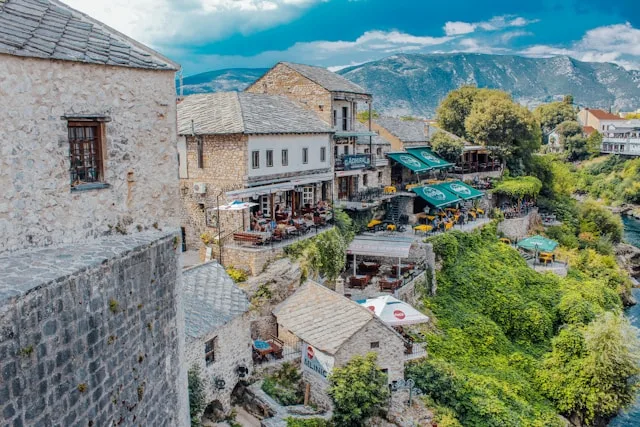
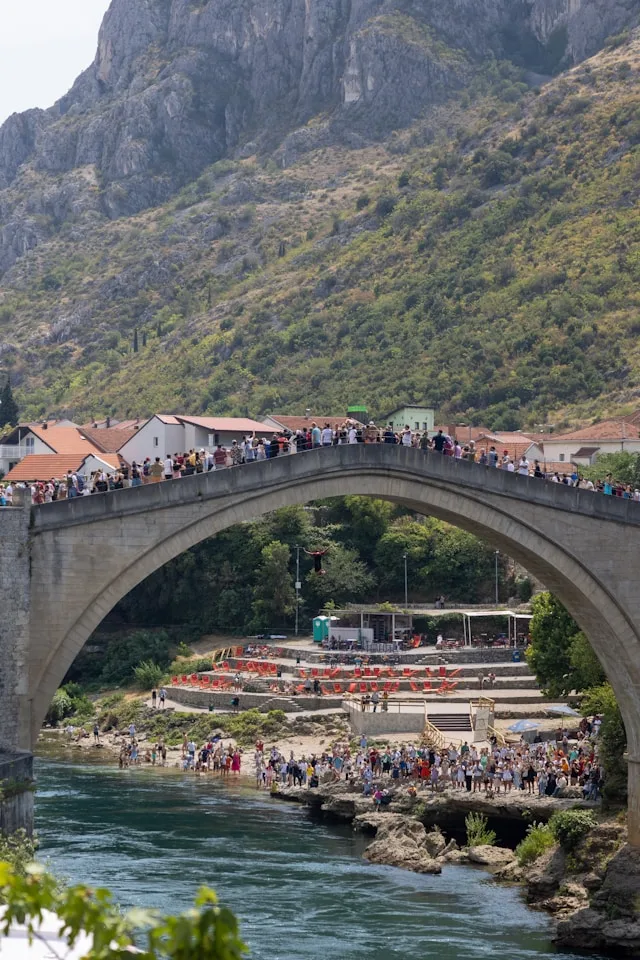
Mostar's tourism economy is anchored by a single asset. The Stari Most complex and its surrounding Old Town drew approximately 1.2 million visitors in 2024, with peak daily foot traffic exceeding 15,000 people during July and August. The Neretva River canyon and associated adventure tourism experiences contributed 340,000 participations across the wider Herzegovina region in the same period. Total tourist arrivals in the canton reached 412,000 with 1.02 million overnight stays through November 2024, representing 14% year-over-year growth.
This growth, however, runs headlong into physical constraints that no amount of demand can resolve. Heritage protection regulations prohibit new construction within the 50-metre UNESCO buffer zone. The Old Town's wastewater management system operates at 140% of designed capacity during peak season, triggering UNESCO monitoring warnings and a de facto moratorium on new restaurant and café licensing within the Stari Most perimeter. That moratorium holds until the €18 million Neretva wastewater treatment plant, co-funded by the EBRD and EU IPA, becomes operational. The project is scheduled for completion in Q2 2026, which means the constraint is only now beginning to lift.
The accommodation stock tells the same story of capped supply in the segment that matters most. Mostar's hospitality market holds just 12 properties rated 4-star or above, totalling 890 rooms. The only 5-star property, Hotel Mepas, operates 110 rooms. Below that tier, 47 properties offer 2,400 rooms, and an estimated 3,200 unregulated private listings on Airbnb and Booking.com absorb overflow demand. Two additions are arriving in 2026: the Hotel Park Mostar (4-star, 85 rooms) and the renovated Hotel Bristol (22 luxury suites), increasing upper-tier inventory by roughly 12%. Both properties lie outside the UNESCO pedestrian zone.
For hiring leaders, the implication is direct. Mostar's tourism economy is growing at double-digit rates into a supply ceiling it cannot raise. Every additional visitor increases operational pressure on a fixed number of premium properties, and every new property that opens outside the core zone needs leadership talent that this market has never produced in sufficient numbers.
The Skills Mismatch That Unemployment Statistics Conceal
The most counter-intuitive feature of Mostar's labour market is the coexistence of 31.2% formal unemployment with 40%+ vacancy rates in the roles hospitality operators need most. The Federal Employment Service data makes the cause clear. The unemployed population overwhelmingly lacks the three capabilities the evolving tourism product demands: German language fluency, digital literacy, and HACCP food safety certification.
A Demand Profile That Has Outgrown the Local Pipeline
Consider the Hotel Mepas Executive Chef vacancy. The role required oversight of three F&B outlets and a €1.2 million annual food cost budget. It also required HACCP certification, German language proficiency, and high-end à la carte experience. That combination of skills does not exist in Mostar's local talent pool. According to Dnevni List, the position remained vacant for 11 months before the hotel recruited from Sarajevo's Hotel Europe.
This is not an isolated case. The Federal Employment Service's Skills Inventory Database records only seven individuals in the entire canton with certified revenue management qualifications. Properties needing dynamic pricing capability across OTAs and direct channels face search durations of 12 to 16 months. Digital marketing specialists are similarly scarce, and the German-language guide market operates at a ratio of approximately one active candidate for every four passive professionals.
The University Pipeline That Drains Before It Fills
The University of Džemal Bijedić Mostar's Faculty of Tourism and Hospitality Management graduates approximately 85 students annually. Only 35% remain in the canton for employment. Within three years of graduation, an estimated 45% of tourism faculty graduates have emigrated to EU markets entirely. The pipeline exists on paper. In practice, it is a conduit for exporting talent to Germany, Austria, and Ireland, where compensation multiples of three to four times Mostar rates and social security stability prove impossible to match.
This is the core analytical insight that makes Mostar's hiring challenge different from a conventional talent shortage. The market is not failing to produce qualified professionals. It is producing them and then losing them before they reach the career stage where they could fill the senior roles that are hardest to recruit. The hidden cost of this dynamic is not measured in a single failed search. It is measured in the permanent thinning of the mid-career pipeline from which future general managers, executive chefs, and commercial directors would normally emerge.
Compensation Realities: Why Money Alone Cannot Solve This
Mostar's hospitality compensation structure reflects its position as the weakest payer in a three-tier competitive hierarchy. Understanding these tiers is essential for any organisation attempting to attract or retain leadership talent in this market.
Hotel General Managers and cluster managers earn €4,500 to €6,800 gross monthly at the top of the Mostar market. Executive Chefs and F&B Directors earn €3,200 to €4,800 gross. Revenue Strategy Directors command €3,600 to €5,200 gross. Operations Managers sit at €2,400 to €3,200 gross. These figures include benefits and, increasingly, accommodation allowances driven by housing cost inflation.
These numbers carry a 15% premium over equivalent roles in local manufacturing. They also sit 35% below Sarajevo benchmarks for the same positions, according to Mercer's Bosnia and Herzegovina Total Remuneration Survey 2024. Sarajevo offers access to international chain properties, Marriott, Hilton, and Swissôtel among them, and a meaningfully larger MICE market. The 130-kilometre corridor between the two cities allows daily commuting for senior professionals, which creates a permanent gravitational pull. Mostar properties report 40% annual turnover among middle management driven by Sarajevo recruitment.
The Croatian and EU Premium
The second competitive tier is more damaging. Dubrovnik and Split compete directly for seasonal culinary staff and adventure tourism guides, offering €800 to €1,200 monthly net premiums during the April-to-October season plus EU labour market access. An estimated 220 qualified guides and hospitality workers migrate annually from the Herzegovina-Neretva Canton to Croatian coastal destinations. The third tier, permanent emigration to Germany, Austria, and Ireland, removes candidates from the accessible talent pool entirely. Senior hotel managers and certified chefs who leave for Central European markets at three to four times the compensation do not return for a Mostar role at any realistic salary.
The consequence is that Mostar's hospitality operators cannot compete on compensation at any of the three tiers where they lose talent. A 10% raise does not close a 35% gap with Sarajevo. A seasonal bonus does not offset EU labour market access. A Mostar package, regardless of how well constructed, does not approach the economics of a permanent move to Munich. The organisations that succeed in hiring leadership talent in this market do so through factors beyond base pay: the proposition must include elements that candidates cannot find elsewhere, whether that is a heritage site management responsibility that exists nowhere else in the region, autonomy that a chain hotel cannot offer, or a quality-of-life argument that only works for a specific candidate profile.
Seasonality: The Structural Force Distorting Every Hiring Decision
Mostar's tourism economy exhibits a Gini coefficient of seasonality of 0.73, indicating extreme concentration. Average monthly hospitality revenues in Q1 represent only 12 to 15% of July revenues. Ninety-two percent of airport traffic is concentrated in June through September. The Old Town Agency contracts 150 to 200 seasonal workers during peak months against a permanent staff of just 24.
This is not merely an operational inconvenience. It is a force that distorts the entire talent market. Senior professionals considering a move to Mostar must evaluate whether a business that generates 85% of its revenue in six months can sustain the career trajectory, compensation stability, and professional development they require year-round. For many, the answer is no.
The Federation of BiH's labour law compounds the problem. High severance obligations of one-third of monthly salary per year of service and restrictive fixed-term contract limits of a maximum 24 months discourage employers from experimenting with seasonal hiring models that might otherwise bridge the gap. A property that needs a revenue management specialist from April through October but cannot justify the role in winter faces a binary choice: carry the cost year-round or do without. Most choose the latter.
According to the Cantonal Chamber of Commerce seasonal business survey, winter working capital crises are routine among SMEs. This cash flow volatility means that the employers most in need of professional management talent are often the least able to offer the contract stability that would attract it. The result is a market where the largest single employer, Hotel Mepas with 142 FTEs, operates in a fundamentally different hiring reality than the 340 registered hospitality businesses where 72% employ fewer than ten people. Building a talent pipeline in a market this fragmented requires a different approach than in a market dominated by large, year-round employers.
Aviation and Access: The Ceiling Above the Ceiling
Mostar International Airport processed 84,000 passengers in 2024, representing 78% recovery from pre-pandemic levels. The 2025 summer schedule provides 24 weekly charter rotations, primarily from Scandinavia, Poland, and the United Kingdom, delivering approximately 6,200 inbound seats per week. Year-round scheduled service remains limited to Croatian Airlines' three-times-weekly Zagreb route and Trade Air seasonal operations.
The airport's €3.2 million terminal expansion, scheduled for completion in April 2026, will increase handling capacity to 200,000 annual passengers. The Federal Ministry of Transport's aviation strategy includes targets for year-round connections to Munich and Vienna. No carrier commitments had been secured as of late 2024.
This creates an investment paradox that matters for anyone making long-term talent and property decisions. The terminal expansion assumes a utilisation trajectory that contradicts the current 92% seasonal concentration of traffic. Unless year-round routes materialise, the expanded terminal will operate below 50% capacity for eight months of the year. The implications extend beyond tourism volumes. Limited aviation access narrows the pool of international hospitality professionals willing to consider Mostar. A General Manager candidate in Vienna can reach Dubrovnik on multiple daily flights. Reaching Mostar requires routing through Zagreb or Sarajevo, adding hours and friction that affect both the candidate's willingness to interview and their family's willingness to relocate.
For hiring executives, this means that international executive search for this market must account for access as a practical barrier, not just a logistical detail. The proposition to a passive candidate must address how they will live and move, not only what they will earn and manage.
Where Conventional Hiring Methods Break Down
The passive candidate ratios in Mostar's hospitality market are among the most extreme in any sector in Southeast Europe. General Manager and cluster leadership roles draw from a pool where active candidates constitute less than 15% of the qualified population. Executive Chefs with international chain experience exhibit unemployment below 3% nationally, with average tenure exceeding 4.5 years. Revenue management and e-commerce specialists are 98% passively employed, with transitions occurring through professional networks rather than advertised vacancies.
In practical terms, this means that a hospitality operator posting a General Manager vacancy on regional job boards is reaching, at best, 15% of the people who could fill the role. The remaining 85% of qualified candidates are employed, not browsing job platforms, and will only move if approached directly with a compelling and specific proposition. This is the hidden 80% that job advertising never reaches.
The DMC Bosnia Herzegovina poaching incident from April 2024 illustrates how the market actually moves talent. According to Slobodna Bosna's tourism sector analysis, the company recruited a senior German-speaking guide and operations manager from competitor Herzegovina Tours by offering a €450 monthly net premium and a guaranteed year-round contract. The move destabilised the smaller operator's peak season capacity. This is not an anomaly. It is the mechanism through which Mostar's scarce senior talent circulates. Direct approach, specific premium, contractual security. Not advertisements. Not applications. Not job boards.
The seven revenue management professionals in the entire canton are all employed. The German-speaking guides with UNESCO site certification operate on exclusive DMC contracts or as independent micro-entrepreneurs. The executive chefs who remain in Bosnia rather than emigrating are embedded in properties where they have autonomy and stability. Reaching any of these individuals requires a method built for passive candidate identification and direct engagement.
What Mostar's Hiring Leaders Need to Do Differently
The organisations that will secure leadership talent in this market over the next 12 months share three characteristics. They understand that Mostar's labour market paradox is not temporary. They design propositions that address the specific reasons candidates leave or decline. And they use search methods calibrated for a market where the overwhelming majority of qualified professionals are invisible to conventional recruitment.
First, the proposition. A candidate choosing Mostar over Sarajevo, Dubrovnik, or Munich is making a lifestyle and career identity decision, not a compensation comparison. The properties and operators that successfully recruit describe offering heritage site stewardship that exists nowhere else, operational autonomy that chain hotels cannot provide, and a quality of life rooted in the Neretva valley's specific character. These are not selling points appended to a job description. They are the architecture of the offer.
Second, the timeline. In a market where 11-month search durations for executive chefs and 12 to 16-month searches for revenue managers are documented norms, the cost of delay compounds. Every month a General Manager role sits empty during peak season represents lost revenue that will not return until the following June. Understanding why executive recruiting fails in markets like this is the first step toward designing a process that does not.
Third, the method. KiTalent's approach to executive search in hospitality and premium service sectors is built for exactly this market profile: small pools of passive candidates, extreme seasonality, compensation structures that cannot compete on salary alone, and a need for speed that traditional retained search firms rarely deliver. By applying AI-powered talent mapping to identify and engage the passive professionals who will never appear on a job board, KiTalent delivers interview-ready candidates within 7 to 10 days, with a pay-per-interview model that eliminates upfront retainer risk. In a market where 85% of General Manager candidates and 98% of revenue management specialists are passively employed, the ability to reach those professionals directly is not an advantage. It is a prerequisite.
For organisations competing for hospitality and cultural tourism leadership in Mostar's constrained and intensely competitive talent market, speak with our executive search team about how we identify and engage the candidates this market cannot surface through conventional methods.
Frequently Asked Questions
What is the average salary for a hotel General Manager in Mostar?
Hotel General Managers and cluster managers in Mostar earn between €4,500 and €6,800 gross monthly, equivalent to approximately €3,150 to €4,760 net. Packages increasingly include accommodation allowances due to local housing cost inflation. These figures represent a 15% premium over manufacturing management roles locally but sit approximately 35% below Sarajevo benchmarks for equivalent positions. The upper range is typically achievable only at Hotel Mepas or through international chain secondments. Market benchmarking for hospitality roles in this region requires accounting for the three-tier competitive structure with Sarajevo, Croatian coastal markets, and Central European destinations.
Why is it so hard to hire hospitality executives in Mostar despite high unemployment?
The Herzegovina-Neretva Canton's 31.2% formal unemployment rate masks a deep skills mismatch. The unemployed population largely lacks the German language fluency, HACCP food safety certification, digital marketing capabilities, and revenue management qualifications that the evolving tourism product demands. Simultaneously, 45% of tourism graduates emigrate to EU markets within three years. The result is mass unemployment among people without the right skills and acute scarcity among people who have them. Only seven individuals in the entire canton hold certified revenue management qualifications.
How long does it take to fill a senior hospitality role in Mostar?
Documented search durations for senior hospitality roles in Mostar are substantially longer than European norms. The Hotel Mepas Executive Chef vacancy remained open for 11 months. Revenue management specialists typically require 12 to 16 months to place. General Manager searches depend heavily on whether the hiring organisation uses direct headhunting methods designed for passive candidates or relies on advertised vacancies, which reach fewer than 15% of qualified professionals in this market.
What are the biggest risks facing Mostar's tourism economy in 2026?
Three risks dominate. First, single-asset dependency: the tourism economy shows 72% correlation with Stari Most visitation metrics, meaning any conservation crisis or geopolitical event creates immediate sectoral recession. Second, the delayed wastewater treatment plant creates regulatory risk of a UNESCO "in danger" listing or visitor number caps. Third, aviation access remains dependent on seasonal charter carriers vulnerable to fuel cost volatility and operator insolvency. The 2024 bankruptcy of Enter Air's Balkan subsidiary arm affected 12,000 Mostar bookings.
What hospitality roles are hardest to fill in Mostar?
Front-of-house management carries the highest vacancy rate at 42%, followed by culinary arts at 38%. Revenue management and e-commerce specialists are the scarcest by absolute numbers, with only seven certified professionals in the canton. German-speaking cultural guides with UNESCO site certification operate in a market where passive candidates outnumber active candidates four to one. Executive Chef roles requiring both international experience and German language capability represent perhaps the single most difficult search in the entire market.
How does Mostar's hospitality talent market compare to Sarajevo and Dubrovnik?
Sarajevo offers 20 to 35% higher gross compensation, access to international hotel chains including Marriott and Hilton, and a larger corporate MICE market. Dubrovnik and Split offer €800 to €1,200 monthly net premiums during peak season plus EU labour market access. An estimated 220 hospitality workers migrate annually from the Herzegovina-Neretva Canton to Croatian coastal destinations alone. Mostar's competitive advantage lies in heritage site management opportunities, operational autonomy at independent properties, and lifestyle factors, but these only resonate with candidates reached through targeted executive search approaches rather than broad advertising.