Reggio Emilia's Agri-Food Paradox: Record Exports, a Modernising Supply Chain, and a Workforce That Cannot Keep Pace
Cantine Cooperative Riunite reported €423 million in consolidated revenues for fiscal 2024, with Lambrusco DOC exports up 8.2% by volume. Parmigiano-Reggiano wholesale prices climbed 12% in the same period. Traditional Balsamic Vinegar unit values are projected to rise a further 5 to 7% through 2026 as Asian luxury demand intensifies. By every revenue metric, Reggio Emilia's agri-food sector is performing at or near historic highs.
The workforce telling is different. As of early 2025, the province carried 1,340 unfilled skilled agri-food positions against just 3.8% unemployment among specialised food technicians. Food Safety Manager roles requiring both HACCP protocols and DOP regulatory expertise sat vacant for 90 to 120 days on average. Export manager positions needing Mandarin Chinese and familiarity with China customs regulations took six to nine months to fill. The sector needs approximately 420 new specialised technicians each year. Regional institutions produce 280.
That 140-person annual deficit is not closing. It is compounding. The investment now flowing into robotics, digital traceability, and precision agriculture has not reduced the demand for skilled workers. It has replaced one category of worker with another that does not yet exist in sufficient numbers. What follows is a structured analysis of the forces reshaping this sector, the employers driving that change, and what senior leaders need to understand before they make their next hiring or retention decision in one of Italy's most concentrated and consequential food production markets.
A Province Where Three DOP Value Chains Converge
Reggio Emilia's agri-food sector contributes approximately €3.2 billion to provincial GDP. That figure represents 18.4% of total economic output, with traditional food production accounting for 62% of the subsector, according to Unioncamere Emilia-Romagna's Q1 2025 outlook. This is not a diversified agricultural economy. It is a province whose identity and economic base rest on three protected designation products, each governed by strict production protocols and each facing a distinct set of talent pressures.
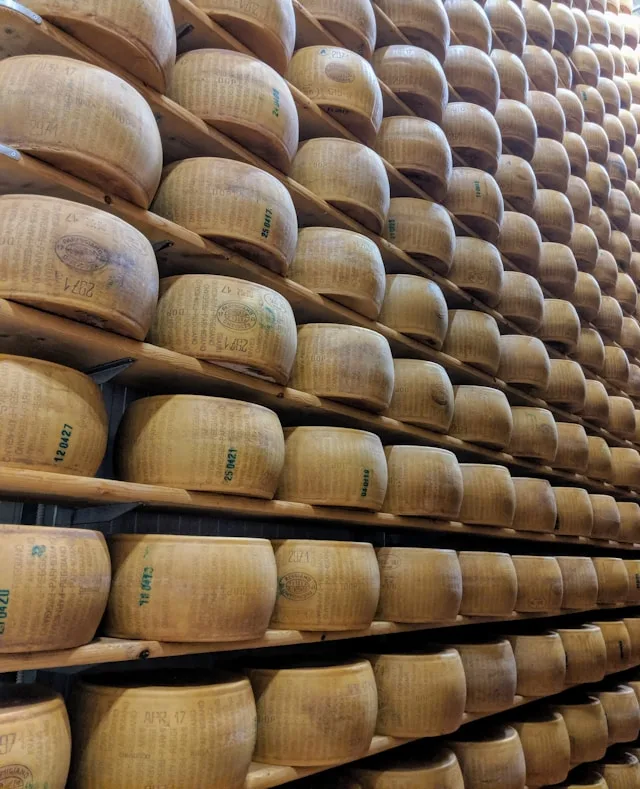
The Parmigiano-Reggiano supply chain in the province comprises 1,247 dairy farms and 45 cheese aging warehouses, employing 4,800 direct full-time equivalents. Production volumes reached 145,000 wheels in 2024, with 38% undergoing final certification and packaging in Reggio Emilia facilities. The Consorzio del Formaggio Parmigiano-Reggiano, the non-profit regulatory body managing quality control and promotion, operates from the province with 340 staff and a €47 million annual budget.
Traditional Balsamic Vinegar operates at an entirely different scale. The 48 licensed acetaie produced a combined 85,000 litres of DOP-certified vinegar in 2024, a 3% year-on-year decline caused by climate-induced grape must shortages. Average aging inventory stands at 12 years per barrel battery. This is not a product that responds to demand signals within any normal commercial timeframe. It is, in effect, a luxury good with a production cycle measured in decades.
Lambrusco's Cooperative Scale
Lambrusco represents the high-volume end of the province's food economy. Cantine Riunite, Italy's largest wine cooperative by volume, is headquartered in Reggio Emilia and processes approximately 70% of regional Lambrusco grape must. Its 1,850 direct employees handle 350,000 tonnes of grapes annually. Export growth has been strong, particularly into Germany, the United States, and Japan, but the cooperative faces margin compression. Average grape prices paid to growers increased 14% in 2024, while shelf-price competition limits the ability to pass those costs through to consumers.
What connects all three value chains is the cooperative structure that underpins them. Dairy consortia, acetaie, and cooperative wineries all draw on the same Po Valley integrated cereal-forage-livestock supply chain. This shared infrastructure is a strength when the system is staffed. When it is not, a shortage in one part of the chain creates pressure across all three.
The Skills Mismatch Hiding Inside a Labour Shortage
The headline figure of 1,340 active vacancies across the province tells only part of the story. Vacancy rates in Q1 2025 stood at 4.8% for food technologists and 6.2% for international commercial managers, against a 2.1% baseline for general manufacturing. These are not entry-level gaps. They sit at the intersection of technical specialisation and commercial sophistication, precisely where DOP production demands the most from its people.
The youth unemployment data makes the mismatch visible. Under-30 joblessness in the province runs at 14.2%. There are young people without work and skilled roles without candidates. The gap is not one of headcount. It is one of capability. Traditional vocational training programmes produce graduates oriented toward manual production methods. The sector now needs professionals who can manage digital traceability systems, operate precision agriculture platforms, and understand EU regulatory frameworks that did not exist five years ago.
UNIMORE's Department of Life Sciences offers Italy's only specialised master's programme in protection and enhancement of traditional food products. It graduates 45 students annually. That programme is excellent. It is also feeding a pipeline that can supply roughly one-tenth of the sector's annual need.
The Consorzio Parmigiano-Reggiano's mandate for digital traceability upgrades, requiring €15,000 to €40,000 per aging facility by Q4 2026, will accelerate this mismatch further. Smaller magazzini that lack both the capital for compliance and the personnel to operate the new systems face consolidation. The roles emerging from this transition demand hybrid profiles: professionals combining dairy science or oenological expertise with digital supply chain management. Projected demand for these cross-functional roles is growing at 18%, against 4% for traditional production positions.
The capital has moved faster than human capital could follow. That single sentence captures more about Reggio Emilia's agri-food talent market than any vacancy statistic.
Three Talent Pools Where Active Recruitment Does Not Work
Reggio Emilia's agri-food sector is a predominantly passive candidate environment for its most critical specialisations. Understanding why requires looking at each talent pool individually, because the dynamics that make candidates unreachable differ across functions.
DOP Compliance and Food Safety Leadership
Unemployment among food safety and DOP compliance specialists in the province is effectively 0.8%. Average tenure exceeds seven years. According to Hays Italy's Food and Beverage Hiring Trends report for 2024, 85% of role transitions in this specialisation occur through direct headhunting rather than application to postings. Qualified candidates typically hold multiple certifications, including HACCP Lead Auditor and BRCGS Professional credentials, and receive three to four unsolicited approaches monthly during peak recruitment seasons.
A Quality Assurance Manager with eight or more years of dairy or vinegar DOP experience commands €58,000 to €72,000 at senior specialist level. At executive level, a Direttore Tecnico overseeing multi-site certification commands €95,000 to €130,000 plus performance bonuses tied to audit compliance rates. These figures carry a 12 to 15% premium over the national manufacturing average, reflecting the regulatory specificity that makes these roles so difficult to fill.
Oenologists with Lambrusco Specificity
The intersection of traditional method sparkling wine production knowledge and Lambrusco-specific grape characteristics creates a national candidate pool of approximately 120 qualified professionals. That is not a typographical error. One hundred and twenty people in all of Italy possess the combination of skills that Reggio Emilia's wine cooperatives need at senior level. Employment rates among this group run at 95%. Average tenure is nine years.
According to Federalimentare's recruitment practices survey, publicly posted vacancies for senior oenologists typically receive zero qualified applications within 90-day windows. The entire market operates through networking and direct approach. When candidates do move, agronomists specialising in Lambrusco viticulture and climate adaptation typically receive multiple simultaneous offers, forcing employers to extend signing bonuses equivalent to 15 to 20% of annual salary.
Export Managers with Asian Market Access
The third critical pool is export managers with established distributor relationships in China, Japan, and South Korea. According to ICE Agenzia's 2024 survey, candidate-initiated job changes in this group occur at rates below 8% annually. Seventy percent of these professionals are accessible only through retained executive search or confidential networking. Active application to job boards accounts for less than 5% of successful placements.
The scarcity here is compounded by geography. Employers in Reggio Emilia frequently find themselves restructuring recruitment to accept remote work arrangements from Milan or Bologna simply to access candidates willing to consider the role. A Direttore Commerciale Estero with P&L responsibility for €50 million or more in export turnover commands €110,000 to €160,000 plus bonus potential of 20 to 40% of base. In Milan, the same profile commands 40 to 50% more. The cost of a prolonged vacancy at this level is not merely a recruitment line item. It represents lost market access in regions where relationship continuity determines contract renewal.
The Competitor Geography That Drains Reggio Emilia's Talent
Reggio Emilia competes for specialised agri-food leadership against three Italian markets, each pulling talent through a different mechanism.
Parma, 40 kilometres west, offers 15 to 20% higher compensation for equivalent executive roles. The presence of multinationals including Barilla, Mutti, and Parmalat provides career trajectory options that Reggio Emilia's cooperative structures struggle to match. Parma's "Food Valley" innovation ecosystem and its concentration of commercial and marketing roles make it the natural next step for ambitious mid-career professionals. Reggio Emilia retains an advantage in DOP-specific specialisation, but that advantage narrows as candidates weigh artisanal depth against career breadth.
Bologna, 60 kilometres north, attracts digital agritech talent and R&D specialists with salaries 25 to 30% above Reggio Emilia levels. The city's CNR research facilities and the University of Bologna's Department of Agricultural and Food Sciences create a gravitational pull for PhD-level candidates that Reggio Emilia's employer base cannot replicate. What Reggio Emilia offers in return is tangible but less immediately compelling: housing costs 30% below Bologna's average and a rural quality-of-life proposition that matters to some candidates and not to others.
Milan captures the commercial tier entirely. Export directors and category managers in Milan command 40 to 50% more than equivalent roles in Reggio Emilia. The city provides English-language working environments, international mobility opportunities, and multinational career paths. According to Regione Emilia-Romagna's labour mobility data, Reggio Emilia sees measurable attrition among under-35 professionals in commercial functions who relocate to Milan after three to five years to access these paths.
At the international level, Reggio Emilia's food technology and R&D roles compete with Wageningen in the Netherlands and Lyon in France, both of which offer English-speaking research environments and higher EU-funded project accessibility. Dutch agritech salaries exceed Italian levels by 35 to 45% for equivalent specialist roles. For a province already producing fewer graduates than it needs, the pull of international alternatives on its strongest emerging talent is a compounding problem.
The pattern is consistent across all competitor markets. Reggio Emilia produces deep, artisanal, regulation-specific expertise that no other geography can match. It then loses the commercial and digital talent it needs to translate that expertise into sustained growth. The province's talent strategy must start from this asymmetry rather than pretending it does not exist.
Structural Pressures That Will Intensify Through 2026
The talent pressures described above operate against a background of environmental, regulatory, and demographic risks that compound hiring difficulty rather than easing it.
Climate, Ageing, and the Shrinking Workforce
The Po Valley experienced precipitation levels 35% below the 30-year average in 2024, according to ARPAE's climate analysis. Water stress affects fodder production for dairy cattle and grape yields simultaneously, threatening DOP production volumes and increasing input costs across all three value chains. The Xylella fastidiosa pathogen, while still a minor presence in the province, requires €2.3 million in annual provincial investment for containment. These environmental pressures increase the urgency of hiring climate adaptation specialists while simultaneously making the province less attractive to candidates who could work in less constrained environments.
Workforce demographics present an equally acute challenge. Thirty-four percent of agricultural workers in the province are over 55. Pension transitions are expected to remove 1,200 experienced workers from the sector by 2027. The average age of agricultural entrepreneurs is 58.4 years. Only 12% of dairy farm ownership has transferred to successors under 40 in the past five years. This is not a future risk. It is a present-tense loss of institutional knowledge that no recruitment campaign can replace at speed.
Immigration policy compounds the problem. The Decreto Flussi seasonal worker permit system remains capped below actual demand. The province requires an estimated 2,800 seasonal workers annually for grape harvesting and cheese production. Allocated permits cover 1,900.
Regulatory Costs and Consolidation Triggers
Regulatory adaptation costs are rising on multiple fronts. The EU Deforestation Regulation imposes supply chain geolocation and due diligence requirements estimated at €8,000 to €15,000 per small enterprise. The Consorzio's digital traceability mandate adds €15,000 to €40,000 per aging facility. France-origin Nutri-Score labelling schemes threaten Parmigiano-Reggiano and Lambrusco positioning in EU markets, requiring defensive marketing investments estimated at €4 to €6 million annually for the Consorzio, according to Federalimentare's labelling observatory.
Energy costs add a further layer. Aging warehouses require constant climate control at 18 to 20 degrees Celsius and 85% humidity. Natural gas price volatility has added €0.12 to €0.15 per kilogram of cheese in energy costs compared to 2019 baselines. The Consorzio anticipates investment concentrating on renewable energy integration in aging facilities through 2026, but the professionals who can manage these transitions are the same hybrid digital-agricultural profiles the sector already cannot recruit in sufficient numbers.
For hiring leaders in this market, the regulatory trajectory means the roles that are hardest to fill today will become harder still. Every new compliance requirement creates demand for talent that does not yet exist in the local labour pool. Understanding where executive recruiting approaches fail is the first step toward designing searches that succeed.
The Automation Paradox Threatening the DOP Brand
This is the tension at the centre of Reggio Emilia's agri-food future, and it deserves to be stated plainly. The province's three flagship products command premium prices because they are perceived as handcrafted, traditional, and artisanal. Parmigiano-Reggiano. Traditional Balsamic Vinegar. Lambrusco. Each carries a price premium of 30 to 40% over industrial equivalents, a premium built on the narrative of human skill applied over time.
Simultaneously, production facilities across the province invested €45 million in 2024 in robotics for warehouse management and AI-driven quality control, according to Regione Emilia-Romagna's innovation data and the Consorzio Parmigiano-Reggiano's digital strategy documentation. The motivation is straightforward. Labour scarcity at current wage levels makes manual production economically unsustainable for many operations. Automation is not a choice. It is a response to the absence of available workers.
The brand positioning risk this creates is real but not yet resolved. If automation becomes visible to consumers and trade buyers, it may erode the authenticity narrative that justifies premium pricing. If it remains invisible, production can continue but the story becomes harder to tell honestly. The executives who must manage this transition need a rare combination of skills: production engineering knowledge, brand strategy sophistication, and the regulatory fluency to ensure that automated processes comply with DOP disciplinary requirements that were written for manual production.
These are not profiles that exist in ready supply. They sit at the intersection of disciplines that have historically operated in separate professional tracks. A talent mapping exercise across this market reveals that the candidates capable of bridging brand authenticity and operational automation number in the low dozens nationally. Most are currently employed. Most are not looking.
This is the synthesis that the aggregate data points toward but does not state directly. Reggio Emilia's agri-food sector is not facing a simple labour shortage. It is facing a category-creation problem. The roles it most urgently needs to fill are roles that did not exist five years ago, combining capabilities that no single training programme produces. The province's educational institutions, its cooperative structures, and its competitive salary position are all calibrated for an era of production that is ending. The era replacing it needs people who do not yet know they are qualified for jobs that have not yet been properly defined.
What This Means for Hiring Leaders in Reggio Emilia's Agri-Food Sector
The talent market described in this analysis has three characteristics that every senior hiring leader in this sector must account for.
First, the passive candidate ratio in the most critical roles exceeds 85%. DOP compliance directors, senior oenologists, and export managers with Asian market access are not reading job boards. They are not updating their CVs. They are employed, retained, and approached multiple times per quarter by competitors. Reaching them requires direct, confidential, and precisely targeted outreach. A posted vacancy for a senior oenologist with Lambrusco expertise will, based on sector data, attract zero qualified applicants within 90 days.
Second, the compensation gap with competitor geographies is not closing. Parma, Bologna, and Milan each offer materially higher packages for the same profiles, and the gap widens at exactly the seniority level where the most critical leadership roles sit. Reggio Emilia employers who compete on salary alone will lose. The winning proposition must combine compensation with something Milan cannot offer: direct involvement in production decisions for globally recognised DOP products, a cost of living that allows a materially different quality of life, and a professional depth that commercial hubs sacrifice for breadth.
Third, the timeline for search completion in this market is longer than most hiring leaders expect. A food safety director search runs 90 to 120 days. An export manager with Chinese market expertise takes six to nine months. These timelines assume effective search methodology. Reliance on job advertising extends them further, often indefinitely. The counteroffer risk is acute in a market where every qualified candidate holds multiple competing approaches. A search that reaches the offer stage and loses the candidate to a counteroffer has not merely failed. It has consumed four to six months that the hiring organisation cannot recover.
For organisations competing for leadership talent in Reggio Emilia's agri-food sector, where the candidates who can bridge DOP tradition and digital transformation are not visible on any job board and the cost of a slow search is measured in lost production cycles, speak with our executive search team about how KiTalent approaches this market. With interview-ready executive candidates delivered within 7 to 10 days through AI-powered talent mapping and a pay-per-interview model that eliminates upfront retainer risk, KiTalent reaches the 80% of senior professionals who are not actively looking. Across 1,450 completed executive placements, our 96% one-year retention rate reflects the precision of matching candidates to roles where they stay and deliver.
Frequently Asked Questions
What are the hardest agri-food executive roles to fill in Reggio Emilia?
Three roles present the greatest difficulty. Food Safety and DOP Compliance Directors with dual expertise in HACCP protocols and Consorzio disciplinary requirements average 90 to 120 days to fill. Senior oenologists with Lambrusco-specific expertise draw from a national pool of approximately 120 qualified professionals and attract zero qualified applications through job postings. Export managers with established Asian distributor networks and Mandarin capability take six to nine months to place, often requiring remote work concessions to access candidates based in Milan or Bologna.
Why is Reggio Emilia's agri-food sector struggling to hire despite high youth unemployment?
The province's under-30 unemployment rate of 14.2% coexists with 1,340 unfilled skilled positions because the gap is one of capability, not headcount. Traditional vocational training produces graduates oriented toward manual production. The sector now requires hybrid profiles combining food science or oenological expertise with digital supply chain management, precision agriculture, and EU regulatory fluency. Regional institutions produce 280 qualified graduates annually against demand for 420, and emerging hybrid roles widen this deficit further.
How does Reggio Emilia's agri-food compensation compare to Parma, Bologna, and Milan?
Parma offers 15 to 20% higher compensation for equivalent executive roles, driven by multinational employer presence. Bologna attracts digital agritech and R&D talent at 25 to 30% premiums. Milan commands 40 to 50% more for Export Directors and commercial strategy roles. Reggio Emilia counters with 30% lower housing costs than Bologna, direct involvement in globally recognised DOP production, and deep artisanal specialisation. KiTalent's market benchmarking service helps employers design packages that compete on total value rather than base salary alone.
What impact will digital traceability mandates have on Parmigiano-Reggiano hiring?
The Consorzio Parmigiano-Reggiano has mandated digital traceability upgrades requiring €15,000 to €40,000 per aging facility by Q4 2026. This creates immediate demand for professionals who can implement blockchain traceability platforms, ERP agriculture modules, and IoT monitoring systems within DOP-compliant production environments. Smaller magazzini lacking both capital and qualified personnel face consolidation. Demand for these cross-functional digital-agricultural roles is projected to grow at 18%, far outpacing the 4% growth in traditional production positions.
How should companies recruit passive candidates in Reggio Emilia's food sector?
In the three most critical specialisations, 70 to 85% of qualified candidates are accessible only through direct, confidential outreach. Job postings and inbound applications reach a fraction of the market. Effective recruitment in this environment requires systematic identification of passive talent through AI-powered candidate mapping, sector-specific intelligence on where qualified professionals are currently employed, and confidential approach strategies that respect the small, relationship-driven nature of the DOP production community.
What are the main economic risks facing Reggio Emilia's agri-food sector in 2026?
Five risks dominate. Po Valley water stress threatens dairy fodder and grape yields. The EU Deforestation Regulation imposes compliance costs of €8,000 to €15,000 per small enterprise. Pension transitions will remove 1,200 experienced workers by 2027. Energy price volatility adds €0.12 to €0.15 per kilogram of cheese production versus 2019 levels. Geopolitical instability affects 22% of Lambrusco exports, with Chinese anti-dumping investigations into EU wine creating specific vulnerability. Each risk intensifies existing talent pressure by increasing the complexity of roles the sector needs to fill.