Zagreb's Financial Services Sector Is Growing Faster Than Its Talent Pool Can Follow
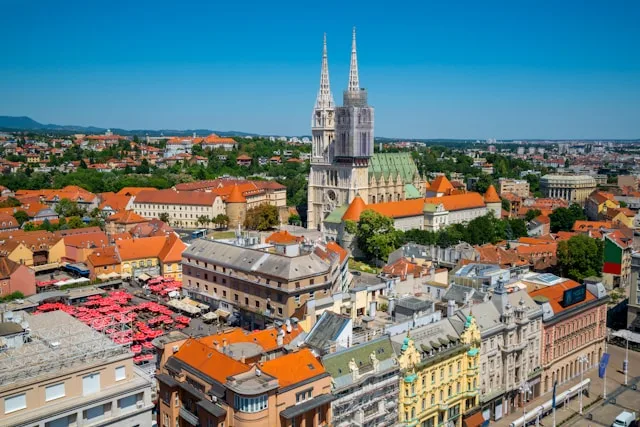
Zagreb in 2026 sits at an unusual intersection. The city's banking headquarters, shared-service centres, and corporate finance operations are expanding on the strength of Euro adoption, EU Banking Union integration, and a nearshoring wave from German and Italian corporates. Headcount projections point upward. Investment flows are real. Yet the talent required to staff this expansion is leaving the country at a rate that erases roughly 60% of new positions created each year.
This is not the familiar story of a market that cannot find enough people. It is a more specific problem. Zagreb produces and attracts the right professionals, but it cannot retain them at the rate its employers need. The result is a labour market that appears functional in aggregate while concealing severe shortages in the three categories that matter most: regulatory compliance, data analytics, and multilingual corporate finance operations. Senior compliance officers take four months to hire. Executive finance roles above VP level are almost never filled through advertised vacancies. The candidates who could fill these positions are overwhelmingly passive, employed, and increasingly open to offers from Vienna, Munich, and Dublin.
What follows is a structured analysis of Zagreb's financial services talent market in 2026: the forces expanding it, the forces depleting it, the compensation dynamics shaping candidate behaviour, and what organisations hiring in this market need to understand before they launch their next search.
The Post-Euro Expansion and What It Demands
Croatia's Euro adoption on 1 January 2023 was more than a symbolic milestone. It eliminated currency risk for domestic banking operations and brought Zagreb's Tier 1 banks under the direct supervision of the European Central Bank through the Single Supervisory Mechanism. The operational consequences of that shift are still unfolding three years later.
Croatian banks have collectively absorbed an estimated €150 to €200 million in IT and compliance adaptation costs since 2022, according to the Croatian Banking Association's cost structure analysis. System migration, dual-display pricing compliance, and ECB reporting standards required new infrastructure and new expertise simultaneously. The one-off costs have largely been absorbed. The ongoing costs have not.
The EU's Digital Operational Resilience Act, which took effect in January 2025, added another layer. DORA mandates enhanced ICT risk management across all financial entities, and the Croatian National Bank's implementation guidelines projected demand for 300 to 400 additional cybersecurity and operational risk specialists in Zagreb's banking sector alone. That demand arrived into a market already short of compliance professionals and losing experienced practitioners to emigration every quarter.
Tier 1 Banks as the Centre of Gravity
Zagreb's financial services market is dominated by three institutions. Zagrebačka banka, the UniCredit subsidiary, employs approximately 3,200 people in the city and serves as the regional headquarters for Southeastern European treasury operations. Privredna banka Zagreb, owned by Intesa Sanpaolo, maintains roughly 2,800 Zagreb-based staff and hosts the Group's Adriatic regional hub. OTP Bank Croatia, the Hungarian group's subsidiary, employs around 2,100 with corporate banking and risk management centralised in the capital.
These three banks collectively control 35 to 40% of Croatia's banking assets. Their hiring decisions set the market's compensation benchmarks, define its working norms, and, when they recruit aggressively from smaller domestic banks, reshape the entire competitive field. Zagrebačka banka's strategic plan disclosed an intention to increase its Zagreb workforce by 8 to 10% in RegTech and data analytics roles by the end of 2026. At its current scale, that represents 250 to 320 new hires in precisely the categories where supply is thinnest.
The Institutional Ecosystem Beyond Banking
The banking headquarters do not operate in isolation. The Zagreb Stock Exchange and the Central Depository and Clearing Company anchor the capital markets infrastructure. The Croatian National Bank itself employs approximately 800 economists, supervisors, and legal professionals. Corporate finance anchors include Atlantic Grupa, whose treasury and accounting shared-service centre employs around 450 in Zagreb, and Adris Group, which runs consolidated corporate services for its insurance and tourism divisions with roughly 380 finance professionals. Rimac Group contributes around 200 corporate finance, controlling, and procurement professionals, while Infobip maintains a financial operations and business analytics centre of approximately 300 employees.
This ecosystem means that financial professionals in Zagreb are not choosing between three banks. They are choosing between banks, SSCs, corporate finance functions, fintech-adjacent employers, and the regulator itself. The competition for the same pool of qualified professionals is broader than it first appears, and it intensifies at exactly the seniority levels where mobility is lowest.
The Brain Drain Arithmetic That Employers Cannot Ignore
Here is the tension at the centre of Zagreb's talent market, and the dynamic that makes it fundamentally different from Prague, Warsaw, or Bucharest.
Croatia experiences net emigration of 8,000 to 10,000 highly skilled workers annually. Finance and IT professionals comprise 25 to 30% of that outflow, with the primary destinations being Ireland, Germany, and Austria, according to the Croatian Bureau of Statistics migration data and the World Bank's Croatia Economic Update. In absolute numbers, that translates to 2,000 to 3,000 finance and IT professionals leaving the country each year.
Set that against the SSC sector's projected headcount growth of 12 to 15% annually, which equates to roughly 1,800 to 2,250 new positions per year based on the current 12,000 to 15,000 SSC workforce. The emigration outflow is consuming the equivalent of 60% or more of new SSC jobs created annually. Zagreb's labour market is not self-sufficient for its own growth trajectory.
This is the original analytical insight that reframes everything else in this article: the investment case for Zagreb's financial services sector and the talent case are moving in opposite directions. Capital is flowing in because Zagreb offers 40% cost savings versus Munich or Milan. Talent is flowing out because Vienna and Munich offer 60 to 80% higher base compensation. Every employer expanding in Zagreb is betting that the cost arbitrage will attract enough corporate investment to eventually close the compensation gap. But in the interim, the professionals needed to deliver on that investment are being recruited away by the very markets Zagreb is trying to undercut on cost.
The dependency this creates is not widely acknowledged in public sector skill gap analyses, which tend to focus on domestic education pipeline outputs. In practice, Zagreb's financial sector increasingly relies on diaspora returnees and immigrant talent from Bosnia and Herzegovina and Serbia to fill the gap. That is a workable strategy at the mid-level. It becomes progressively harder at the senior level, where ECB reporting experience, IFRS 9 modelling expertise, and Eurozone regulatory knowledge are non-negotiable requirements that take years to develop.
Where the Shortages Are Most Acute
Zagreb's financial services sector employs approximately 28,000 to 30,000 professionals directly within banking, insurance, and asset management, with an additional 12,000 to 15,000 in corporate finance, accounting, and SSC/BPO functions. Unemployment in the city sits at 4.2%, below the national average of 6.1%. Annual turnover for mid-level professional roles in financial services runs at 18 to 22%.
Those are the aggregate numbers. The shortages that matter operate beneath them, concentrated in three specific domains.
Regulatory Compliance and Risk Management
Senior Regulatory Compliance Officer positions at Tier 1 banks remain open for 110 to 140 days on average, compared to 45 to 60 days for general accounting roles. The gap is not about volume. It is about the specificity of what ECB supervision demands. Professionals need direct experience with ECB reporting frameworks, AML/CFT automation, and stress testing under IFRS 9 and 17. That experience base is small in a country that joined the Euro area only three years ago.
An estimated 75 to 80% of qualified compliance candidates are passive. They are employed, not looking, and their average tenure in role is 4.2 years. Moving them requires more than a salary increase. It requires a role that offers something their current employer cannot: greater regulatory scope, a path into EU-level institutions, or a governance mandate that expands rather than repeats their experience.
Reports in Poslovni Dnevnik during 2024 described a pattern where Tier 1 banks recruited compliance managers from smaller domestic institutions with total compensation premiums of 25 to 35%. The effect on the smaller banks is predictable: they lose their trained compliance professionals to competitors who can afford to pay more, creating a cascading shortage that moves downward through the market. This pattern is consistent with what executive recruiting failures typically look like in concentrated markets where a small number of large employers set the terms.
Data Analytics and Financial Engineering
The second shortage sits at the intersection of quantitative skills and financial domain knowledge. Financial Data Scientists and Quantitative Analysts in Zagreb command €52,000 to €68,000 annually before bonuses, which add 10 to 15%. The passive candidate ratio in this category runs at approximately 70%.
The shortage is acute enough that employers including Atlantic Grupa and Rimac Group have reportedly established remote-work hybrid arrangements allowing three days of home office, versus an industry standard of two, specifically to retain scarce quantitative analysts. This adjustment came after a pattern where initial searches failed to yield local candidates with combined Python/SQL proficiency and IFRS 9 modelling expertise, according to data from HUP's ICT Sector Salary Survey and CEDRA Consulting.
This points to a problem that talent mapping reveals clearly in practice: the candidate pool for roles requiring both technical and domain expertise is materially smaller than the pool for either skill set individually. Zagreb has Python developers. Zagreb has IFRS accountants. The number who are both is a fraction of either group, and that fraction is being courted by every SSC, bank, and corporate finance function in the city.
Multilingual Corporate Finance Operations
The third shortage is linguistic. Zagreb's SSC expansion is driven by German and Italian corporate nearshoring. That means the finance process managers, accountants, and operations leaders staffing these centres need professional fluency in German or Italian alongside financial expertise. SSC Finance Process Managers with German language skills command €45,000 to €58,000 annually, a premium that reflects the constrained supply of candidates combining language proficiency with finance domain knowledge.
Warsaw and Prague compete directly for the same German-speaking talent pool, with Warsaw particularly aggressive in financial process automation roles and offering 15 to 20% higher salaries. Zagreb's advantage is cost of living and quality of life. Its disadvantage is scale: a professional building a career in shared services has more options, more employers, and more upward mobility in a larger market.
Compensation: Competitive Enough to Attract, Not Enough to Retain
Zagreb's compensation structure reveals the core tension. At every level, the city pays enough to function as a viable market but not enough to prevent its best professionals from being recruited internationally.
At the senior specialist and manager level, Senior Risk and Compliance Managers earn €48,000 to €65,000 annually, representing a 20% premium over 2021 levels. Financial Data Scientists command €52,000 to €68,000 plus bonus. These figures are competitive within Croatia and reasonable within the CEE region.
At the executive and VP level, the picture shifts. CFOs of mid-cap listed companies in Zagreb earn €95,000 to €140,000, with long-term incentive plans prevalent at Atlantic Grupa and Adris Group. Heads of Compliance or Risk at Tier 1 banks earn €110,000 to €160,000. SSC Centre Directors command €85,000 to €120,000.
Compare these to the geographic competitors. A Head of Compliance at a comparable institution in Vienna earns €180,000 to €250,000. The gap is 60 to 80% on base salary alone. Cost of living in Vienna runs 40 to 50% higher than Zagreb, which partially offsets the headline number, but for a senior professional evaluating career trajectory, the arithmetic still favours the larger market. The Vienna role typically offers a path into EU-level regulatory bodies, larger capital markets exposure, and a broader professional network.
This is where the brain drain operates most destructively. It is not entry-level professionals leaving. It is mid-career compliance specialists, experienced data engineers, and multilingual finance managers at exactly the point where they become most valuable to Zagreb employers. The professionals who stay tend to be those with strong personal ties to the city, those who value the quality of life differential, or those who have reached a seniority where they can negotiate packages that narrow the gap. For everyone else, the negotiation dynamics at offer stage increasingly involve a competing international option that Zagreb cannot match on compensation alone.
The 90%+ passive candidate ratio at CFO and VP level tells its own story. These roles are filled exclusively through retained executive search or internal promotion. Advertised vacancies at this level are essentially non-existent. Any organisation planning a senior finance leadership hire in Zagreb that begins with a job posting has already lost time it cannot recover.
The SSC Growth Paradox
The shared-service centre sector is Zagreb's fastest-growing financial employment category, projected to expand headcount by 12 to 15% annually through 2026. The investment thesis is straightforward: Zagreb offers approximately 40% cost savings versus Munich or Milan, competitive English language proficiency, growing German and Italian language capability, EU membership with full labour mobility rights, and a time zone convenient for European corporate headquarters.
International operators including IBM Croatia and Infobip anchor the sector alongside domestic corporates. The Croatian Investment and Trade Agency's FDI strategy actively promotes Zagreb as a nearshoring destination, and the pipeline of German and Italian corporate relocations shows no sign of slowing.
The paradox is that the growth itself is compressing the labour market faster than new graduates and returnees can fill it. Each new SSC that opens in Zagreb draws from the same limited pool of finance professionals with the right language skills, the right technical capabilities, and the right domain knowledge. The aggregate effect is upward pressure on salaries, increased turnover as employers poach from each other, and a progressive difficulty in filling roles that require the specific combination of skills the SSC model demands.
This dynamic makes proactive talent pipeline development not a strategic luxury but an operational necessity. Employers who wait until a role opens to begin sourcing are entering a market where the best candidates were approached by competitors three months ago. Atlantic Grupa and similar employers have recognised this by establishing talent pipelines with universities such as FER and EFZG to secure candidates before graduation. But the university pipeline addresses entry-level supply. It does not solve the mid-career and senior shortage, where experience cannot be accelerated.
The real estate dimension compounds the challenge. While Zagreb's aggregate office vacancy runs at 15 to 18% citywide, Class A stock suitable for financial services, with redundant power, data security compliance, and CBD location, faces vacancy rates of only 8 to 10%. New construction for 2025 to 2026 is limited to 45,000 square metres, insufficient to meet projected SSC demand. The result is rent inflation of 5 to 8% annually for prime space, adding cost pressure to an expansion model built on cost arbitrage.
What This Means for Hiring Leaders in 2026
A senior leader planning to hire in Zagreb's financial services market in 2026 faces a situation with three defining characteristics.
First, the market is bifurcated. For entry-level accounting, retail banking customer service, and general administrative SSC roles, the market favours employers. Unemployment-to-vacancy ratios are manageable, and active candidate pools are sufficient. For regulatory compliance, data analytics, financial engineering, and executive leadership, the market heavily favours candidates. The hidden 80% of passive talent is not a metaphor in Zagreb. It is the literal composition of the senior candidate pool.
Second, speed matters more than it does in larger markets. In London or Frankfurt, a delayed search means the preferred candidate takes another offer. In Zagreb, a delayed search means the preferred candidate has emigrated. The brain drain is not a background trend. It is an active, ongoing loss of qualified professionals at a rate of several thousand per year. A compliance officer who is available in Q1 may be in Vienna by Q3.
Third, compensation alone will not close the gap. Zagreb cannot compete with Vienna or Munich on salary at the senior level. The differential is too large. What Zagreb can compete on is role scope, quality of life, and the specific professional proposition of working in a market that is building its regulatory and financial infrastructure rather than maintaining it. The candidate who wants to help shape an ECB reporting framework from inception will find that opportunity in Zagreb. They will not find it in a mature market where the framework has been operating for decades.
For organisations running executive searches in this market, the methodology must account for all three characteristics. A search that relies on job postings reaches only the active portion of a market where 75 to 90% of senior candidates are passive. A search that moves slowly loses candidates not just to competing offers but to competing countries. And a search that leads with compensation alone will attract candidates motivated by money, who are precisely the candidates most likely to leave for the next salary increase.
KiTalent's approach to this kind of market relies on AI-enhanced talent identification to map the full candidate population, including the passive majority that no job board reaches. With interview-ready candidates delivered within 7 to 10 days and a pay-per-interview model that removes the upfront financial risk of a retained search, the method is designed for markets where the cost of delay is measured in permanent talent loss rather than temporary inconvenience.
Building a Search Strategy That Matches This Market
The conventional executive search process was designed for markets where qualified candidates exist in sufficient numbers and the challenge is selection. Zagreb's financial services market in 2026 inverts that assumption. The challenge is identification and persuasion, not selection.
A search for a Head of Compliance at a Tier 1 bank in Zagreb begins with a qualified universe of perhaps 15 to 20 professionals in the country who meet the ECB reporting and AML/CFT requirements. Of those, 75 to 80% are passive. Of the passive candidates, some proportion are actively being courted by Vienna and Munich employers offering 60% more. The effective addressable market for the search may be single digits.
In that context, the difference between a direct application process and a headhunting approach is not incremental. It is categorical. The direct application process does not reach the candidates. The headhunting approach does, but only if it operates with current market intelligence, accurate compensation benchmarking, and a proposition that addresses what the candidate actually wants, which is rarely just money.
KiTalent has completed over 1,450 executive placements globally with a 96% one-year retention rate. That retention figure matters particularly in a market like Zagreb, where the cost of a bad executive hire is amplified by the difficulty of replacing the incumbent. A failed placement in London means restarting a search in a deep market. A failed placement in Zagreb means restarting a search in a shallow one, with the additional reputational cost of having lost the first candidate's confidence and, potentially, their willingness to work with the employer again.
For organisations competing for regulatory, data analytics, or multilingual finance leadership in Zagreb, where the candidates you need are overwhelmingly passive and the window to reach them narrows with every quarter of emigration, start a conversation with our executive search team about how we approach this market specifically.
Frequently Asked Questions
What are the biggest hiring challenges in Zagreb's financial services sector in 2026?
The most acute shortages are in regulatory compliance (particularly ECB reporting and AML/CFT expertise), data analytics and financial engineering (candidates combining Python/SQL with IFRS 9 modelling), and multilingual corporate finance operations (German and Italian speakers). Senior compliance roles take 110 to 140 days to fill on average, and 75 to 90% of qualified senior candidates are passive. Croatia's annual brain drain of 2,000 to 3,000 finance and IT professionals to Western Europe compounds these shortages, making speed and direct headhunting methodology essential for any senior search.
What do senior financial services professionals earn in Zagreb?
Senior Risk and Compliance Managers earn €48,000 to €65,000 annually. Financial Data Scientists and Quantitative Analysts command €52,000 to €68,000 plus bonuses of 10 to 15%. At executive level, CFOs at mid-cap listed companies earn €95,000 to €140,000, while Heads of Compliance at Tier 1 banks earn €110,000 to €160,000. These figures represent a 20% increase over 2021 levels but remain 60 to 80% below equivalent roles in Vienna, which is the primary driver of senior talent emigration.
How has Euro adoption affected Zagreb's banking talent market?
Croatia's Euro adoption in January 2023 brought Zagreb's banks under direct ECB supervision and imposed new reporting, compliance, and IT infrastructure requirements. Banks have absorbed approximately €150 to €200 million in collective adaptation costs. The resulting demand for professionals with Eurozone regulatory expertise has created a shortage that domestic education pipelines cannot yet fill, particularly for roles requiring direct ECB reporting experience that simply did not exist in Croatia before 2023.
Is Zagreb competitive with other Central European cities for shared-service centre hiring?
Zagreb offers approximately 40% cost savings versus Munich or Milan and 15 to 20% lower salaries than Warsaw or Prague for comparable SSC roles. Its advantages include EU membership, convenient time zone for European headquarters, and improving German and Italian language capability. Its disadvantage is scale: Warsaw and Prague offer larger talent pools and more employer options for career progression. Zagreb's SSC sector is growing at 12 to 15% annually, but brain drain consumes roughly 60% of new positions created, making talent pipeline planning critical for sustained growth.
How can companies attract passive candidates in Zagreb's financial services market?
With 75 to 90% of senior financial professionals in Zagreb not actively seeking new roles, traditional job advertising reaches only a fraction of the qualified market. Successful approaches combine AI-powered candidate mapping with direct outreach built around a proposition that goes beyond compensation. Zagreb cannot match Vienna on salary, but it can compete on role scope, quality of life, and the opportunity to build regulatory frameworks rather than maintain established ones. KiTalent delivers interview-ready executive candidates within 7 to 10 days through this direct search methodology.
What impact does DORA have on financial services hiring in Zagreb?
The EU's Digital Operational Resilience Act, effective January 2025, mandates enhanced ICT risk management for all financial entities. The Croatian National Bank projected demand for 300 to 400 additional cybersecurity and operational risk specialists in Zagreb's banking sector as a direct result. This demand layer arrived on top of existing shortages in compliance and data analytics, further compressing an already tight market for professionals with combined technology and financial services regulatory expertise.