Kiel's Port Is Growing Faster Than Its Workforce: The Bottleneck That Starts on Land
Germany's third-largest passenger port processed 1.3 million ferry and cruise passengers in 2023 and is projecting over 210 cruise calls for 2026. Stena Line, Color Line, and DFDS collectively move approximately 1.6 million lane meters of freight through Kiel's terminals each year. The berths are filling. The investment plans are funded. The vessels are getting larger. The problem is not on the water.
The problem is on the quayside and in the hinterland behind it. Logistics vacancies in Kiel rose 34% year-over-year in the third quarter of 2024, nearly double the national rate. Certified nautical officers take 8 to 14 months to recruit for RoPax ferry operators. Port operations managers with shore power and EU ETS compliance expertise command 25 to 35% salary premiums over 2022 benchmarks and still take four to seven months to place. The port ecosystem needs an estimated 400 additional logistics and hospitality professionals by mid-2026, and the regional labour pool is shrinking.
What follows is a ground-level analysis of the forces reshaping Kiel's maritime economy, where the talent constraints are most acute, what they cost the organisations that cannot solve them, and what a hiring strategy that actually reaches the right candidates in this market looks like. The central argument is one the research data implies but does not state outright: Kiel's deepest constraint is not a shortage of people. It is a collision between a maritime economy that requires physical presence and a labour market that is pulling qualified professionals toward cities and countries that offer more money, more flexibility, and broader career trajectories. Capital is flowing into infrastructure. Talent is flowing out.
A Port Built for Scandinavia, Competing Against Hamburg and Oslo
Kiel's port economy is not a miniature Hamburg. It is a fundamentally different kind of operation. Where Hamburg dominates deep-sea container transshipment, Kiel functions as the southern terminus of the Scandinavian Motorway of the Sea. RoPax traffic accounted for 84% of the port's total freight volume in 2023, running primarily on the Kiel to Gothenburg and Kiel to Oslo routes. Approximately 60% of that freight clears customs in Kiel and moves directly onto the A7 and A210 motorway networks for distribution to Denmark and Southern Sweden, according to the Bundesamt für Güterverkehr.
This specialisation creates a distinctive employer ecosystem. The port sustains roughly 120 freight forwarding and customs brokerage firms in the Kiel-Canal adjacent logistics parks. Röhlig Logistics maintains its Northern Germany regional headquarters nearby with around 150 staff. DHL Freight runs a Nordic groupage service centre. Gosselin Group handles 120,000 vehicle units annually at Ostuferhafen. The sector is real, it is stable, and it is deeply dependent on a workforce with maritime-specific skills that general logistics training does not provide.
The cruise side adds another dimension. Cruise calls generated €85 million in direct regional economic impact in 2023, supporting 2,100 hospitality jobs across Schleswig-Holstein. But cruise activity is compressed into five months. Hotel occupancy in Kiel spikes to 92% on cruise turnaround days, then falls back to a 62% annual average. This seasonal compression creates a workforce that must be recruited, trained, and retained for a window that opens in May and closes in September. Specialists in executive search for industrial and maritime operations will recognise the pattern: the roles that matter most are the ones hardest to staff on a seasonal basis, and the candidates who can fill them know exactly how much their scarcity is worth.
The Green Transition Is Rewriting Job Descriptions Faster Than Candidates Can Qualify
The EU Emissions Trading System reaches full maritime inclusion in 2026. For Kiel's ferry operators, this is not abstract policy. It translates to estimated carbon cost liabilities of €15 to €25 million annually and an additional €4 to €6 per lane meter on RoPax operations, according to the European Commission's DG CLIMA Impact Assessment. On routes where margins are already thin, the cost pressure is material.
Shore Power and AFIR Compliance
Simultaneously, the Alternative Fuels Infrastructure Regulation mandates shore power for cruise and passenger ferries at major ports by 2030. Kiel's port development plan identifies €40 million in required infrastructure investment with, as of the latest published plan, unclear funding mechanisms. The port's immediate priority is a €12 million shore power upgrade at Ostseekai to support overnight berth utilisation for the expanded 2026 cruise schedule.
These regulations do not merely add cost. They create entirely new job categories. Shore power infrastructure requires electrical engineers qualified in high-voltage onshore power supply systems. EU ETS compliance monitoring demands professionals who understand both maritime emissions accounting and carbon market trading mechanics. FuelEU Maritime adds a third layer of regulatory complexity that overlaps with but is not identical to the ETS requirements.
The Skills That Existed in 2022 Are Not the Skills This Market Needs in 2026
The port operations manager who was fully qualified three years ago is no longer fully qualified today. The role has expanded to include sustainability reporting, carbon cost modelling, and regulatory compliance across multiple EU frameworks that did not exist in their current form when most incumbent managers were trained. This is the analytical core of Kiel's talent challenge: investment in infrastructure and regulatory compliance has moved faster than the human capital required to operate within it. The market is not short of port logistics professionals in the generic sense. It is short of professionals who sit at the intersection of traditional RoPax operations and the new green regulatory architecture. That intersection is where the vacancy data concentrates, where the salary premiums cluster, and where the hidden 80% of passive talent becomes the only viable candidate pool.
Berth Capacity Is Expanding While the Workforce to Operate It Is Not
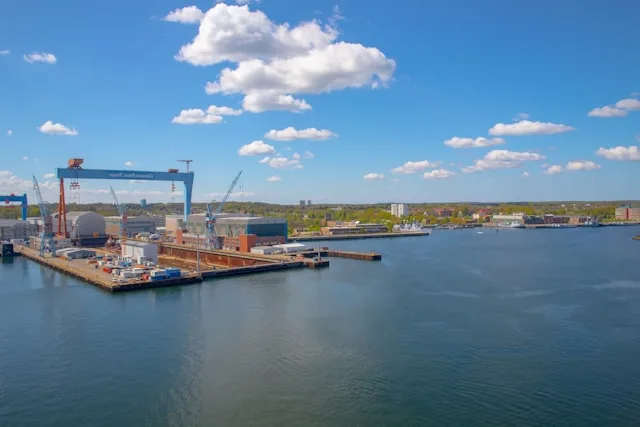
Kiel's four primary terminals each face specific constraints. Ostseekai, the primary cruise berth at 330 metres and 9.5 metres depth, is at capacity during peak season. The 2025 schedule showed 18 double-berth days where two ships carrying a combined 8,000-plus passengers overlapped. For 2026, the port projects over 210 cruise calls, up from 190 in 2025 and 173 in 2024.
Schwedenkai, dedicated to Stena Line's Gothenburg route, handles 650,000 freight lane meters annually but lacks the berth depth for next-generation vessels exceeding 230 metres. Stena Line's planned deployment of its larger E-Flexer class vessels requires dredging scheduled for the second quarter of 2026, temporarily reducing berth availability during a period when the larger vessels are supposed to increase capacity by 30%.
Norwegenkai, Color Line's dedicated terminal, operated at 94% capacity utilisation in 2024. There is almost no buffer.
Each of these expansion moves requires more people, not fewer. More terminal coordinators. More safety officers. More passenger services supervisors. More technical superintendents to manage shore power connections that did not exist last year. The port ecosystem's own estimate of 400 additional logistics and hospitality professionals needed by mid-2026 arrives against a backdrop where the Agentur für Arbeit Kiel's own projections show the regional labour pool contracting. This is not a mismatch that resolves itself with time. It is a mismatch that compounds, because every quarter of delay in filling a terminal operations role is a quarter where the expanded infrastructure runs below its designed capacity.
The Compensation Paradox: Paying More, Still Losing
Kiel's compensation data tells a story that hiring leaders in this market already suspect but may not have quantified.
Ferry and Port Operations
A Senior Port Operations Manager with five to eight years of experience earns €85,000 to €105,000 in base salary, plus maritime sector bonuses of 10 to 15%. A Director of Terminal Operations commands €140,000 to €180,000 with performance incentives tied to berth utilisation and safety metrics. A VP of Maritime Affairs or Fleet Operations at a multinational ferry group earns €160,000 to €220,000, with material variation based on P&L responsibility.
These are respectable figures for Northern Germany. They are not competitive with Hamburg.
Hamburg offers 25 to 40% salary premiums for equivalent executive roles. It offers broader career trajectories across multinational container lines rather than regional RoPax operations. The Statistikamt Nord's migration data shows a net outflow of Kiel-trained logistics professionals aged 30 to 40 to Hamburg's HafenCity and Altona logistics clusters. Kiel's 15% cost-of-living advantage over Hamburg is real but insufficient. It does not offset the career ceiling that mid-career professionals perceive when they compare a RoPax terminal management role in Kiel to a global container operations role 60 kilometres south.
The Scandinavian Pull
The competition is not only domestic. Norwegian-flag ferry operations typically compensate senior officers 30 to 50% above German-flag equivalents, with tax-advantaged seafarer schemes and stronger union-negotiated benefits, according to the Nordic Association of Marine Insurers Crew Cost Analysis. For a certified Chief Officer or Second Engineer weighing a Kiel posting against an Oslo or Gothenburg one, the financial calculation is straightforward. The ferry operators that employ these officers in Kiel cannot match Scandinavian compensation without restructuring their entire cost base on routes where margins are already being compressed by EU ETS costs.
This is why senior roles in Kiel's port sector are overwhelmingly passive candidate markets. An estimated 80 to 85% of qualified port operations directors and terminal managers in Northern Germany are employed and not actively seeking roles. Specialist marine engineers with RoPax experience receive three to five unsolicited approaches monthly. The active-to-passive ratio for maritime technical superintendents is approximately 1 to 9 in the German market. Any organisation relying on advertised recruitment rather than direct headhunting is reaching, at best, 10 to 15% of the viable candidate pool. That is not a strategy. That is a lottery.
The Hinterland Bottleneck Nobody on the Waterfront Can Fix
Here is the paradox the aggregate data reveals but does not explain: RoPax freight volumes through Kiel have remained statistically stable, varying by only plus or minus 2% from 2022 to 2024. Ferry operators report strong booking backlogs. Maritime freight demand is healthy. Yet terminal dwell times are increasing.
The bottleneck is not at sea. It is on the B503 federal highway, the single-access road to Ostseekai cruise terminal, which cannot be expanded due to coastal protection laws. It is in the 15% reduction in available trucking capacity serving the port's Scandinavian corridors, a direct consequence of Germany's truck driver shortage. It is in a rail modal share of just 12% of port hinterland traffic, versus 35% at Hamburg, because Kiel's rail network lacks electrification on key port spurs and has no dedicated port rail terminals for RoPax units.
Kiel's maritime economy is becoming bottlenecked not by sea capacity but by land-side workforce constraints that ferry operators cannot directly control or price into their models. A port that can berth the vessel, unload the freight, and clear customs is still operationally compromised if the freight cannot leave the terminal at the speed the schedule requires. The truck driver shortage is not Stena Line's problem to solve, but it is Stena Line's problem to absorb.
The Fehmarn Belt Fixed Link, expected to open in 2029, compounds this pressure from a different direction. Deutsche Bahn projects a 30% reduction in trucking demand to Kiel ferry routes once the tunnel provides a direct road and rail shortcut to Scandinavia via Puttgarden. The long-term relevance of Kiel's RoPax model depends on whether the port can adapt its value proposition before that tunnel opens. The professionals who will lead that adaptation are exactly the ones the port cannot currently recruit fast enough. Understanding why traditional executive recruiting methods fail in constrained markets like this one is not optional for the hiring leaders involved.
What This Means for Hiring Leaders in Kiel's Port Ecosystem
The average time-to-fill for specialised maritime logistics roles in Kiel is 98 days. In Hamburg, it is 67 days. That 31-day gap is not a minor inconvenience. It is the difference between having a shore power project manager in place before the dredging at Schwedenkai begins and improvising through a €12 million infrastructure upgrade without one.
Three dynamics make this market unusually difficult.
First, the candidate pool is narrow by certification, not just by preference. IMO STCW certification requirements limit the pool for nautical officers to EU/EEA nationals or those with German-flag recognition. You cannot widen the funnel by posting on more job boards. The funnel is structurally constrained.
Second, the seasonal compression of cruise operations means that the hospitality supervisors and terminal coordinators needed for the May to September peak must be recruited and onboarded months in advance. During the 2024 peak season, according to the IHK Kiel Wirtschaftsbericht, ground handlers at the cruise terminal reportedly failed to fill 30% of scheduled hospitality supervisor shifts, resulting in extended passenger embarkation delays. The cost of that failure is not just operational. It is reputational, in a sector where cruise lines choose their ports of call based partly on terminal service quality.
Third, Rostock is competing more effectively than it used to. Its expanding cruise infrastructure at Warnemünde offers similar cost of living, newer terminal facilities, and stronger ties to Baltic states' labour pools. According to reporting from the Maritime HR Forum in 2024, Rostock-based firms have been quicker to adopt remote and hybrid arrangements for shore-based operations staff. Kiel's more traditional ferry operators have been slower on this front, creating a flexibility gap that matters to candidates weighing otherwise comparable roles. Understanding how to negotiate the full compensation package in this context requires knowing what Rostock, Hamburg, and Scandinavian employers are actually offering.
The organisations that fill these roles will not do it through job advertising. They will do it through systematic identification of passive candidates currently employed at competitor terminals, Hamburg port operations, and Scandinavian ferry groups. That requires talent mapping of a specific and finite candidate universe, not broad-spectrum recruitment marketing.
Reaching the Candidates This Market Needs
Kiel's port hiring challenge is a textbook case of a market where the candidates who matter most are the least visible through conventional channels. The 80 to 85% passive candidate rate at director and terminal manager level is not unusual for senior maritime roles, but it becomes acutely consequential when combined with Kiel's specific disadvantages: the Hamburg salary gap, the Scandinavian compensation premium, and the career ceiling perception that drives mid-career migration out of the market.
A search strategy that works here must do three things. It must identify the specific individuals in Hamburg, Rostock, Gothenburg, and Oslo who have the right certification, the right operational experience, and a reason to consider Kiel. It must construct an offer proposition that addresses the career trajectory concern, not just the salary line. And it must move fast enough that the candidate is in an interview before the three to five other recruiters who approach them monthly can close first.
KiTalent's approach to executive search in industrial and maritime sectors is built for exactly this kind of constrained, passive-candidate market. Using AI-powered talent mapping to identify qualified professionals who are not visible on any job board, the firm delivers interview-ready candidates within 7 to 10 days. The pay-per-interview model means organisations only invest when they are meeting qualified people, not when a retainer is signed. With a 96% one-year retention rate across 1,450-plus executive placements, the method is designed for markets where the cost of a wrong hire is measured in delayed infrastructure projects and missed regulatory deadlines.
For port authorities, ferry operators, and logistics firms competing for the finite pool of senior maritime talent in Northern Germany and Scandinavia, speak with our executive search team about how we identify and secure the candidates this market cannot surface through conventional hiring.
Frequently Asked Questions
What is the average time-to-fill for senior maritime logistics roles in Kiel?
Specialised maritime logistics roles in Kiel take an average of 98 days to fill, compared to 67 days in Hamburg. For certified nautical officers on RoPax vessels, vacancy periods typically extend to 8 to 14 months. The gap is driven by IMO STCW certification requirements that limit the candidate pool, competition from Hamburg's higher salaries, and Scandinavian operators offering 30 to 50% compensation premiums above German-flag equivalents. Organisations that rely on advertised recruitment alone are reaching a fraction of the available talent. Direct headhunting methodology is typically the only effective approach at senior levels.
How does Kiel's port compensation compare to Hamburg?
Hamburg offers 25 to 40% salary premiums over Kiel for equivalent executive port operations roles. A Director of Terminal Operations in Kiel earns €140,000 to €180,000, while a COO in multimodal logistics earns €150,000 to €200,000, roughly 15 to 20% below Hamburg equivalents. Kiel's 15% cost-of-living advantage partially offsets the gap but does not close it for mid-career professionals weighing career trajectory against lifestyle. Scandinavian ports add further pressure, with Norwegian-flag operators compensating senior officers 30 to 50% above German rates.
What impact will the EU ETS have on Kiel's ferry operators?
Full maritime inclusion in the EU Emissions Trading System in 2026 imposes estimated carbon cost liabilities of €15 to €25 million annually for Kiel-based ferry operators, adding €4 to €6 per lane meter on RoPax operations. Combined with 5.5 to 7% wage increases negotiated through collective bargaining for 2025 to 2026, margins on the competitive Kiel to Scandinavia routes are being squeezed from both sides. Operators need professionals who combine traditional RoPax expertise with carbon market compliance skills, a profile that barely existed three years ago.
How will the Fehmarn Belt Fixed Link affect Kiel's port relevance?
The Fehmarn Belt tunnel, expected to open in 2029, will provide a direct road and rail connection from Germany to Scandinavia via Puttgarden. Deutsche Bahn projects a 30% reduction in trucking demand to Kiel ferry routes after the tunnel opens. Kiel's port must adapt its value proposition in the intervening years, potentially shifting emphasis toward vehicle logistics, perishables, and cruise tourism. The leaders who will drive that strategic pivot are the same professionals the port currently struggles to recruit.
Why is executive search necessary for Kiel port operations hiring?
An estimated 80 to 85% of qualified port operations directors and terminal managers in Northern Germany are employed and not actively seeking new roles. Specialist marine engineers with RoPax experience receive three to five unsolicited approaches monthly. The active-to-passive candidate ratio for maritime technical superintendents is approximately 1 to 9. In a market this passive, job advertising reaches a small minority of viable candidates. Firms like KiTalent use talent pipeline development and AI-enhanced candidate identification to reach professionals who are not visible through conventional recruitment channels.
What skills are hardest to find in Kiel's port logistics market?
The four scarcest skill profiles are maritime regulatory compliance (EU ETS, FuelEU Maritime, Port State Control), RoPax operations optimisation including vehicle loading algorithms and stowage planning, shore power electrical engineering for high-voltage onshore power supply systems, and Scandinavian language competency for ferry operations coordination. German logistics graduates increasingly lack Swedish and Norwegian language skills, narrowing the candidate pool for operational roles that require daily coordination with Scandinavian counterparts.