Kiel's Shipbuilding Boom Has Billions in Orders and No One to Build Them: The Talent Crisis Behind Germany's Submarine Programme
Germany's post-Zeitenwende defence investment surge was supposed to solve a generation of industrial neglect. In Kiel, home to the country's submarine design authority and the assembly line for the Type 212CD programme, it has instead created one of the most acute talent bottlenecks in European defence manufacturing. The order book at the city's anchor yard now extends to 2032. The workforce required to deliver against it does not exist in sufficient numbers, and it cannot be assembled through conventional hiring.
The scale of the mismatch is specific and measurable. The German Ministry of Defence's Special Fund allocates €6.8 billion for submarine procurement through 2028, with Kiel positioned as the primary beneficiary. Yet senior welding engineer positions at the city's shipyards remain unfilled for 11 to 14 months. Combat systems integration roles attract a qualified candidate pool measured in the low hundreds nationally. The vacancy rate across Schleswig-Holstein's shipbuilding sector stands at 6.8%, double the state average. Capital has moved faster than human capital can follow.
What follows is a ground-level analysis of why Kiel's shipbuilding cluster cannot convert its strongest order pipeline in decades into the workforce it needs, where the gaps are most severe, who is competing for the same talent, and what organisations operating in this market must do differently to secure the engineers, specialists, and leaders that determine whether Germany's submarine programme delivers on time or falls behind.
The Zeitenwende Paradox: More Money, Fewer People
The public narrative around German defence spending since the Zeitenwende policy shift of 2022 implies an industry in expansion. Headlines describe billions in new orders, accelerated procurement timelines, and industrial mobilisation. For a hiring executive reading those headlines from outside the sector, the logical assumption would be that Kiel's shipyards are scaling, that new talent is flowing in, and that the investment is translating into capacity.
The data tells a different story. Shipbuilding unemployment in Kiel sits at 2.1%, below the threshold economists consider full structural employment. Vacancy durations for critical roles have extended from 45 days in 2020 to 127 days in 2024, according to IAB employment research data. The defence investment cycle has not loosened the labour market. It has tightened it, because the money arrived before the people did.
This is the core analytical tension in Kiel's shipbuilding market: the Zeitenwende investment surge has exacerbated rather than alleviated skilled labour scarcity. Every new contract added to the order book creates demand for specialists who were already scarce before the spending increase. The 212CD submarine programme alone requires thyssenkrupp Marine Systems (tkMS) to recruit 400 additional engineers and technicians by end-2025. IG Metall Küste cautions that demographic constraints may limit actual hiring to 60 to 70 percent of that target. The gap between what was planned and what can be delivered is not a future risk. It is a present constraint.
The consequence for hiring leaders is that the conventional signals are misleading. A growing sector with rising budgets typically creates conditions where talent becomes available as employers compete and workers move. In Kiel's submarine cluster, the opposite is happening. The investment is concentrating demand onto a fixed and shrinking pool of qualified specialists, and the specialists know it.
Who Builds Submarines in Kiel: The Cluster and Its Dependencies
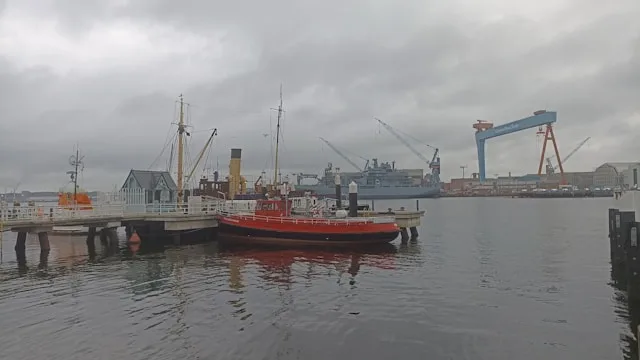
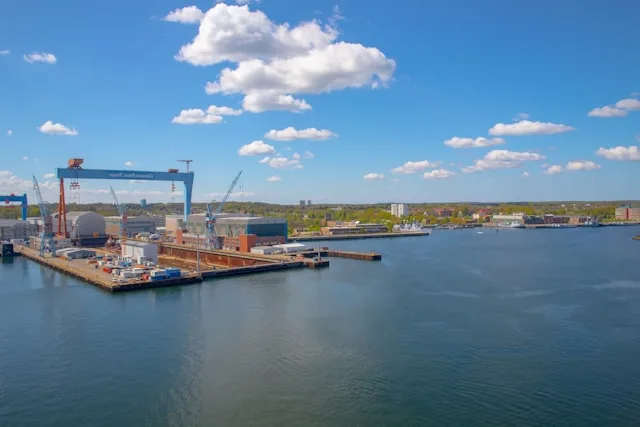
The anchor of Kiel's naval shipbuilding cluster is tkMS, operating the former Howaldtswerke-Deutsche Werft yard at Gaarden with approximately 2,800 employees as of late 2024. The yard holds submarine design authority and serves as the primary assembly site for non-nuclear submarines and corvette modernisation. It currently operates at 85 to 90 percent capacity utilisation, managing parallel production lines for four Type 212CD boats and K130 corvette retrofit programmes.
The Supplier Network That Surrounds the Yard
tkMS does not operate in isolation. The Maritime Cluster Northern Germany (MCN) registers approximately 1,600 maritime-sector companies in Schleswig-Holstein, with 320 classified as direct naval suppliers or engineering service providers. Specialist firms such as Zeppelin Power Systems (marine propulsion, roughly 450 employees in Kiel-Osterrönfeld), Brunvoll Deutschland (thrusters, 180 employees in Rendsburg), and Atlas Elektronik's Kiel satellite office (120 systems engineers for sonar and combat systems) form a tier-one supplier ring. These firms share the same labour market, draw from the same training pipelines, and lose talent to the same competitors.
The Training Pipeline and Its Limits
Christian-Albrechts-Universität zu Kiel's Faculty of Engineering graduates approximately 80 marine engineers annually through its Marine and Maritime Sciences programme. That figure has not materially increased in recent years despite rising industry demand. The Flensburger Schiffbau-Gesellschaft, located 45 kilometres north with 700 employees focused on naval auxiliaries, competes for the same graduates and the same experienced specialists. Direct shipbuilding employment in Kiel proper, including tkMS and tier-one suppliers, totals approximately 4,200 FTEs. An additional 1,800 indirect jobs sit in engineering services and specialised logistics. The entire ecosystem depends on a labour pool that is not growing fast enough to serve any single employer, let alone all of them simultaneously.
The structural dependency is clear. When tkMS needs a pressure hull design engineer, it is drawing from the same national pool of fewer than 400 qualified individuals that every other submarine programme in Europe is targeting. When a Kiel SME loses a senior naval architect to a 30 percent pay increase from an out-of-region competitor, there is no replacement waiting in the local market. The cluster's strength, its concentration of submarine expertise, is also its constraint. Every firm in the network is fishing in the same very small pond.
The Three Roles That Define the Bottleneck
Not all vacancies in Kiel's shipyards carry the same weight. The hiring failures that threaten programme timelines are concentrated in three specific categories, each with its own scarcity dynamic and each requiring a fundamentally different search approach.
Certified High-Strength Steel Welders
Submarine pressure hulls are fabricated from HY-80 and HY-100 high-strength steel, and the welders who work with these materials require DVS/EN ISO 9606-1 certification specific to naval-grade alloys. This is not a transferable skill from commercial shipbuilding. According to IG Metall Küste data, 60 to 70 percent of applicants for senior welding engineer roles are rejected because they lack the correct certification. The qualified population with both the certification and active security clearance is estimated to be 90 percent passive, meaning nearly all of them are employed, not looking, and reachable only through direct identification and approach.
The training pathway compounds the problem. Achieving HY-100 welding certification requires years of supervised practice. There is no accelerated route. The pipeline cannot be widened quickly, and the demographic data suggests it is narrowing: 22 percent of Schleswig-Holstein's current shipbuilding workforce in welding and mechanical fitting trades is projected to retire by 2030, while vocational training completions in relevant trades are declining 8 percent annually.
Combat Systems Integration Engineers
The engineers who integrate sensors, weapons, and C4I systems into submarine platforms work with proprietary architectures such as SUBICS and ISUS 90. The qualified population in Germany is estimated at fewer than 400 individuals. Unemployment in this specialisation runs below 1 percent. Average tenure exceeds eight years. The passive candidate ratio sits at approximately 85 percent.
Atlas Elektronik has responded to the scarcity by establishing a remote-work hybrid model specifically for combat systems software engineers, an arrangement previously unheard of in classified defence work governed by ITAR and EU dual-use regulations. That a defence contractor would restructure its working model for a single engineering category speaks to the severity of the retention pressure. The competition for these engineers comes not only from other defence firms but from Hamburg's civil aviation sector, which offers higher compensation in a city with materially better dual-career infrastructure.
Submarine-Specialised Naval Architects
Design authority for hydrodynamics and pressure hull integrity requires a combination of academic qualification, years of submarine-specific experience, and classification society certification (ABS or DNV-GL). Civilian engineers transitioning from commercial projects face an 18-month qualification barrier before they can work on naval programmes. The passive candidate ratio for experienced submarine naval architects is approximately 80 percent.
The poaching dynamic in this category is particularly acute. According to aggregate survey data from the BDI and the MCN, SME suppliers in the Kiel area report losing senior naval architects to tkMS and to out-of-region competitors, notably Naval Group and Saab Kockums, at salary premiums of 25 to 35 percent above standard mechanical engineering scales. Annual turnover among senior engineers at Kiel-area suppliers runs at 18 percent, with 40 percent of departures moving to non-local defence employers.
The implication for any organisation hiring in this market is that the difficulty is not proportional to seniority alone. It is proportional to the specificity of the skill. A general mechanical engineer may be findable through conventional channels, but that engineer will need 18 to 24 months of security clearance processing and certification before contributing to a submarine programme. The roles that matter immediately are the ones where the hidden 80 percent of passive talent is the only realistic candidate pool.
Compensation: A Bifurcated Market Hiding Behind Averages
Aggregate German engineering salary data for 2024 showed moderation: a 2.1 percent increase against 5.8 percent inflation, according to StepStone's engineering salary report. Read in isolation, that figure suggests a cooling labour market for engineers. In Kiel's submarine sector, the reality is the opposite.
Executive search data for naval-critical specialisations shows accelerating premiums. Combat systems integration roles and pressure hull specialists are commanding 15 to 20 percent increases. Defence shipbuilding pays a 15 to 20 percent premium over commercial shipbuilding at executive level, driven by security clearance requirements and programme complexity. At the same time, it remains 10 to 12 percent below automotive executive compensation for equivalent scope and responsibility.
The specific pay bands tell the story clearly. A senior naval architect with 10 to 15 years of experience earns €78,000 to €95,000 in base salary under IG Metall Schleswig-Holstein metalworking tariff agreements plus above-tariff supplements. A senior welding engineer or inspector earns €65,000 to €82,000. At executive level, a Programme Director for submarine programmes commands €145,000 to €185,000 in base salary plus 30 to 40 percent variable bonus. A VP Engineering earns €135,000 to €165,000 base plus car allowance and long-term incentive plans.
These figures are competitive within northern Germany's industrial base. They are not competitive against what Hamburg, Munich, or international defence competitors offer. Hamburg pays a 12 to 15 percent premium for equivalent engineering roles. Munich and Ingolstadt offer 25 to 30 percent premiums for defence engineers. Norway's Kongsberg competes for submarine systems engineers with 20 percent higher net salaries and English-language working environments.
The market is therefore bifurcated. General mechanical engineering compensation stagnates while naval-critical specialisations experience what the Kienbaum compensation study describes as hyperinflationary pressure. Headline industry statistics mask this divergence entirely. A hiring leader benchmarking Kiel compensation against national engineering averages will underestimate the offer required to move a passive submarine specialist by a wide margin. The gap is not closing. It is widening fastest at exactly the seniority level where the most critical programme roles sit.
For organisations trying to build accurate compensation benchmarks for defence sector roles, this bifurcation is the single most important dynamic to understand. The average tells you nothing. The segment-specific data tells you everything.
What Hamburg, Bremen, and Munich Are Taking from Kiel
Kiel's talent retention challenge cannot be understood without mapping the pull forces operating from competing cities. The outflow is not random. It follows specific patterns tied to career stage, family circumstance, and specialisation.
Hamburg, 80 kilometres south, is the primary competitor. Airbus Operations, Blohm+Voss, and Siemens Energy all draw from overlapping engineering pools. The draw is not purely financial, though the 12 to 15 percent compensation premium matters. Hamburg offers materially better spouse and partner employment opportunities in a diversified economy, international school infrastructure, and higher housing liquidity. CAU alumni survey data shows that senior systems engineers and software architects frequently migrate south for dual-career reasons. A candidate whose partner cannot find equivalent employment in Kiel is not making a compensation decision. They are making a household decision. And Kiel loses that calculation more often than it wins.
Bremen and Vegesack present a different kind of competition. The Lürssen shipyard builds naval surface combatants, and naval architects with surface ship specialisation see a natural career path from Kiel's submarine focus to Lürssen's frigate programmes. The MCN's workforce analysis confirms this drain pattern. Bremen also benefits from automotive-to-defence engineering crossover pipelines, drawing on Mercedes-Benz's local presence for mechanical talent that Kiel cannot replicate.
Munich and Ingolstadt represent the most structurally damaging competitor for Kiel. The compensation premium is the largest, at 25 to 30 percent. The startup ecosystem for dual-use technology offers younger engineers career options that do not exist in northern Germany. BDI survey data shows that engineers under 35 are the demographic most likely to leave northern shipbuilding for Bavarian defence electronics and autonomy sectors. Kiel is losing its future workforce to a region that offers more money, more career variety, and a stronger technology culture.
Kiel's retention advantages are real but narrow. Housing costs are materially lower than Hamburg (median apartment price €3,200 per square metre versus €5,800 per square metre). Baltic Sea proximity and quality of life appeal to a specific demographic. But these advantages primarily retain mid-career professionals with families who have already settled. They do not attract the mobile, early-career engineers who have not yet committed to a city. Understanding what drives senior candidates to accept or decline offers in this market requires accounting for the entire household equation, not just the salary line.
The Technology Transition Nobody Trained For
The talent crisis would be severe enough if the sector only needed more of the same skills it has always required. It does not. Kiel's shipbuilding cluster is undergoing a technology transition that is rewriting the skill requirements for roles that have existed for decades.
The pivot toward autonomous underwater vehicle (AUV) integration and fuel-cell propulsion systems, specifically PEM fuel cell technology under the FCAIP programme, creates demand for software engineers and electrochemistry specialists who have never traditionally existed in mechanical shipbuilding labour pools. The MCN's Maritime Technology Innovation Report identifies these as critical growth disciplines. But the candidates who possess these skills are not working in shipyards. They are in automotive fuel-cell R&D, in academic electrochemistry labs, or in AI and technology businesses that have never considered defence manufacturing as an employer.
Recruiting them into Kiel's naval cluster means overcoming multiple barriers simultaneously. The compensation must compete with what automotive and technology firms offer for the same skills. The working environment must accommodate professionals who expect agile development practices, not traditional engineering hierarchies. And the security clearance regime creates a six to twelve month delay for non-EU engineers, effectively ruling out rapid international hiring for sensitive programmes.
This is the original synthesis this analysis offers: the investment in new submarine technology has not reduced the workforce requirement. It has replaced one kind of worker with another that does not yet exist in sufficient numbers within the defence sector. The naval architects and welders Kiel needs are scarce because the pipeline is shrinking. The software engineers and electrochemists Kiel now also needs are scarce because the pipeline was never built for this industry in the first place. Capital moved faster than human capital could follow, and the firms that recognise this dual challenge earliest will secure the talent. The firms that wait for job postings to work will not.
What This Means for Hiring Leaders in Kiel's Defence Cluster
The structural dynamics described in this analysis do not resolve themselves. The demographic trajectory is fixed: retirements accelerate while training completions decline. The technology transition adds entirely new hiring categories onto an already constrained market. The geographic competition from Hamburg, Munich, and international defence contractors intensifies as the same Zeitenwende spending wave creates simultaneous demand across the entire European defence industrial base.
For senior hiring executives responsible for filling submarine programme director roles, combat systems engineering leaders, or supply chain executives managing specialised procurement under geopolitical constraints, the practical implications are specific.
First, search timelines must be calibrated to the real market, not to general engineering benchmarks. A submarine combat systems engineer search in this market runs three to four times longer than a comparable role in commercial mechanical engineering. Planning that assumes standard timelines will fail.
Second, the candidate pool is overwhelmingly passive. At 80 to 90 percent passive ratios for the most critical specialisations, job boards and inbound applications reach at most 10 to 20 percent of viable candidates. The other 80 percent must be identified, assessed, and approached directly.
Third, the total cost of a wrong hire at programme director level in defence shipbuilding is amplified by security clearance lead times. A failed placement does not simply restart the search. It restarts the clearance process. Eighteen months of qualification time is lost along with the role itself.
For organisations competing for senior engineering and programme leadership talent in Germany's defence shipbuilding market, where the qualified candidate pool is measured in hundreds rather than thousands and the cost of a vacant role is measured in programme delays, speak with our executive search team about how KiTalent's direct headhunting methodology reaches the passive specialists that conventional hiring cannot. KiTalent delivers interview-ready executive candidates within 7 to 10 days, with a 96 percent one-year retention rate across 1,450 completed placements, operating on a pay-per-interview model with no upfront retainer.
Frequently Asked Questions
Why is it so hard to hire submarine engineers in Kiel?
The qualified population for submarine-specific roles in Germany is extremely small. Fewer than 400 engineers have combat systems integration experience with platforms such as SUBICS or ISUS 90. Approximately 85 percent of them are passive candidates, employed and not actively seeking new roles. Security clearance requirements add 6 to 12 months to onboarding timelines for external hires. The Zeitenwende defence spending increase has created simultaneous demand across multiple programmes, concentrating pressure onto this fixed pool. Conventional recruitment methods, including job postings, reach no more than 15 to 20 percent of the viable candidate market.
What do senior naval engineers earn in Kiel in 2026?
Senior naval architects with 10 to 15 years of experience earn €78,000 to €95,000 in base salary. Senior welding engineers earn €65,000 to €82,000. At executive level, programme directors for submarine programmes command €145,000 to €185,000 base plus 30 to 40 percent variable bonuses. Defence shipbuilding pays a 15 to 20 percent premium over commercial shipbuilding but remains 10 to 12 percent below automotive executive compensation for equivalent scope. Critical specialisations are seeing 15 to 20 percent annual compensation increases, far outpacing the broader engineering salary market.
How does Kiel compare to Hamburg for defence engineering careers?
Hamburg offers a 12 to 15 percent compensation premium for equivalent engineering roles, stronger dual-career opportunities for partners, international school infrastructure, and higher housing liquidity. Kiel offers materially lower housing costs (€3,200 per square metre versus €5,800 per square metre), proximity to the Baltic Sea, and direct involvement in Germany's submarine design authority. The decision often comes down to household circumstances: engineers with settled families tend to stay in Kiel, while those seeking dual-career flexibility or broader career options often migrate to Hamburg. Understanding this dynamic is essential for any retention or recruitment strategy in northern German defence.
What is the Zeitenwende's effect on Kiel's shipbuilding job market?
The Zeitenwende defence policy shift has generated €6.8 billion in submarine procurement funding through 2028, extending Kiel's order book to 2032. However, it has tightened rather than loosened the labour market. Shipbuilding unemployment in Kiel sits at 2.1 percent, below full structural employment. Vacancy durations for critical roles have tripled since 2020. The investment surge created demand that the existing workforce and training pipeline cannot absorb. The Special Fund expires in 2027, creating a potential employment cliff in 2028 to 2030 if baseline budgets do not absorb ongoing programmes.
How can defence firms in Kiel hire passive submarine specialists?
With 80 to 90 percent of qualified submarine specialists classified as passive candidates, firms must move beyond job advertising. Direct executive search that maps the full qualified population, identifies individuals by specific certification and programme experience, and approaches them with a compelling proposition is the only method that reaches the full market. KiTalent's AI-enhanced talent mapping identifies and assesses passive candidates across defence and industrial sectors, delivering interview-ready shortlists within 7 to 10 days. The pay-per-interview model means organisations invest only when they meet candidates who meet their requirements.
What security clearance challenges affect hiring in Kiel's defence sector?
ITAR and EU dual-use regulations restrict talent mobility into classified submarine programmes. Non-EU engineers face 6 to 12 month security clearance delays through the Federal Office for Economic Affairs and Export Control (BAFA). ABS or DNV-GL classification requirements for civilian engineers transitioning to naval projects create an additional 18-month qualification barrier. These combined delays mean that even a successful hire may not be operationally deployable for up to two years after offer acceptance. Planning for this timeline is critical, and proactive succession and pipeline building is the only way to avoid programme gaps.