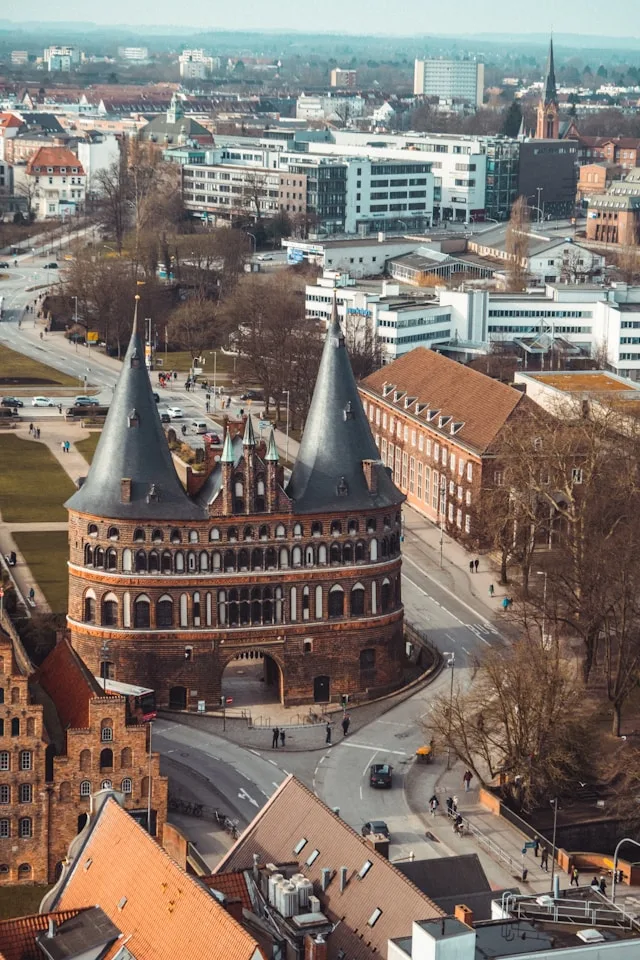
Lübeck's Maritime Logistics Cluster Is Investing in Its Future. The Talent to Deliver It Is Not There
The Port of Lübeck handled 32.5 million tonnes in 2024, holding steady as Germany's second-largest Baltic Sea port. It is the primary German terminal for Swedish trade. TT-Line and Finnlines manage 78% of Baltic Sea passenger and freight ferry traffic from the German coast through Travemünde. Shore power infrastructure is being installed across every terminal. Berth expansion at Skandinavienkai will raise RoRo capacity by 15% by mid-2026. The capital is flowing. The infrastructure is being built.
The people who will run it are a different matter. The Head of Technical Infrastructure role at Lübecker Hafen-Gesellschaft sat vacant for eleven months before it was filled with an internal interim appointment. Specialised crane operators take 89 days to recruit in Lübeck, nearly double the 45-day average for general warehouse logistics. Job postings for maritime port logistics roles in Schleswig-Holstein rose 34% between early 2023 and late 2024. The investment trajectory and the talent trajectory are moving in opposite directions.
This article examines the forces shaping Lübeck's maritime logistics sector in 2026: where capital is going, where talent is not following, what the compensation picture looks like at every seniority level, and why the search methods that work in Hamburg consistently fail when applied to this smaller, more specialised market. The analysis draws on port throughput data, regional employment statistics, named hiring examples, and compensation benchmarks across the three role families that define the sector's executive pipeline.
The Port That Sits Between Two Eras
Lübeck's port cluster occupies a particular position in Germany's maritime system. It is not a deep-sea container hub. Hamburg, 110 kilometres to the southwest, handles 8.3 million TEU annually. Lübeck's container throughput sits at roughly 110,000 TEU and is projected to remain between 110,000 and 115,000 TEU through 2026. Container diversification has stalled. The port's identity, and its future, lies elsewhere.
That identity is RoRo traffic and Baltic Sea ferry connectivity. TT-Line, headquartered in Lübeck, operates seven vessels on Baltic routes and employs 350 shore-based staff in the city alongside 800 seafaring personnel. Lübeck-Travemünde is the departure point for the majority of German-Swedish freight traffic. Roughly 267,000 RoRo units moved through the port in 2023. A modest 1-2% growth in RoRo volumes is forecast for 2026.
What makes this market analytically interesting is not the headline throughput figures. It is the convergence of three simultaneous transitions. The port is electrifying its quay infrastructure to comply with EU Alternative Fuels Infrastructure Regulation requirements. It is expanding physical RoRo capacity through the Skandinavienkai project. And it is attempting to shift freight from road to rail at exactly the moment when the Lübeck-Hamburg rail corridor remains capacity-constrained, with single-track sections that the planned double-tracking of the Lübeck-Hagenow line will not resolve before 2027 at the earliest, according to Deutsche Bahn's infrastructure status reporting.
Each of these transitions demands technical specialists and operational leaders who combine deep port domain knowledge with competencies that barely existed in this sector five years ago. Port electrification engineers. Digitally fluent terminal managers. Logistics directors who can negotiate rail infrastructure access while managing multimodal supply chains across the Baltic. The investment has moved faster than the workforce has evolved.
A RoRo Cluster With Shallow Talent Depth
The structural constraint facing Lübeck's port employers is not that there are too few logistics professionals in Germany. It is that the specific combination of skills this cluster requires is rare, and the professionals who possess it are concentrated in a small number of competing locations. A terminal operations director in Hamburg manages deep-sea container flows and mega-ship berths. A terminal operations director in Lübeck manages RoRo ramp operations, ferry scheduling coordination, and bulk cargo stevedoring. The skill overlap is smaller than it appears. A hiring leader looking at a candidate pool in Hamburg will find hundreds of qualified terminal managers. Most of them have never coordinated a RoRo ramp sequence or managed the operational rhythms of a regular ferry service. The talent pool narrows drastically when the filter moves from "logistics" to "Baltic Sea ferry logistics."
This is the analytical observation that frames everything else in this article: Lübeck's investment programme is building infrastructure for a maritime logistics model that requires a workforce profile found almost nowhere else in Germany in sufficient numbers. The port is investing in expansion while recruiting from a talent base that was already insufficient for its current scale.
Where the Hiring Gaps Are Most Acute
The shortage in Lübeck's port cluster does not affect all roles equally. General operational labour remains adequately supplied through regional vocational training pipelines. Germany's Ausbildung system continues to produce warehouse operatives, freight handlers, and entry-level logistics coordinators at sufficient volume for the region. The pain sits higher: in the senior technical, managerial, and digitally specialised roles that cannot be filled through vocational training alone.
Three role categories dominate the vacancy data.
Maritime Logistics Managers
Senior professionals who combine Baltic Sea ferry operations expertise with multimodal coordination capability. These are the people who optimise the interface between ferry arrivals, RoRo discharge sequences, road haulage dispatch, and rail loading. The role requires fluency in both the physical operations of a ferry terminal and the information systems that coordinate freight movement across modes. Job postings for maritime port logistics roles across Schleswig-Holstein rose 34% between Q1 2023 and Q4 2024, according to StepStone's North German labour market reporting. The average time-to-fill for specialised port sector roles in Schleswig-Holstein reached 127 days in 2024. Comparable logistics roles in Hamburg filled in 94 days, according to Kienbaum's transport and logistics market report.
STS Crane and Project Cargo Operators
Specifically, operators qualified for mobile harbour cranes handling project cargo and non-standard loads. These operators require certifications and hands-on experience that take years to develop. In Lübeck, the average recruitment duration for specialised crane operators is 89 days. For general warehouse logistics, it is 45 days. The gap reflects a simple arithmetic problem: there are more operators retiring or relocating than the training pipeline is producing.
Customs and Trade Compliance Specialists
The post-2022 geopolitical environment created acute demand for specialists in EU-Schengen border processes and sanctions compliance. Every Baltic Sea port faces this pressure, but Lübeck's role as a primary gateway for Swedish and Finnish trade routes concentrates the compliance burden. The sanctions regime against Russia and Belarus has added layers of screening and documentation that did not exist three years ago. Compliance specialists capable of operating at the intersection of EU trade law and maritime logistics are scarce across every northern European port, but Lübeck's smaller employer base means the local pool is functionally empty.
What the LHG Vacancy Reveals About Lübeck's Search Problem
The most instructive example from the research sits at the top of the seniority ladder. According to Federal Employment Agency records and the IHK Lübeck personnel barometer, Lübecker Hafen-Gesellschaft advertised the position of Leiter Technik und Infrastruktur from March 2024 through February 2025. Eleven months. The role required expertise in port electrification and Baltic Sea quay construction. It was reportedly filled through an internal interim appointment made permanent.
This pattern tells a specific story about how executive recruiting can fail in niche markets. The role demanded a combination of maritime civil engineering knowledge, shore power infrastructure expertise, and familiarity with EU funding mechanisms for transport infrastructure. Each of these competencies is individually findable. Their combination, in a single professional willing to work in Lübeck rather than Hamburg, is not.
The 11-month duration also illustrates the cost asymmetry between large and small port employers. Hamburg's HHLA or Eurogate can absorb a prolonged vacancy at this level because their organisational depth allows redistribution of responsibilities. LHG, with approximately 280 direct staff and oversight of 1,200 port-related jobs, does not have that depth. An unfilled technical director role at LHG directly delays infrastructure projects, including the shore power rollout and quay upgrades that underpin the port's EU compliance timeline.
The operational cost of a failed or delayed search at this level is not abstract. It compounds through every month that infrastructure projects stall, compliance deadlines approach, and competing ports in Rostock and Kiel advance their own green transition programmes. The organisations that resolve these searches fastest are the ones whose infrastructure timelines hold. Those that do not fall behind in a race where the cost of a bad or slow executive hire is measured in regulatory risk and lost competitive position.
The Compensation Picture: What Lübeck Pays and Where the Gaps Bite
Understanding why talent does not flow naturally into Lübeck requires understanding what the market pays at each level, and how those figures compare to the alternatives a candidate actually considers.
Terminal Operations and Port Management
At the senior specialist and manager level, a Terminal Operations Manager with ten or more years' experience earns between €78,000 and €95,000 in base salary, with performance bonuses adding 10-15%. This figure comes from StepStone and Gehaltsreporter data for Schleswig-Holstein port operations roles.
At the executive level, a Director of Terminal Operations or equivalent public-law port executive commands between €140,000 and €180,000 annually, plus variable compensation and a company vehicle, based on Kienbaum's executive compensation analysis for transport and logistics.
The critical context is Hamburg's premium. According to StepStone's regional comparison, equivalent terminal operations roles in Hamburg pay 18-25% more in base salary. A Terminal Operations Manager earning €90,000 in Lübeck could expect €107,000 to €112,000 for a comparable role in Hamburg. At the executive level, the gap widens further because Hamburg's larger organisational structures at HHLA and Eurogate offer clearer progression pathways to C-level port management. The compensation gap and the career trajectory gap compound each other.
Maritime Logistics and Supply Chain
Senior logistics managers specialising in maritime traffic earn between €68,000 and €85,000 in Lübeck, according to Hays salary benchmarks. At the executive level, a Head of Maritime Logistics or Director of Logistics sits between €120,000 and €155,000, based on Robert Walters salary survey data for Germany. These roles require multimodal transport planning, Baltic Sea trade lane expertise, SAP TM proficiency, and customs handling capability. At the executive tier, fluency in German, English, and ideally a Scandinavian language is expected.
Port Engineering and Technical Infrastructure
Senior port engineers earn between €72,000 and €88,000, according to VDI salary reporting and federal earnings structure data. At the executive level, a Chief Technical Officer or Technical Director at a public-law port entity earns €135,000 to €170,000. Private terminal operators pay €160,000 to €220,000, based on Kienbaum's executive compensation report for transport infrastructure.
This is the salary band where Lübeck's 11-month vacancy sat. At the upper end, the compensation is competitive with Hamburg. But compensation alone does not explain an 11-month search. The pool of candidates with the right technical profile who are willing to relocate to Schleswig-Holstein rather than take a Hamburg role with a shorter commute, larger employer, and broader career trajectory is vanishingly small. Understanding how salary negotiation dynamics play out in niche technical searches is essential for any employer competing in this space.
Three Competitive Forces Draining Lübeck's Talent Pipeline
Lübeck's hiring challenge does not exist in isolation. It exists within a competitive geography that pulls qualified professionals in three directions simultaneously.
Hamburg: The Gravitational Centre
Hamburg is 110 kilometres away and accessible within 90 minutes by car or rail. For any maritime logistics professional living in northern Germany, Hamburg is always an option. It pays more. It offers exposure to deep-sea container operations and mega-ship handling that Lübeck cannot match. Its organisational structures are larger, offering the C-suite pathways that ambitious mid-career professionals seek. A senior candidate considering a role in Lübeck will, in almost every case, also be considering a role in Hamburg. The question Lübeck's employers must answer is not "can we match Hamburg's salary?" but "what does this role offer that Hamburg cannot?"
The answer, for the right candidate, is operational breadth and speed of impact. A terminal director in Lübeck holds genuine P&L responsibility over a multifaceted operation spanning RoRo, bulk, and project cargo. Their Hamburg equivalent may manage a larger volume through a narrower operational lens. The pitch exists. But it requires a search approach sophisticated enough to identify the professionals who would value it, rather than broadcasting an advertisement and hoping they respond.
Rostock and Kiel: The Lateral Competitors
Rostock, 180 kilometres to the east, handles similar traffic types and offers comparable compensation with a materially lower cost of living. According to IHK Rostock's personnel strategy reporting, Rostock employers have begun offering housing incentives to attract terminal operations staff. This is a direct poaching mechanism targeting Lübeck's mid-career workforce.
Kiel, 80 kilometres north, competes specifically for ferry operations managers and passenger logistics coordinators. Kiel's smaller operational scale allows more flexible hybrid working arrangements. For a professional with school-age children and a working spouse, Kiel's flexibility offer may matter more than Lübeck's marginally higher compensation.
Scandinavian Ports: The International Drain
Trelleborg, Malmö, and Gothenburg draw bilingual German-Swedish logistics professionals with higher net wages. Swedish tax structures for skilled migrants create a post-tax advantage that raw salary comparisons understate. English-speaking work environments appeal to internationally mobile talent. According to Business Sweden's talent attraction reporting, this drain is particularly acute for the exact profile Lübeck needs most: professionals with Baltic Sea operational experience and Scandinavian language capability.
The TT-Line poaching incident from Q3 2024 illustrates the scale of the problem in reverse. According to Lloyd's List Intelligence, TT-Line reportedly secured a Fleet Operations Manager from Stena Line's Gothenburg office by offering a relocation package with a 35-40% salary premium above standard Lübeck market rates. When the flow is reversed and a Lübeck employer must compete across borders for scarce leadership talent, the cost premium is substantial.
Why Conventional Search Methods Fail in This Market
The dynamics described above create a market where the conventional recruitment approach consistently underperforms. Understanding why requires examining who the candidates are and how they behave.
The professionals qualified for senior technical and operational leadership roles in Lübeck's port cluster are, in overwhelming proportion, passive candidates. They are employed. They are not searching job boards. They are not registered with generalist recruitment agencies. A maritime logistics director running terminal operations at a Baltic Sea port is not browsing StepStone on a Thursday evening. They are solving operational problems for their current employer.
This is the market where the hidden 80% of leadership talent is most literally hidden. The total addressable candidate pool for a role like Head of Technical Infrastructure at a German Baltic Sea port might number in the low hundreds across all of northern Europe. Of those, perhaps 10-15% are actively open to approaches. The rest must be identified through systematic talent mapping and approached directly with a proposition that addresses their specific career calculus.
The Rhenus Midgard example from late 2024 demonstrates what adapting to this reality looks like. According to reporting in the Täglicher Hafen-Courier Lübeck, Rhenus Midgard restructured its operational technology department to create a hybrid Port Digitalisation Specialist role combining 60% remote work with 40% on-site presence. This arrangement required significant internal restructuring of shift supervision protocols. The purpose was to attract a specialist from Hamburg who would not have relocated for a full-time on-site role. This pattern was confirmed as typical by Kühne Logistics University's study on digitalisation in German ports.
The adaptation is instructive. It shows that the most effective employers in this market are not simply paying more. They are redesigning roles, rethinking operational structures, and creating employment propositions that remove the specific barriers keeping the best candidates from considering a move to Lübeck. Conventional search methods, posting an advertisement and screening inbound applications, will never reach these candidates. They require direct identification and direct approach, typically through specialist headhunting methods calibrated to the precise profile the role demands.
What This Means for Hiring Leaders in Lübeck's Port Cluster
The synthesis of Lübeck's throughput data, investment pipeline, compensation structure, and competitive geography leads to a single conclusion. This is a market where the capital investment programme has outpaced the talent system's capacity to supply the professionals needed to deliver it. Every major infrastructure project, the Skandinavienkai expansion, the shore power rollout, the eventual rail corridor upgrade, depends on technical and operational leaders who exist in insufficient numbers within the regional talent pool.
The employment outlook supports this reading. The IHK Lübeck projects a net creation of 150-200 jobs through 2026, concentrated in technical services and sustainability compliance. These are not entry-level roles that the Ausbildung system will fill. They are mid-career and senior positions requiring years of domain-specific experience. The pipeline feeding them is thin, and the competing demands from Hamburg, Rostock, Kiel, and Scandinavian ports make it thinner.
For hiring executives at LHG, TT-Line, Rhenus Midgard, Dachser, and the broader freight forwarding ecosystem around Lübeck's port, the practical implications are concrete. Searches for senior technical and operational leadership roles will take longer than equivalent searches in other sectors. Standard job advertising will reach only a fraction of viable candidates. Compensation offers must be benchmarked not against Lübeck regional averages but against what Hamburg and Scandinavian competitors are paying for the same profile. And the employment proposition must include elements beyond salary: operational autonomy, infrastructure modernisation leadership, and, where operationally feasible, working arrangements that reflect the flexibility expectations of a candidate pool that has alternatives.
KiTalent works with organisations facing precisely this type of market constraint: sectors where the qualified candidate pool is small, predominantly passive, and distributed across multiple competing geographies. Through AI-enhanced talent mapping and direct candidate identification, KiTalent delivers interview-ready executive candidates within 7 to 10 days, reaching the professionals who do not appear on any job board. The firm's pay-per-interview model means clients invest only when they meet candidates who match the brief, eliminating the upfront cost risk that makes retained search prohibitive for searches in niche markets.
For organisations competing for maritime logistics leadership in Lübeck's port cluster, where every critical infrastructure project depends on finding the two or three people in northern Europe who combine the right technical knowledge with willingness to commit to this market, start a conversation with our executive search team about how a targeted search reaches the candidates conventional methods miss.
Frequently Asked Questions
What are the main executive roles in demand at the Port of Lübeck in 2026?
The highest-demand executive roles in Lübeck's maritime logistics cluster are Terminal Operations Directors, Heads of Maritime Logistics, and Chief Technical Officers responsible for port infrastructure. These roles require specific Baltic Sea and RoRo operational experience combined with newer competencies in port electrification, digital systems, and EU regulatory compliance. Customs and trade compliance specialists with sanctions screening expertise are also in acute shortage. The average time-to-fill for senior port sector roles in Schleswig-Holstein reached 127 days in 2024, well above the 94-day average for comparable logistics roles in Hamburg.
How do salaries for port operations leaders in Lübeck compare with Hamburg?
Hamburg pays 18-25% more in base salary for equivalent terminal operations roles. A Terminal Operations Manager earning €78,000-€95,000 in Lübeck could expect €107,000-€112,000 in Hamburg. At the executive level, Terminal Operations Directors in Lübeck earn €140,000-€180,000, while Hamburg's larger port organisations offer higher ceilings and clearer C-suite progression. Lübeck employers compete by offering broader operational scope, faster career impact, and emerging infrastructure leadership opportunities. Understanding these dynamics requires current market benchmarking for transport and logistics compensation.
Why is it so hard to hire maritime logistics specialists in Lübeck?
Three factors converge. First, the specific combination of RoRo, bulk, and ferry logistics expertise required is rare across Germany. Second, Hamburg's proximity creates a constant gravitational pull with higher pay and larger employers. Third, Scandinavian ports draw bilingual German-Swedish professionals with favourable post-tax compensation. The qualified candidate pool for senior technical port roles in northern Europe numbers in the low hundreds, and the vast majority are passive candidates not visible through standard recruitment channels.
What is the employment outlook for Lübeck's port sector through 2026?
Lübeck's port sector projects net creation of 150-200 jobs through 2026, concentrated in technical services and sustainability compliance. Total direct port employment stands at approximately 4,200, with an estimated 8,500 indirect jobs in freight forwarding, customs, and related services. Growth is driven by the Skandinavienkai RoRo capacity expansion, shore power infrastructure installation across Travemünde terminals, and increasing sanctions compliance requirements. RoRo volumes are expected to grow 1-2%, while container throughput will remain essentially static at 110,000-115,000 TEU.
How does KiTalent approach executive search for niche maritime logistics roles?
KiTalent uses AI-powered talent mapping to identify passive candidates across the specific geographies and employer categories where qualified professionals work. For a port sector search in Lübeck, this means systematically mapping terminal operations leaders, port engineers, and maritime logistics directors across Hamburg, Rostock, Kiel, and Scandinavian ports. Interview-ready candidates are delivered within 7-10 days. The firm's 96% one-year retention rate reflects the depth of candidate assessment applied before any introduction is made, ensuring that professionals presented have been evaluated for both technical fit and genuine willingness to commit to the Lübeck market.
What skills do port employers in Lübeck prioritise for senior hires in 2026?
Beyond core maritime logistics competencies, Lübeck's port employers now prioritise port electrification expertise, digital operations management, EU funding acquisition capability for transport infrastructure, and sanctions compliance knowledge. Bilingual German-English fluency is standard at senior level, with Scandinavian language capability increasingly valued for roles interfacing with Swedish and Finnish trade routes. P&L management experience, stakeholder coordination with shipping lines, and sustainability transition management round out the executive profile that commands the highest compensation in this market.