Monopoli's Port Cluster Is Investing Millions but Losing the Talent Race to Bari
Monopoli handles roughly 280,000 tons of freight per year. That figure has barely moved in three years. What has moved is the complexity of the roles this small Adriatic port town now needs to fill: marine composite specialists for a growing yacht sector, HACCP-certified cold chain managers for a fish-processing cluster under climate pressure, and CNC machinists whose skills are being poached faster than any local employer can replace them. The money is arriving. The people are not.
The core tension in Monopoli's port-linked economy is not a lack of ambition or capital. A €12 million private marina expansion and €4.2 million in national recovery funding are targeting the right problems: cold chain modernisation, port digitalisation, and a pivot toward high-value yacht services. But the talent these investments require does not exist in sufficient numbers within Monopoli itself, and the market dynamics pulling qualified professionals toward Bari, La Spezia, and Milan have only intensified. Infrastructure upgrades cannot fix a labour market where 78% of the specialists you need are already employed elsewhere and not looking.
What follows is a ground-level analysis of Monopoli's port-linked industrial cluster: the employers driving demand, the roles that remain chronically vacant, the compensation realities that put this market at a systemic disadvantage, and what organisations operating here must do differently to secure the leadership and specialist talent this transition demands.
A Port Economy Operating at the Boundary of Two Identities
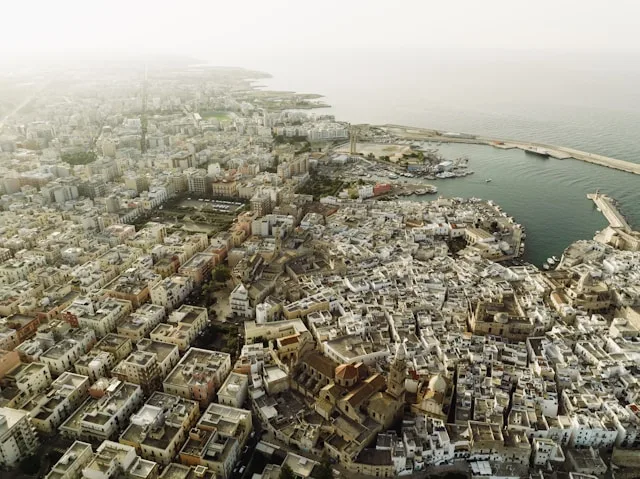
Monopoli's port sits 30 kilometres south of Bari on Puglia's Adriatic coast. It functions not as a competing freight gateway but as a satellite fishing and leisure-craft harbour subordinate to Bari's larger logistics hub. This distinction matters enormously for anyone trying to hire here.
The port's single commercial berth stretches 180 metres and runs at 86% capacity during peak fishing seasons from March through June and again from September through November. Maximum draft is 6.5 metres, which rules out Panamax container vessels entirely. Container traffic is negligible. Of the port's annual throughput, 72% is fishing products, 18% is yacht construction and marine maintenance materials, and the remaining 10% is general break-bulk cargo.
Three kilometres inland, the Zona Industriale Cozzana houses 43 light manufacturing firms employing approximately 850 workers. These firms specialise in precision metalworking, plastics processing, and food packaging machinery. The common assumption is that these workshops feed the port's supply chain. The reality, documented by Regione Puglia's territorial economic analysis, is that they predominantly serve the broader Puglian agricultural sector and construction industry. The backward linkages to port activity are weaker than the industrial zone's proximity would suggest.
This dual identity creates a specific hiring problem. Monopoli needs two distinct talent pools: maritime specialists for a port pivoting toward luxury yacht services, and industrial technicians for a manufacturing zone oriented toward agriculture. Neither pool is deep enough on its own, and the two rarely overlap.
Where the Investment Is Going and Why It Will Not Create the Jobs You Expect
Cold Chain and Digitalisation: The PNRR Allocation
The Italian government allocated €4.2 million in PNRR funding to Monopoli for port digitalisation and fish-market cold chain upgrades, according to the Ministero delle Infrastrutture e dei Trasporti. No deep-water dredging is planned. The 6.5-metre draft limitation stays. This means the investment modernises existing operations without expanding the port's functional capacity. Unioncamere Puglia's employment projections reflect this: a marginal 1.2% growth in port-linked logistics through 2026, concentrated in refrigerated transport, with traditional freight forwarding declining by 2% as Bari consolidates regional distribution.
The paradox is clear. National recovery money is flowing into a port whose physical and geographic constraints prevent the kind of volume growth that typically converts infrastructure spending into job creation. The digital improvements are necessary. They are not sufficient.
The Yacht Village: A Different Kind of Employer
The more consequential investment is private. The "Monopoli Yacht Village" project commits €12 million to a marina expansion adding 120 berths for superyachts in the 30 to 50 metre range. This shifts Monopoli's employment centre of gravity away from industrial logistics and toward high-end marine services: refit specialists, composite engineers, naval architects, and marina management professionals.
The skills these roles demand bear almost no resemblance to the skills currently abundant in Monopoli's labour market. A town whose workforce was built around fishing cooperatives and agricultural supply chain manufacturing is now being asked to produce professionals who can maintain carbon fibre hulls and integrated bridge systems on multimillion-euro vessels. The investment is moving faster than the human capital can follow.
This is the original analytical claim that sits beneath everything else in this article: Monopoli's capital investment is not solving a hiring problem. It is replacing one category of worker with another that does not yet exist locally in adequate numbers. The €16.2 million in combined public and private spending is creating demand for a workforce that must be recruited from outside the market, at compensation levels Monopoli's employers are not accustomed to paying, from candidates who are overwhelmingly passive and satisfied in their current roles elsewhere.
The Three Roles Monopoli Cannot Fill and Why They Stay Vacant
Maritime Maintenance Engineers
Roles combining marine mechanical systems expertise with fiberglass composite repair remain vacant for 110 to 135 days in Monopoli. The same roles fill in 75 days in Bari. The gap is not explained by compensation alone. Small shipyards such as Cantiere Navale Mimi require a specific hybrid: professionals who understand both traditional wooden vessel restoration and modern yacht systems. This combination of heritage craft skills and contemporary engineering is rare anywhere in Italy. In a town of 48,000 people, it is exceptionally rare.
Employers have responded with signing bonuses of €3,000 to €5,000, but these amounts are modest against the 25% to 35% salary premiums that La Spezia and Livorno can offer through the Fincantieri shipyard network. A qualified capotecnico considering Monopoli is weighing a signing bonus worth two months of incremental salary against a permanent compensation gap and a smaller career trajectory. The maths rarely favours the smaller market.
Cold Chain Logistics Coordinators
The Cooperativa Pescatori Monopoli processes 3,200 tons of fish annually and employs up to 140 workers at seasonal peak. Coordinating an HACCP-compliant cold chain from vessel to export requires professionals holding the Direttore Tecnico della Logistica certification. These roles typically remain open for 95 to 120 days. The challenge is compounded by seasonality: 40% of Monopoli's port-linked workforce operates on temporary contracts, compared with a 22% national average for logistics. A cold chain manager considering a move to Monopoli must accept not only lower compensation than Bari or Milan can offer, but also the operational reality of managing a workforce where nearly half the team turns over annually.
CNC Machinists with Marine Applications
In the Cozzana industrial zone, the contest for specialist manufacturing talent plays out at close range. Tecnoplast Monopoli and Officine Meccaniche Meridionali compete directly for CNC operators proficient in both precision agriculture components and marine fitting specifications. Average tenure for these specialists is 18 months. Wage inflation for qualified candidates runs at 12% to 15% annually, driven by mutual poaching between two firms separated by less than a kilometre.
This is not a labour market in any conventional sense. It is a closed loop where two employers trade the same small group of workers back and forth, each cycle ratcheting up the cost without expanding the pool. The result is that neither firm can plan production schedules with confidence beyond a single contract horizon.
Compensation Realities That Work Against Monopoli
The compensation data for Monopoli's port-linked cluster reveals a market that pays enough to retain generalists but not enough to attract the specialists its investment trajectory now demands.
A Cold Chain Operations Manager in Monopoli earns a base salary of €52,000 to €68,000, with total compensation reaching €74,000 to €82,000 including performance bonuses. A Logistics Director (Direttore Logistica e Trasporti) reaches €95,000 to €125,000, with top performers in integrated port logistics touching €140,000 with long-term incentives. These figures are competitive within southern Italy. They are not competitive against Milan, where VP-level supply chain roles command €120,000 to €160,000.
For marine engineering, Senior Naval Architects with 8 to 12 years of composite materials experience earn €48,000 to €62,000 in Monopoli. A Technical Director (Direttore Tecnico Cantiere) earns €85,000 to €115,000, with yacht-building experience commanding a 20% to 25% premium over commercial vessel backgrounds. These are the roles the Yacht Village expansion will generate in volume. Every one of them pays less than what the same professional would earn on the Tyrrhenian coast.
The cost-of-living differential between Monopoli and northern hubs partially offsets the salary gap. But cost-of-living arguments work best for candidates already considering relocation. For the 78% of qualified naval architects and marine composite specialists who are passively employed in the Adriatic yacht-building corridor, with average tenure of 6.2 years, the proposition must go beyond a spreadsheet comparison. They need a role that offers career progression, technical challenge, or lifestyle improvement compelling enough to justify leaving a stable position. Monopoli's employers must construct that proposition deliberately. Few currently do.
The Geographic Competitors Draining Monopoli's Talent Pipeline
Bari's Headquarters Effect
Bari sits 30 kilometres north and functions as Monopoli's most immediate competitor for every category of port-linked professional. The provincial capital offers compensation premiums of 15% to 20% for equivalent logistics roles, plus access to international shipping lines and global 3PL providers including DHL and Kuehne+Nagel, neither of which maintains operations in Monopoli. The Autorità di Sistema Portuale del Mare Adriatico Meridionale, which manages Monopoli's own infrastructure, is headquartered in Bari. This concentrates executive talent and career progression opportunities in the larger city.
For a mid-career logistics professional weighing a Monopoli offer, the Bari alternative provides a higher salary, larger employer brand, shorter commute to the A14 autostrada, and a headquarter proximity that makes promotion visible. The 12-minute drive from Bari's port to the motorway, against Monopoli's 35-minute diversion through the historic centre, is a daily operational irritant that compounds over time. Understanding this competitive context is essential for any senior hiring decision in this market.
Northern Migration and Croatian Competition
The talent drain extends well beyond Puglia. La Spezia and Livorno, on Italy's Tyrrhenian coast, offer naval architects salary premiums of 25% to 35% and entry into the Fincantieri network, which represents the clearest path to career advancement in Italian shipbuilding. A Monopoli-trained marine engineer who moves north gains access to a supply chain, a training ecosystem, and a peer network that does not exist in southern Italy.
Rijeka and Split in Croatia represent a newer competitive vector. According to Confindustria Nautica's labour market observatory, Croatian cities are targeting Italian-speaking yacht construction specialists with tax incentives under specialist visa schemes. Aggregate compensation remains 10% to 12% below Italian levels, but the tax advantages and lower cost of living narrow the effective gap. For a composite specialist earning €55,000 in Monopoli, a Croatian offer at the same nominal salary with a 15% effective tax reduction represents a meaningful financial improvement.
The combined effect of these competitive pressures is a talent pipeline that leaks at every career stage. Junior technicians leave for Bari's larger employers. Mid-career engineers leave for the Tyrrhenian coast. Experienced specialists are now being courted across national borders. Monopoli's employers must recruit against all three forces simultaneously.
The Structural Risks Compounding the Hiring Challenge
Monopoli's talent difficulties do not exist in isolation. They sit atop a set of economic and regulatory pressures that threaten to shrink demand and supply in parallel.
The EU Green Deal's implementation requires fishing vessels over 12 metres to comply with IMO Tier III emissions standards by 2026. Engine retrofits cost an estimated €45,000 to €80,000 per vessel. For Monopoli's fleet of 127 registered fishing vessels, dominated by small operators, these costs are likely to force consolidation. Fewer vessels mean lower processing volumes at cooperatives like Co.P.M., which in turn reduces the labour demand that justifies investment in cold chain infrastructure. The PNRR-funded upgrades arrive into a sector that may be contracting.
Meanwhile, rising Adriatic sea temperatures have reduced sardine and anchovy catches by 14% between 2019 and 2023, according to CNR-ISMAR's marine status report. A fish-processing cluster built on volume faces an existential question when the underlying resource is declining. This is not a cyclical fluctuation. The directional trend has been consistent for five consecutive years.
The infrastructure constraints compound these risks. The SS16 coastal highway remains a single-carriageway bottleneck through Monopoli's urban core. No heavy-vehicle bypass is planned before 2028. The Bari-Lecce rail line passes three kilometres inland with no port connection, preventing intermodal logistics development. Even if Monopoli could attract the freight volumes that would justify larger-scale logistics investment, it cannot move the goods efficiently enough to compete with Bari.
For hiring leaders, the implication is direct. Every senior appointment in Monopoli's port cluster carries a layer of strategic risk that does not apply in Bari or northern ports. The cost of a wrong executive hire is amplified in a market where replacement candidates are scarce, retention is fragile, and the underlying business model faces regulatory and environmental headwinds.
What Organisations Hiring in Monopoli Must Do Differently
The standard recruitment approach for Italian SMEs relies heavily on regional job boards, word of mouth within trade associations, and promotion from within. In Monopoli's port cluster, this approach reaches at most the 22% of qualified professionals who are actively seeking new roles. The other 78%, particularly in naval architecture, marine composite engineering, and certified port operations management, must be identified and approached directly.
This is not a market where posting a role on InfoJobs or relying on a local staffing agency will produce a shortlist of qualified candidates within a reasonable timeframe. A maritime maintenance engineer search that runs 110 to 135 days represents not just a recruitment delay but a production bottleneck for a shipyard with active refit contracts and seasonal deadlines.
The firms succeeding in this market share three characteristics. First, they construct a total proposition that addresses the specific calculation a passive candidate makes: compensation benchmarked against Bari and the Tyrrhenian coast, not against local norms. Housing support in a town where rental availability is thin. A role description that emphasises technical challenge and autonomy, which is often Monopoli's strongest differentiator against larger shipyards where specialisation narrows.
Second, they move fast. In a market where two metalworking firms poach the same CNC machinists on 18-month cycles, the employer who identifies, approaches, and makes an offer first wins. The one that runs a three-round interview process over six weeks loses.
Third, they look beyond the Adriatic corridor. Croatian-trained yacht specialists, returning Italian diaspora professionals from northern European shipyards, and career-changers from adjacent industrial and manufacturing sectors represent candidate pools that local employers rarely access. Reaching them requires systematic talent mapping and cross-border sourcing capabilities that most Monopoli SMEs do not possess internally.
KiTalent works with employers across southern European industrial markets to identify and deliver precisely this kind of specialist and leadership talent. Using AI-enhanced direct headhunting methodology, KiTalent reaches the passive candidate pools that conventional recruitment cannot access, delivering interview-ready candidates within 7 to 10 days. With a 96% one-year retention rate across 1,450 executive placements, the approach is built for markets where the margin for error is thin and the cost of a failed search is measured in lost contracts and production delays.
For organisations competing for maritime engineering, logistics leadership, or specialist manufacturing talent in Puglia's port-linked economy, where the candidates who can run your operations are already employed and not responding to job postings, speak with our executive search team about how KiTalent approaches this market differently.
Frequently Asked Questions
What are the hardest roles to fill in Monopoli's port-linked economy?
Maritime maintenance engineers combining marine mechanical systems and fiberglass composite repair skills are the most difficult to recruit, with vacancies lasting 110 to 135 days. Cold chain logistics coordinators holding Direttore Tecnico della Logistica certifications follow closely at 95 to 120 days. CNC machinists with dual proficiency in agricultural precision and marine fitting applications face 18-month average tenure due to competitive poaching within the Cozzana industrial zone. All three categories are dominated by passive candidates who require direct headhunting approaches rather than job board advertising.
How does Monopoli's compensation compare with Bari and northern Italian ports?
Bari offers 15% to 20% salary premiums for equivalent logistics roles, plus access to international employers absent in Monopoli. For naval architects and marine engineers, La Spezia and Livorno on the Tyrrhenian coast pay 25% to 35% more. Milan commands €120,000 to €160,000 for VP-level supply chain positions against Monopoli's ceiling of €125,000. The cost-of-living differential partially offsets these gaps, but for passive candidates weighing career progression and employer brand alongside compensation, Monopoli must construct a total proposition that goes well beyond base salary.
What impact will the Monopoli Yacht Village project have on local hiring?
The €12 million marina expansion adding 120 superyacht berths will shift employment demand toward high-end marine services: refit specialists, composite engineers, naval architects, and marina management professionals. These roles require skills that differ fundamentally from Monopoli's traditional fishing and light manufacturing workforce. The project will intensify competition for the same scarce yacht-building talent already contested by Tyrrhenian coast shipyards and increasingly by Croatian employers offering tax incentives to Italian-speaking specialists.
Why do infrastructure investments in Monopoli's port not translate into employment growth?
Despite €4.2 million in PNRR funding for digitalisation and cold chain upgrades, employment projections show only 1.2% growth through 2026. The port's systemic constraints explain this: a maximum 6.5-metre draft that prevents container operations, a single commercial berth at 86% peak capacity, no rail connection, and a 35-minute road diversion to the nearest motorway. These limitations cap freight volume regardless of how efficiently the port's digital systems operate. KiTalent's market benchmarking capabilities help employers in constrained markets understand exactly what it takes to attract talent despite these disadvantages.
How can Monopoli employers attract passive maritime engineering talent?
Approximately 78% of qualified naval architects and marine composite specialists in the Adriatic yacht-building corridor are passively employed with average tenure of 6.2 years. Reaching them requires three things: compensation packages benchmarked against Tyrrhenian coast and Croatian competitors rather than local norms, role propositions emphasising technical autonomy and project variety that larger shipyards cannot match, and a search methodology built around direct identification of passive candidates rather than advertising and inbound applications.
What regulatory risks affect hiring decisions in Monopoli's port sector?
The EU Green Deal requires fishing vessels over 12 metres to meet IMO Tier III emissions standards by 2026, with retrofit costs of €45,000 to €80,000 per vessel. This will likely force consolidation among small operators, reducing processing volumes at local cooperatives. Simultaneously, Adriatic sardine and anchovy catches have declined 14% since 2019. Hiring leaders must weigh these headwinds when deciding whether to invest in permanent senior hires or consider interim management solutions that provide leadership flexibility during a period of structural uncertainty.