Siroki Brijeg Construction: The Diaspora Money That Built a Market Its Own Workforce Left Behind
Siroki Brijeg's construction sector entered 2026 with full order books and empty site offices. Remittance inflows from Germany, Austria, and Switzerland continue to fund residential development at record levels across West Herzegovina Canton. Yet the workers and managers needed to deliver those projects are increasingly absent, drawn to the same countries that send the money home. The result is a market where capital and labour move in opposite directions, and the gap between demand and delivery capacity widens with every construction season.
This is not a conventional talent shortage driven by economic growth outpacing training. It is a structural inversion. The same emigration that generates construction capital is depleting the construction workforce. A municipality that once had more masons, welders, and site managers than it needed now operates at near-full capacity during peak season, constrained not by contracts but by the number of qualified people available to work them. Project managers command 127-day vacancy durations. Certified welders leave for Croatian shipyards paying three times the local rate. Prefabrication equipment sits idle because no one in the municipality can programme it.
What follows is an analysis of the forces reshaping Siroki Brijeg's construction sector, the specific roles and skills that are hardest to source, and what organisations competing for leadership talent in this market need to understand before their next search. The dynamics here are not unique to one municipality. They represent a pattern emerging across diaspora-funded construction markets throughout the Western Balkans, and the hiring strategies that fail here will fail across the region.
Where the Money Comes From and Where the Workers Go
The Central Bank of Bosnia and Herzegovina recorded remittance inflows equivalent to 15.1% of national GDP in 2023, and West Herzegovina Canton received a disproportionate share of that total. Historic emigration patterns concentrated in Germany, Austria, and Switzerland mean that Siroki Brijeg's diaspora communities are large, established, and economically active. As of the most recent household data, 60% of Siroki Brijeg households receive regular transfers from abroad.
That capital flows directly into residential construction. Residential building permits accounted for 78% of total construction permits issued in the municipality in the last year for which disaggregated data is available. Single-family dwelling construction comprises 65% of private sector activity. Average construction cost per square metre ranges from €650 to €850 for standard masonry builds, compared to €900 to €1,100 in Sarajevo. The cost differential makes Siroki Brijeg an attractive build location for diaspora families investing in homes they occupy seasonally or intend for retirement.
The Emigration Feedback Loop
The paradox at the centre of this market is precise and measurable. While remittance inflows to West Herzegovina reached €340 million in 2023, the emigration of working-age populations to those same diaspora destinations reduced local construction labour supply by an estimated 12% since 2019. The money arrives. The people leave. Construction demand rises while the workforce shrinks.
This is the analytical claim that defines Siroki Brijeg's construction economy in 2026: the sector's primary source of capital and its primary source of talent depletion are the same phenomenon. Emigration simultaneously creates the demand for construction and destroys the capacity to deliver it. No amount of conventional recruitment activity can resolve a constraint that is demographic and structural rather than transactional. The firms that understand this are adapting their workforce strategies. The firms that do not are losing peak seasons to unfilled positions.
Thirty percent of Siroki Brijeg's construction workers hold Croatian passports or work permits, enabling frictionless mobility into the EU labour market. For a certified welder earning €700 to €900 net monthly in Siroki Brijeg, the calculation is straightforward when Croatian shipyards offer €1,800 to €2,200 for the same certification. The hidden 80% of qualified candidates in this market are not hidden in the conventional sense. They are visible, employed, and located in another country.
The Roles That Cannot Be Filled From Job Postings
Siroki Brijeg's talent shortages are not distributed evenly across the construction workforce. General labourers remain available, with 12% unemployment in the unskilled construction category. The crisis concentrates in three specific role categories where experience, certification, and language requirements create bottlenecks that no volume recruitment approach can address.
Construction Project Managers
The ZHK Employment Service registered 47 unfilled vacancies for site managers in Q3 2024. Average vacancy duration reached 127 days, compared to 34 days for general labourers. The gap between those two figures tells the story of a bifurcated labour market.
The qualified project manager in this market requires a combination of attributes that is genuinely rare: ten or more years of construction experience, bilingual German and Bosnian capability for diaspora client management, and familiarity with EU-funded project protocols. An estimated 80 to 85% of candidates in the 8 to 15 year experience bracket are employed and not actively seeking roles. The unemployment rate among certified civil engineers with more than five years of experience stands at just 4.2%, effectively representing full employment.
Local firms report a typical pattern of offering salary premiums of 20 to 25% to attract project managers from Mostar-based companies. This poaching dynamic raises costs across the market without increasing the total supply of qualified managers. The talent pool is not growing. It is merely being redistributed at higher prices.
CNC Stone Processing Operators
Siroki Brijeg's tufa quarries and stone processing workshops supply cladding material throughout the Balkans, with 15 active extraction sites operating in the municipality. The sector has invested in CNC cutting automation for precision stone work. The machines arrived. The operators did not.
Local workshops report equipment standing idle due to operator shortages, according to the Association of Stone Processors Herzegovina. The region's stone processing automation has outpaced vocational training supply so completely that employers now offer six to nine month on-the-job training programmes to mechanics transitioning from the automotive sector. This is not recruitment. It is manufacturing a workforce from adjacent skills because the correct workforce does not exist locally.
A CNC stone processing team lead commands €900 to €1,300 net monthly, with a 30% premium over standard metal CNC operators due to the specialist G-code programming skills required for stone. The premium reflects scarcity, not complexity. The skill is learnable. The people available to learn it are leaving for higher-paying markets before they complete their training.
Certified Welders
The numbers are stark. ZHK had 89 registered welding vacancies against only 34 certified active job seekers in 2024. The ratio of open positions to available candidates is worse than 2.5 to 1, and the retention dynamics make even that figure optimistic. Certified welders who accept local positions frequently depart within months for Croatian shipyards or German manufacturing plants where the compensation differential is too large for local employers to match.
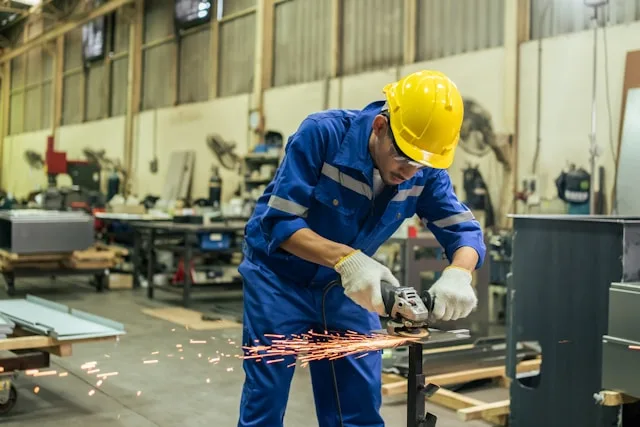
The welding shortage matters for Siroki Brijeg's prefabrication ambitions specifically. Light metal prefabrication workshops cannot scale without certified welders. The workshops exist. The equipment exists. The orders exist. The constraint is entirely human.
A Materials Cluster Without Enough People to Run It
The municipality anchors a localised building materials cluster that extends beyond individual construction firms. Three stationary concrete batching plants operate at capacities of 60 to 120 cubic metres per hour. Stone processing supports both local construction and regional export. Two workshops produce prefabricated reinforced concrete elements including hollow-core slabs and beams.
However, those prefabrication workshops operate at just 60% capacity. The causes are dual: irregular electricity supply averaging 4.2 hours of outage per month in ZHK industrial zones, and high steel reinforcement costs that fluctuated by 20% annually between 2021 and 2023. The energy constraint is particularly damaging for any manufacturing process that requires consistent three-phase power, which prefabrication inherently does.
The municipality hosts approximately 120 active construction-related business entities employing an estimated 1,800 to 2,200 persons directly. The anchor employer, ŽGP Siroki Brijeg d.d., employs 280 to 320 people and generates estimated annual revenue of €25 to €30 million across residential construction, civil engineering, and stone façade installation. Kamenolom Siroki Brijeg, the municipal quarry operator, employs 85 to 100 workers. SB Gradnja, a mid-tier residential specialist, employs 60 to 80, focusing specifically on diaspora-funded housing.
These firms operate within a regional corridor alongside Mostar and Capljina, characterised by cross-border labour mobility with Croatia and stone trade integration with Split-Dalmatia County. The corridor dynamic means that talent competition is not contained within the municipality. A construction professional in Siroki Brijeg is competing in a labour market that extends from Mostar to Split, and the compensation gradient runs in one direction: away from Bosnia.
Why Prefabrication Has Not Solved the Timeline Problem
Diaspora investors typically allow six to nine month build windows, timed to summer visits when they can supervise progress. Traditional masonry construction strains against these timelines, particularly given the seasonal contraction that reduces FBiH construction output by 40 to 45% in Q1 compared to Q3 peaks.
Prefabrication should be the answer. Modular and prefabricated construction methods can reduce build times by 40%, fitting neatly within diaspora scheduling constraints. Industry projections suggest 15 to 20% growth in light prefabrication methods including timber frame and SIP panels by 2026.
Yet the market has not adopted these methods at scale. The reasons form a second tension in the data that is as important as the emigration paradox. Municipal building inspection regimes and client preferences remain optimised for traditional masonry construction. Seismic risk perceptions in Herzegovina's Zone 3 classification favour heavy concrete and masonry. Established supplier relationships reinforce existing methods. Heavy concrete prefabrication faces prohibitive transport costs from manufacturing facilities in Mostar or Split.
The result is a market failure in technology adoption rather than a lack of technical capability. Prefabrication workshops exist but operate under capacity. Traditional masonry contractors face severe skilled labour shortages. The economic logic points one way. Cultural inertia and regulatory design point another. The organisations that could bridge this gap require a specific type of leader: someone who understands both civil engineering and manufacturing logistics, who can manage the regulatory process for non-traditional building methods, and who has the credibility with diaspora clients to shift preferences. That profile describes the emerging Prefabrication Operations Manager role, currently filled by expatriate managers or Croatian consultants because the domestic talent pool has not yet produced enough candidates with the hybrid skill set required.
The Regulatory and Financial Constraints That Compound Every Hire
Even when Siroki Brijeg's construction firms identify the right candidate, the operating environment creates friction that slows every process and raises every cost.
Permitting Complexity
Construction permitting in the Federation of BiH requires 22 separate administrative steps across entity, cantonal, and municipal levels. The average timeline is 168 days, exceeding EU averages by 90 days. No single-window system exists. Each approval is sequential rather than parallel. This permitting burden does not merely slow construction. It concentrates demand for professionals who understand how to manage the process, making FIDIC contract management and EU procurement experience among the scarcest and most valuable skills in the local market.
Local firms' ability to bid independently on European Investment Bank and World Bank tenders is directly limited by the shortage of professionals with FIDIC expertise. ZHK municipalities awarded €42.3 million in civil engineering contracts in 2023, with Siroki Brijeg-based firms capturing approximately 35% of local contract value. The remaining 65% went to firms from outside the municipality, many of whom brought their own project management teams because local capacity was insufficient.
Financial Access
The banking sector's non-performing loan ratio for construction stood at 8.4% in Q3 2023, prompting restrictive lending criteria that effectively exclude most construction SMEs from term financing. Fifty-eight percent of construction SMEs report credit applications rejected or incompletely fulfilled due to insufficient collateral. Working capital financing relies on trade credit from material suppliers on 30 to 60 day terms, or on informal rotating savings arrangements with diaspora investors.
This financing constraint shapes the talent market directly. Firms that cannot access bank lending cannot invest in training programmes, cannot offer competitive retention packages, and cannot stockpile materials during price troughs. The seasonal cashflow pattern, with 70% of annual revenue concentrated in Q2 and Q3, means that the cost of a bad hire is not just the replacement cost. It is the lost revenue from a peak season that cannot be recovered.
Workforce Ageing
Thirty-eight percent of skilled masons and concrete specialists in Siroki Brijeg are over 55 years old. Vocational school enrolment in construction trades has declined 15% since 2018. The replacement pipeline is not merely inadequate. It is contracting. The combination of an ageing domestic workforce and declining training intake means that the skilled trades shortage will worsen before it improves, regardless of any change in demand conditions.
Meanwhile, land registry delays affect 30% of Siroki Brijeg construction land, where unclear title due to wartime displacement and inheritance disputes blocks project financing entirely. Labour code rigidities make seasonal hiring on flexible contracts difficult, increasing off-season employment costs for firms whose revenue is concentrated in six months of the year.
What the Compensation Data Reveals About This Market
The compensation structure in Siroki Brijeg's construction sector reflects a market segmented by skill and mobility rather than by seniority alone.
A senior construction project manager earns €1,200 to €1,800 net monthly, carrying a 15 to 20% premium above the FBiH construction average driven by bilingual German-speaking requirements. A Director of Construction or VP Operations earns €2,500 to €4,000 net monthly, representing the top 5% of construction earnings in the municipality. These executive roles are often filled by returning diaspora professionals or retained through profit-sharing arrangements in family-owned firms.
The gap between local compensation and Croatian or German alternatives remains the defining feature of this market. A welder in Siroki Brijeg earns €700 to €900. The same welder in Split earns €1,800 to €2,200. An engineer in Siroki Brijeg earns less than a comparable role in Mostar, which itself pays 50 to 60% less than a comparable role in Zagreb. Each step up the geographic hierarchy offers a material salary improvement with minimal barriers to mobility.
Only 35% of graduates from Mostar University's Faculty of Civil Engineering, the primary talent pipeline for Siroki Brijeg, remain in the Canton after graduation. The other 65% move to Sarajevo, Zagreb, or directly into EU labour markets. The firms competing for the remaining 35% are competing against the entire European construction labour market, and they are doing so with compensation packages that represent a fraction of what those graduates could earn elsewhere.
New FBiH building codes effective in 2025 mandating improved thermal insulation have shifted demand toward specialised envelope contractors. This capability barely exists in the current local market. The 2026 net employment growth projection of 150 to 200 positions is insufficient to meet demand, with vacancy rates for skilled trades exceeding 12%.
Hiring in Siroki Brijeg: What Needs to Change
The conventional approach to executive recruitment fails in this market for reasons that are specific and identifiable. Job postings reach active candidates. In Siroki Brijeg's construction sector, the roles that matter most are filled by people who are not looking: project managers embedded in Austrian firms, CNC operators working in German manufacturing, returning diaspora professionals who have not yet decided to come home.
BIM proficiency is required by 40% of large diaspora-funded projects, yet only three to four individuals in the municipality possess intermediate Revit or ArchiCAD skills. Seismic-resistant design capability is mandated by Herzegovina's Zone 3 classification but in chronic undersupply. German language proficiency at B2 level or above is specified in 60% of project manager job postings. These are not preferences. They are requirements that eliminate most of the visible candidate market before a search begins.
The commercial director role in a Siroki Brijeg construction firm now requires financial modelling skills for complex cross-border payment structures in EUR, CHF, and BAM. The technical director role requires familiarity with 2025 energy efficiency regulations and seismic codes alongside 15 or more years of experience and EU project exposure. These are not roles that can be filled through a job board in Mostar.
For organisations operating in Siroki Brijeg's construction market, where the talent pipeline runs through diaspora networks rather than domestic job markets and the cost of an unfilled peak-season role is measured in lost annual revenue, KiTalent's direct headhunting methodology reaches the passive candidates that conventional searches miss. With interview-ready candidates delivered within 7 to 10 days and a 96% one-year retention rate for placed candidates, start a conversation with our executive search team about how to approach this market before the next construction season begins.
Frequently Asked Questions
What are the hardest construction roles to fill in Siroki Brijeg?
Construction project managers with bilingual German and Bosnian capability are the most difficult roles to fill, with average vacancy durations of 127 days in West Herzegovina Canton. CNC stone processing operators and certified welders are also acutely scarce, with welding vacancies outnumbering certified active job seekers by more than 2.5 to 1. These shortages are driven by emigration to EU labour markets and declining vocational training enrolment rather than by cyclical demand fluctuations.
Why is diaspora investment driving construction demand in Bosnia?
Remittances to Bosnia and Herzegovina equalled 15.1% of national GDP in 2023, with West Herzegovina Canton receiving a disproportionate share from communities in Germany, Austria, and Switzerland. Sixty percent of Siroki Brijeg households receive regular transfers. Lower construction costs per square metre compared to Sarajevo make the municipality attractive for residential investment. The challenge is that the same emigration creating this capital depletes the local workforce needed to deliver projects.
What do construction executives earn in Siroki Brijeg?
A senior construction project manager earns €1,200 to €1,800 net monthly. A Director of Construction or VP Operations earns €2,500 to €4,000 net monthly plus performance bonuses. CNC stone processing team leads earn €900 to €1,300. These figures carry premiums of 15 to 30% above FBiH averages for specialist skills, though they remain substantially below Croatian and German equivalents for comparable roles. Detailed compensation benchmarking for construction leadership roles can inform offer strategy.
How does Bosnia's regulatory environment affect construction hiring?
Construction permitting in the Federation of BiH requires 22 administrative steps across municipal, cantonal, and entity levels, averaging 168 days. This complexity concentrates demand for professionals with FIDIC contract management and EU procurement experience. Land registry delays affect 30% of construction land in Siroki Brijeg. Labour code rigidities make seasonal hiring difficult. These regulatory factors make experienced project managers and commercial directors especially valuable and correspondingly difficult to recruit.
How can companies find passive construction talent in West Herzegovina?
With 80 to 85% of qualified construction project managers in passive employment and many residing in EU countries, conventional job postings reach a fraction of the viable candidate pool. Effective executive search in industrial and manufacturing sectors requires direct identification of candidates through diaspora networks, professional associations, and AI-powered talent mapping. KiTalent's pay-per-interview model delivers interview-ready candidates within 7 to 10 days, reaching the professionals who do not respond to advertisements.
Is prefabrication growing in Bosnia's construction sector?
Light prefabrication methods including timber frame and SIP panels are projected to grow 15 to 20% by 2026, driven by diaspora investors' compressed build timelines. However, heavy concrete prefabrication remains limited by transport costs and unreliable electricity supply. Cultural preference for traditional masonry and building inspection regimes optimised for conventional methods slow adoption. The emerging Prefabrication Operations Manager role requires hybrid civil engineering and manufacturing logistics skills that are currently sourced from expatriate managers or Croatian consultants.