Trebinje Construction Talent: The Diaspora Capital Pouring In and the Workforce Walking Out
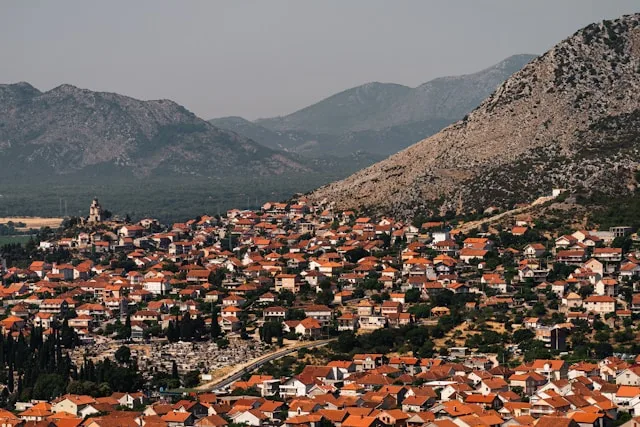
The money arrives from Munich, Vienna, and Zurich. It funds villa projects, aparthotels, and stone-clad residential developments in a small city on Bosnia and Herzegovina's southern border. Trebinje municipality issued 147 building permits for residential construction in the first three quarters of 2024, a 23% year-on-year increase. Sixty-eight per cent of those permits were registered to owners holding foreign residency status, predominantly in Germany, Austria, and Switzerland.
The workers leave for Munich, Vienna, and Zurich. Trebinje's working-age population declined 18% between 2013 and 2023. German construction firms actively recruit in the municipality through bilateral Western Balkans labour mobility partnerships, offering certified masons and welders net wages of €2,500 to €3,500 per month. That is triple what the same workers earn at home. The capital and the labour are flowing in opposite directions along the same corridor, and the result is a construction market where demand is accelerating and the ability to meet it is collapsing.
What follows is an analysis of how this paradox operates in practice, where the talent gaps are most severe, how the stone processing cluster is being squeezed between resource abundance and value-chain truncation, and what organisations hiring in Trebinje's industrial and manufacturing sector need to understand before they commit to a search in this market.
The Diaspora Funding Loop That Creates Its Own Labour Crisis
Trebinje's construction boom is not driven by domestic economic expansion or public infrastructure spending. It is driven by a very specific capital source: wealth accumulated by Bosnian-Herzegovinian emigrants in Western European construction and manufacturing industries, recycled back into property development in their home municipality. This creates a dependency that most market participants understand intuitively but rarely quantify.
According to the Republika Srpska Institute of Statistics, the overwhelming majority of new residential permits in Trebinje are linked to foreign-resident owners. These projects are diaspora housing: retirement villas, family compounds, and small-scale tourism accommodations designed to generate rental income from the Dubrovnik tourist corridor, located just 30 kilometres to the south.
The structural problem is that the same migration pattern that generated this capital is simultaneously emptying the local labour pool. According to the German Federal Employment Agency, bilateral recruitment from the Western Balkans has intensified since 2022. A certified welder in Trebinje earns roughly €800 to €1,100 per month. The same qualification commands €2,500 to €3,500 in Germany. The arithmetic is not subtle, and it is not reversible through modest local wage adjustments.
This is the original synthesis this article is built around: the source of Trebinje's construction demand and the source of its labour crisis are not merely correlated. They are the same economic force operating in two directions simultaneously. Diaspora wealth funds the projects. Diaspora labour markets drain the workers who would build them. Every villa permit filed from a Munich address makes the local hiring problem fractionally worse, because the economic gravity that generated the capital continues to pull skilled workers toward the same destination. Capital moves faster than human capital can be replaced, and in a municipality of Trebinje's size, the replacement pipeline is measured in years, not quarters.
Inside Trebinje's Stone Processing Cluster: Resource Wealth Without Value-Chain Depth
Trebinje anchors what the regional industry calls the "Herzegovina Stone" processing cluster. The geological formations in and around the municipality yield limestone and marble from active quarries in Zupci, Gomiljani, and Aranđelovo. Granit d.o.o. Trebinje operates the primary stone beneficiation facility, employing approximately 45 to 55 workers in quarrying and primary processing.
The sector appears well positioned on paper. Local raw material supply, growing construction demand, and proximity to the Dubrovnik renovation market should create conditions for value-chain deepening. In practice, the opposite is occurring.
Low Value Capture Despite Resource Proximity
While quarrying remains locally anchored, high-precision stone fabrication is frequently outsourced. Finish-cutting and architectural carving for complex façade systems are exported to processing centres in Croatia and Italy. According to the Federation of Bosnia and Herzegovina Chamber of Commerce Stone Sector Report, this pattern reflects limited local CNC capacity rather than a lack of raw material quality.
The result is that Trebinje captures the lowest-margin segment of its own value chain. Quarry operators extract stone. Primary processors cut it into slabs and basic shapes. But the architectural products that command premium pricing in the Dubrovnik and Italian markets are finished elsewhere. Raw material proximity has not conferred the competitive advantage that standard resource-economics models would predict.
The Technology Inflection Point
This truncation is about to become more costly. EU Green Deal construction standards, which embed carbon footprint requirements for building materials, are expected to penetrate the Croatian market fully by late 2025. For Trebinje suppliers selling into Dubrovnik, this creates immediate compliance pressure. Firms lacking ISO 14001 environmental certification or digital stone layout capabilities risk exclusion from cross-border value chains entirely.
Investment in bridge-cutting automation and 5-axis CNC capacity is anticipated but constrained. According to the Central Bank of Bosnia and Herzegovina's RS Entity Banking Sector Report, local banks offer lending at 5.5% to 7.5% interest with 30% collateral requirements. A single CNC stone processing machine requires €150,000 to €300,000 in capital investment. For an SME employing 45 to 55 workers, the financing gap is not trivial.
The technology gap creates a secondary talent problem. Even where firms can finance CNC equipment, they cannot find operators to run it. This connects directly to the market's most acute hiring shortage.
Three Roles Where the Talent Pipeline Has Collapsed
Trebinje's labour market is bifurcated. Unskilled construction labourers operate in an active candidate market with vacancy fill times of three to four weeks. Junior administrative staff are in surplus. But in three specific categories, the pipeline has not merely thinned. It has ceased to function.
CNC Stone Processing Operators
The vacancy duration for CNC stone operator roles in the Herzegovina region averaged 14 months in 2024, according to the Federation of Bosnia and Herzegovina Employment Service. The number is striking on its own. In context, it is more so: 85% of qualified CNC stone operators in the region are employed and not actively seeking new roles, with average tenure exceeding four years, according to the Sarajevo Economic Institute. These operators are passive candidates in the deepest sense. Their skills are highly specific, their current employers have invested heavily in their training, and the local market offers no obvious reason to move.
No secondary vocational school in Trebinje municipality offers stone processing curricula. The nearest relevant institution is the Školski centar in Mostar, 60 kilometres away. Firms that manage to identify candidates often recruit from vocational schools in Foča or Banja Luka and provide three months of paid upskilling before the hire becomes productive. The total cost-to-competence for a single CNC stone operator, including recruitment, relocation support, and training, can approach six months of salary.
For organisations unfamiliar with how direct headhunting reaches candidates who are not visible on job boards, this market provides a case study in why conventional recruitment methods fail when the passive-to-active ratio reaches 85:15.
Licensed Construction Supervisors With German Language Skills
The Republika Srpska Employment Service lists "Odgovorni izvođač" (Responsible Constructor) licence holders with German language proficiency on its occupation shortage list. The market state is zero unemployment. Every qualified individual holding both the licence and the language skill is employed.
The demand is structural. EU-standard building codes require certified supervision for structures exceeding 400 square metres. Diaspora clients funding projects from Germany and Austria require German-language site management as a condition of engagement. A typical mid-sized Trebinje construction firm seeking this profile encounters vacancy durations exceeding 11 months. When candidates are identified, they are typically employed in Mostar or Dubrovnik, requiring 30% to 40% wage premiums to relocate.
Dubrovnik is the primary competitor. Croatian construction firms offer Euro-denominated wages averaging 60% to 80% higher than Trebinje for identical roles. Daily cross-border commuting or weekly rotational work arrangements make the Croatian market accessible without full relocation. A bilingual construction supervisor in Trebinje earns approximately €2,500 per month. The same role in Dubrovnik commands €3,800 to €4,200. In Munich, it commands €4,800 to €5,500.
Certified Welders to EN 1090 Standard
Metal fabrication workshops in Trebinje's industrial zone require CE-marked structural steel output for export to Croatia. This requires welders certified to EN 1090 standard in TIG and MIG processes. The active candidate pool represents 20% of demand. The remaining 80% of qualified welders are passive candidates employed in Slovenia or Croatia, according to the Sarajevo Economic Institute's Skills Mismatch Analysis.
The mismatch is not temporary. It reflects a systemic pattern where EU-standard certification, once obtained, makes the holder immediately mobile into EU labour markets that pay multiples of local rates. Certification is an exit ticket, not a retention tool. Every welder a Trebinje workshop trains to EN 1090 standard becomes a recruitment target for Croatian and Slovenian employers offering Schengen mobility access and Euro wages.
The Compensation Trap: Why Trebinje Cannot Close the Gap
Trebinje's executive and specialist compensation sits at the bottom of a three-tier regional hierarchy, and the gaps are widening rather than narrowing.
A Senior Construction Project Manager with 10 or more years of experience and EU project credentials earns €2,200 to €3,100 monthly net in Trebinje. A Production Manager in stone processing earns €1,800 to €2,500, with a scarcity premium of 15% to 20% for CNC programming capability. At the executive level, a Managing Director of a construction SME with 50 or more employees earns €4,000 to €6,500, according to Deloitte BiH's Executive Compensation Report for 2024.
These figures track 15% to 20% below Banja Luka and 35% to 40% below Sarajevo for equivalent roles. The cost of living differential between Trebinje and these cities exists but is insufficient to offset the wage gap. Against Dubrovnik's 60% premium for skilled trades, local compensation is not competitive at any point on the experience curve.
The problem deepens at the bilingual specialist level. Wage premiums for Serbian/German project managers reach 40% above Republika Srpska averages. This premium reflects genuine scarcity, but it still does not match the absolute wage levels available across the Croatian border or in German-speaking markets. A firm in Trebinje paying a 40% premium above the local average is still paying less than half what the same candidate could earn in Munich.
This is the arithmetic that drives the counteroffer dynamics in this market. When a firm finally identifies and approaches a bilingual construction supervisor after an 11-month search, the candidate's current employer can often retain them simply by matching a modest portion of the Trebinje offer. The external opportunity that truly moves these candidates is not a lateral offer from another Trebinje firm. It is a call from Dubrovnik or Germany.
For organisations benchmarking compensation in this market, the critical insight is that Trebinje salaries must be evaluated against the cross-border alternatives available to every qualified candidate, not against local or national averages.
Structural Constraints That No Single Employer Can Solve
Three systemic barriers shape the talent market in ways that individual firms cannot overcome through better recruitment practices or higher salaries alone.
The Vocational Training Void
There is no dedicated vocational training facility for stone processing in Trebinje municipality. The nearest institution offering relevant curricula is 60 kilometres away in Mostar. For advanced construction trades, the picture is similar. This means the local talent pipeline produces almost no new entrants in the categories where shortages are most acute.
Trebinje Economic Development Agency (TREDA) coordinates vocational training linkages, but coordination is not the same as capacity. A firm that needs a CNC stone operator today must recruit from Foča, Banja Luka, or Mostar and invest in three months of paid upskilling. A firm that needs one next year faces the same situation. The pipeline will not improve without institutional investment that operates on a five-to-ten-year horizon.
Transport Infrastructure Isolation
Trebinje sits 35 kilometres from Pan-European Corridor Vc. According to the BiH Transport Community Secretariat's Infrastructure Gap Analysis, this isolation increases logistics costs by 12% to 15% compared to Mostar-based competitors. For heavy materials like processed stone, this margin is the difference between export competitiveness and irrelevance in markets beyond the immediate 50-kilometre catchment radius.
The transport constraint also affects talent. Dubrovnik is accessible for daily commuting. Mostar is not. A candidate choosing between a Trebinje employer and a Mostar employer faces a genuine mobility barrier that salary adjustments alone cannot fully offset. The same isolation that limits stone exports limits the effective recruiting radius.
Demographic Contraction on a Municipal Scale
An 18% decline in working-age population over a single decade is not a trend that reverses quickly. Trebinje's demographic trajectory is compounding every other constraint. The vocational training gap matters more when each cohort is smaller than the last. The emigration pressure matters more when the total pool from which emigrants are drawn is shrinking. Active construction employment is projected to decline 8% by the fourth quarter of 2026 even as output value increases, because fewer workers will be producing more per person through productivity gains rather than headcount growth.
Women constitute less than 4% of sectoral employment, concentrated in administrative roles. This represents both a demographic waste and a strategic blind spot. The sector has not materially attempted to recruit from the other half of the working-age population, even as the male labour pool contracts year after year.
What 2026 Looks Like: Shifting Demand, Deepening Gaps
The current wave of diaspora-funded villa projects is approaching completion. Residential permits are projected to decline 12% to 15% in 2026. This does not mean the labour market relaxes. It means the demand profile shifts.
Municipal infrastructure investment, financed through Republika Srpska Infrastructure Ministry allocations for water treatment upgrades and road rehabilitation, will partially offset the residential decline. These are public procurement projects with different skill requirements: quantity surveyors licensed for public procurement, civil engineers with infrastructure experience, and project managers capable of navigating the entity-level regulatory environment.
The stone processing sector faces a more consequential shift. EU Green Deal compliance pressure will force a technology adoption decision on every firm selling into Croatia. Those that invest in CNC automation, digital stone layout capability, and ISO 14001 certification will retain access to the Dubrovnik market. Those that do not will be confined to the domestic memorial monument and basic construction stone segments, which offer lower margins and no growth trajectory.
Both shifts intensify the talent problem. Infrastructure projects require licensed professionals who are already at zero unemployment. Technology adoption requires CNC operators who take 14 months to recruit. The demand is changing, but the supply constraints remain identical.
For organisations whose hiring strategy in this market relies on job board postings through the Trebinje Employment Bureau, the data is unambiguous. CNC operator roles advertised through the Bureau receive zero qualified applicants for six or more months. Licensed construction supervisors are not on any job board. The 9:1 passive-to-active ratio among licensed supervisors means that nine out of every ten potential candidates must be found through direct identification and approach, not through any mechanism that depends on the candidate applying.
Where Direct Search Is the Only Method That Works
In most labour markets, direct executive search is a premium service for senior and hard-to-fill roles. In Trebinje's construction and stone processing cluster, it is closer to the only viable method for any role above unskilled labourer.
The passive candidate ratios tell the story. CNC stone operators: 85% passive. Licensed construction supervisors: 90% passive. Bilingual project managers: near-universal passive status. Certified EN 1090 welders: 80% passive and employed outside Bosnia and Herzegovina entirely.
A C-level or senior specialist search in this market is not a matter of advertising a role and waiting for responses. It is a matter of identifying the 15 to 20 individuals in the Herzegovina region who hold the required certification, determining which of them might consider a move given the right proposition, and presenting an opportunity that competes not just with their current employer but with standing offers from Dubrovnik, Ljubljana, and Munich.
KiTalent's approach to markets like Trebinje combines AI-powered talent mapping with direct headhunting methodology. In a municipality where the total qualified candidate pool for a given specialisation may number in the dozens rather than hundreds, comprehensive talent mapping is not a luxury. It is a prerequisite. The firm delivers interview-ready candidates within 7 to 10 days and operates a pay-per-interview model that eliminates the upfront retainer risk that Trebinje's SMEs, already constrained by limited credit access, cannot afford to absorb.
The 96% one-year retention rate for placed candidates matters disproportionately in a market where replacement cost is measured in 11-to-14-month vacancy durations rather than weeks. A failed placement in Trebinje is not an inconvenience. It is a project delay that compounds through every subsequent phase of construction.
For organisations competing for certified construction supervisors, CNC stone operators, or bilingual project managers in a market where the best candidates are not looking and the second-best candidates are already in Dubrovnik, speak with our executive search team about how direct search reaches the candidates this market's job boards cannot.
Frequently Asked Questions
What are the hardest construction roles to fill in Trebinje in 2026?
Three categories face the most severe shortages. Licensed construction supervisors holding the "Odgovorni izvođač" certification with German language proficiency are at zero unemployment. CNC stone processing operators have a 14-month average vacancy duration across the Herzegovina region. Certified welders to EN 1090 standard are 80% passive, with most qualified candidates employed in Slovenia or Croatia. Conventional recruitment methods consistently fail for these roles because the candidates are not actively seeking positions.
Why is Trebinje losing skilled construction workers to Croatia and Germany?
Dubrovnik offers Euro-denominated wages 60% to 80% higher than Trebinje for identical construction roles. German employers offer triple local rates through bilateral Western Balkans recruitment agreements. Schengen mobility access and EU labour protections create additional pull factors. Trebinje's cost of living advantage is real but insufficient to offset wage gaps of this magnitude. Every construction worker who obtains EU-standard certification becomes immediately mobile into higher-paying markets.
What does a construction project manager earn in Trebinje compared to regional competitors?
A Senior Construction Project Manager with 10 or more years of experience earns €2,200 to €3,100 monthly net in Trebinje. The same role commands €3,800 to €4,200 in Dubrovnik and €4,800 to €5,500 in Munich. At the executive level, a Managing Director of a construction SME earns €4,000 to €6,500 in Trebinje. Bilingual Serbian/German project managers command a 40% wage premium above Republika Srpska averages, but this premium still falls short of cross-border alternatives.
How does the diaspora investment cycle affect Trebinje's construction labour market?
Diaspora capital from Germany and Austria funds approximately 68% of Trebinje's residential construction permits. Simultaneously, the same countries recruit Trebinje's skilled construction workers through bilateral labour agreements. This creates a paradox: the source of construction demand and the source of labour supply depletion are the same economic force. A German recession directly threatens both sides of this equation, as construction output in Germany contracted 3.2% in 2023, posing risk to both remittance-funded project pipelines and the stability of diaspora employment abroad.
How can companies recruit passive construction talent in Bosnia and Herzegovina?
With passive candidate ratios reaching 85% to 90% in critical categories, direct identification and approach is essential. Job board postings through the Trebinje Employment Bureau receive zero qualified applicants for CNC operator roles over six-month periods. KiTalent uses AI-enhanced talent mapping to identify and engage passive candidates across the Herzegovina region and diaspora networks, delivering interview-ready candidates within 7 to 10 days. The pay-per-interview model is particularly relevant for Trebinje SMEs that cannot absorb traditional retainer costs.
What impact will EU Green Deal standards have on Trebinje's stone processing sector?
EU Green Deal construction standards embedding carbon footprint requirements are penetrating the Croatian market, which is the primary export destination for Trebinje stone processors. Firms lacking ISO 14001 environmental certification or CAD/CAM digital stone layout capabilities risk exclusion from the Dubrovnik value chain. This compliance pressure coincides with the existing CNC operator shortage, meaning firms must solve a technology adoption challenge and a talent acquisition challenge simultaneously. The financing barrier is considerable: CNC equipment requires €150,000 to €300,000, with local bank lending at 5.5% to 7.5% interest.