
The buyer question
We need production, operations, quality or plant leadership for a precision-manufacturing employer in or around Innsbruck - CNC and medtech subcontracting, alpine technology, industrial machinery; what does the verified record establish about this market, and what should a mandate here actually cover?
What the public record shows
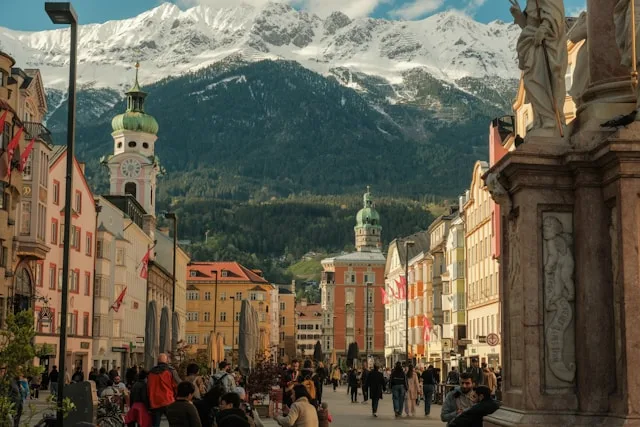
Innsbruck is the capital of the Austrian state of Tyrol and its fifth-largest city, with 132,188 inhabitants in 2024, set on the River Inn in a broad Alpine valley at the junction with the Wipp Valley and the Brenner corridor. It is a university city - the University of Innsbruck (founded 1669), the Medical University and the MCI Management Center Innsbruck - and a twice Winter Olympic host, in 1964 and 1976. The precision-manufacturing geography is the Inn valley itself: Rum and Hall in Tirol sit within about ten kilometres of the city, Wattens about fifteen, Schwaz about twenty-five, and Kufstein roughly sixty-eight kilometres down-valley, measured straight-line. An Innsbruck manufacturing mandate is, in practice, a corridor mandate.
The corridor's anchors are documented. MED-El GmbH, the hearing-implant maker, is headquartered in Innsbruck, where it was founded in 1990, and describes itself as a global company with over 3,300 employees worldwide - the medtech demand anchor that explains why titanium micromachining and medical-device supply capability exists in this region at all. Along the valley: Swarovski's crystal manufacturing at Wattens, founded 1895; Swarovski Optik's precision optics at Absam, built since 1949; and TYROLIT's grinding and precision-tooling technology at Schwaz. Across the Fern Pass in the Außerfern region around Reutte, the Plansee Group - founded 1921 and a world leader in tungsten and molybdenum powder metallurgy - anchors a precision base that extends beyond the Inn valley itself. This is a geography of family- and group-owned precision manufacturers with global reach, and most of them sit outside the city proper.
The industry frame is measurable at national level. Austria's metal industry counts roughly 1,100 firms and 130,000 employees, with 79 percent of firms classified as SMEs and 85 percent as family businesses (Facts & Figures 2025) - the family-SME pattern that shapes hiring across the Tyrolean segment. The provincial labour market is tight by Austrian standards: Tyrol's 2024 annual unemployment rate was 4.3 percent, the lowest of any Austrian state (AMS Arbeitsmarktprofil 2024), and no sector-level unemployment rate is published. In the metal and machine-building occupational field Austria-wide, 8,587 unemployed stood against 7,177 reported vacancies - close to parity, neither a deep pool of idle specialists nor an empty one (Stellenradar). The trade's traditional entry route is real and local: 10,258 apprentices were in training in Tyrol at the end of 2023 (WKO), and Metalltechnik with the Zerspanungstechnik machining module is a 3.5-year dual apprenticeship.
The regulatory frame is dated and checkable. Medical-device manufacturing in Europe has run under Regulation (EU) 2017/745, the MDR, since 26 May 2021, replacing the earlier directives. The transition out of the old-directive certificates is staged, not single-step: under Regulation (EU) 2023/607 they remain valid until 31 December 2027 for Class III devices and implantable Class IIb devices other than listed implantable hardware such as screws, plates, wires and pins, and until 31 December 2028 for the remaining Class IIb devices, Class IIa devices and Class I devices supplied sterile or with a measuring function, provided the manufacturer had its quality-management system in place and its certification application lodged by 26 May 2024 and a written agreement signed with a notified body by 26 September 2024. That staged schedule is the compliance era any medtech-adjacent production leader must have worked through, alongside the ISO 13485 quality-management norm.
What the verified record does not contain is any provincial Tyrol-metalworking employment total or enterprise count, any published unemployment rate for Tyrol's manufacturing sector, any public vacancy-duration record for a named Innsbruck employer, or any Austrian salary series supporting a €65,000 to €78,000 base for senior CNC programmers - market salary sources for the trade cluster between roughly €38,000 and €50,000 gross a year. Nor is there a KMU Forschung Austria digitalisation report with Tyrol percentages, or a Standortagentur Tirol property-price analysis. The structure - an Inn-valley precision corridor anchored by global niche leaders - is verifiable; the shortage arithmetic must be argued per mandate, not quoted.
What changes in this market
An Innsbruck precision-engineering mandate is usually a family-firm mandate in a global niche. The employers are mostly SMEs and subsidiaries of specialist groups, not large corporate HR machines: decisions sit with owners, hiring processes are short when the fit is right and frozen when it is not, and the person hired must deliver both technical authority and owner-level trust. Candidates prove themselves through apprenticeship pedigree and material-specific evidence - Zerspanungstechnik training, titanium and hard-metal experience, optical-grade surfaces - with the engineering programmes of the University of Innsbruck's Faculty of Engineering Sciences (Mechatronik, Elektrotechnik) and MCI's industrial and medical-technology tracks feeding the technical layer above it.
The medtech segment is defined by MED-El's presence and the MDR era. Since May 2021, European medical-device supply has required notified-body certification, technical documentation and post-market surveillance that the old directives did not; a Tyrolean subcontractor serving implant-grade customers lives in that regime permanently. For leadership hiring this means the screen is specific: not "ISO 13485" on a CV, but auditable decisions - certifications held, audits passed, documentation owned - taken under Regulation 2017/745 since 2021. The concentration around one anchor customer also cuts both ways: deep, transferable precision capability on one side; narrow, single-customer process experience on the other. Transferability has to be tested reference by reference.
Competition for senior people is cross-border by structure. Bavarian and Swiss employers sit within commuting or easy-relocation distance, operate at higher national wage levels and, in Switzerland's case, under lower personal income tax - a pull every retention case must be designed against, with the actual differentials verified per mandate rather than asserted. And in family firms the career ceiling is real: group-level roles rarely exist in Tyrol, so ambitious production leaders look to Munich, Vorarlberg or Switzerland for the next step. The retention argument has to be about scope, autonomy and stability, not title inflation.
KiTalent's mandate analysis
- Medtech-adjacent production leadership: screen for MDR-era records - specific audit, technical-file and cleanroom decisions under Regulation 2017/745 since 2021 - not just a quality-standard keyword.
- Machining mastery verification: apprenticeship pedigree plus material-specific evidence (titanium, hard metals, optical-grade surfaces); the corridor's anchors - MED-El, Plansee, the Swarovski companies, TYROLIT - define the local standard of precision a candidate should be measured against.
- Corridor-wide search geography: a mandate "in Innsbruck" is an Inn-valley mandate - Hall in Tirol, Wattens, Schwaz and the Innsbruck-Land district hold much of the candidate base, and Kufstein, roughly 68 kilometres down-valley, belongs in scope for regional roles.
- Family-firm governance fit: in an 85-percent-family-firm segment, operations leaders succeed or fail on owner alignment, succession clarity and delegation; interview evidence should test that directly, not just technical competence.
- Cross-border retention design: benchmark the offer against the Bavarian and Swiss alternatives the candidate can actually take, and build the case on scope, stability and Alpine living - with salary differentials verified for the specific role rather than assumed from averages.
Where the public record stops
Claims beyond the dated public record above are not repeated on this page. The verified record - the Inn-valley corridor and its distances, MED-El's Innsbruck headquarters and 3,300-plus global headcount, the Austrian metal industry's 1,100 firms and 130,000 employees, Tyrol's 4.3 percent 2024 unemployment rate, the near-parity vacancy picture in the metal occupational field, and the MDR's 2021 application date - supports the structural argument without invented cluster sizes, wage bands, vacancy durations or digitalisation percentages.
Sources
- MED-EL - About (headquarters, founding era, 3,300+ employees)
- Magnetics Magazine (2021) - MED-EL profile (founded 1990; 2,200+ employees at that date)
- University of Innsbruck - Faculty of Engineering Sciences (Mechatronik, Elektrotechnik)
- MCI - master's programmes (Industrial Engineering & Management; Medical & Sports Technologies)
- metalltechnischeindustrie.at - "Österreichs stärkste Branche: Daten & Fakten" (association figures; Facts & Figures 2025 edition)
- AMS Arbeitsmarktprofile 2024 - Tirol (annual unemployment rate 4.3 percent)
- Stellenradar - metal and machine-building occupational field (vacancies vs unemployed)
- WKO - Tyrol apprenticeship statistics (10,258 apprentices, end-2023)
- Plansee Group - company profile (Reutte, founded 1921, tungsten and molybdenum powder metallurgy)
- TYROLIT - company profile (Schwaz, grinding and precision-tooling technology)
- EUR-Lex - Regulation (EU) 2017/745 (MDR), applicable 26 May 2021
- EUR-Lex - Regulation (EU) 2023/607 (extended MDR transition)
- Therapeutic Goods Administration - EU MDR transition extension (class dates and 2024 conditions)
- Wikipedia - Innsbruck (capital, 132,188 inhabitants 2024, universities, Olympic record)
Related KiTalent research
- The Market Map Is Not the Shortlist: helps a buyer decide whether an Innsbruck mandate is really a medtech-production, machining-operations or family-firm succession search, and how to scope it across the Inn-valley corridor
- How to Assess a Leader Beyond Competencies: shows how to gather decisional evidence for this mandate - testing MDR-era audit records, apprenticeship pedigree, owner alignment and cross-border retention design - with candidate evidence assessed conversation by conversation