
The buyer question
We need barge-fleet, terminal-operations or waterway-corridor leadership around Namur; what does the verified record say about this market and how should a mandate here be structured?
What the public record shows
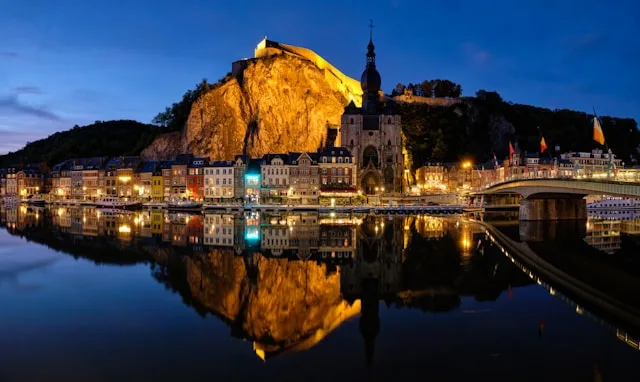
The verified public record for Namur is anchored by the city and river articles. Namur is the capital both of the province of Namur and of Wallonia, hosting the Parliament of Wallonia, the Government of Wallonia and its administration, with 115,330 inhabitants at the 2026 municipal vintage. The city stands at the confluence of the rivers Sambre and Meuse, straddling the Hesbaye, Condroz and Entre-Sambre-et-Meuse regions, with Charleroi to the west and French as the spoken language.
The waterway position is documented at corridor level: the Meuse is navigable over a substantial part of its length, and in the Netherlands and Belgium the river forms part of the major inland navigation infrastructure, connecting the Rotterdam-Amsterdam-Antwerp port areas to the industrial areas upstream - 's-Hertogenbosch, Venlo, Maastricht, Liège and Namur. South of Namur the river carries more modest vessels, though barges up to 100 metres long can still reach the French border town of Givet, beyond which the canalised Meuse - the Canal de la Meuse - continues for 272 kilometres.
What the verified record does not contain is any tonnage figure for Namur's terminals, quay-occupancy rates, enterprise counts, barge-captain training pipelines, vacancy durations or Antwerp compensation differentials. The structure - a regional capital at a two-river confluence on the documented north-south waterway chain between the seaports and the French border - is verifiable; the capacity-versus-pipeline arithmetic must be argued from structure, not quoted.
What changes in this market
A Namur river-logistics mandate is a confluence-and-corridor mandate in a regional-capital market. The freight logic runs on the Meuse chain - downstream toward Liège, Maastricht and the Antwerp-Rotterdam seaport complex, upstream toward Givet on hundred-metre barges - with the Sambre confluence adding the Charleroi-industrial connection, so careers here are waterway-specific: barge operations, river-terminal handling and corridor scheduling in a French-speaking administrative region whose private-employer base is smaller than its public one. Candidates prove themselves through inland-navigation certification and terminal-operations records; the assessment problem is that the specialised pool is thin in a city whose institutional weight is governmental, and offers compete with the Flemish seaport corridor - Antwerp above all - for exactly the operations managers who can run growing terminals.
KiTalent's mandate analysis
- Barge and fleet operations leadership: mandates should screen for inland-navigation certification and fleet-scheduling records on the Meuse-Sambre system rather than maritime or road-only careers.
- Terminal-operations management: the documented corridor position supports aggregate-and-construction flows; candidates need crane-and-yard operations references and water-level-seasonality planning experience.
- Corridor-commercial roles: connecting Wallonian cargo to the Antwerp-Rotterdam chain demands brokers and planners fluent in Flemish-port as well as French river interfaces - a bilingual bridge profile the screening grid should name.
- Antwerp-corridor benchmarking: senior offers must be stress-tested against seaport-corridor compensation; retention cases should build on the regional-capital living environment that the Flemish ports cannot offer.
- Public-interface fluency: in a city hosting the Walloon Parliament and Government, waterway projects interface with regional administration; leaders need public-stakeholder records, not only commercial ones.
Where the public record stops
Claims beyond the dated public record are not repeated on this page. The verified record above - the Wallonia-capital standing with 115,330 inhabitants, the Sambre-Meuse confluence, the documented navigation chain from the seaports through Namur to Givet and the 272-kilometre Canal de la Meuse - supports the structural argument without invented tonnage, occupancy, training or wage statistics.
Sources
Related KiTalent research
- The Market Map Is Not the Shortlist: helps a buyer decide whether a Namur mandate is really a barge-operations, terminal-management or corridor-commercial search, and how to price it against the Flemish seaport corridor
- How to Assess a Leader Beyond Competencies: shows how to gather decisional evidence for this mandate - the research method behind testing inland-navigation certification, water-level-seasonality planning, bilingual bridge capability and public-interface fluency - with candidate evidence assessed conversation by conversation