
The buyer question
Can a Berat heritage-construction mandate - master stonemasons, conservation carpenters, heritage project managers - be staffed in this UNESCO city, and what does the public record actually prove about the demand and about the workforce that has to deliver it?
What the public record shows
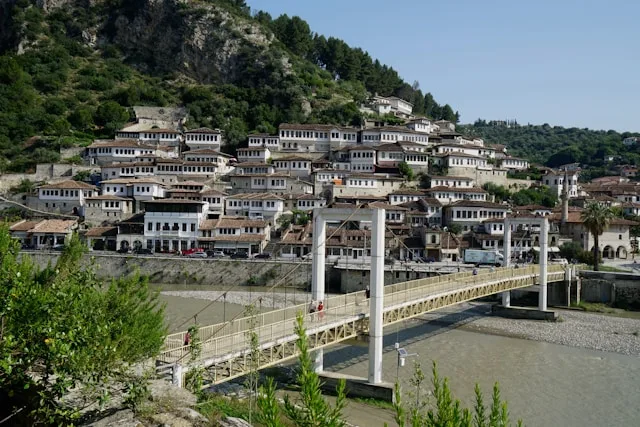
Berat is one half of the UNESCO World Heritage property Historic Centres of Berat and Gjirokastra. Gjirokastra was inscribed in 2005 and the listing was extended to Berat in 2008, under cultural criteria iii and iv. The old town stands on the right bank of the Osum in three quarters - Kalaja on the castle hill, Mangalem at its foot, Gorica across the river - and Berat's artisanal and commercial past is part of the property's stated outstanding value.
The protected fabric is counted. Albania's State Party report to the UNESCO World Heritage Centre of January 2025 records approximately 87 first-category and 360 second-category monuments enjoying special legal protection in Berat's historic centre and protected area. That is the work surface every restoration mandate here has to respect.
Restoration demand is documented, not asserted. Under the World Bank-financed Project for Integrated Urban and Tourism Development - US$71 million approved in 2016 with a US$34.6 million additional financing approved in 2022 - the restoration of the historic urban landscapes of the Gorica and Mangalem quarters, Selamllek and Iliaz Vrioni squares and the Antipatrea streetscape is recorded as completed, with further Berat urban packages and tourism-site works ongoing. The World Bank separately reports twelve key tourist sites restored across southern Albania, the Berat, Borshi, Gjirokastra and Kanina castles among them, alongside nearly 200,000 square metres of upgraded public space.
The permit pipeline is live. In 2024 the National Council for Material Cultural Heritage processed 36 applications from Berat - roughly three quarters of them restoration projects, equal to about 5% of all listed structures inside the property and its buffer zone in a single year - and most proposals were driven by owners converting properties into tourist accommodation. Albania hosted 11.7 million visitors in 2024, and the World Bank reports visitor numbers in Berat nearly quadrupling between 2019 and 2024. The State Party report scales the pressure itself: at that pace, around half of Berat's historic centre and buffer zone could be transformed or restored within ten years.
What changes in this market
The demand side of this market is well lit; the workforce side is documented at the level of structure, not headcount. The State Party report highlights the shifts the 2024 national census brings out in Berat - population decline, aging demographics and changing household structures - and the World Heritage Committee's decisions of 2023, 2024 and 2025 ask the State Party to keep limiting illegal construction inside the property. The property still operates without a finalized Integrated Management Plan, a process restarted in 2024, which the Committee has noted with regret. Every documented permit therefore converts into craft demand inside a shrinking, aging city whose trades recruit through small, reputation-based workshop networks rather than postings.
Permitting is dual. Restoration inside the property requires heritage clearance through the National Council for Material Cultural Heritage and the regional institute alongside municipal approvals, and in 2024 several decisions on Gorica properties were postponed pending heritage impact assessments - a study type the record itself describes as constrained by limited national expertise. Hiring timelines in this market inherit the permitting calendar, not only the construction calendar.
KiTalent's mandate analysis
- Size the mandate against counted fabric, not headlines: approximately 450 protected monuments in the historic centre and protected area are the real work surface for conservation roles.
- Treat the permit calendar as part of the hiring calendar: heritage clearance, municipal approval and, where required, a heritage impact assessment set the date a craft team can start - plan the pipeline before the search.
- Recruit the craft core through direct mapping: master stonemasons and conservation carpenters cluster in small workshop networks that predate the internet. Contacted, assessed and validated candidates are the only evidence of availability a buyer should accept.
- Set pay evidence explicitly: no published Berat craft wage series exists, so a mandate must build its own bands before launch rather than inherit a market average the record does not carry.
- Ask any search partner for contacted, assessed and validated candidates per craft and project phase before accepting demand statistics as evidence of workforce availability.
Where the public record stops
No located primary public record verifies the size of Berat's heritage-craft workforce - no headcount, unemployment rate or average tenure for stonemasons, carpenters or heritage project managers - nor graduate outcomes from Berat's vocational training system, vacancy durations, craft wage bands, or the number of operational lime kilns. No project named Albania Cultural Heritage Site Management appears in the World Bank's project database. The UNESCO mission of record for this property is the joint World Heritage Centre/ICOMOS/ICCROM mission of December 2021; the property's documents page lists no 2023 periodic report and no 2023 mission report, the periodic reporting on record being the 2014 and 2024 cycles. What the public record can prove stands above; what a mandate needs beyond it requires a commissioned search with contacted, assessed and validated candidates.
Sources
- UNESCO World Heritage Centre - Historic Centres of Berat and Gjirokastra: inscription 2005, Berat extension 2008, criteria iii and iv
- Republic of Albania - State Party Report on the State of Conservation, January 2025: protected monument counts, 2024 applications and decisions, project status, 2024 census demographics
- World Bank - Project for Integrated Urban and Tourism Development, P155875: US$71 million approved 2016; additional financing P171438, US$34.6 million, approved 2022
- World Bank - How Heritage Tourism Is Creating Jobs and Revitalizing Southern Albania, 12 August 2025: twelve restored sites including Berat Castle, public-space area, visitor growth
Related KiTalent research
- The Market Map Is Not the Shortlist: helps a buyer choose between testing the Berat heritage-construction market and commissioning a search with contacted, assessed and validated candidates
- How to Assess a Leader Beyond Competencies: shows how to gather decisional evidence for a construction or heritage-project mandate - the research method behind permit-calendar planning and direct craft-network mapping - with candidate evidence assessed conversation by conversation
Sources verified against the live public record on 26 September 2026: the UNESCO listing record, Albania's January 2025 State Party report, the World Bank PIUTD project records and the World Bank's August 2025 southern-Albania feature. Every figure on this page comes from those records; the craft-workforce numbers a hiring leader actually needs are not published, and any claim of availability requires a commissioned search with contacted, assessed and validated candidates.
Related Links
How this page was produced
This page combines KiTalent market intelligence, direct-search methodology, and primary market sources where available.