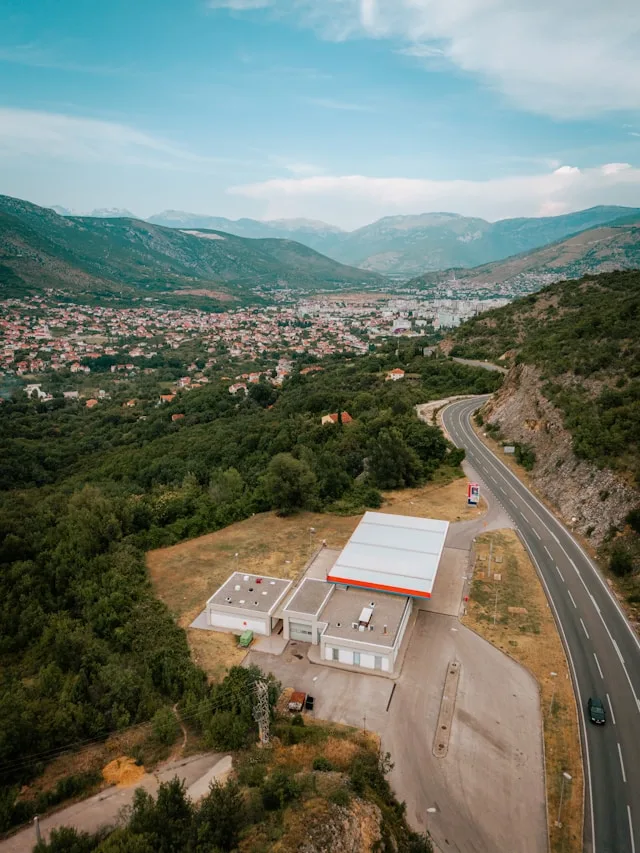
The Bottleneck Economy: Why a Rail Hub Is Not Labour Market Power
The reality is a town whose advantages are fixed and whose workforce is not. Average net pay in Bosnia and Herzegovina stood at 1,706 KM, about €870, in June 2026, and the transport and storage sector earned 1,470 KM, roughly €750, on average in April 2026 - roughly 13 percent below the national average of the same month. Against that stands a German labour market that admits citizens of the Western Balkans without a labour-market test, on a quota of 50,000 approvals a year since June 2024, and Croatia, which issued about 115,000 work permits to foreign workers in the first seven months of 2025, more of them to citizens of Bosnia and Herzegovina than to any other nationality. Freight passes through. Value does not stay.
What follows is an analysis of why Doboj's rail-hub position has not translated into labour market strength, what that means for the firms that operate there, and what hiring leaders working in or recruiting for the Western Balkans logistics corridor need to understand before their next search.
The conventional assumption is straightforward. A town that hosts the seat of Republika Srpska's railways, sits where four rail directions meet, and stands on the E73 road corridor should be able to attract and retain the talent needed to operate all of it. Doboj is the home of Željeznice Republike Srpske, the entity's railway operator, which runs a network of some 425 kilometres, roughly 385 of them in operation and almost entirely electrified, and carries several million tonnes of freight a year. That position should, in theory, create the conditions for wage growth, career progression and a self-sustaining talent ecosystem.
That theory collapses when geographic mobility allows talent arbitrage.
Doboj's infrastructure advantage is fixed. The junction cannot move. The corridor cannot relocate. But the customs specialists, operations managers and international drivers who make that infrastructure function are not fixed. They respond to wage signals from Zagreb and Ljubljana, and to a German employment channel that is open to them without a labour-market test. The result is what this analysis calls a bottleneck economy: a place where freight concentrates due to geography but where the economic value of moving that freight accrues to labour markets elsewhere.
This is the analytical tension at the centre of this article. Doboj's strategic geography should be a source of labour market leverage. Instead, it functions as a subsidy to competing markets. Every driver trained in Doboj who moves to Germany for a multiple of their pay at home takes operational knowledge of the corridor with them. Every customs specialist who relocates to Sarajevo, Zagreb or further north carries expertise that took years to develop. The infrastructure stays. The knowledge walks.
For hiring leaders operating in this market, the implication is direct. You are not competing with other Doboj employers. You are competing with labour markets that Bosnia and Herzegovina's EU candidate status, granted in December 2022 with accession negotiations following in March 2024, is progressively making more accessible - and with the German and Croatian channels that are already open today.
Three Constraints Defining Doboj's Logistics Labour Market
Customs and Freight Specialists: A State-Level System, a Thin Local Bench
The first thing the verified record establishes is what Doboj is not dealing with. Bosnia and Herzegovina is a single customs territory: customs and VAT are administered nationally by the Indirect Taxation Authority, and goods moving between Republika Srpska and the Federation of BiH cross no customs line. The Inter-Entity Boundary Line that runs through the wider Doboj area is an administrative boundary, not a customs border.
What that means for hiring is that the customs profession here is defined by a state-level system in the middle of modernisation. Customs declarations have moved through paperless, NCTS-based processing since August 2022, and the authority has been pushing customs representatives and forwarders into digital certification. The specialists who can operate that system - and who are simultaneously fluent in the two entities' separate business administrations, from two railway operators to entity and cantonal registration and licensing practice - are the layer every freight firm on the corridor depends on.
What no public dataset shows is how deep that layer is around Doboj. The Indirect Taxation Authority does not publish per-office declaration volumes or licensed-representative counts, and no verified number exists for how many customs practitioners work in and around the town. For a hiring organisation this absence is itself a finding: the market cannot be sized from a register, which is why direct mapping, firm by firm and practitioner by practitioner, is the only reliable way to read it.
The two-entity environment keeps the premium on dual fluency real. A specialist who has cleared freight in both administrative frameworks is worth more than one who has not, and that premium is set by the structure of the state, not by any employer's generosity.
International Drivers: The Wage Gap That Relocates
The driver market operates on different mechanics. Domestic and regional routes can be staffed from the local pool. The constraint sits at the international tier: drivers with C/E licences, digital tachograph cards and the EU driver qualification that cross-border work requires.
The verified wage arithmetic explains the pressure. Drivers in international haulage at Bosnian firms typically take home between €700 and €1,500 net a month, with long-absence contracts advertised at 4,000 KM and more. In Germany, the Federal Employment Agency's pay atlas puts median gross pay for goods-transport drivers at about €3,200 a month, roughly €2,000 net for a single earner. Croatian and Slovenian average net pay, at roughly €1,500 and €1,700 a month respectively, sits at 1.7 to 2 times Bosnian levels.
The channels are open and widening. Germany's Western Balkans regulation admits citizens of Bosnia and Herzegovina to its labour market without a labour-market test and without a formal qualification requirement, on a quota that has stood at 50,000 approvals a year since June 2024. Croatia issued about 115,000 work permits to foreign workers in the first seven months of 2025, more of them to citizens of Bosnia and Herzegovina than to any other nationality, and 7,723 of them in transport and communications alone. No public series measures driver turnover intention or vacancy durations in Bosnia and Herzegovina - but the direction of the wage gap and the scale of the permit flows do not need a survey to be read.
The adjustments follow the arithmetic. Firms that cannot price international drivers competitively run fewer international routes, subcontract across the border at higher cost, or decline contracts. Each response erodes the position that the corridor location was supposed to secure.
Compliance Specialists: The Layer EU Alignment Will Demand
The third constraint is the least quantified and, over a mandate's horizon, possibly the most important. Bosnia and Herzegovina's EU candidate status dates from December 2022, accession negotiations formally opened in March 2024, and in December 2025 the European Commission approved the country's Reform Agenda, unlocking up to €976.6 million under the EU's Reform and Growth Facility.
For logistics firms, alignment means road-freight rules converging on EU frameworks through the Transport Community, a customs system already digitalised, and environmental and market-access requirements whose eventual cost for Bosnia's aging truck fleet has not been publicly quantified. Whether fleet renewal will be forced, how fast, and what it would do to the country's small hauliers is an open question no published projection answers - which is exactly why it belongs in a hiring plan rather than outside it.
The education pipeline shows the same gap from the other side. Doboj maintains technical secondary education producing logistics-adjacent graduates. What share of local curricula covers EU regulatory practice, and how that maps to employer demand, is not published. Shortages of experienced professionals alongside graduates whose qualifications do not match market needs are the working pattern across the Western Balkans; the local numbers to prove or disprove it in Doboj do not exist in public form.
Compensation: What Is Verified and What Is Not
The verified compensation record for this market is national and entity-level, not city-level. Average net pay in Bosnia and Herzegovina reached 1,706 KM, about €870, in June 2026; in Republika Srpska it stood at 1,698 KM. The transport and storage sector averaged 1,470 KM, roughly €750, in April 2026, against a national average of 1,684 KM - roughly 13 percent below. That is the domestic baseline: a sector whose pay at home runs well below the country average while its skills are priced at multiples of that abroad.
No Doboj-level salary band, time-to-fill or vacancy series is published. The calibration evidence a buyer needs for a specific Doboj mandate lives in comparable mandates, not in city statistics that do not exist in public form.
The pull factors are measurable at the destination end. Average net pay in Croatia and Slovenia now runs at roughly €1,500 and €1,700 a month respectively - 1.7 to 2 times Bosnian levels for comparable work - and German goods-transport drivers earn a median of about €3,200 gross. These are not the three-to-six-fold differentials sometimes claimed for the region, and they do not need to be: a stable near-two-to-one gap, reachable through open legal channels, is enough to move people whose profession is, by definition, mobility.
The answer to why talent stays anyway is familiar: family ties, property ownership, and a cost of living that partially offsets the wage gap. That calculation erodes as destination labour markets keep repricing upward.
The 2026 Infrastructure Gamble
Doboj's trajectory into the late 2020s hinges on two internationally financed projects that will either relieve or deepen the bottleneck.
The Corridor Vc Railway Modernisation Through Doboj
The rail project on Doboj's corridor is the modernisation of the Corridor Vc line through the junction: renewal of the 62-kilometre single-track section between Šamac, on the northern border with Croatia, and Doboj, and a second track on the 18-kilometre Doboj-Rječica section toward Zenica, together with modernised signalling. The package is financed by European Bank for Reconstruction and Development and European Investment Bank loans of €60 million each plus an €80 million EU grant through the Western Balkans Investment Framework, roughly €200 million in total, with works on the track and signalling under way as of 2025.
If completed, this investment would materially change the talent equation. Higher throughput means more freight revenue concentrated in Doboj. More revenue creates headroom for higher wages. Higher wages slow the emigration drain. The virtuous cycle is plausible.
The infrastructure being renewed is genuinely old, and its age shows operationally: in the July 2025 heat, the operator had to suspend services on sections including the line out of Doboj after track deformed. No public asset-age or failure-rate series exists for the network; the €200 million renewal itself is the measure of the underinvestment it corrects.
The Doboj Bypass and Its Double-Edged Effect
The road project is the Doboj bypass: a 13.8-kilometre motorway section between the Rudanka and Medakovo interchanges that carries Corridor Vc around the town, financed by two European Bank for Reconstruction and Development loans totalling €210 million within a €256 million project approved in 2019. The Republika Srpska sub-section runs 5.3 kilometres from Rudanka through two tunnels, 1,595 and 700 metres long, and a 288-metre viaduct to the inter-entity border.
The first motorway section on this corridor in Republika Srpska, between Johovac and Rudanka, opened in August 2022. The bypass itself was targeted for the end of 2025 and was still under construction as of late 2025, with local reports of schedule slippage. As of mid-2026, roughly 45 percent of the Corridor Vc route through Bosnia and Herzegovina was built.
When it opens, the bypass will take heavy through traffic off the M-17 that currently runs through the town; the project's own environmental documentation frames congestion relief in the built-up area as a core benefit. No verified figure exists for what share of the M-17's truck traffic will divert. For urban quality of life, the direction is unambiguously positive. For the local logistics labour market, it cuts both ways: through-traffic efficiency improves, while the short-haul distribution pattern built on the current routing changes with it. Firms positioned for higher-volume, higher-efficiency operations will grow. Firms dependent on the inefficiencies of the current system will not.
For hiring leaders, the bypass creates a skills transition. The roles that grow are those managing higher-volume, higher-efficiency operations. The roles that shrink are those built around manual workarounds for infrastructure limitations. Organisations that have not begun planning for this transition will find themselves restructuring under pressure rather than by design.
EU Candidate Status: The Compliance Horizon
Bosnia and Herzegovina's EU candidate status, granted in December 2022, is driving regulatory harmonisation that will reshape which firms survive in Doboj's logistics market.
The verified milestones are concrete: accession negotiations formally opened in March 2024, and the European Commission approved the country's Reform Agenda in December 2025, unlocking up to €976.6 million under the Reform and Growth Facility. The mechanism for transport is the Transport Community framework, through which the Western Balkans align their road-freight rules with the EU acquis.
What is not yet knowable is the cost curve. No published projection quantifies what EU emissions and market-access requirements would mean for Bosnia's aging truck fleet or its micro-hauliers, and no verified fleet-age series for the country's hauliers could be located in the public record. The consolidation logic, in which fewer and better-capitalised firms absorb market share, is a scenario to plan for, not a statistic to quote.
The fragmentation that is real today is administrative. Two railway operators run the national network, and vehicle registration and licensing run through entity and cantonal administrations. These are complexities a new hire in this market must master from day one, and they raise the cost of a mis-hire relative to a single-jurisdiction market.
What This Means for Hiring Leaders in Western Balkans Logistics
The Doboj market presents a specific challenge for organisations that need logistics leadership or scarce specialists here. The talent exists. It is identifiable. But it is already employed and passive, already gone to an EU market, or qualified on paper but missing the EU regulatory layer that makes the qualification functional.
How much of this market is actively looking is not measured in any public series - and that is the operating fact. A conventional posting strategy reaches the visible fraction of the market, and the constraint sits in the fraction it cannot reach. In a market whose destination economies actively recruit the same profiles, Germany through an open quota and Croatia through a six-figure annual permit intake, the passive candidate is not an anomaly. It is the norm.
The search methodology that works in this market is direct. It means mapping the customs and freight-forwarding specialists along the Šamac-Doboj-Zenica axis and the Doboj-Banja Luka line, firm by firm; assessing who holds the dual-entity experience that commands a premium; and extending the search to Sarajevo, Banja Luka and the BiH diaspora in Zagreb, Ljubljana and Germany, where returnees with EU corridor experience represent the highest-value targets.
KiTalent's approach to executive search in industrial and manufacturing logistics markets is built for this dynamic: markets where the visible candidate pool is inadequate and the real talent must be identified through systematic talent mapping before any approach is made.
For organisations hiring across the Western Balkans logistics corridor, where the candidate you need is passive, the regulatory requirements are shifting beneath you, and the compensation gap with EU markets widens each quarter, start a conversation with our search team about how we identify and engage the professionals this market cannot surface through conventional channels.
Frequently Asked Questions
Why is it difficult to hire customs specialists in Doboj?
Bosnia and Herzegovina runs a single, state-level customs and VAT system, the Indirect Taxation Authority, and declarations have been paperless through the NCTS since August 2022. The specialists who work that system while also navigating two entities' separate administrations are scarce, and no public register shows how many practise around Doboj: the authority does not publish per-office figures. That absence is why direct, name-by-name mapping rather than advertising is the effective strategy here.
What do logistics roles earn in Doboj compared with other cities?
No Doboj-level salary series is published. The verified baselines are national: Bosnia and Herzegovina's average net pay was 1,706 KM, about €870, in June 2026, with the transport and storage sector at 1,470 KM, roughly €750, in April 2026 - roughly 13 percent below the national average. Croatia and Slovenia average roughly €1,500 and €1,700 net respectively, and German goods-transport drivers earn a median of about €3,200 gross. The verified gap to the nearest EU markets is roughly double, not five-fold, and it is enough to move people.
How will EU candidate status affect Bosnia's logistics workforce?
Bosnia and Herzegovina became an EU candidate in December 2022, opened accession negotiations in March 2024, and had its Reform Agenda approved in December 2025, unlocking up to €976.6 million under the Reform and Growth Facility. Alignment through the Transport Community will progressively move road-freight rules toward EU frameworks, which raises demand for regulatory, customs and compliance capability. What compliance will cost the country's aging truck fleet and small hauliers is not publicly quantified - a reason to build that capability early rather than wait for the numbers.
Why does Doboj lose logistics talent to EU countries despite its infrastructure advantages?
Doboj's infrastructure is geographically fixed; its workforce is not. Germany admits Western Balkans workers without a labour-market test on a quota of 50,000 approvals a year, and Croatia made citizens of Bosnia and Herzegovina the largest group among the roughly 115,000 foreign workers it issued work permits to in the first seven months of 2025. Against a domestic transport-sector average of roughly €750 net a month and a German goods-transport median of about €3,200 gross, infrastructure advantage does not convert into labour market power.
How should companies approach hiring for logistics roles in Doboj?
Distinguish the active applicant pool from the wider market. No public data measures the active fraction here. Direct search can map customs specialists, international drivers and operations managers around the corridor, verify regulatory capabilities and calibrate the proposition.
What infrastructure changes could improve Doboj's logistics talent market by 2027?
Two verified projects. The Corridor Vc railway modernisation - €60 million each from the EBRD and EIB plus an €80 million EU grant - renews the 62-kilometre Šamac-Doboj line and adds a second track on the 18-kilometre Doboj-Rječica section toward Zenica, with works under way as of 2025. The Doboj bypass, financed by €210 million in EBRD loans within a €256 million project, will carry the corridor's motorway around the town; it missed its end-2025 target and was still under construction as of late 2025, with roughly 45 percent of the corridor through Bosnia and Herzegovina built as of mid-2026. Both could concentrate more freight value in Doboj. Both have already slipped past earlier timelines.
What the Public Record Does Not Show
Claims beyond the verified record are not repeated on this page. No public series exists for Doboj-level salary bands, vacancy durations, customs-broker or licensed-representative counts, driver turnover intention, transport-firm counts by size, per-office customs declaration volumes, asset-age or failure rates for the rail junction, or the share of M-17 traffic the Doboj bypass will divert. The verified record - the junction and its four directions, the corridor projects and their financing, national and entity wage levels, the German quota and the Croatian permit flows - supports the structural argument; the hiring arithmetic must be argued from structure and from mandates actually run, not quoted.
Sources
- Željeznice Republike Srpske company profile (Business Srpska)
- EBRD procurement notice - Rail Corridor Vc in Republika Srpska, July 2022
- EBRD project summary - Republika Srpska Railways modernisation
- EBRD project summary - Corridor Vc: Doboj Bypass
- Republika Srpska Motorways - Doboj Bypass Non-Technical Summary, December 2018
- Radio Free Europe - reporting on the Johovac to Rudanka motorway section opening, August 2022
- JP Autoceste FBiH - Corridor Vc motorway construction progress report, Q2 2026
- European route E73 / Pan-European Corridor Vc route record
- Agency for Statistics of Bosnia and Herzegovina - average net salary statistics
- Klix.ba - Republika Srpska average net salary, June 2026
- Ekapija - BHAS average net salary by activity, April 2026 (transport and storage)
- BHRT - pay of Bosnian drivers in international transport
- Bundesagentur für Arbeit - Entgeltatlas, goods-transport drivers
- Bundesagentur für Arbeit - Western Balkans employment rule (Westbalkanregelung)
- Poslovni.hr - Croatian work permits for foreign workers, first seven months of 2025
- European Western Balkans - BiH Reform Agenda approval, December 2025
Related Links
- Doboj
- Bosnia and Herzegovina
- Zenica's Metal Fabrication Sector Is Modernising and Shrinking at the Same Time: What That Means for Industrial Hiring Leaders
- Sarajevo Tourism and Hospitality Talent: What the Verified Record Shows
- Široki Brijeg Wood Processing: The Talent Bottleneck Behind a €142 Million Industry's Fragile Growth
- Quebec City's Insurance Sector Cut Hundreds of Jobs and Still Cannot Hire the People It Needs

Published March 2026, updated 2026-04-12. Sources and evidential limits are stated in the article.
Related Market Reads
Articles tied to the same hiring geography or market context.
Zenica's Metal Fabrication Sector Is Modernising and Shrinking at the Same Time: What That Means for Industrial Hiring Leaders
Zenica's steel and fabrication sector sits at a strange inflection point. ArcelorMittal's €70 million decarbonisation feasibility study for the city's anchor steelworks signals...
Sarajevo Tourism and Hospitality Talent: What the Verified Record Shows
The verified public record for Sarajevo - Bosnia's capital in a Dinaric valley, a 1984 Winter Olympics host whose Film Festival has run since 1995 - and what a hospitality mandate there must actually cover.
Široki Brijeg Wood Processing: The Talent Bottleneck Behind a €142 Million Industry's Fragile Growth
Široki Brijeg's wood processing cluster generated approximately €142 million in annual turnover across the West Herzegovina Canton as of late 2024, representing 18% of the...
Nearby Market Signals
Lateral reads from adjacent cities, sectors, or themes.
Quebec City's Insurance Sector Cut Hundreds of Jobs and Still Cannot Hire the People It Needs
Quebec City's two largest insurers eliminated 450 administrative positions over a two year integration cycle. The headlines told a story of contraction. The recruitment data...
Los Angeles Entertainment Hiring: Define the Mandate Before the Search
Which studio-production, games-and-interactive or music-and-recording responsibility actually defines an LA entertainment mandate?
Dallas Telecom and Digital Infrastructure: Define the Network Mandate
Which network, facility or deployment decisions define the Dallas telecom and digital-infrastructure mandate?
From the Archive
Evergreen background reading that still sharpens current hiring decisions.
Široki Brijeg Metal Fabrication Talent: What the Verified Record Shows
The verified public record for Široki Brijeg - a West-Herzegovina municipality of 28,929 whose record names metal industry among its significant industries, 88 kilometres from the Adriatic - and what a metal-fabrication mandate there must actually cover.
Čapljina Tourism Hiring: What the Verified Record Shows
What the verified public record establishes about Čapljina's Hutovo Blato wetland, the recorded scale of the lower Neretva visitor economy, and where a tourism, hospitality or conservation-management mandate needs contacted, assessed and validated candidates.
Čapljina Logistics Hiring: What the Verified Record Shows
The verified public record for Čapljina's logistics market - the Bijača crossing on the European Union's external border, an AEO capability barely two years old, rail rehabilitation arriving on the Ploče line - and what a logistics or customs-compliance mandate here must actually cover.