The buyer question
Can a Karlsruhe retail or consumer-goods mandate - supply chain, logistics, e-commerce, or sustainability and compliance leadership - be defined against a verifiable market record, and what does that record actually prove about hiring in this city?
What the public record shows
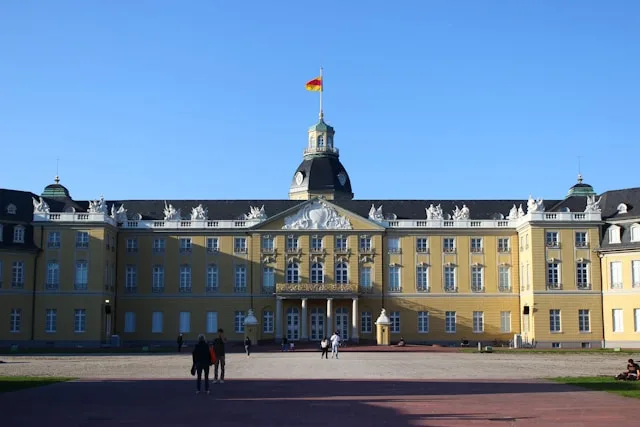
The verified public record for Karlsruhe's retail market is anchored by dm-drogerie markt's own disclosures. dm was founded in Karlsruhe in 1973 and still runs its European business from headquarters at Am dm-Platz 1 in the city. In the 2024/25 financial year, which ran from 1 October 2024 to 30 September 2025, the company reported European gross revenue of €19.2 billion, up 8.2 percent on the prior year, 4,189 stores across 14 European countries, and 93,426 employees - 63,648 of them in Germany, where dm operates 2,154 stores. It invested around €200 million in the closed year and plans more than €250 million for 2025/26. Its published priorities - a mail-order pharmacy, a Europe-wide SAP S/4HANA system landscape, self-service checkout across German stores by 2027 and a second online distribution centre near Leipzig by February 2026 - are precisely the supply chain, IT, e-commerce and health-commerce functions a Karlsruhe headquarters recruits for.
dm's logistics network anchors the wider corridor. The company's own logistics-centre record lists the Waghäusel distribution centre between Karlsruhe and Mannheim, which supplies up to 1,000 stores, alongside the centres at Weilerswist near Cologne and Wustermark near Berlin - the latter around 30,000 square metres with roughly 350 employees - and a Karlsruhe facility focused on textiles since 2011. The operational labour market for retail logistics in this region is corridor-shaped, Karlsruhe to Mannheim, rather than city-shaped.
The compliance demand is dated and checkable in the primary law. The German Supply Chain Due Diligence Act (LkSG) has applied since 1 January 2023 to companies with at least 3,000 employees in Germany, and since 1 January 2024 to companies with at least 1,000 - dm, with more than 63,000 employees in Germany, has been in scope from the first tier. Its administrative fines reach €800,000 for the most serious offences, and for legal entities with average annual turnover above €400 million, 2 percent of average annual turnover. The EU Packaging and Packaging Waste Regulation (EU) 2025/40 has been in force since 11 February 2025 and applies from 12 August 2026, with all packaging on the EU market to be recyclable in an economically viable way by 2030. Both regimes put real obligations on retail headquarters functions - and neither publishes how many roles any one city adds.
The city's own statistics frame the labour pool only in aggregate: 204,617 employees subject to social insurance at the Karlsruhe workplace as of 30 June 2025, and 8,691 unemployed at the end of 2025, in a city of about 305,000 residents. What these aggregates do not measure is availability in a specific function - supply chain IT, packaging compliance, e-commerce operations - at a given seniority in a given quarter. That requires a search with contacted, assessed and validated candidates.
What changes in this market
Karlsruhe's retail employers prove themselves against a headquarters-and-corridor structure rather than a diversified multi-employer downtown: one anchor employer of European scale sets the local standard for supply chain, logistics IT, e-commerce and sustainability competence; the distribution work sits in a corridor that runs from the city toward Mannheim; and the regulatory workstreams - supply-chain due diligence in force since 2023 and 2024, packaging rules applying from August 2026 - land on the same headquarters functions at the same time. Each mandate here proves itself against that structure and against the anchor employer's published investment programme, not against aggregate city statistics or a national average.
KiTalent's mandate analysis
- Name the side of the ecosystem the role serves - headquarters programme leadership, corridor distribution operations, or store and format operations - because results evidence differs completely across them.
- For regulatory mandates, test delivered compliance work against the actual thresholds: risk analysis, preventive and remedial measures and reporting under the LkSG, and packaging redesign toward the 2030 recyclability requirement of Regulation (EU) 2025/40 - not generic sustainability credentials.
- Treat the corridor as the competitive map: candidates within reach of Waghäusel and the Rhine-Neckar region are visible to every other logistics operation in the same corridor, so precision of approach decides outcomes.
- Use aggregate city statistics only as context: employment and unemployment totals say nothing about a specific function's availability. Ask any search partner for contacted, assessed and validated candidates instead.
Where the public record stops
No located primary public record verifies Karlsruhe-specific retail-sector employment totals, vacancy snapshots, time-to-fill figures, abandoned-search rates, digital-literacy shares, compensation bands, city-to-city salary premiums, passive-candidate ratios, motorway capacity percentages or land-allocation figures for this market. What the public record can prove stands above, with its dates attached; the rest must be tested against the live mandate.
Sources
- dm newsroom - dm financial year 2024/25 disclosure
- dm logistics centres - Waghäusel, Weilerswist, Wustermark, Karlsruhe
- Lieferkettensorgfaltspflichtengesetz (LkSG)
- European Commission - Packaging and packaging waste
- City of Karlsruhe - Statistik und Zensus
Related KiTalent research
- The Market Map Is Not the Shortlist: helps a buyer choose between testing the Karlsruhe retail market and commissioning a search with contacted, assessed and validated candidates
- How to Assess a Leader Beyond Competencies: shows how to gather decisional evidence for this mandate - the research method behind testing anchor-employer fit, corridor competition and regulatory delivery - with candidate evidence assessed conversation by conversation