The buyer question
We need winery, agro-food processing or export-compliance leadership around Mostar; what does the verified record say about this market and how should a mandate here be structured?
What the public record shows
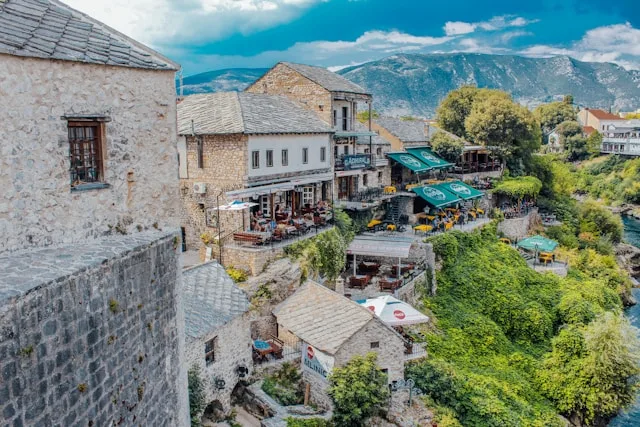
The verified public record is anchored by the Mostar and Herzegovina articles. Mostar, the historical capital of Herzegovina and the country's fifth-largest city, sits at the centre of a region of around 12,188 square kilometres - roughly 24% of Bosnia and Herzegovina - whose terrain is mostly hilly karst with high mountains such as Čvrsnica and Prenj, except for the central valley of the river Neretva. That valley is the agro-food heartland any mandate here actually operates in.
The climate record explains the crop base: Mostar and the Herzegovina area in general experience a humid subtropical climate (Cfa) under the Köppen classification, with cool humid winters and hot, drier summers in which temperatures above 40 °C are not uncommon. Mostar is the sunniest city in the country, with an average of 2,431 solar hours a year. The industrial record documents the sector's pedigree - after World War II, Mostar developed industries producing plastics, tobacco, bauxite, wine, aircraft and aluminium, and several dams (Grabovica, Salakovac, Mostar) were built in the region to harness the hydroelectric power of the Neretva - so wine is a documented pillar of the local industrial history, and water infrastructure is part of the agricultural backdrop.
What the verified record does not contain is any EU pre-accession allocation, vineyard or olive hectarage, export shares, GDP share, holding-size distribution, vacancy-fill rates or neighbouring-country salary premiums. The structure - a hot karst-and-valley region with a documented wine-and-tobacco industrial past, centred on one city - is verifiable; the investment-and-scarcity arithmetic attached to it must be argued from structure, not quoted.
What changes in this market
A Mostar agro-food mandate is a small-holding valley mandate in a fragmented institutional environment. The production base sits in the Neretva valley's hot subtropical microclimate, on karst terrain where arable land is scarce and holdings are small, and the employer base is family-scale wineries and processors rather than industrial agribusiness. Candidates prove themselves through hands-on cross-functional range - one person covering cellar, compliance and export paperwork - and through credibility across the communities of a post-conflict canton; pay is set against a domestic market with the Croatian employers of the nearby Adriatic littoral as the standing pull on trained specialists, which is a structural feature of any border-adjacent labour market rather than a quoted statistic.
KiTalent's mandate analysis
- Wine-production and cellar leadership: the documented post-war wine industry anchors a small pool of experienced oenologists and cellar managers; searches should be referenced and network-mediated because advertising reaches almost none of them.
- Agro-food processing and quality systems: tobacco's documented place in the industrial past signals a processing heritage to build on; leadership candidates need EU-alignment food-safety and quality-system records, since export ambition runs straight into compliance questions.
- Export and market development: with the Croatian market and Adriatic-coast buyers as the natural first export step, commercial leadership should bring cross-border trade and diaspora-channel experience rather than only domestic distribution records.
- Water and irrigation interfaces: the Neretva's dam infrastructure documents the water system the valley depends on; agri-management roles that include irrigation planning reward candidates who can work with hydropower-era institutional constraints.
- Climate-adaptation screening: in a valley where temperatures above 40 °C are not uncommon, harvest logistics and heat-management experience is a practical screening criterion, not a theoretical one.
Where the public record stops
Claims beyond the dated public record are not repeated on this page. The verified record above - the Cfa climate with 2,431 annual solar hours and 40 °C summers, the documented wine-tobacco-bauxite industrial past and the Neretva dams - supports the structural argument without invented funding, hectarage, export or vacancy statistics.
Sources
Related KiTalent research
- The Market Map Is Not the Shortlist: helps a buyer decide whether a Mostar agro-food mandate is really a winery-leadership, processing-and-quality or export-commercial search, and how to scope sourcing across the border-adjacent market
- How to Assess a Leader Beyond Competencies: shows how to gather decisional evidence for this mandate - the research method behind testing cross-functional range, EU-alignment compliance records, cross-border channel experience and heat-adapted operations - with candidate evidence assessed conversation by conversation