The buyer question
We need hotel, destination-management or tourism-operations leadership in Mostar; what does the verified record say about this market and how should a mandate here be structured?
What the public record shows
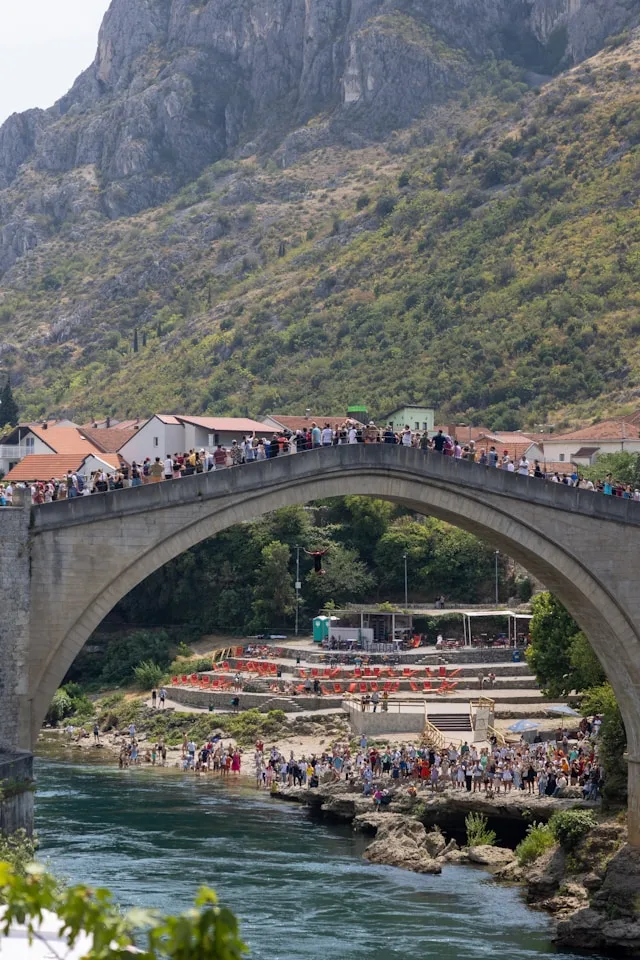
The verified public record for Mostar is anchored by the city's Wikipedia article. Mostar is situated on the Neretva River, is the fifth-largest city in Bosnia and Herzegovina and the historical capital of Herzegovina, with a population of 113,169 in the city-wide infobox vintage (60,195 urban); it was founded in 1452 and named after the bridge keepers (mostari) who guarded the Stari Most over the Neretva during the Ottoman era. The city is one of the most important cultural and tourist centres in southern Bosnia and Herzegovina, and its documented visitor economy is anchored by a single asset.
The asset at the centre of that economy is verified and singular. The Old Bridge - a UNESCO World Heritage Site commissioned by Suleiman the Magnificent in the 16th century - is one of Bosnia and Herzegovina's most visited landmarks and is considered an exemplary piece of Islamic architecture in the Balkans. A destination whose flagship attraction is a 16th-century bridge in a protected heritage core is structurally a day-trip and season-peaked visitor economy, whatever the current annual visitor count happens to be.
The labour market's modern shape was set by the war and the reconstruction that followed. Numerous religious buildings and most of the city's bridges were destroyed or severely damaged during the fighting, including the Old Bridge itself; since the end of the wider war in 1995, great progress was made in reconstructing the city under the European Union Administration of the City of Mostar (EUAM). The hospitality sector that exists today was substantially rebuilt after that rupture, on a base of restored heritage fabric rather than purpose-built resort infrastructure.
What changes in this market
A Mostar hospitality mandate is a heritage-destination mandate in a small, season-peaked market. Candidates prove themselves across two languages and three communities in a city that was physically divided within living memory, running operations whose capacity is capped by protected heritage fabric rather than by land availability. Pay is benchmarked against a cantonal economy whose national labour market carries high documented unemployment - 20.5% for 2017 in the Bosnia and Herzegovina record, with earlier vintages near 40% - yet only a thin stock of trained hotel generalists; the practical assessment problem is distinguishing candidates with genuine multi-season, multi-lingual operating experience from the far larger pool of seasonal service workers those unemployment figures count.
KiTalent's mandate analysis
- Heritage-destination management: roles at destination-management organisations and heritage institutions live or die on UNESCO-protocol fluency, multi-stakeholder patience and grant-cycle experience; a mandate should screen for those directly rather than for generic tourism-marketing credentials.
- Hotel and food-and-beverage operations: the operating stock is small and heritage-weighted, so general-manager and F&B-leadership candidates with protected-building operating experience (conservation constraints, seasonal staffing, utilities limits) are the relevant population - not resort-scale operators.
- Seasonal and adventure operations: the Neretva river setting supports rafting, canyon and activity operators whose businesses are summer-shaped; leadership hiring there must plan shoulder-season retention explicitly or accept annual rehiring churn.
- Language and community fluency: a city with Bosnian/Croatian/Serbian usage and a recent history of division rewards management candidates who can operate credibly across communities; that fluency is a screening criterion, not a nice-to-have.
- Regional benchmark honesty: senior hospitality pay in Mostar is set against a domestic market with very limited deep-pocketed employers, so mandates that price against Adriatic-coast (Croatian) scales should say so explicitly or they will misread both supply and counter-offer risk.
Where the public record stops
The structural argument - a capped heritage economy inside a high-unemployment national labour market - stands on the verified record above without invented visitor, licensing or infrastructure statistics.
Sources
- Wikipedia - Mostar (city rank, bridge and tourism record)
- Wikipedia - Mostar (war damage and reconstruction record)
- Wikipedia - Bosnia and Herzegovina (national unemployment record)
Related KiTalent research
- The Market Map Is Not the Shortlist: helps a buyer decide whether a Mostar hospitality mandate is really a heritage-destination, hotel-operations or seasonal-adventure search, and how to price it against domestic rather than coastal benchmarks
- How to Assess a Leader Beyond Competencies: shows how to gather decisional evidence for this mandate - the research method behind testing UNESCO fluency, protected-building operating experience, community and language credibility, seasonality planning - with candidate evidence assessed conversation by conversation