
The buyer question
We need residential-construction, site-management or materials-processing leadership in Trebinje; what does the verified record say about this market and how should a mandate here be structured?
What the public record shows
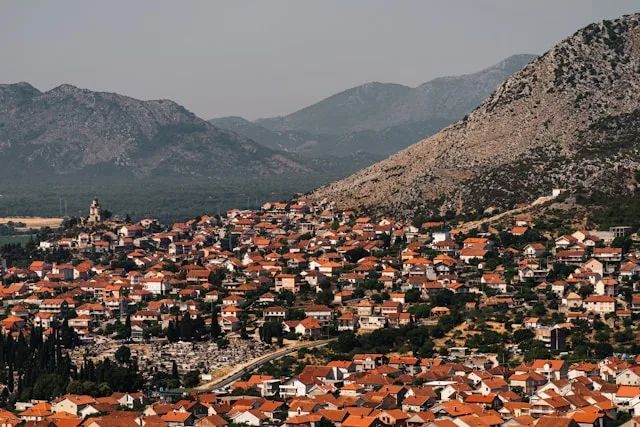
The verified public record for Trebinje is anchored by the city's Wikipedia article. Trebinje is a city and municipality in Republika Srpska, the southernmost city in Bosnia and Herzegovina, situated on the banks of the Trebišnjica river in East Herzegovina at the foot of Leotar, with a population of 31,433 at the 2013 census. It lies some 30 kilometres by road from Dubrovnik, Croatia, on the Adriatic coast; its walled old town dates to the eighteenth-century Ottoman period, with the Arslanagić Bridge on the Trebišnjica nearby, and the city is known as 'the city of the sun and plane-trees'.
The employment structure is documented and dated: the registered-employment table of 2018 records manufacturing at 1,440, electricity-gas-and-steam supply at 1,286, wholesale-and-retail trade at 1,157, construction at 362, and agriculture at 152. The dominant institution is the headquarters of Elektroprivreda Republike Srpske - the largest employer in Republika Srpska as of 2016 - located in the city, while as of 2016 most of the economy was based on services.
What the verified record does not contain is any building-permit count, foreign-residency ownership share, working-age-population trajectory, German-recruitment wage offer or diaspora-capital characterisation. The structure - a city of thirty-one thousand, thirty kilometres from an EU member state's premier coastal market, with a services-and-utilities economy and a small construction sector - is verifiable; the diaspora-boom-and-exodus arithmetic must be argued from structure, not quoted.
What changes in this market
A Trebinje construction mandate is an Adriatic-hinterland mandate in a small entity city. The plausible demand base - residential and hospitality building for buyers connected to the Dubrovnik-coast economy and its diaspora - sits thirty kilometres away across an EU border that pulls certified trades in exactly the opposite direction, because Croatian and wider EU construction wages price the same masons and welds far above the local market. Candidates prove themselves through stone-aware building craft, small-site general management and documentation discipline sufficient for foreign-financed projects; the assessment problem is verifying certified trade competence in a market whose construction sector counted 362 registered workers in 2018, which argues for portfolio-and-reference verification over paper credentials.
KiTalent's mandate analysis
- Residential and hospitality site leadership: diaspora- and coast-linked projects demand site managers who can run small, quality-sensitive jobs with foreign owners' expectations; screening should test handover-quality records rather than volume throughput.
- Materials and stone processing: East-Herzegovina's karst heritage supports craft-standard materials roles; candidates need finishing quality references, and testing should inspect delivered work rather than accept certificates alone.
- Cross-border workforce planning: with Dubrovnik thirty kilometres away in the EU, every trade-role plan must assume wage competition from Croatian employers; retention design is part of the mandate, not an afterthought.
- Utilities-adjacent interface: the hydroelectric exploitation of the Trebišnjica documented on the record, and the Elektroprivreda headquarters, mean construction leaders here meet utility stakeholders routinely; candidates need institutional-interface experience.
- Small-market sourcing honesty: with construction at 362 registered workers citywide, senior searches are reference-mediated by necessity; advertised processes reach a pool that is simply too small to carry them.
Where the public record stops
Claims beyond the dated public record are not repeated on this page. The verified record above - the 31,433 population (2013), the 30-kilometre Dubrovnik distance, the 2018 registered-employment table including construction at 362, and the Elektroprivreda headquarters standing - supports the structural argument without invented permit, demographic or wage statistics.
Sources
- Wikipedia - Trebinje (city and geography record)
- Wikipedia - Trebinje (economy and employment record)
Related KiTalent research
- The Market Map Is Not the Shortlist: helps a buyer decide whether a Trebinje mandate is really a site-management, materials-craft or cross-border-workforce search, and how to design retention against Adriatic-coast pull
- How to Assess a Leader Beyond Competencies: shows how to gather decisional evidence for this mandate - the research method behind testing handover-quality records, work-inspection verification, utility-interface experience and small-market reference sourcing - with candidate evidence assessed conversation by conversation