Heraklion's Port in 2026: What the Verified Record Establishes
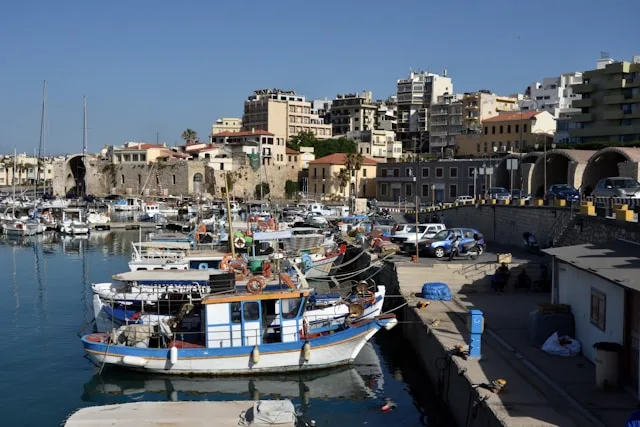
Heraklion Port Authority S.A. operates the port that anchors Crete's sea connectivity. The port's passenger terminals can process more than 10,000 passengers and crew in a day, and up to five cruise vessels can be berthed simultaneously at its central piers. Cruise traffic set a record in 2024 (518,575 passengers on 266 calls) and rose again in 2025 (536,543 passengers on 281 calls). On the cargo side, Heraklion is not a deep-sea container terminal: the island's goods move overwhelmingly as accompanied and unaccompanied Ro-Ro units on the ferry corridor from Piraeus, which makes the port's freight business inseparable from the ferry schedule itself.
The ownership of that gateway has changed hands. On 18 December 2023, Greece's privatisation fund HRADF signed the sale of 67% of Heraklion Port Authority S.A. to Holding of Heraklion Port S.A., a vehicle formed by Grimaldi Euromed and Minoan Lines, for €80 million. Completion was announced on 19 September 2024, with HRADF retaining the remaining 33%. Emanuele Grimaldi framed the acquisition around an ambitious investment programme: leveraging Heraklion's strategic position in the Eastern Mediterranean, developing passenger and freight flows including cruise and vehicle shipments, and making the port a model green port for the Mediterranean.
Two lines of that agenda translate directly into roles. The first is electrification: the port is pursuing on-shore power supply through the ElectriPort project, which is preparing the studies and engineering designs for OPS at Heraklion with partners including Wärtsilä, in the run-up to the EU requirement for on-shore power at TEN-T ports from 1 January 2030. The second is compliance and digitalisation: the regulatory stack described later in this article, covering emissions trading, cybersecurity and port-community systems, does not reduce the port's workforce requirement. It raises the qualification bar for nearly every technical role.
The Corridor Structure That Shapes the Talent Pool
The ferry market serving Heraklion is concentrated to a degree that directly determines how talent moves, what it costs and where it goes. In August 2023 the Hellenic Competition Commission cleared the absorption of ANEK Lines by Attica Holdings, the group behind Superfast Ferries, Blue Star Ferries and Hellenic Seaways, and 2024 was the first year Attica reported results with ANEK integrated. The Piraeus to Heraklion passenger corridor today is operated under the Attica umbrella. Minoan Lines, majority-owned by the Grimaldi Group since 2018, has stepped back from the Crete passenger corridor as a brand, and Grimaldi has redeployed vessels such as Knossos Palace into freight-focused operations on the same route, a tonnage swap the trade press reported was aimed at raising freight capacity on Piraeus to Heraklion by roughly 30%.
The result is an employer landscape in which senior maritime and logistics careers on Crete are made within a very small number of institutions: the Attica-group operators on the corridor, the Grimaldi-owned port authority itself, Grimaldi's freight operations, SeaJets as the dominant high-speed operator in the Aegean, and a thin layer of local freight forwarders, warehouse and cold-store operators. When one of these employers loses a port operations manager or a cold-chain specialist, the realistic shortlist is drawn from the same handful of organisations. The pool recirculates rather than grows.
The outward pull is structural. Athens and Piraeus concentrate Greece's shipping cluster, its head offices and its pay scales, and mainland pay for equivalent logistics and maritime titles runs visibly above island pay; that differential is the standard context for counter-offers in every senior Cretan search. Limassol adds a second pull with a different mechanism: Cyprus's non-domiciled regime exempts qualifying residents from special defence contribution on dividend and interest income for up to seventeen years, a package internationally mobile maritime executives weigh alongside role scope. How many mid-career specialists Crete loses to Athens and Limassol each year is not measured by any public statistic we could locate. KiTalent's read, formed in searches rather than surveys, is that the outflow is material, and we record the exact volume as an open question rather than put a number on it.
The Labour Market: No More Slack, and No Specialist Bench
The unemployment frame most outside organisations still carry for the Greek islands is out of date. Eurostat's regional series shows Crete's unemployment rate falling from 12.1% in 2022 to 10.8% in 2023, 8.6% in 2024 and 5.1% in 2025, below the EU average of 6.0% and below Attiki's 8.1% in the same year. Greece as a whole followed the same path, from 11.1% in 2023 to 8.9% in 2025. The slack labour pool that once made island hiring look straightforward has been absorbed.
What remains is the shape of the scarcity. The roles the port's agenda now demands, from terminal and port-community system operators and cybersecurity-capable IT staff to GDP-trained cold-chain supervisors, ETS-literate marine engineers and dual-certified operations managers, draw on qualifications that take years to build and that the island's education and training provision produces only in small numbers. An unemployment rate can fall to a historic low without producing a single additional certified port operations manager. Aggregate tightness on top of specialist scarcity is the mismatch that defines this market.
The training pipeline explains part of it. Crete does train deck and engine officers: the Merchant Marine Academy of Crete, founded in 1963, operates from Souda in Chania. The Hellenic Mediterranean University, headquartered in Heraklion, is a public university with a strong engineering and technology orientation. What the island does not have is a dedicated university-level maritime studies or port logistics department; Greece's university provision in shipping concentrates in Athens, Piraeus and the Aegean. Graduates who want port-side careers mostly build them off the island, and the distance between a new graduate and an ISM-, ISPS- and GDP-certified professional is measured in years, not semesters.
Geography: One Road Corridor, No Rail, a New Airport Coming
Crete has no railway, and none is coming: the revised trans-European transport network regulation adopted in 2024, which maps the TEN-T network to 2050, includes no rail on the island. Every container, pallet and refrigerated load that leaves Heraklion moves by road.
Road capacity is improving on a longer timeline than often assumed. The concession for the new northern road axis, VOAK, covering the roughly 157-kilometre Chania to Heraklion section led by a GEK Terna-headed consortium, commenced on 30 January 2026 with a construction programme of about five years, and 2026 industry reporting already pointed to slippage toward 2029, with Heraklion-area bypass sections opening in phases. At the end of January 2026, contracts were also signed advancing the new Kastelli airport that will replace Heraklion's current airport, a project that will add construction-period and then operational logistics demand on top of the port's.
For hiring leaders, the infrastructure picture matters because it shapes every logistics role on the island. A supply chain director in Heraklion is managing a system where weather, a road incident or a missed sailing cascades through the island's food and pharmaceutical supply in hours, with no rail alternative and a road network at its seasonal limit in August. The role demands a different profile than the same title in Piraeus or Thessaloniki.
Regulatory Pressure and What It Means for Every 2026 Hiring Decision
The regulatory environment bearing down on Heraklion's port and maritime sector is not background context. It is the primary driver of the skills profile this market now demands, and in 2026 it intensifies.
The most consequential change is the completion of the EU Emissions Trading System's maritime phase-in. Since 2024, ships of 5,000 gross tonnes and above have had to surrender allowances for intra-EU voyage and at-berth emissions: 40% of verified emissions in 2024, 70% in 2025 and 100% from 2026. For the ferry operators serving Crete, 2026 is the year the full obligation lands. Someone on the island side of each operation must own monitoring, reporting and allowance management, and engineers who understand both vessel systems and carbon accounting are scarce across southern Europe, not only in Greece.
The second pressure is cybersecurity. The NIS2 directive, which member states were required to transpose by 17 October 2024, classifies transport, explicitly including ports, among its critical sectors, with port authorities and operators designated as essential or important entities subject to risk-management and incident-reporting duties. Port community systems, customs interfaces and terminal operating systems all sit inside that perimeter. The skills required to secure those systems differ from those required to operate them. Heraklion needs both categories and produces neither locally at scale.
Third, the port services and electrification agenda. The EU Port Services Regulation, 2017/352, sets the framework for market access to port services and for the financial transparency of ports, and it frames the technical-nautical services around any port of Heraklion's size. On-shore power is the nearer-term programme: EU rules require OPS at TEN-T ports from 1 January 2030, and the ElectriPort project is Heraklion's vehicle for getting there. Each of these programmes converts into a specific hiring requirement: a compliance engineer for ETS, a security lead for NIS2 obligations, an electrification project engineer. The roles compound while the pool does not.
What Roles Cost: Designing Compensation Without a Local Benchmark
Here is the part of this market that surprises budget-holders most: there is no published, Heraklion-specific salary survey for port and logistics roles. The figures that circulate anecdotally are drawn from Athens and Piraeus benchmarks, and the mainland premium for equivalent titles is real and visible in every counter-offer situation. But an organisation that anchors a Heraklion mandate to an Athens salary grid will either overpay structurally or, far more often, underprice the relocation and lose the only viable candidate in the process.
The practical approach is to benchmark each mandate individually: the Athens or Piraeus market rate for the title, adjusted for the island's cost of living, the scope premium of running an island operation with no institutional bench behind it, and the relocation package, from housing support to a credible career narrative, that makes the move rational for a mainland or Limassol-based professional. Compensation for these roles is a design question, not a lookup.
Why Conventional Search Methods Underperform Here
Three characteristics of this market make standard recruitment approaches structurally weak. The first is the passive-candidate ratio. The specialists who can credibly run port operations, cold-chain compliance or ETS reporting on Crete are few, employed, and not browsing job boards; a posting-based process reaches the residue of the market, not the market itself. The second is geographic isolation. The pool physically present and willing to stay is small and known to every employer; the pool that must be persuaded to relocate sits in Athens, Thessaloniki and Limassol, and moving them is a negotiation, not a transaction. The third is seasonality. The third-quarter peak compresses the effective hiring window, and an operations role unfilled by early summer is unfilled for the season.
The organisations that fill critical roles fastest in Heraklion are therefore not the ones with the best job advertisements. They are the ones with proactive talent maps built before the vacancy exists and with the outreach capability to approach employed specialists confidentially in a market where everyone knows everyone. In a market this small, the search must begin before the role opens.
What Hiring Leaders Operating in Heraklion Need to Do Differently
The organisations that will secure the maritime operations directors, cold-chain compliance engineers and port specialists this market needs in 2026 will share three characteristics.
They will treat the search as a relocation proposition, not a local hire. The candidate pool on Crete is thinner than the port's compliance-heavy trajectory requires. Every senior search should be scoped from the outset to include Athens and Piraeus, Thessaloniki and Limassol, with a package structured to make relocation rational: housing support, clear progression timelines and a quality-of-life narrative that offsets the salary differential.
They will begin the search before the role opens. With a tight labour market, a passive specialist pool and a compressed pre-season window, reactive hiring guarantees a missed season. Talent mapping conducted in the first quarter for a third-quarter peak-season role is the minimum viable timeline; organisations that hold a live map of the qualified specialists on and off the island can move within days when a vacancy arises.
They will use a search partner that understands both the sector and the geography. Heraklion is not a market where a generalist recruiter can produce results by mining a database. The certifications are niche, the employer base is small enough that confidentiality matters acutely, and the relocation conversation requires current intelligence about what competing offers look like in Athens and Limassol.
KiTalent's approach to executive hiring in industrial and maritime markets is built for this profile of challenge: a small, specialised candidate pool where direct identification of passive professionals and confidential outreach are not advantages but prerequisites.
For organisations recruiting maritime operations directors, cold-chain engineers or supply chain leaders for Crete, where specialist vacancies linger, the strongest candidates are invisible to job boards and verified market data is thin on the ground, start a conversation with our executive search team about how we source and deliver leadership talent in markets conventional methods cannot reach.
Frequently Asked Questions
What does the verified public record show about Heraklion's port?
Heraklion is Crete's principal ferry and cruise gateway, not a deep-sea container terminal; the island's cargo moves overwhelmingly as Ro-Ro units on the Piraeus corridor. Cruise traffic set a record of 518,575 passengers on 266 calls in 2024 and rose to 536,543 on 281 calls in 2025. Since September 2024, 67% of Heraklion Port Authority S.A. has been owned by a Grimaldi-led consortium with Minoan Lines, which paid €80 million and committed to an ambitious investment and green-port programme.
Why is it hard to hire logistics specialists in Heraklion when unemployment is falling?
Crete's unemployment rate fell to 5.1% in 2025, below the EU average of 6.0%, so the slack of the previous decade is gone. What remains is specialist scarcity: port and logistics roles demand certifications and systems experience, from ISM and ISPS to GDP cold-chain compliance, port community systems, NIS2-driven cybersecurity and ETS reporting, that the island's education and training provision produces only in small numbers. The employer base is concentrated in a handful of groups that recruit from one another.
How does Heraklion compete with Athens and Limassol for maritime talent?
On base salary it usually cannot. Mainland pay for equivalent titles runs visibly above island pay, and Limassol adds the pull of Cyprus's non-domiciled regime, which exempts qualifying residents from special defence contribution on dividend and interest income for up to seventeen years. Heraklion's realistic proposition combines the scope and autonomy of an island operation, quality of life on Crete and a structured relocation package, not a bidding war.
What are the most in-demand roles in Heraklion's port and logistics sector?
Port operations managers with ISM and ISPS grounding and Greek port-regulatory knowledge, cold-chain specialists with GDP compliance experience, marine engineers and technical superintendents able to own EU ETS compliance, cybersecurity-capable IT staff for NIS2-designated systems, and electrification project engineers for the on-shore power programme.
What regulatory changes affect Heraklion's port and maritime employers in 2026?
The EU ETS maritime phase-in completes in 2026: ships of 5,000 gross tonnes and above must surrender allowances for 100% of verified intra-EU voyage and at-berth emissions, after 70% in 2025 and 40% in 2024. NIS2, transposed from October 2024, brings ports into critical-infrastructure cybersecurity obligations. EU rules require on-shore power at TEN-T ports from 2030, which Heraklion's ElectriPort project is preparing. The Port Services Regulation (2017/352) continues to frame port-services market access and financial transparency.
Are there published salary benchmarks for Heraklion port and logistics roles?
No. We could locate no published Heraklion-specific salary survey for these roles, and the numbers that circulate are Athens and Piraeus benchmarks applied to an island market. Each mandate should be benchmarked individually against mainland rates, adjusted for cost of living, scope and relocation. The absence of a local benchmark is an open question the market should stop papering over with borrowed figures.
Related Links
- Heraklion
- Greece
- Patras Maritime Hiring: A Strategic Gateway With a Workforce That Cannot Keep Pace
- Volos Tourism and Marine Recreation: €42 Million in Infrastructure, Not Enough Leaders to Run It
- Volos Maritime and Logistics Hiring: Define the Mandate Before the Search
- Quebec City's Insurance Sector Cut Hundreds of Jobs and Still Cannot Hire the People It Needs
Related Market Reads
Articles tied to the same hiring geography or market context.
Patras Maritime Hiring: A Strategic Gateway With a Workforce That Cannot Keep Pace
Patras is a TEN-T core port on the Orient/East-Med corridor and the Greek anchor of the Motorway of the Sea link to Italy: 204,761 of the 207,422 freight units it handled in ...
Volos Tourism and Marine Recreation: €42 Million in Infrastructure, Not Enough Leaders to Run It
Volos funnels 3.5 million ferry passengers a year toward the Sporades islands, anchors 12 yacht charter operations in the Pagasetic Gulf, and serves as the primary service hub...
Volos Maritime and Logistics Hiring: Define the Mandate Before the Search
What the verified public record establishes about Volos - Greece's third-largest cargo port, founded 1893 at the head of the Pagasetic Gulf - and where a mandate needs contacted, assessed and validated candidates.
Nearby Market Signals
Lateral reads from adjacent cities, sectors, or themes.
Quebec City's Insurance Sector Cut Hundreds of Jobs and Still Cannot Hire the People It Needs
Quebec City's two largest insurers eliminated 450 administrative positions over a two year integration cycle. The headlines told a story of contraction. The recruitment data...
Milan Professional Services: Define the Practice and Delivery Mandate
How should a Milan professional-services firm define a mandate across regulated assurance, advisory, legal practice, data delivery and partnership economics?
Los Angeles Entertainment Hiring: Define the Mandate Before the Search
Which studio-production, games-and-interactive or music-and-recording responsibility actually defines an LA entertainment mandate?
From the Archive
Evergreen background reading that still sharpens current hiring decisions.
Volos Agrifood Cluster: Why €120 Million in New Capacity Cannot Find the People to Run It
Volos entered 2026 with more processing capacity under construction than at any point in the past two decades. Myloi Thessalias is commissioning specialty flour lines for...
Thessaloniki Technology Hiring: Define the Mandate Before the Search
Which nearshore-delivery, product-engineering or student-pipeline responsibility actually defines a Thessaloniki technology mandate?
Thessaloniki's Agri-Food Sector Has Invested Heavily in Infrastructure. The Workforce to Run It Has Not Followed.
Thessaloniki processed and exported €2.14 billion in agri food products through its port in the twelve months to March 2025. That figure rose 7.3% year on year, driven by olive...