The Capacity Ceiling: A Small Market at the End of the Corridor
Dubrovnik-Neretva is the smallest nautical county on the Croatian coast by marina income. Its nautical tourism ports recorded €10.6 million in income excluding VAT in 2025, up from €10.0 million in 2024 but still the lowest of the six coastal counties, against €48.4 million in Split-Dalmatia. The county held 560 vessels on permanent sea berths in 2025, 4.3 percent of Croatia's total, and its principal yacht facility, ACI Marina Dubrovnik at Komolac on the Rijeka Dubrovačka, is listed at 371 sea berths and 120 dry berths. This is a real market, but a small one, and it sits at the southern end of a charter corridor whose centre of gravity lies two counties north.
The national frame makes the capacity ceiling measurable. Croatia's nautical tourism ports numbered 216 in 2025 with 18,850 berths, down from 19,073 in 2024 and 19,131 in 2023. Average berth occupancy over the year was 68.7 percent in 2025, and 78.0 percent for sea berths, a figure that averages the full winter alongside the full summer. Capacity, in other words, has been contracting slightly while demand concentrates into fewer, fuller summer months. No public statistic reports peak-season occupancy for an individual marina; the annual averages are the verified measure.
Demand is volatile rather than compounding. In October 2025 the county's marinas recorded 3,222 nautical vessel arrivals, 20 percent more than in October 2024, and 27,403 nautical overnight stays, up 11 percent. In August 2026, nautical overnight stays in Dubrovnik fell 7 percent. A hiring plan built on an assumption of uninterrupted growth is assuming a trend the published monthly record does not show.
For an employer, the verified structure matters more than any growth story. The roles this market must fill - marina management, fleet technical leadership, certified marine engineering and electrical competence - sit on top of a fixed berth stock, a county-sized rather than national-scale labour pool, and a demand curve that swings by month. That is the frame a mandate here has to work inside.
The Infrastructure Ceiling: Heritage Protection and a Fixed Berth Stock
The Old City of Dubrovnik has been on the UNESCO World Heritage List since 1979, inscribed under criteria (i), (iii) and (iv), with the protected area extended in 1994 and a period on the List of World Heritage in Danger from 1991 to 1998. Development in and around the historic core is governed by that protection and by the city's conservation practice. What no published regulation or plan states is a fixed radius within which marinas or boatyards are prohibited. The operative constraint is simpler and measurable: the berth stock is fixed, and nationally it has been shrinking since 2023.
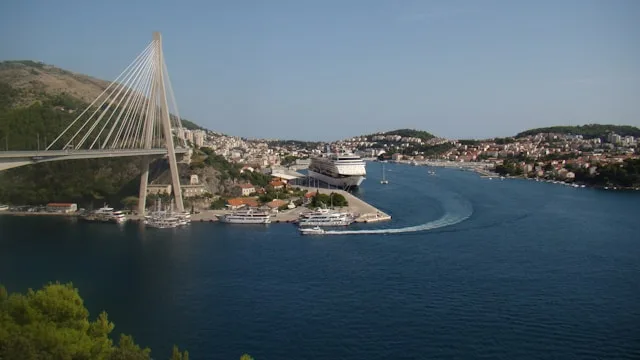
Where capacity is being added in Dubrovnik, it is seaport capacity rather than yacht capacity. The European Bank for Reconstruction and Development has financed the extension of the berth area in the Port of Gruž, the port that handles the city's passenger and cruise traffic, and the port authority's own project documentation describes new operational berths in the Batahovina area. That serves ships, not the charter fleet. On the marina side, the county's place in the national numbers - 4.3 percent of permanent sea-berth vessels, the lowest nautical-port income of the six coastal counties - is the verified picture of a market whose physical footprint is not growing.
Refit and boatyard capacity is the part of this market that no public series measures. No published statistic states how many lifting or refit facilities operate in the county, what share of heavy maintenance migrates to Split, Šibenik or Italian yards, or how much of the fleet winters outside it. For a fleet-technical mandate this absence is itself operational information: winter maintenance logistics have to be mapped firm by firm, because the record does not carry them.
Certification Gates and the Local Pipeline
What genuinely narrows the candidate pool here is certification. Marine electrical work at sea falls under the STCW convention's electro-technical officer standard, Regulation III/6, introduced by the 2010 Manila Amendments; senior engineering authority falls under Regulation III/2, which covers chief and second engineer officers on ships of 3,000 kW propulsion power or more. Holders are certified against international standards, move across flags, and are recruited internationally. The yacht and superyacht markets of the western Mediterranean bid for exactly the same papers.
The local pipeline exists and is older than most. Dubrovnik has educated seafarers at higher level since 1959, the institution became the Faculty of Maritime Studies in 1984, and it is now part of the University of Dubrovnik, founded in 2003. Its undergraduate portfolio runs from Nautical Studies and Marine Engineering to a dedicated Yacht and Marina Technologies programme, alongside electrical and communication technologies in maritime studies, with graduate study in Maritime Studies. That is a documented, degree-level pipeline aimed partly at exactly this sector.
What the public record does not carry is the arithmetic that used to be quoted about it. No published series states how many maritime graduates the university produces each year, how many stay in local employment, or what the sector's annual demand for new entrants is. The same applies to vacancy duration, passive-candidate shares and time-to-fill: no Croatian public statistic measures them for this market. The depth of the pipeline, and the competition for its graduates, must be established directly - which is precisely the work a mandate here depends on.
The employer base is a mix the record does support. International brands operate in the county: Sunsail runs a Dubrovnik base at ACI Marina Dubrovnik, and Sunsail and The Moorings are sister brands under Travelopia, the group acquired by KKR from TUI in 2017. Navigare Yachting also bases from ACI Marina Dubrovnik. Alongside them sits a domestic charter and marina-services sector whose staffing levels are not published individually. The verified point for a buyer is that this is a professionalised, internationally owned operator base rather than a cottage industry - and small enough that every senior hire is visible to the whole market.
Compensation: What No Public Series Shows
No public salary series exists for nautical roles in Dubrovnik - not for fleet technical directors, marina operations managers, or certified engineers. The figures that circulate for this market are unsourced, and the crew salary surveys that do exist publicly cover onboard superyacht positions by vessel size, not shoreside fleet and marina management in Croatia. Compensation for a mandate here is calibrated from comparable mandates, not quoted from a survey.
Two structures that are published do shape offers. The first is tax. Croatia taxes employment income at national rates of 20 and 30 percent, and since 2024 cities and municipalities set their own rates within statutory ranges. Montenegro, whose Porto Montenegro base in Tivat competes for the same Adriatic operators, taxes salaries progressively: no tax on monthly gross income up to €700, 9 percent from €700 to €1,000, and 15 percent above that, plus a municipal surtax. Montenegro is not a 9 percent flat-tax jurisdiction, and the real differential is narrower than often claimed - but for freelance skippers and technical contractors choosing where to base, it remains material.
The second is geography. Palma, Genoa and Athens concentrate year-round yacht employment - refit, management, crew services - on a scale the southern Adriatic does not match, and Croatian-certified engineers are mobile across that market. This is a structural competitive position, not a measured salary gap; no published comparison quantifies it. What a buyer can verify is that the local market is small, that the same certifications are bid for internationally, and that retention therefore has to be argued role by role.
Seasonality: The Verified Shape
The official employment measure shows the seasonal structure plainly. Croatia's nautical tourism ports employed 2,047 people in 2025, of whom 423 were seasonal - roughly a fifth of the sector's marina-side workforce taken on for the season on top of a year-round core. Demand concentrates accordingly: the ministry reports charter guests and vessel activity monthly, and the county's nautical traffic rose through 2025 before turning down in August 2026.
Beyond that, the winter picture is inference rather than record. It is consistent with how Adriatic charter operations are organised that vessels and their maintenance move toward winter facilities elsewhere, taking technical work with them. But no published series states what share of the county's fleet winters outside it, which roles convert to year-round contracts, or how many employers guarantee winter employment. Those are open questions a mandate should price in, not statistics it can quote.
Regulation: What Is Actually Changing
The verified regulatory layer for charter operators is digital reporting and safety, not a fleet-equipment shock. Croatia's e-Nautika portal already carries the nautical sojourn tax online together with vessel check-in and check-out and crew reporting, and charter companies register crew and passenger lists through the ministry's eCrew system before departure. A new Croatian maritime safety ordinance came into force in April 2025 with stricter rules on navigation and anchoring along the coast.
On shore power, the operative European instrument is the Alternative Fuels Infrastructure Regulation, which obliges ports rather than individual vessels to provide shore-side electricity, with milestones through 2025 and 2030 for passenger and container shipping at ports on the trans-European network. For marina operators this is an investment direction with real cost implications; no published figure states what electrification will cost an individual Croatian marina or operator, and any mandate that assumes a specific compliance bill is assuming a number that does not exist in the record.
What This Means for Hiring Leaders
This market rewards mandates built on its actual shape: a fixed berth stock, a small county-scale labour pool, internationally recognised certification gates, a documented local pipeline whose throughput is not published, seasonal employment structures, and an operator base with international owners. The senior roles - marina and fleet management, technical leadership, certified engineering and electrical competence - are few, visible to the whole local market when they open, and contested by employers beyond Croatia.
Because no public series measures vacancy duration, salary bands or candidate availability here, a conventional advertising-led search starts with no market data at all. The work that replaces it is direct: mapping the certified specialists and the operators who employ them across the southern Adriatic, establishing what the local pipeline actually produces by engaging with it rather than quoting it, and calibrating propositions against the tax and mobility structures that genuinely move candidates.
Timing follows the season, not the calendar year. Identification and approach work done before the pre-season window meets candidates before they are committed to summer contracts; the same work done in high season meets contractual obligations. That counter-seasonal logic is structural to every seasonal maritime market, and it is the single most controllable variable a hiring organisation owns here.
KiTalent's direct-search methodology is built for precisely these conditions. In markets defined by high passive-candidate ratios, niche certification requirements, and cross-border competition, the ability to identify and engage candidates who are not active in advertised channels is the difference between filling a critical role and operating without one.
For charter operators, marina management companies, and fleet services businesses competing for leadership talent on the Adriatic's most capacity-constrained stretch of coast, start a conversation with our executive search team about how a targeted, counter-seasonal search strategy can reach the candidates your competitors cannot.
Frequently Asked Questions
What does Dubrovnik's nautical sector actually consist of?
A county-scale market at the southern end of Croatia's charter corridor. Its nautical tourism ports recorded €10.6 million in income excluding VAT in 2025, the lowest of the six coastal counties, and held 560 vessels on permanent sea berths, 4.3 percent of the national total. The principal facility, ACI Marina Dubrovnik at Komolac, is listed at 371 sea berths. Nationally, Croatia's nautical ports held 18,850 berths in 2025, slightly fewer than in each of the two preceding years, with international charter brands operating alongside domestic operators.
Why is it hard to hire certified marine engineers in Dubrovnik?
Because the certifications are international and the pool is small. Electro-technical competence falls under STCW Regulation III/6 and senior engineering authority under Regulation III/2, and holders of both are recruited across the European yacht market, not only in Croatia. Dubrovnik's own Faculty of Maritime Studies, educating seafarers at higher level since 1959, runs programmes from Nautical Studies and Marine Engineering to Yacht and Marina Technologies, but no published figure states how many graduates it produces or how many the local sector absorbs. The constraint is structural; the arithmetic is not published.
How does Dubrovnik compare with Split for maritime employment?
On the verified record, Split-Dalmatia is the larger nautical county by every published measure: €48.4 million in nautical-port income in 2025 against Dubrovnik-Neretva's €10.6 million, 54,183 vessels in transit against a far smaller county figure, and 1,596 vessels on permanent sea berths against 560. Split is also Croatia's principal maritime-services centre. No public series compares salaries between the two markets; what the record does show is that the centre of the corridor's nautical employment sits two counties north of Dubrovnik.
What do nautical roles pay in Dubrovnik?
No public salary series exists for nautical roles in the county - not for marina management, fleet technical leadership or certified engineers. The published structures that shape offers are Croatia's employment-income tax rates of 20 and 30 percent, with locally set rates since 2024, and Montenegro's progressive schedule of 0, 9 and 15 percent plus a municipal surtax across the bay. Compensation for a specific mandate is calibrated from comparable searches, not quoted from a survey.
What regulatory changes affect Dubrovnik's charter operators?
Digital reporting and safety rules are the verified changes. Croatia's e-Nautika portal carries the nautical sojourn tax, vessel check-in and check-out and crew reporting online, charter crew and passenger lists run through the ministry's eCrew system, and a new maritime safety ordinance took effect in April 2025 with stricter navigation and anchoring rules. At European level, the Alternative Fuels Infrastructure Regulation obliges ports to provide shore-side electricity for passenger and container shipping on the trans-European network, with milestones through 2030.
Is year-round employment possible in Dubrovnik's yacht sector?
Partly, and the structure is documented rather than anecdotal. Nationally, 423 of the 2,047 people employed in Croatia's nautical tourism ports in 2025 were seasonal, so the sector keeps a year-round core everywhere it operates. What no published series shows is how many county employers extend senior staff through the winter, or how much of the local fleet winters elsewhere for refit. Year-round employment in a specific role is a question to put to the employers concerned, not a statistic the market publishes.
What the Public Record Does Not Show
Claims beyond the verified record are not repeated on this page. No public series exists for Dubrovnik-level nautical revenue by segment, peak-season berth occupancy at an individual marina, charter-fleet counts by county, maritime-graduate throughput at the University of Dubrovnik, nautical vacancy duration, salary bands, passive-candidate shares, boatyard and refit capacity, or the winter location of the county's fleet. The verified record - the national and county nautical-port statistics, the berth stock, the marina's listed capacity, the university's programmes, the certification framework, the tax schedules and the regulatory instruments named above - supports the structural argument. The hiring arithmetic must be argued from that structure and from mandates actually run, not quoted.
Sources
- Croatian Bureau of Statistics - Nautical tourism: capacity and turnover of ports, 2025
- Croatian Bureau of Statistics - Nautical tourism: capacity and turnover of ports, 2024
- Ministry of the Sea, Transport and Infrastructure - nautical tourism statistical reports
- University of Dubrovnik - university history
- University of Dubrovnik - faculties and study programmes
- Wikipedia - Dubrovnik (Old City UNESCO record)
- ACI Marinas - ACI Marina Dubrovnik (official marina record)
- PredictWind marina guide - ACI Marina Dubrovnik
- Sunsail - Dubrovnik yacht charter base
- The Moorings - heritage record (Travelopia and KKR ownership)
- Wikipedia - Electro-technical officer (STCW Regulation III/6 record)
- Edumaritime - STCW Regulation III/2, chief and second engineer officers
- PwC Tax Summaries - Montenegro, taxes on personal income
- PwC Tax Summaries - Croatia, taxes on personal income
- e-Nautika - Croatian nautical sojourn-tax, check-in and crew-reporting portal
- The Dubrovnik Times - Dubrovnik-Neretva County tourism, October 2025 (eVisitor data)
- The Dubrovnik Times - Dubrovnik nautical tourism, August 2026 (Dubrovnik Tourist Board data)
- Sustainable Ships - AFIR shore-side electricity requirements for ports
- EBRD - Port of Dubrovnik infrastructure modernisation project (Gruž berth extension)
Related Links
- Dubrovnik
- Croatia
- Zagreb Software Hiring: Define the Mandate Before the Search
- Osijek's Agri-Food Sector Produces Enough Graduates to Fill Every Vacancy. The Problem Is What Happens Next
- Zagreb Financial Services Talent: What the Verified Record Shows
- Quebec City's Insurance Sector Cut Hundreds of Jobs and Still Cannot Hire the People It Needs
Related Market Reads
Articles tied to the same hiring geography or market context.
Zagreb Software Hiring: Define the Mandate Before the Search
What the verified public record establishes about Zagreb's software economy - the Google-Photomath acquisition record and the 1669-founded university - and where a mandate needs contacted, assessed and validated candidates.
Osijek's Agri-Food Sector Produces Enough Graduates to Fill Every Vacancy. The Problem Is What Happens Next
Osijek's Faculty of Agrobiotechnical Sciences graduated 240 students in 2020/21 alone, yet Osijek-Baranja County has Croatia's highest unemployment rate. The problem is...
Zagreb Financial Services Talent: What the Verified Record Shows
The verified public record for Zagreb - Croatia's capital on the Sava whose economy hosts the national companies' headquarters, the only Croatian stock exchange and the highest per-capita output in the country - and what a financial-services mandate there must actually cover.
Nearby Market Signals
Lateral reads from adjacent cities, sectors, or themes.
Quebec City's Insurance Sector Cut Hundreds of Jobs and Still Cannot Hire the People It Needs
Quebec City's two largest insurers eliminated 450 administrative positions over a two year integration cycle. The headlines told a story of contraction. The recruitment data...
Milan Financial Services: Define the Regulated Business Mandate
Which regulated entity, product, control function and decision rights define a Milan financial-services mandate?
Los Angeles Entertainment Hiring: Define the Mandate Before the Search
Which studio-production, games-and-interactive or music-and-recording responsibility actually defines an LA entertainment mandate?
From the Archive
Evergreen background reading that still sharpens current hiring decisions.
Zagreb Electrical Engineering Hiring: Define the Mandate Before the Search
What the verified public record establishes about Zagreb's electrical-machines industry, the 1919-founded Končar anchor and its transformer record, and where a mandate needs contacted, assessed and validated candidates.
Zadar's Tourism Infrastructure Has Doubled Its Capacity. Its Workforce Has Not Kept Up.
Zadar Airport now handles two million passengers a year. The terminal expansion completed in late 2024 added fourteen winter routes where there had been nine. Cruise traffic...
Zadar's Seafood Boom Is Outgrowing Its Workforce: The Talent Crisis Behind the Export Numbers
Zadar County's seafood and agri food exports reached €78.4 million in 2024, an 8.3% increase year on year. Tuna farms off the islands of Ugljan and Dugi Otok shipped record...