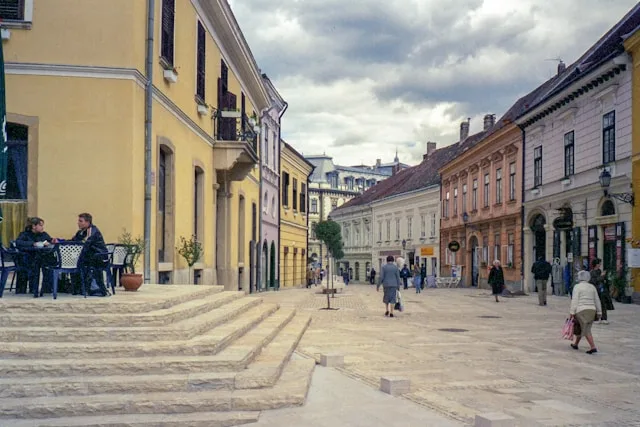
The Koralmbahn Effect: Infrastructure That Rewrites the Talent Map
It is not. Beneath the surface stability, two labour markets are forming inside a single sector. Traditional retail in the city lives with declining footfall, rising vacancies and online spending that now leaks roughly €79 million a year out of Klagenfurt's catchment, five times the 2010 figure, according to the city-commissioned retail study published in February 2024. Logistics and rail-corridor operations, anchored by the Koralmbahn line that opened for passengers on 14 December 2025, form the growing half. The skills required by the growing half of this market barely overlap with the skills released by the flat half. Hiring leaders who treat Klagenfurt's commerce sector as a single talent pool are misreading the market.
What follows is a structured analysis of the forces reshaping Klagenfurt's retail and logistics sector, the employers and infrastructure investments driving that change, and what senior leaders need to understand before they make their next hiring decision in this region.
The single most consequential development for Klagenfurt's commerce sector is not a new shopping centre or a retailer expansion. It is a railway. The Koralmbahn entered passenger service with the timetable change on 14 December 2025, after roughly 27 years of construction and around €6 billion invested in some 130 kilometres of new line, including the 33-kilometre Koralm tunnel. ÖBB's fastest Railjet-Xpress services now connect Graz and Klagenfurt in 41 minutes, and Vienna is down to 3 hours 10 minutes. That number reshapes everything.
For logistics, the implications are direct. Klagenfurt sits on the Baltic–Adriatic corridor, the axis that links Central Europe to the Adriatic ports of Trieste and Koper, both within roughly 200 kilometres of the city. The Logistik Center Austria Süd in Fürnitz, near Villach, already combines a rail terminal with a customs corridor toward Trieste, and Carinthia's development marketing now sells the region explicitly as a distribution hub between the Alps and the Adriatic. How much warehouse employment this actually adds around Klagenfurt is an open question rather than a settled fact. The corridor investment is real, but the region's most-publicised large logistics estate, a contested centre planned at Federaun near Villach, was never built and was abandoned in 2026 after zoning disputes and objections, with a data centre now proposed for the site instead. Hiring plans should follow verified commitments, not corridor maps.
A Labour Market That Moves in Two Directions
For the talent market, though, the Koralmbahn cuts both ways. It makes Klagenfurt more attractive as a logistics hub. It simultaneously makes Graz more accessible as a place to work while living in Carinthia. A supply chain director who previously had to choose between Klagenfurt's smaller market and Graz's larger one, a city of roughly three times the population with a broader base of corporate and industrial headquarters, can now commute in 41 minutes. The rail link does not just connect two cities. It integrates two labour markets.
This integration is asymmetric. Graz offers the deeper employer pool, the larger corporate structures and the broader internal career ladder; Klagenfurt offers lower living costs and lifestyle proximity to Wörthersee. For junior and mid-level staff, Klagenfurt's proposition may hold. For senior logistics executives, the Koralmbahn has made the Graz option accessible without relocation.
What This Means for Search Strategy
Any organisation hiring a senior logistics or supply chain leader in Klagenfurt now competes directly with Graz employers. The competitive set has widened overnight, and the compensation benchmarks that worked in 2024 may no longer hold. One honest caveat belongs here: no published survey compares supply-chain pay between Graz and Klagenfurt directly, so whether Graz employers pay a systematic premium for these roles is a question each hiring organisation should benchmark for itself, before an offer is made rather than after one is declined.
Retail Stability Is Real, but Its Foundation Is Fragile
Klagenfurt's physical retail sector does not look distressed. City Arkaden, opened in 2006 and managed by ECE Projektmanagement, holds around 120 shops on roughly 37,000 square metres and recorded 4.9 million visits in 2024 with 97 per cent occupancy, according to its owner Deutsche EuroShop. What the headline figures hide is the pressure underneath. The Wirtschaftsstrukturanalyse Klagenfurt, conducted by the CIMA consultancy and presented in February 2024, found declining customer frequencies, prominent store closures and a growing number of vacant premises, with the city's traders described as pushed to the edge of existence by successive crises. Klagenfurt has 3.8 square metres of retail space per resident, nearly double the density of Graz or Innsbruck, and only 85 per cent of the €686 million of local purchasing power was still being spent in the city, down from 93 per cent in 2010.
The Slovenian question is part of that fragility. Klagenfurt was still a very popular shopping destination for Italian and Slovenian customers in 2010, the CIMA study records, but consumers from the border regions increasingly stay at home, and the study's remedy was a marketing offensive in Slovenia and Upper Italy to win them back. Slovenia itself now has one of the densest shopping-centre landscapes in Europe, which keeps more of that spending on the Slovenian side of the border.
At the same time, e-commerce keeps taking share. Thirteen per cent of retail-relevant consumer spending in Austria now flows to online retail, a record, according to the Handelsverband's E-Commerce Study Austria 2026, compiled by KMU Forschung Austria. City Arkaden increasingly functions as a showroom for purchases completed online. This compresses margins for non-anchor tenants without reducing the staffing requirements of physical operations.
The hiring implication is specific. Traditional retail is not collapsing, but it is not growing. The roles being created sit at the intersection of physical and digital commerce: omnichannel retail managers who can integrate POS systems with e-commerce fulfilment, and professionals fluent in SAP Commerce Cloud or Salesforce integrations. These roles did not exist in Klagenfurt's retail sector five years ago. The people qualified to fill them are scarce, and they are not responding to job advertisements.
The Three Shortage Categories That Define This Market
Three role categories exhibit severe scarcity in Klagenfurt's commerce sector, and each shortage has a different structural cause. Understanding the distinction matters because a single recruitment approach will not address all three.
Commercial Vehicle Drivers
CE-category licensed drivers remain in acute deficit across all of Austria: the vida transport union estimated in 2025 that around 8,000 truck and bus drivers are missing nationwide, and that one in five drivers now working will retire within ten years. The recruitment levers, though, are narrower than the industry asks for. Professional drivers are not on the federal 2026 shortage-occupation list under the Fachkräfteverordnung, so the simplified Red-White-Red Card route for listed occupations is closed to them. Hiring a third-country driver as a key worker instead requires a minimum gross salary of €3,465 per month plus special payments at 2026 thresholds, a points-based assessment, and a labour-market test. German is not formally required on that route, since language certificates only earn points, but the salary floor and the labour-market test set a real limit on international supply. The pipeline is thin at both ends: replacement demand is demographic and large, and the regulatory route for new supply is constrained.
Warehouse Operations Managers
Warehouse specialist roles sit where the corridor buildout meets the training pipeline. No public statistic measures average vacancy duration for warehouse roles in Klagenfurt's industrial zones, and any number quoted to that precision should be treated with caution. The structural gap is nonetheless identifiable: professionals who can deploy and optimise warehouse management systems in fulfilment environments that did not exist in Klagenfurt until the corridor expansion began. These are not entry-level warehouse staff. The demand was created by infrastructure investment. The supply was not.
Omnichannel Retail Managers
This is the role category where reach, not scarcity alone, is the problem. No published Austrian survey quantifies the passive-to-active ratio for supply chain directors and omnichannel transformation leads, and precise ratios quoted in market commentary are estimates rather than measurements. The mechanism, however, is well established: these professionals typically hold long tenure with current employers and do not respond to posted vacancies, while active applicants in this category often signal distressed employment situations rather than quality availability. Reaching the right people requires direct search methodologies that go well beyond conventional advertising.
For organisations facing the challenge of reaching candidates who are not visible on any job board, the distinction between an active and passive recruitment strategy is not theoretical. It is the difference between a search that succeeds and one that stalls for months.
Compensation: Where the Gaps Are and Why They Matter
Public benchmark data for Klagenfurt's commerce sector is thinner than buyers expect, and honesty about that is part of useful benchmarking. Austria's national reference points are solid: the StepStone Gehaltsreport 2025 puts the national median full-time salary at about €3,900 gross per month, roughly €54,600 a year, with the average at €60,500, and user-reported pay for retail store managers centres near €47,700, spanning roughly €30,000 to €74,000 depending on format and region. Carinthia-specific bands for retail operations, supply chain and dealership leadership are not published, and the Vienna or Graz deltas quoted in market commentary are estimates, not measured figures. An organisation preparing a senior offer in this market should benchmark the specific role rather than import a generic regional discount.
At the executive and VP level the absence of public data is even sharper: no published series covers total cash compensation for retail-operations, supply-chain or premium-brand leadership in Klagenfurt. Treat any precise euro band quoted without a live, role-specific basis as a negotiating position, not a fact.
The more interesting dynamics sit in the exceptions, and each is an open question rather than a settled number. Do Slovenian-speaking logistics executives command a scarcity premium? The logic is real, because bilingual German and Slovenian capability matters for cross-border customer management and customs coordination and the pool combining language competence with senior logistics experience is narrow, but no published series measures the premium. Are regional dealership groups paying large signing bonuses to move after-sales managers between competitors? Anecdote says yes; public data does not exist. What is certain is the consequence: money of that kind redistributes existing professionals rather than creating new ones, and headline averages understate what it actually costs to move a qualified candidate.
The risk of losing a preferred candidate to a counteroffer from their current employer is elevated in any market this tight. When a scarce after-sales manager receives a competitive offer, the current employer can often match or exceed it, because the cost of replacement is higher still.
The Skills Pipeline Mismatch: Infrastructure Leads, Education Follows
Klagenfurt's infrastructure investment has outpaced its educational pipeline. The Koralmbahn has created demand for intermodal freight specialists and rail-cargo technicians. The corridor around Fürnitz needs operations managers with WMS expertise. Cross-border logistics needs bilingual customs professionals. Carinthia's vocational system, shaped for decades by the region's tourism economy, continues to produce most of its commercial-track graduates for retail, tourism and hospitality rather than logistics and fulfilment, and no published forecast sizes that gap precisely. What is verifiable is demographic: one in five professional drivers retires within a decade, while the corridor investments are already in service.
The capital moved. The curriculum did not.
This is not a shortage that compensation alone can solve. An employer cannot pay a premium for a rail-cargo technician who does not exist in the regional labour market. The apprenticeship pipeline is training the workforce for the segment of commerce that is flat or declining, while the segment that is growing has no feeder system of comparable size. The vocational institutions producing graduates in these fields have not scaled to match the corridor.
The implication for hiring leaders is stark. For the next two to three years, every senior logistics and fulfilment hire in Klagenfurt will plausibly come from one of three sources: relocation from Graz or Vienna, lateral moves from competitors within Carinthia, or cross-border recruitment from Slovenia. None of these sources is easy. Relocation requires overcoming the pay differential. Lateral moves require outbidding incumbents who are themselves scrambling to retain. Cross-border recruitment requires navigating the tax and certification questions that make Ljubljana an attractive alternative.
Organisations that wait for the pipeline to catch up will wait too long. Those that invest in proactive talent pipeline development now will have a material advantage as the Koralmbahn corridor reaches full operational scale.
The Cross-Border Calculus: Slovenia as Competitor, Not Just Customer
Most discussions of Klagenfurt's cross-border dynamic focus on Slovenian shoppers as a source of retail revenue. That framing is incomplete. Slovenia is also a competitor for the bilingual professionals that Klagenfurt's commerce sector needs most, and the tax comparison usually made in this debate is frequently misstated.
Slovenia does not have a 16 per cent flat income tax. Slovenian employment income is taxed progressively, from 16 per cent on the lowest bracket to 50 per cent on income above roughly €82,000. Austria's top marginal rate is 50 per cent; the 55 per cent rate applies only to annual income above one million euros. For a senior logistics professional weighing Klagenfurt against Ljubljana, the marginal-rate difference between the two countries is therefore far smaller than the folk comparison suggests. The real differences sit in gross salary levels, social-security contributions and cost of living, and the net-of-tax calculation, run properly, does not always favour the Austrian side. Whether Klagenfurt employers systematically lose bilingual candidates to Ljubljana-based logistics providers is an open question; no published measurement exists. The direction of the pressure is nonetheless visible in the corridor itself: the second tube of the Karawanken tunnel opened in March 2026, and even with the old tube under renovation in single-tube operation until around 2029, the road link between Carinthia and the Ljubljana basin keeps tightening.
This competition intensifies at exactly the seniority level where Klagenfurt's need is greatest. A warehouse operative may prefer the Austrian gross salary. A customs clearance specialist or cross-border e-commerce manager with ten years' experience runs a different calculation. The professionals who have the most options are the ones hardest to attract, and their options now span two countries an hour apart.
For any organisation that needs to fill a senior commercial or logistics role requiring Slovenian language competency, the search cannot be confined to the Austrian market. It requires international executive search capability that maps the talent pool across both sides of the border and builds a proposition that addresses the specific factors driving candidate decisions: net income, career trajectory, and the quality of the role itself, not merely the salary attached to it.
Understanding what makes an executive candidate choose one opportunity over another is essential in a cross-border market where the financial variables are this finely balanced.
What Hiring Leaders in This Market Need to Do Differently
The conventional approach to hiring in Klagenfurt's commerce sector has relied on job advertisements, regional recruitment agencies, and the assumption that a competitive salary will attract sufficient applicants. That approach still works for retail sales associates and last-mile delivery drivers. It does not work for the roles that determine whether a logistics expansion succeeds or an omnichannel transformation delivers results.
If the senior candidates in this market are predominantly passive, and every signal from comparable markets says they are, then job postings reach only the small, actively looking fraction of the viable pool. The rest are employed, performing well, and not monitoring job boards. Reaching them requires a direct approach using talent mapping and executive identification before a vacancy becomes urgent.
An extended vacancy in warehouse operations management is not merely a staffing inconvenience. It is a commercial risk. A fulfilment centre that cannot staff its operations management layer cannot optimise its WMS deployment. That delays throughput improvements, increases per-unit handling costs, and undermines the business case for the logistics investment itself. The cost of a prolonged vacancy at this level is not the recruitment fee. It is the operational performance gap that compounds every week the role sits empty. Organisations that have experienced the true cost of a failed or delayed senior hire understand this calculation intimately.
Speed matters because candidates in a small talent pool may receive multiple approaches. Move from identification to engagement without avoidable delay.
If your organisation is navigating the specific combination of logistics expansion, cross-border competition, and omnichannel transformation that defines Klagenfurt's commerce sector in 2026, where the candidates who matter most are passive, bilingual, and choosing between two countries, start a conversation with our executive search team about how we approach this market.
Frequently Asked Questions
What is the average salary for a supply chain director in Klagenfurt?
No published benchmark covers supply-chain director pay in Klagenfurt specifically. Austria's national references are the StepStone Gehaltsreport 2025 median of roughly €54,600 gross per year, an average of €60,500, and user-reported retail store management pay centred near €47,700; executive supply-chain bands in Carinthia must be benchmarked role by role. Commonly quoted Vienna and Graz differentials for this market are estimates rather than measured figures. For a current compensation benchmarking analysis specific to this market, specialist guidance is advisable.
How has the Koralmbahn affected hiring in Klagenfurt?
The Koralmbahn entered passenger service on 14 December 2025. ÖBB's fastest services connect Graz and Klagenfurt in 41 minutes, and Vienna is down to 3 hours 10 minutes, positioning Klagenfurt on the Baltic–Adriatic corridor toward the ports of Trieste and Koper. For hiring, two effects dominate: corridor-linked logistics demand around the region, and the integration of the Graz and Klagenfurt labour markets, meaning Klagenfurt employers now compete directly with Graz's larger employer base for senior talent. How much new warehouse employment the corridor creates around Klagenfurt remains an open question.
Why are warehouse specialist roles so hard to fill in Klagenfurt?
The gap is structural rather than statistical. Carinthia's vocational system produces most of its commercial-track graduates for retail, tourism and hospitality rather than logistics and fulfilment, so employers seeking WMS implementation experience must recruit from Graz, Vienna, or cross-border from Slovenia. No public statistic measures vacancy duration for these roles in Klagenfurt, so precise duration figures quoted for this market should be treated with caution and searches planned conservatively.
What roles are hardest to hire for in Klagenfurt's retail and logistics sector?
Three categories exhibit the most severe scarcity. CE-category commercial vehicle drivers: Austria is short an estimated 8,000 truck and bus drivers, and the occupation is not on the 2026 shortage-occupation list, which narrows third-country recruitment to the key-worker route with its salary floor and labour-market test. Warehouse operations managers with WMS experience are scarce because demand was created by recent corridor investment without a corresponding training pipeline. Omnichannel retail managers who can integrate POS systems with e-commerce fulfilment are predominantly passive candidates, making them effectively unreachable through conventional job advertising.
How does cross-border competition with Slovenia affect executive hiring in Klagenfurt?
Slovenia competes directly for bilingual German-Slovenian professionals. The tax contrast is often overstated: Slovenia taxes employment income progressively from 16 to 50 per cent, with the top rate starting above roughly €82,000, while Austria's top marginal rate is 50 per cent and the 55 per cent rate applies only above one million euros. The decisive variables are gross salary, social contributions and cost of living, and the net calculation does not always favour Austria. No published measurement exists for how many bilingual candidates Klagenfurt loses to Ljubljana-based providers, but the opening of the second Karawanken tunnel tube in March 2026 keeps tightening the corridor. Effective executive search in this market must map talent across both sides of the border.
How can KiTalent help with executive hiring in Klagenfurt's commerce sector?
KiTalent uses direct headhunting to identify and engage passive senior candidates who do not appear on job boards. In a market where most supply chain directors and omnichannel leaders are not actively seeking roles, this methodology reaches candidates that conventional recruitment may miss.
Related Links
- Klagenfurt
- Austria
- Food Beverage Fmcg
- Wels Machinery Hiring in 2026: Why the Firms That Built This Sector Cannot Recruit the People to Run It
- Wörthersee Hospitality Hiring: Define the Mandate Before the Search
- Wels Trade Fair Talent: What the Verified Record Shows
- Quebec City's Insurance Sector Cut Hundreds of Jobs and Still Cannot Hire the People It Needs

Published March 2026, updated 2026-10-08. Based on primary market sources and KiTalent's market-intelligence process.
Related Market Reads
Articles tied to the same hiring geography or market context.
Wels Machinery Hiring in 2026: Why the Firms That Built This Sector Cannot Recruit the People to Run It
Upper Austria's machinery and metalworking sector produced more revenue per capita in 2025 than any comparable industrial region in the EU outside Bavaria. The Linz Wels Steyr...
Wörthersee Hospitality Hiring: Define the Mandate Before the Search
What the verified public record establishes about the Wörthersee - Carinthia's largest lake, from Klagenfurt to Velden - its documented tourism competition and niche repositioning, and where a mandate needs contacted, assessed and validated candidates.
Wels Trade Fair Talent: What the Verified Record Shows
The verified public record for Wels - Austria's eighth-largest city on the Traun near Linz, famous for a fair held every spring and autumn on Roman Ovilava's site - and what an exhibition-economy mandate there must actually cover.
Nearby Market Signals
Lateral reads from adjacent cities, sectors, or themes.
Quebec City's Insurance Sector Cut Hundreds of Jobs and Still Cannot Hire the People It Needs
Quebec City's two largest insurers eliminated 450 administrative positions over a two year integration cycle. The headlines told a story of contraction. The recruitment data...
Milan Financial Services: Define the Regulated Business Mandate
Which regulated entity, product, control function and decision rights define a Milan financial-services mandate?
Hangzhou's E-Commerce Talent Market Has Split in Two: Why the Roles That Were Cut Are Not the Roles That Need Filling
Alibaba's "1+6+N" restructuring eliminated or relocated more than 20,000 positions across China between 2023 and 2024. The headlines said Hangzhou's tech sector was contracting...
From the Archive
Evergreen background reading that still sharpens current hiring decisions.
Wels Logistics: €400 Million in Infrastructure, and Not Enough People to Run It
Upper Austria's logistics hub is building faster than it can hire. Wels, the inland freight node sitting at the junction of the A1 and A8 motorways, processed roughly 2.5...
Villach Semiconductor Hiring: Define the Mandate Before the Search
Which fab-operations, process-engineering or equipment responsibility actually defines a Villach semiconductor mandate?
Villach Tourism and Wellness Talent: What the Verified Record Shows
The verified public record for Villach - Carinthia's second city at the Alpe-Adria crossroads, whose Warmbad hot spring has served visitors since Roman times - and what a tourism-and-wellness mandate there must actually cover.