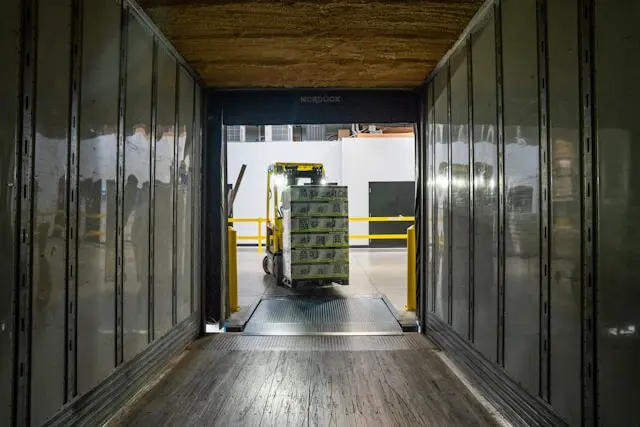
Yet the market that looks healthy in aggregate is fracturing under the surface. The qualified driver pool that moves freight in and out of these sites is contracting nationally rather than growing: the Road Haulage Association warned in September 2025 that the UK may have lost more than 117,000 qualified HGV drivers in twelve months, with an ageing workforce compounding the loss — trade reporting puts the share of employed UK drivers aged 50 and over at nearly half. No reliable published count exists of logistics vacancies specifically within Leeds or West Yorkshire; what a Leeds hiring leader actually faces is a shrinking national pool, competed for by every distribution market on the M62 corridor and in the Midlands. The picture beneath the headline investment is one where demand has structurally outpaced the talent base.
What follows is an analysis of the forces reshaping Leeds logistics and distribution, the collision between automation investment and the workforce available to support it, and what senior leaders responsible for hiring in this sector need to understand before they commit to their next search. The central argument is this: the investment in warehouse automation across Leeds has not reduced the need for people. It has replaced one category of worker with another that does not exist in sufficient numbers. Capital moved faster than human capital could follow, and the consequences are increasingly visible in every search that matters.
The Northern Logistics Triangle and Why Leeds Sits at Its Centre
Leeds' position in the UK logistics network is a function of geography, infrastructure, and historical investment. The city sits at the intersection of the M1 (north-south) and M62 (east-west) motorway corridors. The ONS has estimated that the Midlands 'golden logistics triangle' lies within a four-hour drive of 90% of the British population — and that Yorkshire and The Humber, immediately to its north, was the largest destination for warehouse spending outside it, at 16% of the UK total. That is the connectivity case for Leeds: close enough to the triangle to serve the same national demand, far enough north to anchor distribution into Scotland and the North East.
The operator footprint reflects that case. GXO Logistics — which acquired Leeds-founded fashion and e-commerce fulfilment specialist Clipper Logistics in 2022 — operates a large distribution site at Sherburn-in-Elmet, currently serving Sainsbury's. Amazon launched its £500 million Amazon Robotics fulfilment centre at Gateway45, Cross Green, in August 2024, with more than 2,000 jobs, and runs sortation operations in east Leeds. National 3PLs, parcel operators and grocery distribution sit alongside them along the Aire Valley corridor and around Thorpe Park at Junction 46 of the M1.
Amazon's Gateway45 centre is the clearest signal of the direction of investment across this market. It is a robotics building: an Amazon Robotics fulfilment centre in which picking and sorting are organised around automated storage and robotic handling rather than manual travel across a warehouse floor. The robotics designation matters. It signals where new capital is going — toward automation, toward technology-intensive operations, and toward a workforce profile that bears little resemblance to the one the sector employed five years ago.
But the hypothesis that Leeds Bradford Airport contributes meaningfully to this logistics cluster does not hold up under scrutiny. LBA handles negligible freight volumes. East Midlands Airport, by contrast, is the UK's busiest pure-cargo airport, handling hundreds of thousands of tonnes a year, and it anchors the triangle's air-freight capability. Leeds remains passenger-focused at its airport, which limits the city's ability to capture high-value air freight e-commerce in pharmaceuticals and electronics. For senior hiring decisions in the industrial and manufacturing sector, this distinction matters: the talent drawn to Leeds will be ground logistics talent, not air cargo talent.
Where the Land Runs Out and What That Means for Hiring
The single most underappreciated feature of the Leeds property market is not a simple shortage of space — it is a mismatch between what is available and what national occupiers need. In its July 2026 review of the Yorkshire and North East logistics market, Savills recorded 1.88 million sq ft of take-up in the first half of 2026 across ten deals, with available warehouse space up 25% year on year to 12.3 million sq ft and a regional vacancy rate of 11.49%. Yet the same review identifies the defining constraint: limited XL availability, with only one available unit over 500,000 sq ft in the region. Of the space that is available, 39% is Grade A speculative development and 17% second-hand Grade A — while the big-box segment that fulfilment networks are actually built around remains close to empty.
The Quality Mismatch Behind the Vacancy Rate
A headline vacancy rate in double digits superficially suggests abundant supply. The figure is misleading. Availability has grown in mid-size and second-hand stock, much of it outdated, while demand concentrates on prime, energy-efficient big-box units along the M1/A1(M) corridor. The vacancy rate describes one market. The demand describes another. They barely overlap.
For hiring leaders, this property picture has a direct talent implication. Operators who cannot secure the Grade A big-box space they want must either intensify operations within existing footprints — which requires automation expertise that few candidates possess — or run older, less efficient stock that demands more labour per unit of throughput and more management attention per pound of margin. Either path leads to a harder search.
The Planning Pipeline as Release Valve
The planning system's main answer for east Leeds is the East Leeds Extension, an allocation of land around the eastern edge of the built-up area that Leeds City Council expects to deliver around 5,000 new homes alongside employment land, unlocked by the new East Leeds Orbital Road. It is housing-led, and its employment land comes forward over years rather than quarters — no rapid release of logistics space for a market that wants it now. At Skelton Grange, on the former power-station land, regeneration developer Harworth Group secured planning consent in November 2023 for up to 800,000 sq ft of industrial and logistics space within a scheme expected to reach around 1.5 million sq ft once complete — the city's large-unit industrial pipeline closest to delivery. Since then the site has been redirected rather than built out: in 2024 Harworth sold 48 acres of it to Microsoft for a hyperscale data centre, retaining 16 acres for 250,000 sq ft of employment space, and in April 2026 Leeds City Council's planning committee approved Microsoft's revised plans for the site — a full application for the data centre itself, with only outline permission for the remaining industrial and logistics space. That sale illustrates the scale of capital now competing for Leeds land, well beyond logistics itself.
The Automation Inflection Point That Is Rewriting Every Job Description
There is no published Leeds-specific forecast of warehouse automation adoption rates, and this page will not invent one. What is verifiable is the direction: the largest facility investment in the market's history — Amazon's Gateway45 centre — is a robotics building, and the technologies it deploys, from automated storage and retrieval to robotic sortation, are now standard in new UK big-box development. What follows on skills is KiTalent's reading from mandate work in this market, not a published survey.
The demand for Warehouse Management Systems expertise illustrates the shift. Configuration experience in systems such as Manhattan Associates, Blue Yonder and SAP EWM, and integration experience with platforms in the AutoStore family, increasingly appear in senior operational job specifications — including in Leeds, where the new robotics-capable stock demands them. The pool of candidates who combine warehouse operations management with automation commissioning and WMS configuration experience is thin everywhere in the UK, and Leeds competes for it with the Midlands golden triangle and Coventry's automotive-automation base.
This is the central tension. Investment in automation assumes either that qualified workers will arrive from outside the region, or that the technology itself will substitute for labour rather than requiring higher-skilled labour to operate and maintain it. Neither assumption holds reliably. The national driver pool is contracting. Goods-to-person systems, autonomous mobile robots and automated sortation all require skilled technicians, integration engineers, and operations managers who understand both the technology and the supply chain context in which it operates. Whether the regional education and apprenticeship pipeline can produce those profiles at the rate the new Leeds stock demands is an open question no published data this page could find answers — and it is the question that should shape how organisations plan senior automation hires: build the pipeline deliberately, or pay to relocate the expertise.
Key Roles That Define the Shortage
HGV Cat C+E Drivers: A National Pool That Is Shrinking
The driver shortage is not new. What is new is its persistence and, on 2025 evidence, its acceleration. The Road Haulage Association warned in September 2025 that the UK may have lost more than 117,000 qualified drivers in twelve months. Trade reporting puts the share of employed UK HGV drivers aged 50 and over at nearly half, which means retirement outflow compounds every year that recruitment underperforms. No reliable published count exists of HGV vacancies specifically within West Yorkshire; what is verifiable is the direction of the national pool and the fact that Leeds operators recruit from it alongside every other market on the M62 and in the Midlands.
The structure of the candidate market compounds the problem. Drivers in this segment are largely employed and move through agency offers or direct approaches rather than job advertisements — which is why sustained advertising campaigns underperform direct search, and why signing bonuses alone rarely move a fleet's vacancy position for long.
At the executive level, KiTalent's indicative scoping ranges for the region — planning figures used when sizing mandates, not a published salary survey — sit around £52,000 to £68,000 plus car allowance for Fleet Manager roles, and £110,000 to £150,000 plus bonus and long-term incentives for Head of Transport and Director of Logistics positions.
Warehouse Operations Managers: The Search That Keeps Failing
The operations manager shortage in Leeds is quieter but arguably more damaging than the driver gap. Operations managers who have commissioned or run automated sites are scarce across the UK, and Leeds' new robotics-capable stock concentrates that scarcity. Conventional recruitment methods do not work for these profiles: they are employed, they are not scanning job boards, and they move through direct approaches and retained search rather than application.
Geographic competition takes an unexpected form here. Commuting-radius economics matter at this level: candidates weigh a Leeds salary against housing costs across South and West Yorkshire, and neighbouring cities offer comparable pay with cheaper housing within reach of the same motorway network. The cost of a failed senior hire in this market extends well beyond the search fee. It includes months of underperformance at automated facilities where the technology is present but the leadership to optimise it is not.
Senior Specialist Operations Manager roles for large sites typically scope at £48,000 to £62,000 plus bonus; Director of Operations positions covering multiple sites at £95,000 to £135,000 plus bonus and car — again, indicative scoping ranges rather than survey data.
The Post-Brexit Compliance Gap Nobody Planned For
Customs and trade compliance is the shortage that logistics firms expected to be temporary after Brexit and that has instead become structural. The most recent systematic evidence predates the current market but is unambiguous in direction: a Financial Times-reported survey of customs brokers and freight forwarders in September 2020 found that almost two-thirds did not have enough staff to handle the extra paperwork required to trade across the EU-UK border, and the UK's customs-intermediary sector has been recruiting against that deficit ever since. No Yorkshire-specific survey of declarant recruitment this page could find updates that picture with a current figure — the honest position is that the regional percentage is unknown, while the structural pressure it measures has not eased.
Leeds sits mid-tier in that national market. It is inland and port-free: it generates enough declarations work to need qualified declarants and customs managers, but not enough to sustain the deep specialisation pools that exist around the major ports and the Midlands. When traditional recruiting approaches fail in a specialist market like this, the most common outcome is not a longer search. It is the permanent relocation of the function to wherever the expertise already sits — and each departure makes the next local hire harder by reducing the critical mass of regional expertise.
Cost Pressures That Compress the Offer
The talent challenge in Leeds logistics does not exist in isolation. It operates against a backdrop of regulatory and economic pressures that squeeze the margins available to fund competitive compensation.
Employer National Insurance contributions rose from 13.8% to 15% from 6 April 2025, with the secondary threshold falling from £9,100 to £5,000. The change lands hardest on large, modestly-paid workforces such as distribution centres. As a worked example on the verified rates: for an employee on £28,000, employer NIC rises from £2,608 a year to £3,450 — about £840 more per employee. For a 500-person site, that is more than £400,000 a year, before the Employment Allowance reliefs available to smaller employers. The National Living Wage rose to £12.21 an hour from 1 April 2025 for workers aged 21 and over, lifting the floor across warehousing and transport roles and compressing the differential between entry-level and supervisory pay.
Bradford's Class C+ Clean Air Zone, live since September 2022, charges £50 per day for non-compliant HGVs — a cost any Leeds-based fleet serving Bradford must either absorb or engineer out of its vehicle fleet. Leeds itself scrapped its planned charging zone in 2020 after modelling showed nitrogen-dioxide compliance without it, but the neighbouring authority's scheme still affects Leeds fleets that cross the boundary daily.
E-commerce fulfilment economics remain thin, and statutory cost increases arrive on the same balance sheets as wage-floor rises. These pressures do not make hiring impossible. They make it harder to compete on compensation alone. When the margin for a higher offer is constrained, the approach to offer design must widen: total compensation design, relocation support, flexible working patterns, and career progression clarity all become differentiators where base salary alone cannot close the gap.
What This Market Demands From Senior Hiring Leaders
The emerging executive roles in Leeds logistics reflect the sector's transformation. Asda, headquartered in Leeds, appointed David Lepley as chief supply chain officer in January 2025, adding the role to its executive team — a signal that the city retains strategic supply-chain importance at grocery scale despite the operational challenges at facility level.
Director-level last-mile, automation and robotics leadership is where the scarcity concentrates. Director of Last Mile Innovation roles, managing micro-fulfilment centres and dark stores, typically scope at £85,000 to £120,000 in indicative terms. VP of Automation and Robotics candidates, overseeing major AMR deployment programmes, represent perhaps the scarcest executive profile in the region. They are typically recruited from automotive automation backgrounds in the Midlands or from European manufacturing technology firms. They do not appear on job boards. They do not respond to advertisements. They are identified and approached through direct headhunting methods because the pool is too small and too specialised for any other approach.
Green logistics expertise adds another layer. ISO 14001 implementation experience, electric vehicle fleet transition planning, and carbon accounting now appear regularly in senior logistics job specifications. This is not a decorative requirement. It reflects the ESG expectations of retailers and manufacturers who will only contract with operators demonstrating credible sustainability credentials. The leaders who can combine operational automation knowledge with environmental compliance fluency represent the most sought-after executive profile in this market.
The passive majority of senior talent in Leeds logistics is not hidden because these professionals are secretive. They are hidden because they have no reason to make themselves visible. A VP of Automation at a Midlands site will not see a Leeds-based posting and self-select into the process. They need to be found, assessed against the specific requirements of the role, and presented with a proposition that addresses not just compensation but the professional challenge, the relocation logistics, and the career trajectory that Leeds can offer.
For organisations competing for automation leadership and senior supply chain talent across industrial sectors in a market where the best candidates are not looking, start a conversation with our executive search team about how KiTalent approaches this market. In a market this constrained, method determines outcome.
Frequently Asked Questions
What is the average salary for a logistics director in Leeds in 2026?
No published Leeds-specific salary survey for logistics leadership exists that this page could verify. The honest way to answer the question is with clearly-labelled indicative scoping ranges of the kind KiTalent uses when sizing mandates: Director of Operations positions covering multiple sites typically scope at £95,000 to £135,000 plus bonus and car; Head of Transport and Director of Logistics roles at £110,000 to £150,000 plus bonus and long-term incentives; emerging positions such as Director of Last Mile Innovation at £85,000 to £120,000. These are planning figures, not measured market averages. KiTalent's market benchmarking service provides current compensation data specific to the role, seniority level, and geography you are hiring for.
Why is it so hard to hire warehouse operations managers in Leeds?
Because the role has changed faster than the candidate base. Leeds' newest facilities are robotics-capable buildings that demand operations managers who understand both supply chain management and automated systems integration — a combination the UK pipeline produces slowly and the Midlands golden triangle competes for aggressively. These candidates are largely employed and move through direct approaches and retained search rather than job applications. Commuting-radius economics across South and West Yorkshire add a further pull away from Leeds-bound roles.
How does Leeds compare to Manchester for logistics hiring?
Both markets sit north of the Midlands golden logistics triangle, which the ONS estimates lies within a four-hour drive of 90% of the British population. Yorkshire and The Humber accounted for 16% of UK warehouse spending in the ONS analysis, the largest share outside the triangle itself, while the East Midlands captured 38% of national big-shed take-up in the first half of 2026 on Savills data — a reminder of how much demand concentrates further south. Leeds' position at the M1/M62 intersection provides genuine north-south and east-west connectivity. On compensation, no verified published Leeds-versus-Manchester differential for logistics roles exists; treat claimed premiums with caution and benchmark each mandate individually. What the Leeds market does concentrate is scarcity at the automation-literate senior level, which is what shapes search difficulty more than raw population catchment.
What automation skills are most in demand in Leeds logistics?
Configuration expertise in Warehouse Management Systems — specifically Manhattan Associates, Blue Yonder and SAP EWM — and integration experience with automated storage and robotic sortation platforms in the AutoStore family. Robotics-capable facilities also need reliability-maintenance engineering skills for the automated equipment itself. No published measure exists of how many Leeds warehouse workers hold relevant certifications, and this page does not present one; what is verifiable is that every new Grade A big-box delivery in the region embeds more of this technology, and the senior roles that run it grow correspondingly harder to fill.
How can companies fill senior logistics roles in Leeds when candidates are not actively looking?
The senior candidate market in Leeds logistics is predominantly passive: employed drivers, operations managers and automation leaders move through agency offers, direct approaches and retained search rather than job advertisements. Conventional advertising therefore reaches a fraction of the viable market. The effective approach combines talent mapping to identify qualified professionals in comparable roles with direct, confidential approaches that present a structured proposition. Understanding why candidates move through headhunters rather than applications is essential for any organisation serious about filling these roles.
What is the outlook for Leeds logistics employment in 2026 and beyond?
The property evidence points to continued growth with a twist: Savills recorded 1.88 million sq ft of Yorkshire and North East take-up in H1 2026 and availability up 25% year on year, yet XL big-box supply remains the defining constraint, with one unit over 500,000 sq ft available in the region. The East Leeds Extension releases employment land over years, housing-led, while Skelton Grange adds a major new industrial pipeline. Cost pressures from rising employer National Insurance contributions, the £12.21 National Living Wage and Bradford's Clean Air Zone charges constrain employers' ability to compete on compensation. Automation shifts demand toward higher-skilled roles at exactly the moment the national driver pool is contracting — creating a market that is simultaneously growing in volume and narrowing in the talent profile it needs.
Related Links
- Leeds
- United Kingdom
- Industrial Manufacturing
- London Fintech Talent: What the Verified Record Shows
- London Financial Services Talent: What the Verified Record Shows
- Glasgow's Financial Services Sector Is Splitting in Two: What Hiring Leaders Need to Understand Before the Gap Widens
- Milan Professional Services: Define the Practice and Delivery Mandate
How this page was produced
This page combines KiTalent market intelligence, direct-search methodology, and primary market sources where available.
Related Market Reads
Articles tied to the same hiring geography or market context.
London Fintech Talent: What the Verified Record Shows
The verified public record for London - a nine-million-person global financial centre whose City, Canary Wharf and West End form the primary business district - and what a fintech mandate there must actually cover.
London Financial Services Talent: What the Verified Record Shows
The verified public record for London's financial sector - the City-and-Canary Wharf twin centres with their documented institutions and workforce scale - and what a financial-services mandate there must actually cover.
Glasgow's Financial Services Sector Is Splitting in Two: What Hiring Leaders Need to Understand Before the Gap Widens
Glasgow's financial and professional services sector contributes £5.2 billion annually to the Scottish economy and employs upwards of 60,000 people across banking, insurance,...
Nearby Market Signals
Lateral reads from adjacent cities, sectors, or themes.
Milan Professional Services: Define the Practice and Delivery Mandate
How should a Milan professional-services firm define a mandate across regulated assurance, advisory, legal practice, data delivery and partnership economics?
Hangzhou's E-Commerce Talent Market Has Split in Two: Why the Roles That Were Cut Are Not the Roles That Need Filling
Alibaba's "1+6+N" restructuring eliminated or relocated more than 20,000 positions across China between 2023 and 2024. The headlines said Hangzhou's tech sector was contracting...
Wiltz Renewable Energy Talent: What the Verified Record Shows
The verified public record for Wiltz - a 764-documented Ardennes town of 6,145 on the river of the same name, battle-scarred and castle-crowned - and what a renewable-energy mandate in Luxembourg's north must actually cover.
From the Archive
Evergreen background reading that still sharpens current hiring decisions.
Bristol Aerospace Hiring: Record Order Backlogs, a Saturated Labour Market, and the Talent Gap That Threatens Both
Bristol's aerospace cluster entered 2026 with an order backlog stretching to 2030 and a labour market where unemployment in relevant engineering occupational codes sits below...
London Professional Services Hiring: Define the Mandate Before the Search
What the verified public record establishes about London's service-dominated economy, its business-district structure and its financial-export standing, and where a mandate needs contacted, assessed and validated candidates.
Liverpool Visitor Economy Hiring: Define the Mandate Before the Search
Which destination-brand, city-hospitality or cultural-attraction responsibility actually defines a Liverpool visitor-economy mandate?